6 Burr Coffee Grinders for French Press That Cut the Sludge in 2026
We read 46,000+ owner reviews to rank 6 burr coffee grinders for French press in 2026, $79 to $250, and matched each one to the press you own.
By the CoffeeGearGuides team · USA · Updated Sep 7, 2026 · 36 min read
On this page19
The best coffee grinder for French press is the Baratza Encore. It holds a coarse grind cleanly, and it is the one grinder here you can still repair in year seven.
What makes a press different is not the grind size. It is that a French press has no paper in the water path.
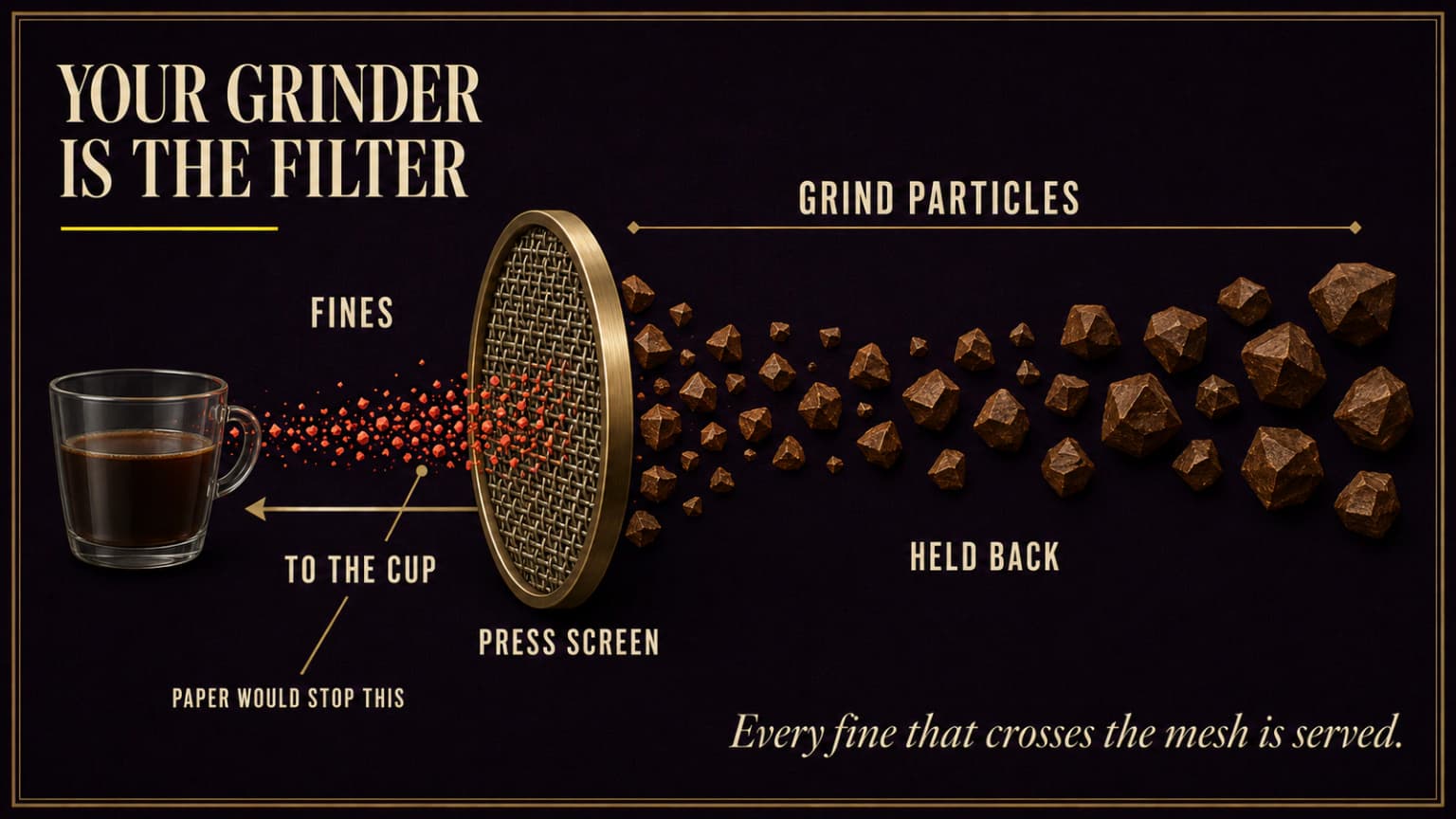
The mesh disc you push down is the coarsest filter in an ordinary kitchen. Whatever dust your grinder makes goes into the cup and carries on extracting while you drink.
That single fact is why a grinder chosen for espresso so often disappoints in a press, and why grind consistency matters more here than in any other brewer.
We compared burr specifications, manufacturer grind guidance, independent grind consistency reporting, and more than 46,000 Amazon owner reviews.
This 2026 guide covers the six burr grinders we would spend our own money on, the two famous names we deliberately left out, and how to match one to the press on your counter.
How we chose these press grinders for 2026
We research rather than test, and we say so plainly. You can read exactly how we work on our about page.
The short version is that we do not build a ranking from one launch review, ours or anyone else's.
We read manufacturer grind guidance, independent grind consistency reporting, long term owner threads, and the full spread of Amazon reviews rather than the five star summary.
We paid the closest attention to three star reviews. That is where owners describe a real flaw without either rage or excitement attached to it.
Four rules shaped the final six. Every grinder had to be a true burr grinder, in stock on Amazon US, with a live price verified through Amazon's own product API.
Every one had to hold a 4.0 star average or better on a review base deep enough to mean something. Every one had to reach a genuine press-coarse setting, not merely claim one on the box.
And every one had to earn a different buyer. Two grinders that suit the same person are one grinder and one piece of padding.
Two well known grinders failed those rules. We name both further down rather than quietly leaving them out.
How big is your French press?
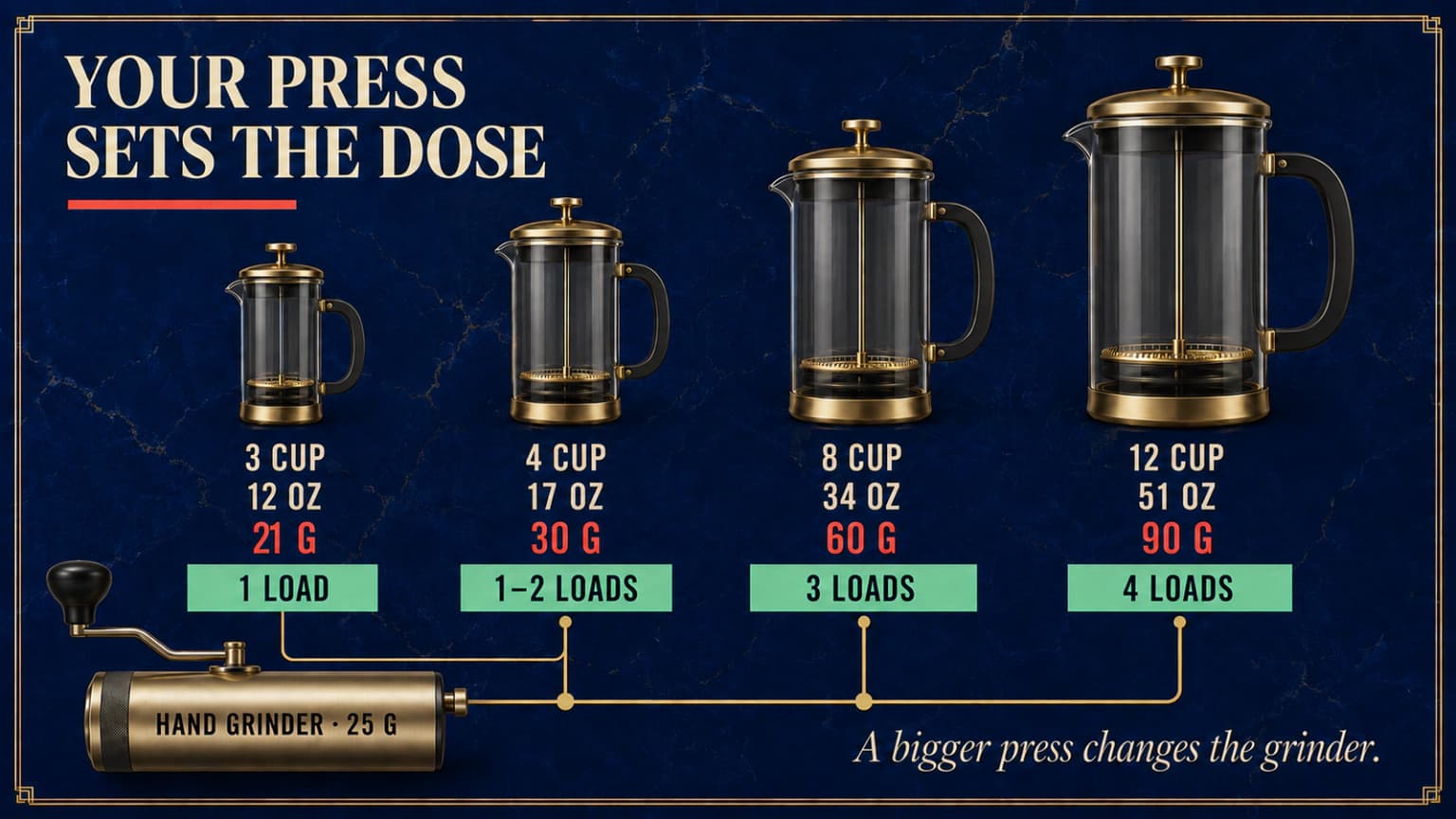
A 12 ounce press needs about 21 grams of coffee and a 34 ounce press needs about 60 grams, so the pot on your counter decides the grinder before any spec does.
Almost no buying guide asks this. Bodum, which makes the press most American kitchens own, sells four sizes: 12, 17, 34 and 51 ounces.
Its own brewing guidance is about 14 grams of coffee for every 8 ounces of water. Run that arithmetic across the four sizes and the spread is nearly fourfold.
The press on your counter decides the grinder. A hand grinder that suits the smallest size needs three loads for the largest.
Now put a hand grinder next to those numbers. Most hold about 25 grams of beans in one load, so the smallest press is a single fill and the largest is four.
That is the fork. For a small press, a manual burr grinder like the TIMEMORE Chestnut C3S Pro is the best value in home coffee.
For a full pot every morning, a hopper grinder like the OXO Brew stops being a luxury. It becomes the reason you still make coffee at home in year two.
Press size, dose, and what it means for your grinder
Press size, dose, and what it means for your grinder
Press size
Water
Coffee dose
Hand grinder loads
3 cup
12 oz / 0.35 L
About 21 g
One
4 cup
17 oz / 0.5 L
About 30 g
One or two
8 cup
34 oz / 1 L
About 60 g
Three
12 cup
51 oz / 1.5 L
About 90 g
Four
Doses follow Bodum's own guidance of roughly 14 g per 8 oz of water. Load counts assume the 25 g chamber typical of a hand grinder.
There is a second reason the dose matters, and it shows up only in a press. Immersion brewing gives you no second lever.
With a pour over you can change how you pour. With espresso you can change the pressure profile.
Once the water is in a press there is nothing left to steer, so the grind has to be right before you start.
If you already own a good grinder and want the workflow rather than the burrs, our guide to single dose coffee grinders covers the models built around weighing one brew at a time.
The 6 best coffee grinders for French press
The lineup below runs from the grinder we recommend to most people down to the one for the smallest kitchen. Every link was verified live and in stock through Amazon's own product API on the day we published.
Ratings and review counts recorded on Amazon US at the time of writing. Prices move; use the buttons for the live number. Amazon.com prices as of 15/09/2026. Details
1. Baratza Encore
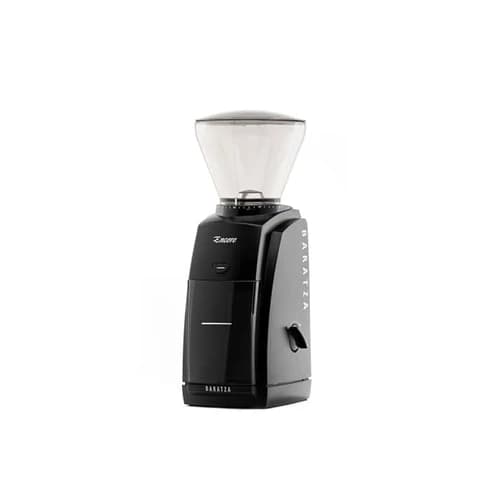
The Baratza Encore is the best coffee grinder for French press for most people, and it has been the default answer since long before most of its rivals existed.
Ask any coffee forum and this is the name that comes back. Its 16,619 Amazon reviews averaging 4.2 stars are the largest body of evidence on any specialist grinder here.
What it does well is unglamorous. Forty millimetre conical burrs, forty stepped settings, and a coarse end that stays where you put it rather than drifting as the machine warms up.
Baratza Encore Conical Burr Coffee Grinder
Rated 4.2 from 16,619 ratings
The default recommendation for filter and press coffee, with 40mm commercial grade conical burrs and a spare parts programme almost nobody else offers.
Key details
40mm commercial grade conical burrs
40 stepped grind settings across the full brew range
Front mounted pulse button plus a simple on and off switch
Hardened alloy steel burrs made in Liechtenstein
DC motor with gear reduction for lower burr speed
Burrs, gearbox and motor sold as replacement parts
What we like
Holds a genuine press-coarse setting without drifting
The best documented grinder here, with a fix for every known fault
Repairable rather than disposable, which changes its real cost
Award winning design that has outlived several generations of rivals
Watch out for
Beans bounce rather than feed at the coarsest settings
Owner reviews follow a consistent shape. The first pot is a revelation after pre ground coffee, and the grinder then disappears into the routine for years.
The complaints are equally consistent, and the main one belongs to the coarse end of the dial. At wide burr gaps beans skip and bounce in the hopper instead of feeding, which owners call popcorning.
It is a feeding problem rather than a fault, and it costs a few extra seconds per dose. A gentle tap on the hopper while it runs settles the beans and clears it.
The honest weak point is the body. At $149.95 you are buying burrs and a gearbox, not a metal case, and it looks its price beside the Virtuoso+.
We would still start here. Nothing else in this guide can still be repaired in year seven, and that is the argument that eventually wins.
2. Baratza Virtuoso+
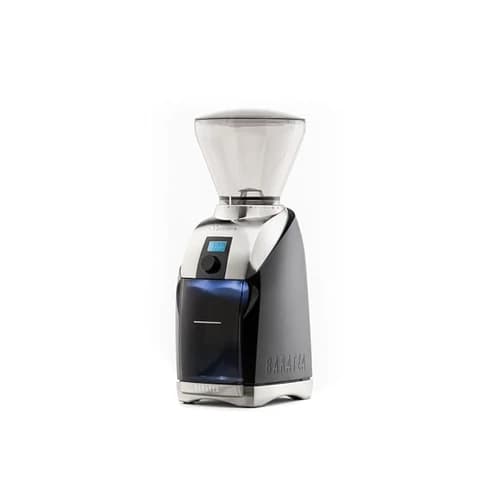
The Baratza Virtuoso+ is the same idea with the compromises removed, and it is the grinder we would choose for anyone filling a 34 ounce press every day.
At 4.5 stars across 2,228 owners it holds the highest rating of any electric grinder here, and the reviews are unusually free of the "it broke after a year" pattern that dogs cheap grinders.
Two upgrades matter for a press. Baratza fits a harder, faster burr set than the Encore's, and it adds a digital timer adjustable to a tenth of a second.
Baratza Virtuoso+ Conical Burr Coffee Grinder
Rated 4.5 from 2,228 ratings
A metal bodied grinder built on the Encore platform, with enhanced commercial grade burrs, a 40 second digital timer and a markedly faster motor.
Key details
Enhanced commercial grade conical burrs
40 grind settings across espresso to press
Digital timer adjustable to a tenth of a second
Backlit grounds bin so you can see the dose land
Sculpted metal top and base rather than plastic
European hardened steel burrs on a powerful DC motor
What we like
The tightest coarse grind in this guide, with visibly less dust
Noticeably faster than the Encore, which shows on a 60 gram dose
A timer that makes the same dose repeatable every morning
Same repairable Baratza parts programme as the Encore
Watch out for
It still eases off at the very coarsest settings
A $100 premium over the Encore for the same burr geometry
Independent reviewers who compare the two describe the Virtuoso+ as noticeably cleaner at press-coarse settings, with fewer fines in the pile than the Encore leaves.
That gap is small in a cup of pour over and obvious in a press, because the press has nothing downstream to catch what the burrs got wrong.
Speed is the underrated part. On a 60 gram dose the Encore is a patient machine and the Virtuoso+ is finished before the kettle is full.
The honest weak point is that even this grinder eases off at its very coarsest settings. That limit appears on every conical burr grinder we found evidence for.
If your press is small, the extra $100 buys speed and a metal case rather than a better cup. If your press is large, it buys both.
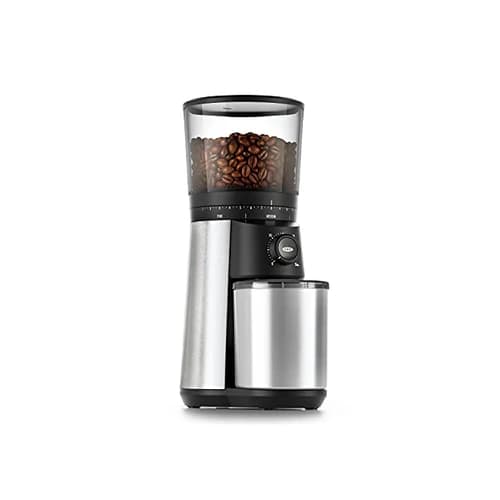
3. OXO Brew Conical Burr Grinder
The OXO Brew Conical Burr Grinder is the grinder most American kitchens should probably own, and its 23,334 reviews at 4.3 stars make it the most reviewed product in this guide by a wide margin.
For $109.95 it fits the same 40mm steel conical burrs as the Encore, adds a 12 ounce hopper, and remembers your last setting so a morning grind is one button.
Fifteen numbered settings sound restrictive next to Baratza's forty, until you notice the hopper itself rotates to give 43 micro adjustments between them.
OXO Brew Conical Burr Coffee Grinder, 12 oz
Rated 4.3 from 23,334 ratings
The mainstream burr grinder that gets the fundamentals right, with 40mm steel burrs, a large hopper and a one-touch memory for your usual setting.
Key details
40mm stainless steel conical burrs
15 grind settings plus 43 micro adjustments
One touch start that remembers your last setting
Removable hopper holding up to 12 ounces of beans
UV blocking tint to protect beans in a sunny kitchen
Stainless steel grounds container
What we like
Serious burrs at a mainstream price
The largest hopper here, so a 60 gram dose is one press of a button
By far the deepest owner evidence of any grinder in this guide
Genuinely coarse at the top of its range
Watch out for
Static throws grounds around the container and the counter
The grounds bin does not lock in place while it runs
The recurring owner complaint is static, and it is worth understanding before you buy. Grounds cling to the bin and a few escape over the rim.
The cause is the design: the container sits under the chute rather than locking into it.
Coarse grounds hold less static than fine ones, so a press user meets a milder version of this than an espresso user does. A brief pause before lifting the bin lets the last grounds fall.
The second limitation is longer term. OXO does not publish a burr replacement route, so worn burrs eventually mean a new grinder rather than a new part.
That is the trade at this price, and for a great many households it is the right one.
Buy it if you want the least fuss for the money and are not planning to still own it in ten years.
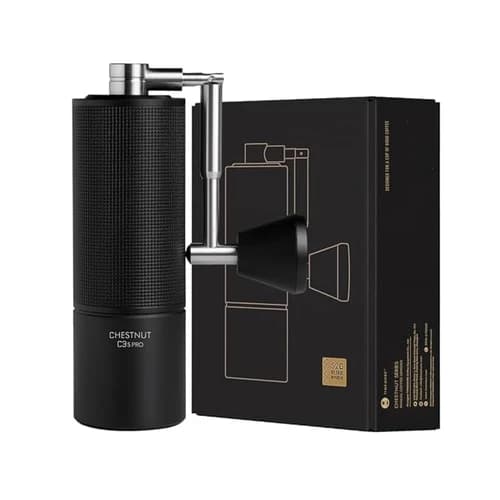
4. TIMEMORE Chestnut C3S Pro
The TIMEMORE Chestnut C3S Pro carries the highest rating in this guide at 4.7 stars across 1,714 owners, which is remarkable for a $95.00 grinder of any kind.
It is also the only manual grinder we kept. The arithmetic above is the reason: a hand grinder is a superb answer to a small press and an unhappy one to a large press.
Timemore's S2C hexagonal conical burr does the work here. It is the burr family used across the Chestnut line, and it bites into beans far better than the ceramic burrs in cheap hand grinders.
TIMEMORE Chestnut C3S Pro Manual Coffee Grinder
Rated 4.7 from 1,714 ratings
The best rated grinder in this guide, pairing a patented S2C conical burr with an all metal body and a foldable handle, at a price that undercuts every electric here.
Owners describe the same two things over and over. The grind is better than they expected at the price, and the all metal body makes the thing feel like a tool rather than an appliance.
The criticism, where it appears, is never about the coffee. It is about effort, and it scales exactly with the press you own.
For a 12 ounce press this is about a minute of cranking and a genuinely excellent result. For a 34 ounce press it is three loads, several minutes, and a decision you will resent by Thursday.
The other honest limit is that a hand grinder gives you no way to walk away. There is no timer and no dose memory, so your attention is the mechanism.
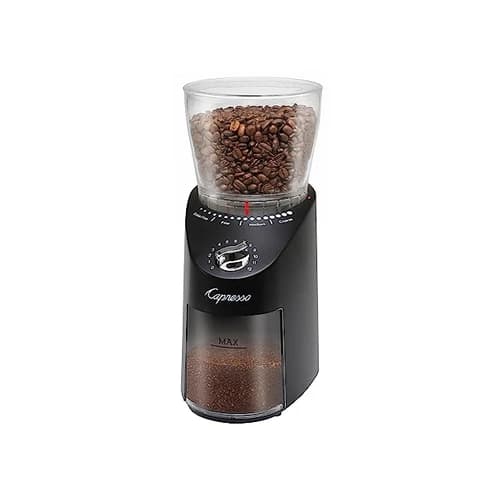
The Capresso Infinity Plus is the quiet one, and for a household where someone is still asleep at six in the morning that is not a small feature.
At 4.4 stars across 1,684 owners and $98.00 it is the best rated electric grinder here under $100, with solid steel conical burrs and sixteen stepped settings.
The mechanism responsible is a gear reduction motor, which turns the burrs slowly rather than quickly. Slower burrs mean less noise, less friction and less heat in the grounds.
Capresso Infinity Plus Conical Burr Grinder
Rated 4.4 from 1,684 ratings
A gear reduction burr grinder that runs slowly and quietly, with sixteen settings spanning Turkish fine to the coarse end used for percolators and cold brew.
Key details
Commercial grade solid steel conical burrs
Gear reduction motor for lower burr speed and less heat
Capresso lists the top of the range as very coarse, suitable for percolators and cold brew, and most owners agree. A minority do not, and that disagreement is the one thing to weigh before buying.
Enough owners report the coarsest setting is finer than they wanted that the point belongs in the open rather than in a footnote.
Our reading is that it lands at the fine end of press-coarse rather than beyond it. If you like a long, gentle eight minute steep you will be fine, and if you want a very coarse, very short brew you may run out of dial.
The second known issue is moisture. Coffee that has been kept in a cold cupboard or a damp kitchen sticks in this grinder more than in the Baratzas.
Buy it for quiet, for a small counter, and for the price. Buy the OXO instead if you want more headroom at the coarse end.
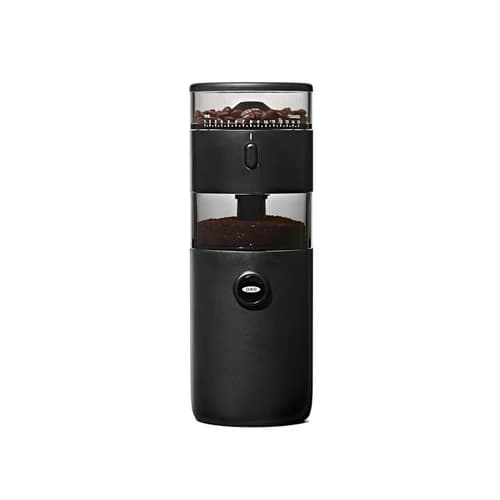
6. OXO Brew Compact Conical Burr Grinder
The OXO Brew Compact is the grinder for the kitchen where counter space is the binding constraint rather than money, at $79.95 and 4.3 stars across 571 owners.
It is 11 inches tall and 4 inches wide, so it stands where a hopper grinder cannot, and it still uses steel conical burrs with fifteen settings and 29 micro adjustments.
The design choice that defines it is the 50 gram bean capacity. There is no tall hopper, which is exactly why it fits, and it caps what you can grind in one go.
OXO Brew Compact Conical Burr Coffee Grinder
Rated 4.3 from 571 ratings
A slim burr grinder built for small kitchens, four inches wide and eleven tall, holding 50 grams of beans and rated by OXO for up to 30 ounces of coffee.
Key details
Stainless steel conical burrs
15 grind settings plus 29 micro adjustments
Holds up to 50 grams of beans
Rated by OXO for up to 6 cups or 30 ounces of coffee
11 inches tall and 4 inches wide
Upper and lower burrs both removable for cleaning
What we like
Real burrs in a footprint most grinders cannot match
The cheapest grinder here that we would still recommend
Both burrs come out, so cleaning is genuinely thorough
Fits under a wall cabinet where a hopper grinder will not
OXO rates it for up to 6 cups or 30 ounces of coffee, which is an honest number and worth reading carefully. A 34 ounce press at 60 grams sits just past what one fill holds.
For a 12 or 17 ounce press that is irrelevant. For the classic 8 cup press it means topping the bin up, which is a smaller annoyance than three hand grinder loads but still an annoyance.
The review base is the thinnest here at 571, because the listing is newer than the others. The rating is strong and consistent with OXO's larger grinder.
We are comfortable including it, and equally comfortable saying the evidence is younger.
Static behaves the same way it does on the 12 ounce model. It is the family trait.
Buy it if your kitchen is small and your press is too. Buy its bigger sibling if you have the height for a hopper.
Your grinder is the only filter here
A French press has a woven mesh disc and nothing else, so the burrs are the only thing standing between the beans and your mug.
Every other brewer has a second line of defence. A drip machine and a pour over both run through paper, and an espresso machine holds the coffee in a compressed puck behind a fine steel screen.
Whatever your burrs produce is what reaches your mouth. That is why grind quality shows up here more clearly than anywhere else, and why the beans you load into a press have nothing to hide behind either.
Espro, which sells a press built around this problem, rates its own double micro-filters at nine and twelve times finer than a standard press filter. The comparison only works because the standard screen is genuinely coarse.
No burr set produces one particle size. The press screen decides which part of that spread you drink and which part stays behind.
Here is the part most guides get backwards. Grinding coarser does not create more dust.
Finer settings produce more breakage and more fines, the trade term for the powder at the small end of the spread. What changes in a press is not how much powder exists but where it ends up.
In a paper brewer that powder is trapped. In a press it is served.
So a grinder can be perfectly pleasant on a drip machine and disappointing in a press. The press is simply the honest test.
What each brewer catches before the cup
What each brewer catches before the cup
Brewer
Filter in the path
What reaches the cup
French press
Woven metal mesh only
Oils, colloids and every fine particle
Pour over
Paper cone
Almost nothing but liquid
Drip machine
Paper or fine gold mesh
Clean, with more body on a mesh basket
AeroPress
Paper disc, or metal if swapped
Clean on paper, silty on metal
Moka pot
Perforated plate and gasket
Some sediment, held back by the puck
Espresso
Fine basket behind a packed puck
Very little, held by the bed itself
The press is the only common brewer with no paper and no compressed bed. Its grinder has no help.
The practical consequence is a rule you can act on today. If your cup has a silt layer at the bottom, the answer is a coarser setting first and a better grinder second, in that order.
Sediment that survives a genuinely coarse setting is the grinder telling you its spread is too wide. That is the point at which spending money actually changes the cup.
Sediment also keeps working after you pour. It carries on extracting in the mug, which is why a press that tasted fine at the first cup can taste harsh by the third.
Grind numbers do not travel between grinders. Setting 30 means one thing on a Baratza and something else entirely on an OXO, which makes "grind at 30" useless advice on its own.
Grind size is measured in microns, but no home grinder prints microns on its dial. Every guide therefore falls back on a texture comparison and a setting number.
What is useful is knowing where the press window falls on each grinder's own range, because that tells you how much room you have to move.
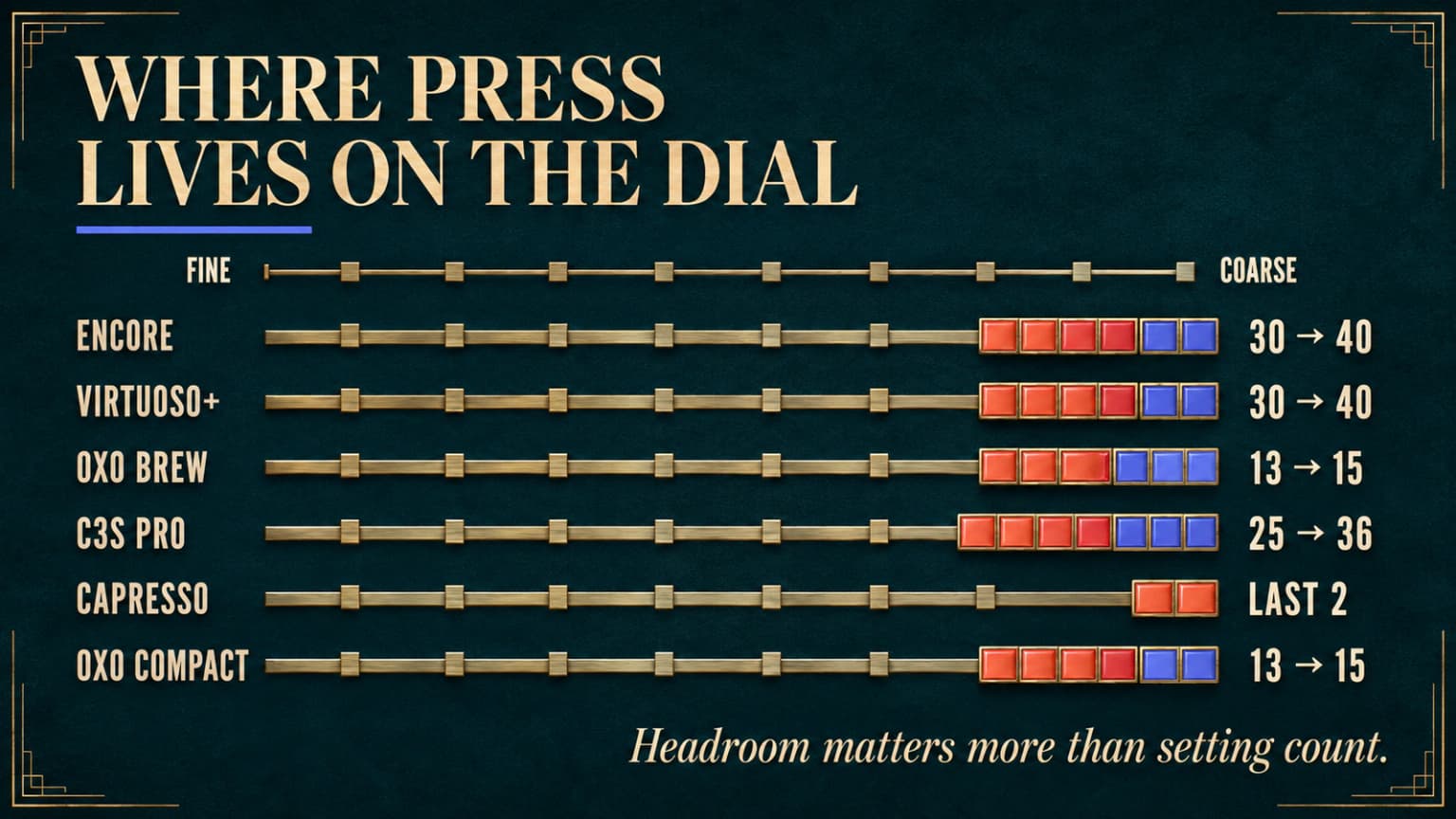
Grinders built around espresso spend most of their range below the press window. The last few clicks are where a press user lives.
The pattern is consistent, and it explains why so many buyers end up disappointed. A grinder designed to reach espresso packs most of its adjustment into a narrow band of very fine settings.
The press then lives on the last two or three clicks of the dial, with no room above it if the cup still runs silty. A grinder built for brewed coffee spreads its steps across the range you actually use.
A starting point on each grinder in this guide
A starting point on each grinder in this guide
Grinder
Adjustment range
Press starting point
Room to go coarser
Baratza Encore
40 stepped settings
Around 30
Ten more steps
Baratza Virtuoso+
40 stepped settings
Around 30
Ten more steps
OXO Brew
15 settings, 43 micro steps
Setting 13 to 15
Micro steps only
TIMEMORE C3S Pro
About 36 clicks
Around 25 clicks
Roughly ten clicks
Capresso Infinity Plus
16 stepped settings
The coarsest two
Very little
OXO Brew Compact
15 settings, 29 micro steps
Setting 13 to 15
Micro steps only
Starting points drawn from manufacturer guidance and owner reports, not from our own testing. Beans, roast and steep time all move them.
Two things follow from that table. Grinders with genuine headroom above the press setting let you chase a cleaner cup; grinders without it leave you adjusting the brew instead.
That is not a reason to avoid the Capresso Infinity Plus or either OXO, both of which make good press coffee. It is a reason to know which lever you will be pulling when something tastes wrong.
The second consideration is popcorning, which shows up at the coarse end of hopper grinders specifically. Wide burr gaps let beans bounce rather than feed, and the Baratza Encore is the most reported example.
The fix is free. Tap the hopper while it runs, or grind with the lid off and press the beans down gently with a spoon handle.
Two popular grinders we did not rank
Two grinders show up on nearly every list of the best coffee grinder for French press, and neither made ours. We would rather explain that than have you notice the gap.
The Breville Smart Grinder Pro at $199.95 is the first. It is genuinely well liked, at 4.5 stars across 6,991 Amazon owners when we checked, and it is a very good espresso grinder with 60 settings and precise dose timing.
The problem is specific, and it is exactly our subject here. Multiple independent reviewers who grind across its whole range report that consistency falls away at the coarse end.
They describe more dust mixed into larger fragments than its finer settings produce.
That is the wrong failure for a brewer with no paper filter. In an espresso basket it is invisible; in a press it is the silt layer.
The Fellow Ode Gen 2 at around $339.95 is the second, and it is the harder call. Its 64mm flat burrs are built specifically for brewed coffee rather than espresso.
Expert reviewers consistently rate its grind uniformity above everything in this guide. On paper it is the ideal press grinder.
Its Amazon rating is 3.9 stars across 703 owners, below our 4.0 bar. We hold that line even when the specification sheet argues the other way.
A rating built from hundreds of owners is evidence. A specification is a promise.
Static, mess, and the morning routine
Grind quality is what you compare before buying. Mess is what you live with, and it is the single most common theme in the negative reviews of every electric grinder here.
Coarse grinding helps you more than most buyers expect. Coarse grounds carry less static than fine ones, so a press user meets a milder version of this than an espresso user does.
It does not disappear. Grounds still cling to plastic bins, and both OXO grinders lose a few over the rim of an unclamped bin.
Three habits remove most of it, and none costs anything. Pause for a couple of seconds after the burrs stop before lifting the bin, tap the bin on the counter before you open it, and pour into the press rather than scooping.
Noise is the other daily reality. The Capresso is the quietest here by design, since its gear reduction motor turns the burrs slowly, and the Baratzas are the most assertive.
The TIMEMORE Chestnut C3S Pro has no motor at all. In a small apartment, or a house with a sleeping baby, that is a real argument for a hand grinder.
A minute of quiet cranking beats ten seconds of noise at 6 a.m. more often than people admit.
Counter height deserves one line. Hopper grinders are tall, and the OXO Brew Compact exists because a tall grinder cannot have its hopper lid opened under a wall cabinet.
Measure the gap above your counter before you order, not after. It is the least glamorous check in this guide and the one most likely to save you a return.
The case against upgrading at all
We would be writing marketing rather than a guide if we skipped this. There is a real argument for keeping the grinder you own, and for some readers it is the right answer.
A French press is the most forgiving brewer in common use. The water is not under pressure, the contact time is long, and the recipe tolerates a wide band of grind sizes without collapsing.
That forgiveness is exactly why grinder upgrades pay off less here than in espresso. Moving from a $100 burr grinder to a $250 one transforms an espresso shot and merely improves a press.
The jump that genuinely matters is the first one. Going from a blade grinder, or from pre ground coffee, to any competent burr grinder is the biggest single change available to a press drinker.
After that, the returns flatten fast. If you are choosing between a better grinder and better beans, buy fresher coffee first and grind it a little coarser.
There is also a free fix that most people never try. Skim the crust off at four minutes, then pour the last inch of the pot away rather than draining it.
A large share of the sediment stays in the vessel. Try that for a week before spending anything.
If the cup comes out clean and you like it, the grinder you already own is fine and this page has saved you money.
What a grinder costs over seven years
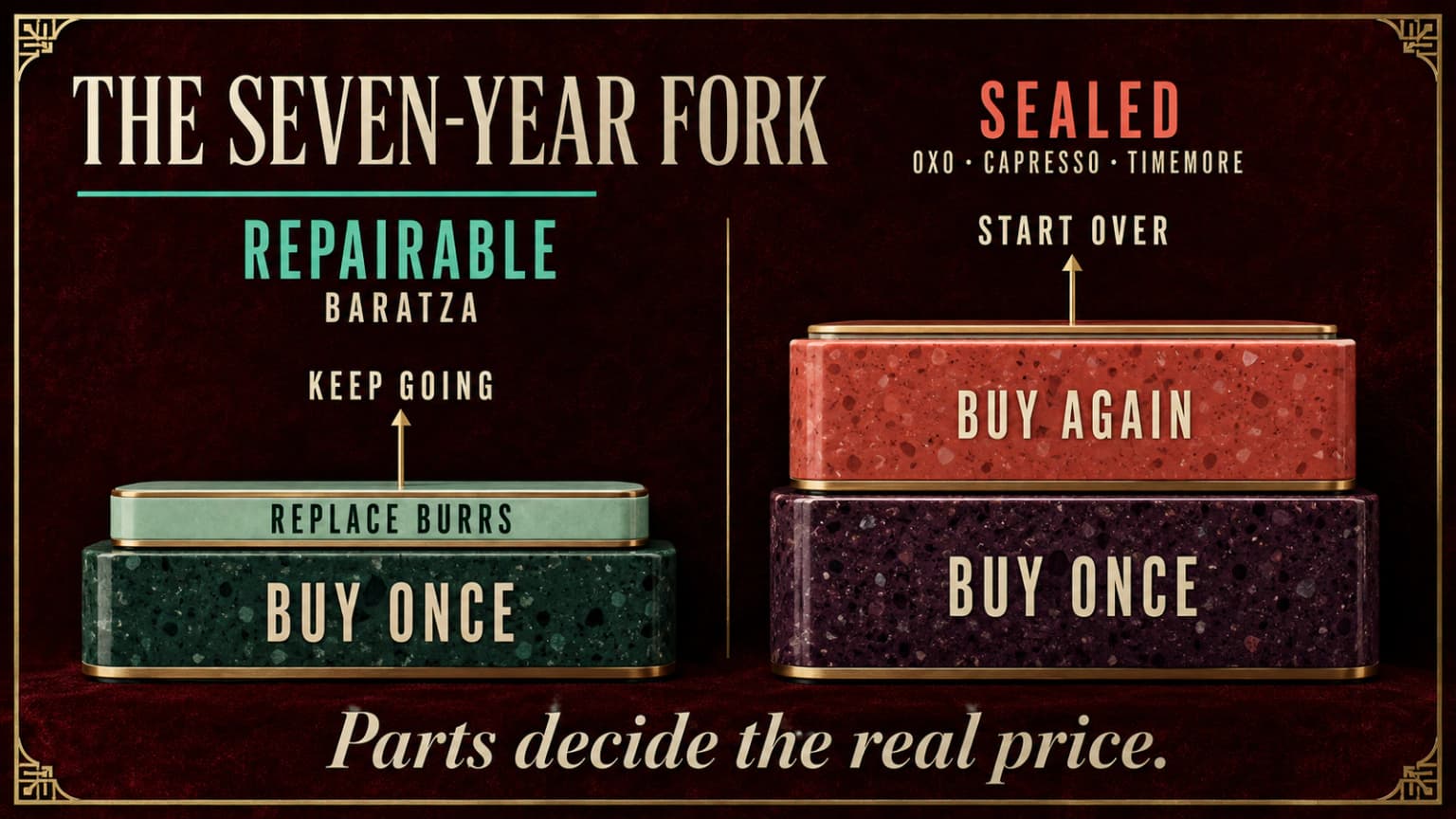
Over seven years these six split into two groups, and the divide is not grind quality. It is whether you can buy a new burr set when the old one wears out.
Burrs do wear. Every source we read puts a home grinder's stock burrs somewhere in the hundreds of pounds of coffee, which for most households is several years rather than months.
Grinders are one of the few kitchen purchases where the sticker price and the real price genuinely diverge, and burrs are the reason.
A repairable grinder is bought once and re-burred. A sealed one is bought again. The gap opens the first time a burr set wears out.
Baratza is built around a spare parts programme. Burrs, gearboxes, motors and hoppers are all sold as individual components through Baratza and its authorised service partners.
A worn Encore or Virtuoso+ is a part and ten minutes.
For the OXO, Capresso and TIMEMORE grinders, a search of Amazon US returns lids, knobs and grounds containers, and no replacement burr set at all.
Their end of life is a new grinder.
What wears out, and whether you can replace it
What wears out, and whether you can replace it
Grinder
What wears first
Spare burrs in the US?
Seven year outlook
Baratza Encore
Burrs, then gearbox
Yes, Baratza and partners
Re-burr and keep going
Baratza Virtuoso+
Burrs
Yes, same programme
Re-burr and keep going
OXO Brew
Burrs, bin lid
None found
Replace the grinder
TIMEMORE C3S Pro
Burrs, bearings
None found
Replace the grinder
Capresso Infinity Plus
Burrs, plastic bin
None found
Replace the grinder
OXO Brew Compact
Burrs
None found
Replace the grinder
Burr availability checked on Amazon US at the time of writing. Brands may sell parts through other channels, so ask before assuming a grinder is disposable.
Two conclusions come out of that table, and they point in different directions depending on how you buy.
If you replace kitchen appliances every few years anyway, repairability is worth nothing to you and the OXO Brew is the best value here by a distance. If you keep things, the Baratzas cost less than they look.
The running cost beyond burrs is close to zero for all six. Grinders need no filters, no descaler and no consumables, which is why we have not built a yearly upkeep figure the way we do for SCA certified coffee makers.
When to buy
Grinders discount on a predictable rhythm, and the swings are large enough to be worth a fortnight of patience.
Prime Day, Black Friday and the December gifting weeks are when the Baratza and OXO prices move most. Both brands appear in those sales in most years.
Our practical rule is the same one we apply to espresso machines. If the grinder you want is already 15 percent or more below its usual price, buy it.
If it is at full price with no holiday nearby, waiting a few weeks rarely costs you anything.
The prices on this page refresh daily, so the buttons show the current number rather than what was true when we wrote this.
One caution on marketplace listings. Deep third party discounts on Baratza grinders sometimes come from sellers outside the warranty chain.
That matters most on the one brand here whose service network is half the reason to buy it.
How to grind for a French press
Grind coarse, at roughly the texture of raw sugar, then weigh the dose and change one thing at a time. That is the whole method, and the steps below are the order to do it in.
It works on any coffee press and with whichever grinder you already own, including an insulated steel press where you cannot watch the crust form.
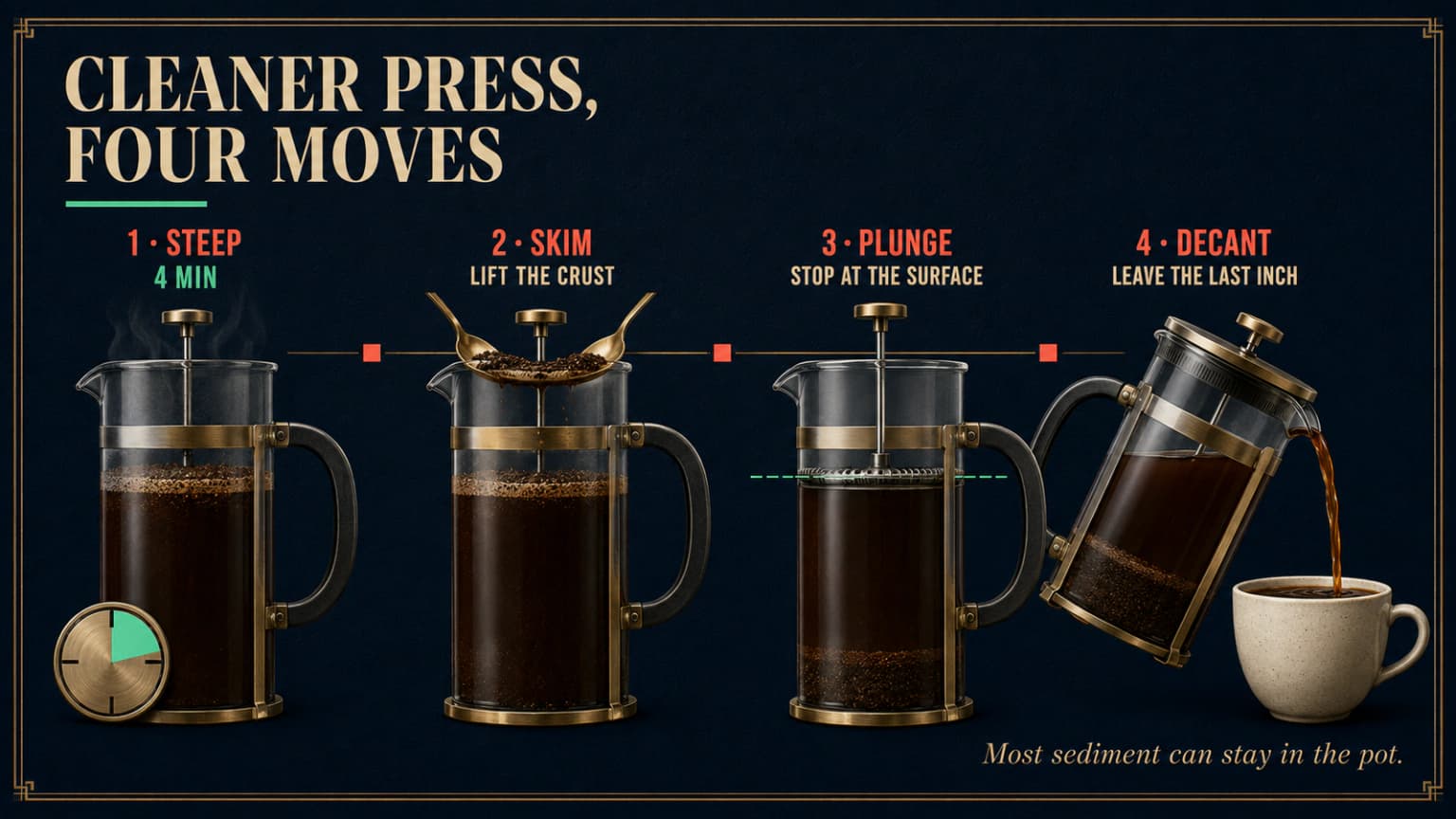
The last two stages are where sediment is won or lost. Most of it never has to reach the cup at all.
Grinding and brewing a cleaner press
1
Weigh the dose before you touch the grinder
Use about 14 grams of coffee for every 8 ounces of water, so roughly 60 grams for a 34 ounce press. Keep that number fixed while you experiment with the grind.
Tip Coarse grounds are bulky. A tablespoon of coarse coffee weighs noticeably less than a tablespoon of fine, which is why scoops mislead here.
2
Start at the coarse end, not the middle
On a 40 setting grinder begin around 30, and on a 15 setting grinder use one of the last three. The grounds should look like raw sugar with visible individual pieces.
3
Pour, stir once, and leave it alone
Add water just off the boil, stir once to wet every particle, then fit the lid without plunging. Agitating a press repeatedly drives fines into suspension.
Watch out Do not plunge early to "check" the brew. Pushing the screen down and lifting it again stirs the bed and puts sediment back into the liquid.
4
Skim the crust at four minutes
A raft of grounds and foam forms on top. Lift it off with two spoons and discard it, taking a large share of the fines with it before they sink.
5
Plunge only to the surface
Press the screen down slowly until it just meets the liquid, not to the bottom of the pot. Driving it into the bed forces fine particles up through the mesh.
Tip If the plunger fights you, the grind is too fine. That resistance is the clearest feedback a press ever gives you.
6
Decant, and leave the last inch
Pour into mugs or a carafe straight away and stop before the bottom of the pot. Coffee left on the grounds keeps extracting and the final inch is where the silt lives.
7
Change one setting and taste again
Harsh and drying means grind coarser. Thin and sour means grind finer. Move one or two steps, brew the same recipe, and write down the setting that works.
Tip A longer steep needs a coarser grind. If you like an eight minute brew, expect your setting to sit above the four minute one.
Two of those steps do most of the work. Skimming the crust and leaving the last inch remove more sediment than any grinder upgrade in this guide.
They are also free, which is why we would run them for a week before deciding that the problem is the burrs.
Cleaning burrs without wrecking them
Grinders are low maintenance and high consequence. There is very little to do, and the three mistakes people make are all avoidable.
The first is water. Burrs are cleaned dry, always, because coffee oil and moisture together form a paste that sets hard against the burr faces.
The second is retention, the small amount of coffee every grinder holds between doses. Left alone it goes stale and flavours the next pot.
The third is timing. Stale oil is the most common reason a grinder that used to make good coffee stops, and it builds up slowly enough that nobody notices.
The maintenance rhythm
1
Weekly: empty and brush
Empty the grounds bin, brush out the chute with a dry pastry brush, and wipe the bin with a dry cloth. Ninety seconds, and it prevents most of what follows.
2
Monthly: open the burrs
Remove the upper burr and brush both faces and the housing. On the OXO grinders both burrs lift out, and on the Baratzas the top burr comes out without tools.
Watch out Never run water, soap or cleaning fluid through a grinder unless the manual explicitly allows it. Dry brushing is the whole procedure.
3
Quarterly: run grinder cleaning tablets
Food safe grinder tablets pick up the oil film that brushing leaves behind. Grind a dose through, then grind and discard a small dose of coffee afterwards.
Tip Uncooked rice is not a substitute. It is harder than coffee and several manufacturers warn against it.
4
Yearly: check the burrs for wear
Look at the cutting edges under a light. Rounded, polished edges rather than sharp ones mean the grind will keep getting less even no matter what setting you use.
5
Whenever beans change: purge a little
Every grinder holds a little retention in the chute. Grind and discard about five grams after switching beans, so your first pot is not a blend of two roasts.
Dark, oily roasts accelerate every one of these intervals, which is worth knowing if you buy a traditional French roast for the press.
Oil coats the burrs and the chute, clumps the grounds, and is the most common cause of a grinder that suddenly runs slowly. A medium roast with a dry looking surface feeds far more cleanly.
The pattern across negative long term reviews is consistent. Grinders described as broken were very often grinders that never had their burrs opened up.
Which French press grinder to buy in 2026?
Buy the Baratza Encore at $149.95. It holds a coarse grind cleanly, it carries the deepest owner evidence of any specialist grinder here, and it can still be repaired years from now.
We weighed coarse grind consistency, how much of each dial sits in the press window, capacity against real press sizes, owner sentiment and repairability.
Then we asked the question that settles it: how much coffee do you make at once?
The three we recommend first
Our pick
Baratza Encore
$149.95
You are
Buying one grinder for years
Best at
Holding a coarse setting
Press size
Any, comfortably
Weak spot
Popcorning, plastic body
OXO Brew
$109.95
You are
After the most for the money
Best at
Big doses, one button
Press size
Any, 12 oz hopper
Weak spot
Static, no spare burrs
TIMEMORE C3S Pro
$95.00
You are
Brewing one or two cups
Best at
Grind quality per dollar
Press size
12 oz, maybe 17 oz
Weak spot
25 g per load
The three we recommend first
Specification
Our pick
Baratza Encore
$149.95
OXO Brew
$109.95
TIMEMORE C3S Pro
$95.00
You are
Buying one grinder for years
After the most for the money
Brewing one or two cups
Best at
Holding a coarse setting
Big doses, one button
Grind quality per dollar
Press size
Any, comfortably
Any, 12 oz hopper
12 oz, maybe 17 oz
Weak spot
Popcorning, plastic body
Static, no spare burrs
25 g per load
Whichever you choose, buy from the coffee grinders tier that matches the pot you actually brew, not the one you imagine hosting with.
A grinder sized to your morning gets used every day for years. Daily use is where every grinder on this list earns its price.
Frequently asked questions
What grind size do you need for a French press?
Coarse, roughly the texture of raw sugar or coarse sea salt, with visible individual particles rather than powder.
On a 40 setting grinder that usually lands around 30. On a 15 setting grinder it is one of the last two or three clicks.
The exact number is different on every grinder because no two manufacturers number their dials the same way. Write yours down once you find it.
Brew time changes the target. A four minute steep wants a slightly finer grind than an eight minute one, so adjust the setting rather than the clock.
Can you use a blade grinder for French press?
You can, and it is the single worst pairing in home coffee. A blade grinder chops rather than mills, so one batch holds powder and boulders at the same time, and the powder goes straight through the mesh.
The press has no paper filter to catch that powder. Everything small enough to pass the screen ends up in your cup and keeps extracting while you drink.
If the budget only stretches to a blade grinder, a cheap burr hand grinder will make better press coffee than an expensive blade one.
Why is my French press coffee always sludgy?
Almost always because the grind is too fine or too uneven, not because the press is faulty. A press screen is the coarsest filter in an ordinary kitchen, so the fine particles your grinder makes are the sediment you taste.
Grinding coarser is the first fix. Skimming the crust after four minutes and pouring the last inch away rather than draining the pot are the next two.
If the sludge persists at a coarse setting, the grinder itself is producing too wide a spread of particle sizes.
How much coffee do you grind for a French press?
About 14 grams of coffee for every 8 ounces of water, which is Bodum's own guidance for its presses. That works out to roughly 21 grams for a 12 ounce press and 60 grams for a 34 ounce one.
Weigh it rather than scooping it. Coarse grounds are bulky, so a tablespoon of coarse coffee weighs noticeably less than a tablespoon of fine coffee.
Once you know your number, keep it fixed and change only the grind setting when the cup tastes wrong.
Is a manual grinder good enough for French press?
For a small press, yes, and the grind quality per dollar is excellent. The limit is capacity rather than quality, because most hand grinders hold about 25 grams of beans in one load.
That is one 12 ounce press. A 34 ounce press needs three loads and several minutes of cranking every morning.
Buy a hand grinder if you brew one or two cups at a time. Buy an electric one if the whole pot goes on the table.
Do you need an expensive grinder for French press?
No, but you do need a burr grinder, and the cheapest burr grinders are where the trouble starts. Below about $70 the market is mostly blade grinders and burr sets that lose their setting.
The useful jump is from a blade grinder to any decent burr grinder. The jump from a $100 burr grinder to a $250 one is real but much smaller.
Spend the difference on fresher beans first if you are choosing between the two.