Coffee Filter Types in 2026: Your Filter Is Part of the Recipe
Paper vs metal changes flow, not just clarity. Our 2026 guide compares 6 coffee filter types on pour speed, body and what fits the brewer you own.
By the CoffeeGearGuides team · USA · Updated Sep 21, 2026 · 24 min read
On this page19
Most guides to coffee filter types stop at one sentence: paper makes a clean cup, metal makes a bold one. That is true, and it hides the thing that actually changes your coffee.
A filter does two jobs at once. It strains what reaches the cup, and it restricts how fast water can leave the brewer, which quietly sets how long your coffee spends extracting.
For 2026 we worked from published standards, independent measurements of the filters themselves, and manufacturer guidance. This guide covers six coffee filter types, what each does to the cup, and which ones your brewer will accept.
The filter is a valve, not just a strainer
Your filter is the narrowest point in the brewer, so it sets your flow rate as well as your clarity. That second job is the one almost nobody accounts for, and it is why a filter swap changes the cup.
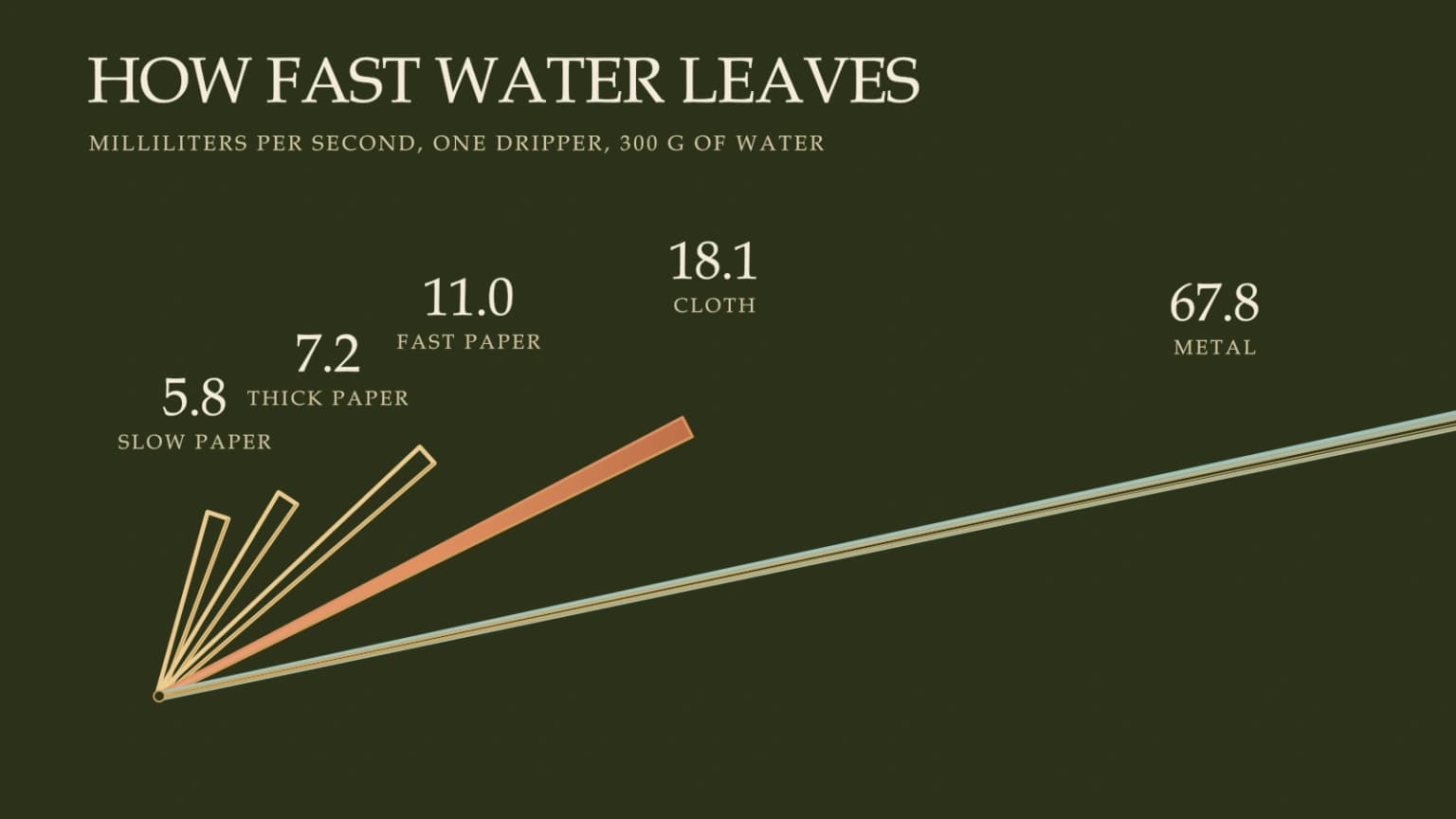
An independent measurement set put numbers on this, running 300 grams of water through one dripper and timing every filter. The papers landed between roughly 5.8 and 15.3 milliliters per second, cloth near 18, and metal at about 68.
That is a metal filter moving water four to twelve times faster than the papers measured beside it. Nothing about the coffee changed in that test, only what was underneath it.
Clarity gets all the attention, but this is the difference a reader feels first. The filter decides how long water and coffee stay in contact.
The term for the time water takes to clear the bed is drawdown, and it belongs to the recipe just as much as grind size does. A faster drawdown means less contact, which means less extraction from identical grounds.
This is why a filter swap can undo a recipe that took weeks to settle. Move from paper to metal and the cup usually reads thinner and sharper, not because the metal removed anything but because the water left early.
An immersion brewer sidesteps the problem by ignoring flow entirely. An insulated French press has the most open filter in the house and compensates with a four minute steep, which is the whole design.
Filter problem, or grinder problem?
Two components sit between your beans and your cup, and readers routinely blame the wrong one. The filter sets a floor on what is physically able to pass, and the grinder decides how much of your coffee is small enough to try.
Neither can fix the other. A fine paper cannot rescue a grinder throwing dust into the bed, because that dust clogs the paper and stalls the brew. The same dust is what turns one cup bitter and under-brewed at once.
A good grinder cannot give a metal filter the clarity of paper either. The openings are simply larger than a meaningful share of what any burr set produces, so something will always get through.
What the cup is telling you
What the cup is telling you
What you notice
Usually the cause
First move
Silt in the last mouthful
Open filter plus a wide grind spread
Grind coarser before changing filter
Brew stalls, water sits on top
Grind too fine for that paper
Coarsen one step, do not switch filter
Cup turned thin after a swap
Faster filter, shorter drawdown
Grind finer to restore contact time
Faint papery note
Unrinsed brown paper
Rinse with hot water before brewing
Oily film on the surface
Working as intended on metal or cloth
Nothing, unless you dislike it
Harsh no matter the recipe
Old oil in a reusable filter
Deep clean or replace the filter
Only two of these six are filter faults. Work out which component you are arguing with before you spend money on the other one.
There is a reliable way to tell them apart in one brew. Change the filter and nothing else, and if the cup moves a lot, you were fighting flow rather than particle size.
Sediment that survives a genuinely coarse grind is the grinder telling you its spread is too wide. That is the point at which the grinder, not the filter, is the thing to replace.
How we compared coffee filters for 2026
CoffeeGearGuides is research-driven and we have not brewed through every filter on this page in a lab. Our about page sets out how we work and what we do not claim.
Our most useful material was independent measurement work on the filters themselves, with thickness taken by calipers and flow timed by volume. Those are one experimenter's results, not a standard, so we treat them as indications of scale.
Manufacturer guidance filled in the practical side. Filter dimensions, basket sizes, cleaning intervals and material composition come from the people who make the things, and they are more specific than general advice.
Published brewing research supplied the chemistry, particularly the work on the oil-borne compounds a paper filter holds back. That literature is genuinely settled on what paper removes, and much less settled on what it means for any individual.
Last came the pattern work across owner reports, looking for complaints that recur across brands rather than the loudest ones. Clogged reusable filters and filters that collapse mid-brew dominate that list, and neither gets much space elsewhere.
6 coffee filter types, compared
Paper vs metal is the question most people arrive with, and it is only the first of six forks. The types below differ on what they let through, how fast they let it through, and how much upkeep they want.
Read them as a spectrum rather than a ranking. The right answer changes with the brewer on your counter and the cup you are trying to make.
The gap between paper and metal is not a detail of degree. A press screen has to stay open enough to plunge against, and that decision is what puts silt in your mug.
1. Bleached paper filters
White paper is the default in American kitchens and the safest starting point for any brewer that takes paper. Measured dry, bleached filters gave off essentially no dissolved solids in hot water, which is the cleanest result of any material here.
That is the practical case for white paper. It contributes nothing of its own to the cup, so what you taste is the coffee and the recipe rather than the packaging.
The word bleached still worries people, and the worry is thirty years out of date. Filters from the main European and American makers are whitened with oxygen rather than chlorine, and the dioxin concern belongs to an abandoned process.
Thickness varies more than the uniform white color suggests. Hario's tabbed and tabless V60 papers differ by roughly 36 microns and flow at 11.0 against 6.9 milliliters per second, a real difference inside one product line.
Buy one kind and stay with it. Switching between brands of white paper is a quieter version of switching to metal, and it will move your brew time without announcing itself.
2. Unbleached paper filters
Brown paper skips the whitening step, which is the entire difference. It is the same wood pulp, processed less, and it costs about the same.
The papery taste people report is real and it is measurable. Dry unbleached filters released around 5 parts per million of dissolved solids into hot water against zero for bleached, and a hot rinse removed all of it.
So the rinse is not optional here, and it is not a ritual either. A few seconds of hot water through the filter before the coffee goes in is the whole fix.
There is a second finding worth knowing, because it runs against the marketing. Unbleached papers showed more uniform pore distributions and flowed faster than their bleached equivalents, so brown is not simply a rougher white.
Choose brown if you prefer less processing and will always rinse. Choose white if some mornings you will not, because an unrinsed brown filter is the one that shows up in the cup.
3. Bamboo and hemp paper filters
Bamboo and hemp filters are sold as the environmental option, and the labeling is looser than most buyers expect. Bamboo filters are usually a blend of bamboo fiber and unbleached wood pulp, not pure bamboo, and the ratio is rarely printed anywhere.
The taste claims deserve the same skepticism. Smoother coffee from bamboo is a marketing line rather than a measured result, and some owners report the opposite, a faint vegetal note on an unrinsed filter.
Treat them as unbleached paper with a different supply story. Rinse them the same way, expect flow in the same general region, and judge them on the cup rather than the claim.
Reusable hemp filters are a genuinely different product and worth separating out. They are woven cloth rather than paper, makers commonly claim several years of use, and they behave like the cloth filters further down this list.
The honest environmental picture is less flattering than the packaging. A paper filter is a fraction of a gram of pulp against a bed of grounds it leaves compostable, so the filter is rarely the meaningful part of a coffee habit's footprint.
4. Metal mesh filters
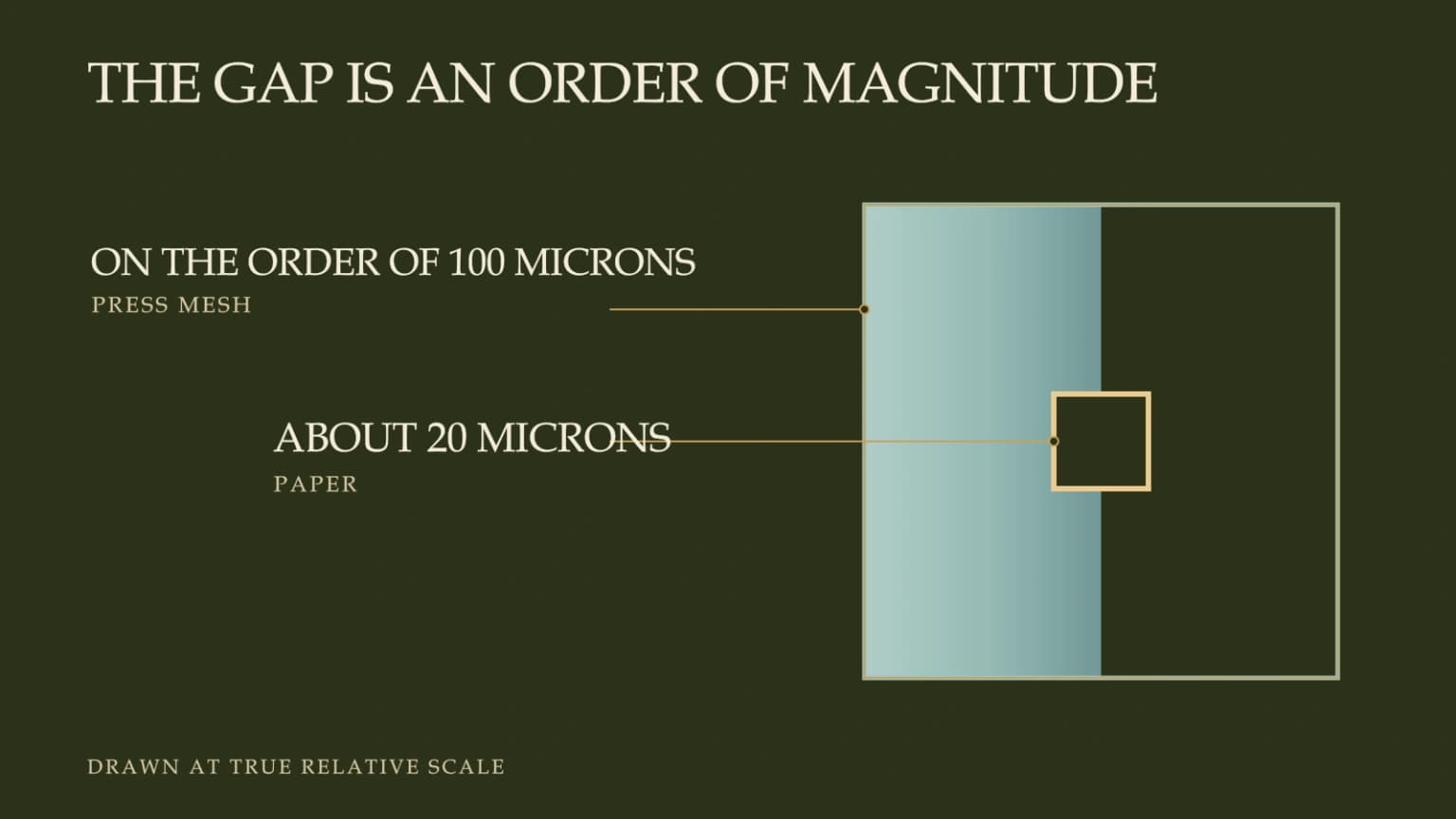
Metal is the choice for body, and it arrives in two shapes: a woven mesh, as in a French press or a pour-over cone, and a perforated plate, as in a moka pot. Press mesh runs on the order of 100 microns against roughly 20 for paper, which is not a small margin.
It could not be otherwise. A screen fine enough to match paper would need pressure to push through it, which is exactly what a plunger cannot safely deliver by hand.
What gets through is oils, colloids and every particle under that threshold. Those oils are what give press coffee its weight, and the fine particles are what settle at the bottom of the mug and keep extracting while you drink.
Metal is also the fastest filter you can fit. That speed is why pour-over through a metal cone so often tastes thin, and why the fix is a finer grind rather than a slower pour.
The grinder carries more of the load here than anywhere else, because nothing downstream is catching its mistakes. Our French press grinder guide covers which burr sets keep the silt layer down.
5. Cloth filters
Cloth is the oldest filter material still in regular use, and the Japanese nel drip tradition treats it as the finest brewing method there is. It sits between paper and metal in every respect that matters.
It catches most of the fine particles the way paper does, while letting a good share of the oils through the way metal does. The result is a cup with clarity and body at the same time, which is genuinely hard to get any other way.
Cloth filters last roughly 90 to 120 brews, so daily use is measured in months rather than years. They flow faster than most papers, around 18 milliliters per second in the measurements available.
The upkeep is the reason most people give up. A used cloth filter left on the counter will sour and then grow mold, so it needs rinsing within the half hour and storing wet in the fridge, dried completely, or frozen between uses.
A new one tastes of cotton for a brew or two. Boil it in plain water before first use, or accept that the first pot is a rinse cycle you happen to be drinking.
Never wash one with soap. Detergent lives in the weave and comes back out in the next brew, which is the single most common way a promising cloth filter gets ruined.
6. Permanent plastic baskets
The gold-tone or nylon basket that came free with your drip machine is its own category, and it is the least loved filter in any kitchen. It costs nothing because it shipped in the box, which is most of its appeal.
Functionally it is a coarse metal or nylon mesh, so expect body, sediment and a fast drawdown. Good ones are genuinely fine enough to be usable, and cheap ones pass enough grounds to leave a layer in the pot.
The real problem is oil. A permanent basket accumulates a film that a rinse under the tap will not shift, and that film goes rancid and turns every subsequent pot harsh regardless of the coffee.
The basket also affects what you are buying. Some machines are sold in near-identical versions that differ chiefly by shipping a permanent filter against a paper starter kit, a trap our guide to dual coffee makers names on one specific pair.
Our position is simple. Use it if you like the body and will deep clean it weekly, and switch to paper if the phrase weekly deep clean already sounds unlikely.
Which filter your brewer will take
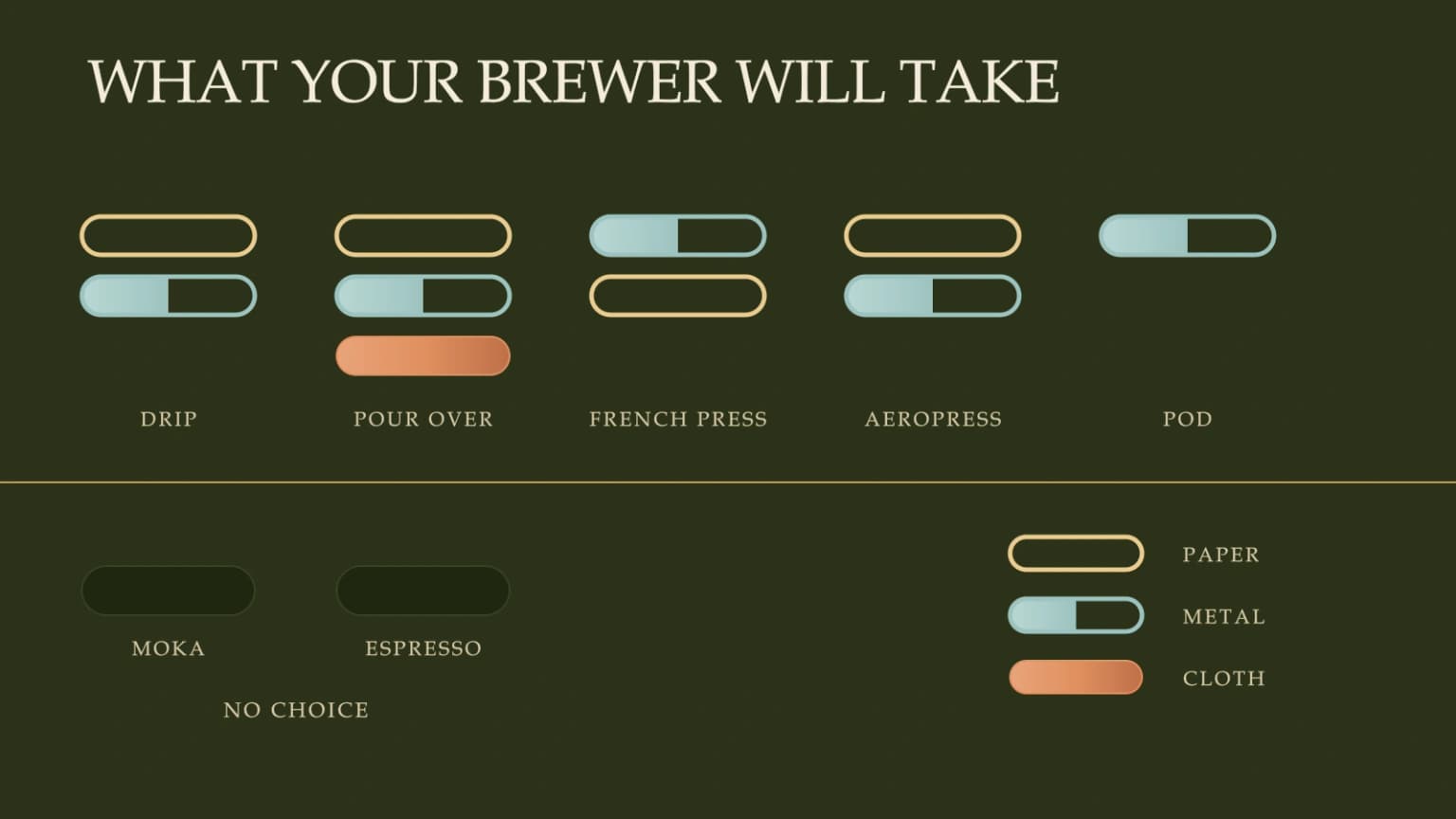
Most brewers will accept more than one filter, and almost nobody realizes it. The table below is about what you can swap rather than what came in the box.
Two brewers here have no choice at all. Everywhere else the filter is a lever you already own and have probably never pulled.
What you can actually swap
What you can actually swap
Brewer
Filters it will take
What changes when you swap
Automatic drip
Paper cone or basket, permanent mesh
Mesh brews faster and leaves body and silt
Pour over cone
Paper, cloth, metal cone
Metal needs a finer grind to hold contact time
French press
Mesh screen, or add a paper disc
Paper gives clarity and a much heavier plunge
AeroPress
Paper disc or metal disc
Metal keeps oils and shortens the press
Moka pot
Perforated plate only
Nothing, but a paper disc on top cuts silt
Espresso
Basket only, the puck does the filtering
Nothing swappable, basket holes are fixed
Pod machine
Sealed capsule, or a reusable pod basket
Reusable pods behave like any metal filter
Swapping a filter is the cheapest change available to most brewers. Five of these seven give you a real choice, and the other two decided for you.
Automatic drip is where most American kitchens live and where the swap is easiest. A machine brewing through paper behaves as its designers intended, which is the reasoning behind our guide to SCA certified coffee makers.
Pour-over is where the swap bites hardest, because the brewer contributes nothing but geometry. Every part of the recipe is in your hands, so a metal cone shortens the brew by a large margin and the grind has to move to meet it.
Moka pots have no choice in the matter. The perforated plate is part of the boiler assembly, though a paper disc cut to size and laid over the basket is a known trick for a cleaner cup, and our induction moka pot guide covers what else that pot responds to.
Espresso is the special case worth understanding. The basket has fixed holes, but the compressed bed of coffee is doing most of the filtering, which is why a channeled puck ruins a shot that the basket alone would have handled.
AeroPress is the easiest swap in the house and the most instructive one. The paper disc gives a clarity close to filter coffee, the metal disc keeps the oils, and one recipe tastes clearly different through each.
Pod machines lock everything away by design. Reusable pod baskets exist for most systems, and they change the drink in exactly the way any metal filter does, with more body and more sediment.
Coffee filter sizes: cone or basket
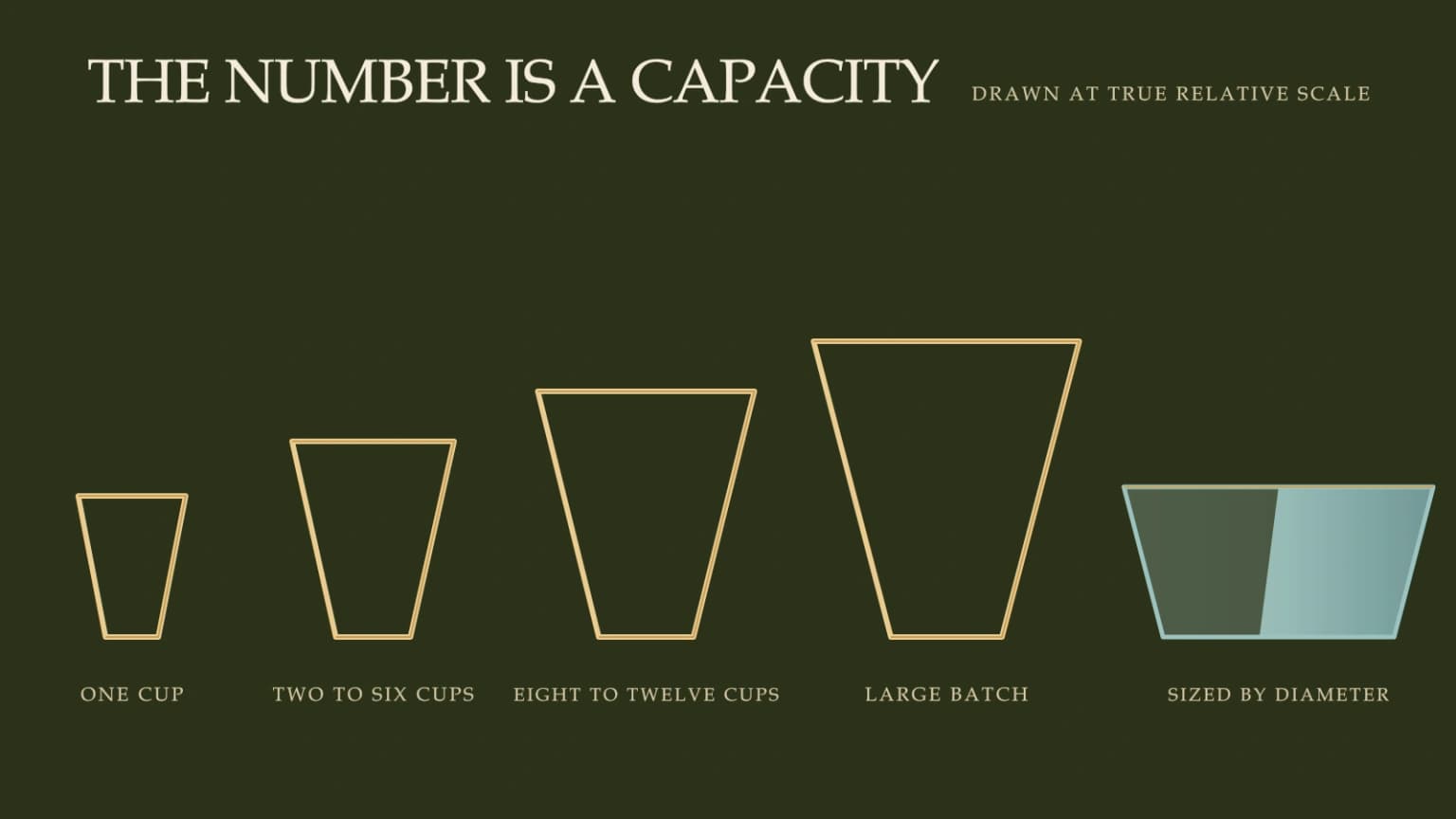
Coffee filter sizes come in two families: numbered cones and flat-bottomed baskets. The numbers apply only to cones, and getting that wrong is what sends people back to the store.
The numbering came from Melitta, whose founder patented the paper coffee filter in 1908. It is a capacity scale rather than a brand code, and every maker follows it.
A #1 fits single-cup brewers and a #2 covers roughly two to six cups. A #4 covers the eight to twelve cup machines most households own, and a #6 is for larger batch brewers.
A #4 next to a #2 is an obvious difference on paper and an easy mistake in a supermarket aisle. Buy by the cup rating on your machine, not by eye.
Cone number, basket, and what fits
Cone number, basket, and what fits
Filter
Machine it suits
What goes wrong
#1 cone
Single-cup cone brewers
Too small for anything above one mug
#2 cone
Roughly 2 to 6 cup machines
Collapses inward in a #4 holder
#4 cone
Roughly 8 to 12 cup machines
Rim folds over in a smaller holder
#6 cone
Large batch and commercial brewers
Rarely stocked in supermarkets
Basket
Flat-bottomed drip baskets
Sized by diameter, no number applies
Chemex
Chemex only
Far thicker, not interchangeable with cones
Cone numbers describe capacity and nothing else. If your brewer takes a basket, measure across it, because the numbering system does not apply.
Shape changes the brew as well as the fit. A cone funnels water toward a single exit point and builds a deeper bed, while a basket spreads the same coffee wider and shallower, which generally reads as the milder of the two.
The failure mode people actually hit is buying small. A #2 in a #4 holder looks fine dry, then folds inward once the bed is wet and tips grounds straight into the carafe.
Chemex filters deserve their own line. They are far heavier than a standard cone at roughly 167 to 210 microns thick, and that weight is why a Chemex brews slowly and tastes as clean as it does.
They also come folded unevenly on purpose, which the box explains badly. A folded Chemex filter has a three layer side and a single layer side, and the thick side goes against the pouring spout.
That is not a matter of preference. The three layers hold the air channel open so the brewer can vent as water goes in, and reversing it can stall the drawdown or pull the filter down into the neck.
The oils a paper filter removes
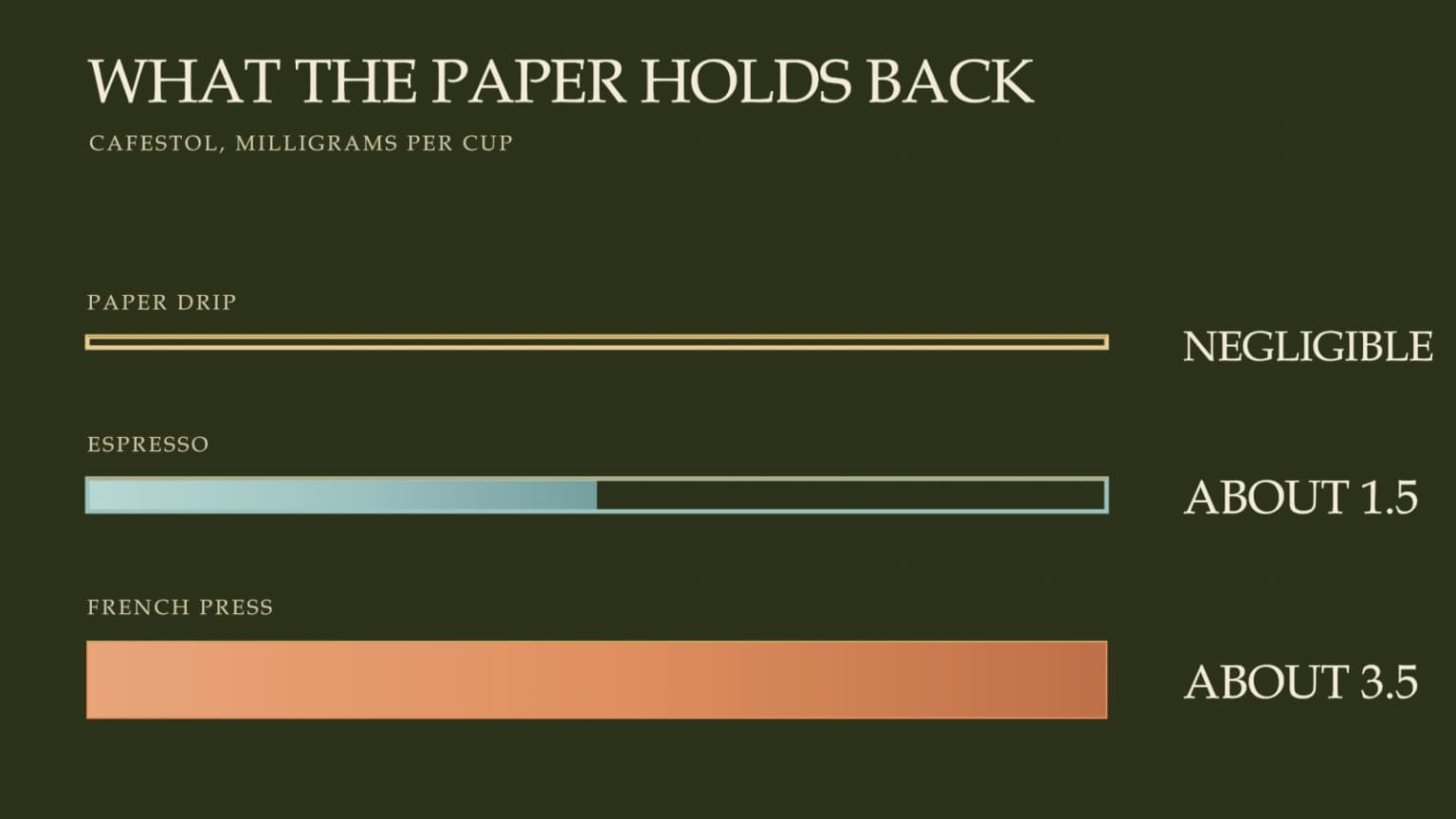
This is the one genuine difference between filter types that has nothing to do with taste. Coffee oils carry a group of compounds called diterpenes, and paper holds most of them back while metal and cloth do not.
Cafestol is the one studied most. Published measurements put French press coffee near 3.5 mg of cafestol per cup and espresso near 1.5 mg, against negligible amounts in paper-filtered drip, with the difference coming down entirely to what the paper absorbs.
The oils that make press coffee feel rich are the same ones paper takes out. This is a trade rather than a flaw in either direction.
The research links those compounds to higher LDL cholesterol, with intake near 10 mg a day tracking a few mg/dL of increase. We are reporting the literature rather than giving medical advice, and one press cup a day sits far below those intakes.
What makes it worth a section is that almost nobody knows the lever exists. Someone drinking several unfiltered cups a day who has been told to watch their LDL has an easy change available that costs nothing and keeps the coffee.
Espresso sits in an awkward middle. Per cup it is modest because the serving is small, but anyone pulling four or five a day on an espresso machine with a grinder is drinking more than a single-shot figure suggests.
A paper disc solves it without giving up the brewer. Laid under a press plunger or over a moka basket, it removes most of the oil-borne fraction while the brewing method stays exactly the same.
Coffee filter types, measured
The numbers that separate coffee filter types are thickness, flow rate, and what a dry filter gives off in hot water. Thickness came from calipers, flow from a fixed 300 grams of water through one dripper.
Thickness, flow and taint by filter
Thickness, flow and taint by filter
Filter
Thickness
Water flow
Taint when dry
AeroPress paper disc
About 120 microns
Not comparable, pressed
Bleached, expect none
Chemex unbleached
About 167 microns
About 9.8 mL/sec
Rinse before use
Pour over brown paper
About 203 microns
About 15.3 mL/sec
About 5 ppm measured
Chemex bleached
About 210 microns
About 7.2 mL/sec
Bleached, expect none
Pour over white paper
About 206 to 242 microns
About 6.9 to 11.0 mL/sec
None detected
Cloth cone
About 690 microns
About 18.1 mL/sec
Cotton at first use
Metal cone
Not comparable
About 67.8 mL/sec
None when clean
Figures come from one carefully documented independent measurement set, not an industry standard, so read them as reliable indications of scale rather than exact specifications.
Two things in that table are worth sitting with. Thickness does not predict flow in the way you would expect, because pore structure matters more than how much paper is in the way.
The white pour-over papers show it plainly. Two versions of the same product, 36 microns apart in thickness, differ by roughly 60 percent in flow rate, which is more than most people's entire grind adjustment range.
The cloth number explains the tradition. At 690 microns it is three times the thickness of paper and still flows faster, because a woven structure has far more open area than a pressed sheet.
The case for keeping the oils
Everything above leans toward paper, so here is the argument against our own framing. The oils paper removes are not contaminants, and a cup stripped of them has lost something real.
Body is the clearest loss. Those oils and the suspended colloids alongside them are what make coffee feel like a drink with weight rather than a flavored infusion, and no grind adjustment puts that back.
Aroma travels with them too. A share of what you smell over a French press never reaches the cup through paper, which is why the same beans can smell richer in an immersion brewer than they taste in a drip machine.
Whole traditions are built on unfiltered coffee and are not mistakes. Turkish coffee, moka, Scandinavian boiled coffee and espresso all carry their oils on purpose, and filtering them into clarity means brewing something other than what they are.
The sediment question is also partly a grind question. A genuinely coarse, evenly ground coffee in a good press leaves far less silt than most people assume, and the mud at the bottom of the mug is usually a grinder problem wearing a filter costume.
What makes this argument easy to settle is the price of being wrong. A grinder is a considered purchase and a brewer is a bigger one, while a box of paper costs less than a bag of coffee and can be abandoned tomorrow.
Switch filters without wrecking a brew
A filter swap is the cheapest change available to most home brewers and the one most likely to be blamed on the coffee. This is the order that keeps the result readable.
Changing filter, in order
1
Write down what you brew now
Dose in grams, water in grams, grind setting, and roughly how long the brew takes end to end. You need the timing most of all, because that is what the filter will move.
Tip Two lines in a notebook is enough. You are recording a baseline, not keeping a diary.
2
Change the filter and nothing else
Same coffee, same grind, same water, same temperature. Brew it and time it, so you can see what the filter alone did to the drawdown.
Watch out Rinse the new filter first if it is unbleached paper, or you will read the paper as a flavor change.
3
Read the clock before the cup
A brew that finished much faster has told you why it tastes thinner. A brew that stalled has told you the paper is finer than your grind expects.
4
Move the grind to meet it
Go finer if the brew ran fast on a more open filter, coarser if it stalled on a tighter one. One step at a time, tasting after each.
Tip Aim to land back near your original brew time. That is the target the swap disturbed.
5
Adjust the dose last, if at all
Only touch the ratio once the timing is back where you want it. Moving strength and extraction together makes the result impossible to read.
6
Buy one box and stay with it
Once a filter works, stop switching brands. Papers vary enough between makers that a supermarket substitution can undo everything above.
Watch out This includes swapping between tabbed and tabless versions of the same brand, which are not the same filter.
Keep the baseline notes even after it works. The next time a cup goes wrong you will want to know whether the filter, the grind or the bag changed.
Keeping a reusable coffee filter usable
Every reusable coffee filter fails the same way, and it is never a hole in the mesh. Coffee oil builds into a film that a rinse cannot shift, goes rancid, and then makes every brew harsh no matter what you do to the recipe.
The reusable filter reset
1
Rinse within the half hour
Hot water and nothing else, immediately after brewing. Almost all reusable filter trouble starts with a wet filter left on the counter until evening.
2
Soak weekly in a coffee cleaner
Use a dedicated coffee equipment cleaner at its stated dilution. Oil sits inside a woven mesh where no sponge reaches, so soaking does the work scrubbing cannot.
Tip Mesh and plunger assemblies hold the most oil and want the longest soak.
3
Skip vinegar on gold-tone mesh
Acid attacks the plating on gold-finish filters. Mild dish soap or a proper cleaner is the safe route, followed by a very thorough rinse.
Watch out Never use soap on a cloth filter. The weave holds detergent and returns it to the next brew.
4
Dry cloth completely, or keep it wet
A cloth filter must be bone dry, stored submerged in clean water in the fridge, or frozen damp in a sealed bag. The dangerous state is damp and warm.
Tip Freezing suits anyone brewing with cloth a few times a week rather than daily.
5
Hold the mesh up to a light
Blocked sections show as dark patches against a window or a lamp. A filter that no longer passes water evenly is brewing unevenly too.
6
Replace on a schedule you decide now
Cloth is done after roughly 90 to 120 brews. Metal lasts years, but only if the weekly soak actually happens.
If a cup tastes harsh across every bean and every setting, suspect the filter first rather than last. It is the one component that gets wet daily and cleaned almost never, and the oily dark roasts we avoid in superautomatic machines load it fastest.
Which coffee filter to use in 2026
Start with paper unless you have a reason not to. It is the cheapest, the most predictable, the material most recipes assume, and the one that lets you judge a coffee without the equipment adding a voice.
Move to metal if you want body and you are willing to grind for it. A metal filter is a faster filter, so treat the swap as a recipe change rather than an upgrade.
Cloth is the enthusiast's answer and it earns the reputation. It also asks for a rinse within the half hour and a considered storage habit, which is a fair description of who it suits.
The one choice we would argue against is a permanent basket nobody cleans. It starts as a small saving and ends as the reason a machine gets replaced.
The filter is the cheapest component in any brewer and the one most people never think about twice. It is also the only one you can change tomorrow morning for the price of a box of paper.
Frequently asked questions
Are paper or metal coffee filters better?
Neither is better in general, because they solve different problems. Paper gives you a clean cup with very little sediment and almost none of the coffee oils, and metal gives you body, texture and a heavier mouthfeel.
The part most comparisons leave out is speed. Metal lets water through several times faster than paper, so the same grind extracts less through metal than it does through paper.
Choose paper if you like clarity and want your brewer to behave predictably. Choose metal if you want body, you are happy to grind coarser, and you will clean it properly.
Do I need to rinse a paper coffee filter?
Rinse unbleached filters. Measurements of dry filters steeped in hot water found detectable dissolved solids coming off brown paper and essentially none off white paper, and a hot rinse removed what was there.
On bleached filters the rinse does something else that still matters. It warms the brewer and the carafe, which stops the first pour losing heat into cold ceramic or glass.
A few seconds of hot water is enough either way. There is no need to soak a filter or run a full kettle through it.
What can I use if I run out of coffee filters?
A clean cotton handkerchief, a cut square of an old cotton t-shirt, or a fine mesh kitchen sieve will all hold back grounds well enough for one morning. Rinse cloth in hot water first so you are not tasting the laundry.
A paper towel works but is the weakest option. It is not made for hot liquid, it can tear under the weight of a wet bed, and thicker quilted sheets slow the drawdown to a crawl.
Treat all of these as a rescue. Cloth and mesh both pass more oil and sediment than the paper you ran out of, so the cup will taste heavier than usual.
Is a #2 or #4 coffee filter right for my coffee maker?
Go by batch size. A #2 cone suits machines that brew roughly two to six cups, and a #4 cone suits the eight to twelve cup machines that are standard in American kitchens.
If your brewer takes a flat-bottomed basket rather than a cone, the numbers do not apply at all. Basket filters are sized by diameter, so measure across the basket instead.
The usual failure is a filter that is too small. It folds inward once the bed is wet, and grounds spill over the rim into the carafe.
Do paper coffee filters remove cholesterol?
Paper filters retain most of the oil-borne compounds called diterpenes, of which cafestol is the one studied most. Published measurements put French press coffee near 3.5 mg of cafestol per cup and espresso near 1.5 mg, against negligible amounts in paper-filtered drip.
Those compounds are associated with higher LDL cholesterol in the research, with roughly 10 mg a day tracking a few mg/dL of increase. The coffee itself is not removed by the paper, only the oils carrying those compounds.
This is worth knowing rather than worrying about, and it is not medical advice. If a doctor has asked you to watch your LDL, the brewing method is a lever most people do not know they have.
Can I use a paper filter in a French press or a Keurig?
In a French press, yes, and some owners do. A paper disc cut to the plunger diameter, or sat under the mesh, gives a much cleaner cup, though the plunge gets noticeably heavier and slower.
Keurig and other pod machines are a different case, because the filter is sealed inside the capsule and you cannot reach it. Reusable pod baskets exist for most systems and behave like any other metal filter.
Both swaps change the flow rate, so expect the cup to taste different even with the same coffee. Adjust the grind rather than assuming the swap failed.