Eight Coffee Storage Containers for 2026, Sized to the Bag You Buy
Air stales coffee, not time. We read 63,000+ owner ratings to rank eight coffee storage containers for 2026, from $16 to $70, sized to the bag you buy.
By the CoffeeGearGuides team · USA · Updated Sep 13, 2026 · 37 min read
On this page22
The best coffee storage container is the one that leaves the least air sitting on top of your beans, and almost nothing on the shelf is labeled in a way that tells you which one that is.
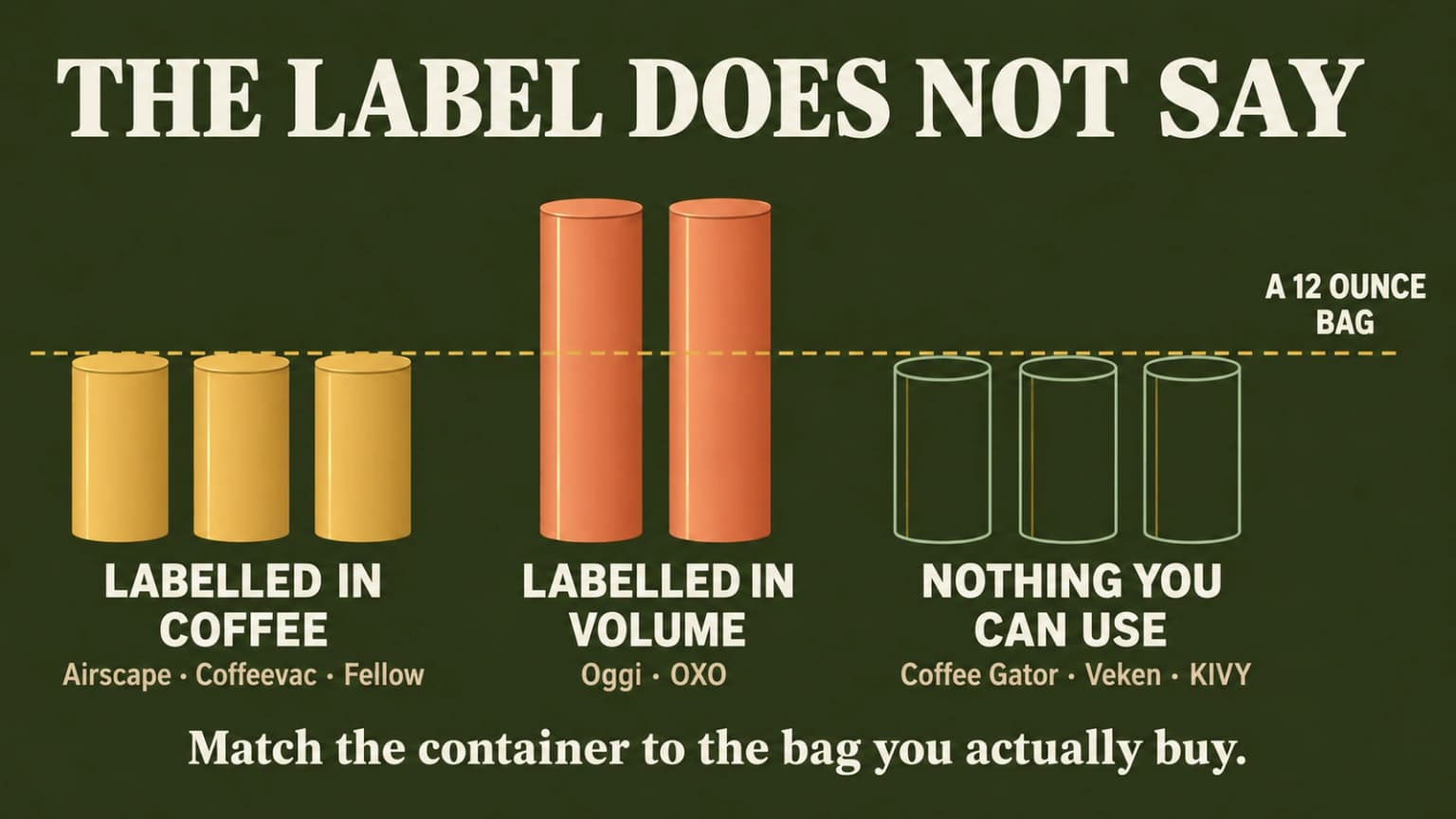
Three of the eight containers here state their size as a weight of coffee. Two state a volume. The rest print a bare number of ounces, or nothing at all.
That matters because air is what stales coffee, not time. A tin twice the size of your bag is a tin half full of oxygen, however good its gasket is.
For this 2026 guide we compared maker specifications, published research on how roasted coffee off-gasses, the National Coffee Association's storage guidance and more than 63,000 Amazon owner ratings. What follows is which container fits the bag you actually buy, and the one case where the freezer beats every tin here.
How we chose these coffee canisters for 2026
We research rather than test, and we think that is honest work when it is done in the open. You can read how we work on our about page.
For this guide that meant maker documentation first, because storage is one of the few coffee categories where the manufacturer publishes checkable numbers. Fellow states its own bean capacities and re-sealing interval, and both matter more than any review.
We then read the full spread of Amazon ratings on each container, weighting three-star reviews hardest. That is where owners describe a lid that sticks or a seal that fades, without either rage or marketing.
Three rules shaped the list. Every container had to be in stock on Amazon US with a live price on the day we published, and every one had to serve a buyer the others do not.
And every claim about capacity had to trace back to something the maker actually prints. Where it does not, we say so instead of inventing a number.
One well-known canister missed our 4.0 star bar, and it gets its own section rather than a quiet omission.
Vent the CO2 or pull a vacuum?
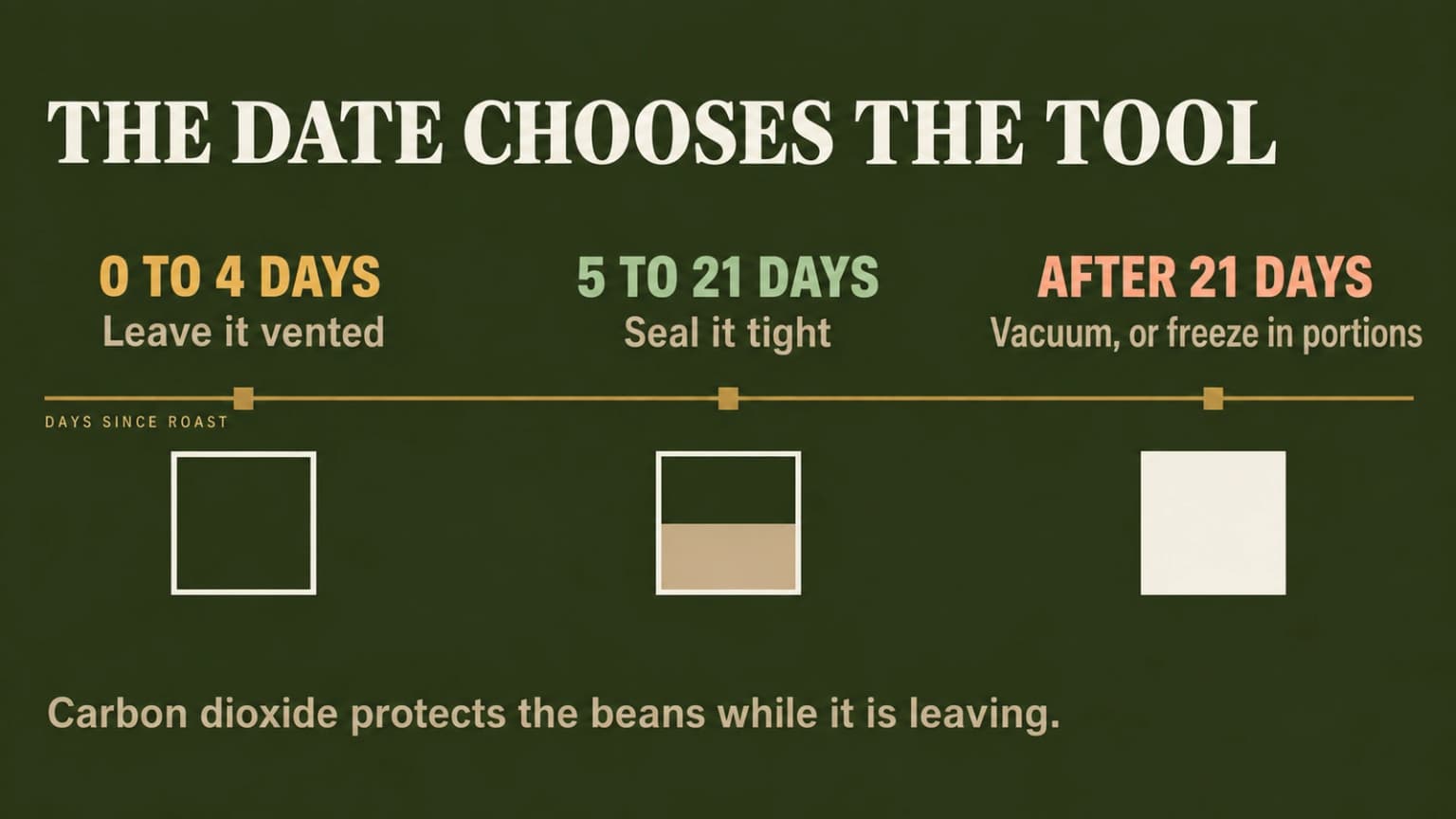
Vent it if the coffee is less than three weeks off roast, and pull a vacuum after that or whenever you buy in bulk. Every container here seals; the split is what each one does about the gas already inside.
Roasted coffee is still working when you buy it. Published measurements put the carbon dioxide in freshly roasted and ground coffee between 4.0 and 8.6 milligrams per gram, with dark roasts holding more than double the residue of light ones.
That degassing runs for days and weeks, and while it is running it protects the beans. Carbon dioxide is heavier than air, so it settles on the coffee and pushes oxygen out of the way.
A vented container works with that. A valve lets the CO2 escape so pressure never builds, and the escaping gas carries oxygen out with it. The Coffeevac and Coffee Gator do this.
A vacuum container, which listings usually call vacuum sealed, ignores that and removes everything. It is the right tool once degassing has finished, and the wrong one on day two, when you are pulling out the blanket the roaster paid to create.
Coffee changes what it needs from a container as it ages. The date on the bag chooses the tool, not the price.
There is a second, quieter difference: a vented tin asks nothing of you, while a vacuum asks for a habit. Fellow's guidance for the Atmos is to twist the lid every four to five days, which is physics rather than a defect.
Vent it or vacuum it
Vent it or vacuum it
What matters to you
Vent and seal
Pull a vacuum
Best for coffee that is
Under three weeks off roast
Past three weeks, or in bulk
Effort after filling
None
Pump or twist every few days
Handles pre-ground
Yes, all of them
Not the Atmos, by maker policy
Headspace still matters
Very much
Less, air is removed
Parts that can fail
One gasket
Gasket, valve, pump or motor
Typical spend
$16 to $44
$27 to $70
Generalizations that hold across the eight containers here. Each section covers the individual quirks.
If you buy coffee weekly and drink it fast, the vent column is your column and you can stop reading price tags at $25. If you buy two pounds at a time, or keep a decaf you touch twice a month, the vacuum column earns its money.
The 8 best coffee storage containers
The lineup below runs from the one we would buy first to the one that suits a specific buyer only. Every link was verified in stock with a live price through Amazon's own product API on the day we published.
Ratings and review counts recorded September 2026 on Amazon US. Prices move; use the buttons for the live number. Amazon.com prices as of 15/09/2026. Details
1. Airscape Classic Stainless Steel Canister
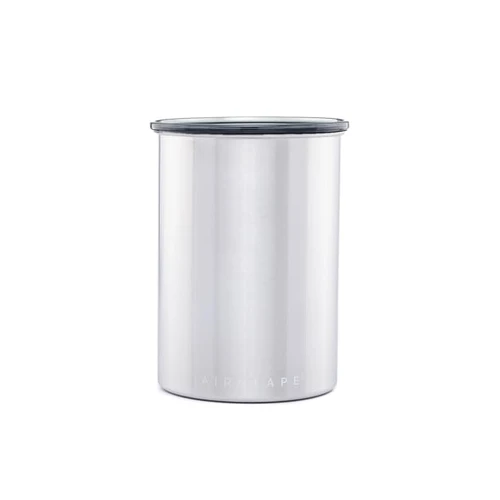
The Airscape solves a problem the rest of this shelf only manages: as the coffee goes down, the container gets smaller.
Planetary Design has sold the patented design for over fifteen years, and 6,250 owners hold this stainless version at 4.8 stars, the joint highest rating here.
The mechanism is a second lid that travels inside the body. You press it down onto the beans, a valve in its center lets the displaced air hiss out, and an outer lid closes over the top. Nothing charges and nothing pumps.
Airscape Classic Stainless Steel Coffee Canister
Rated 4.8 from 6,250 ratings
The patented plunger canister that shrinks to fit whatever coffee is left in it, in opaque steel.
Owner reports settle into a pattern. The hiss becomes the sound people associate with fresh coffee, and the recurring grumble is a plunger going stiff over months, which tracks with oil reaching the sliding seal.
The honest limitation is that this is displacement, not a vacuum. The Airscape removes the air above the beans; it cannot remove the air trapped between them.
For coffee you finish inside a month that distinction is academic. For a bag you will nurse through a quarter, a true vacuum holds longer.
At $44.00 it is the only container here whose central idea is not available cheaper. If you buy one canister and stop thinking about it, buy this one.
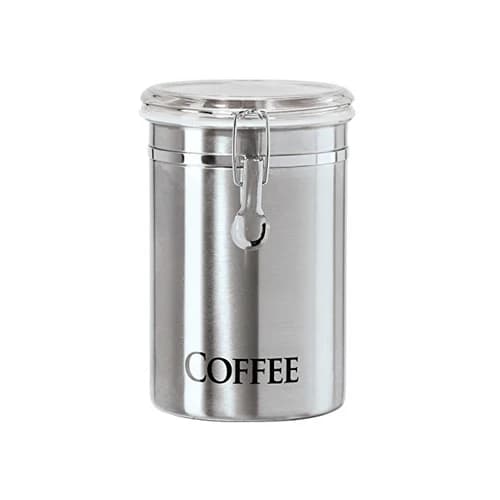
2. Coffee Gator Stainless Steel Canister
The Coffee Gator is the container most people actually end up owning, and at $21.99 it is easy to see why.
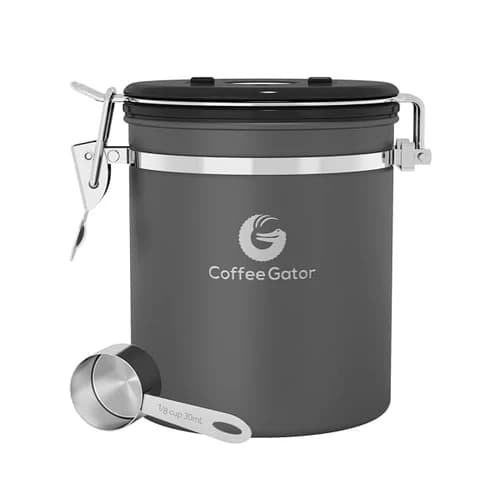
Opaque steel body, a gasket lid with a CO2 valve, a date wheel on the top and a measuring scoop in the box, held at 4.7 stars by 10,171 owners.
The date wheel deserves more credit than it gets. It is the only feature here that addresses the actual enemy: a bag you forgot you opened.
Coffee Gator Stainless Steel Canister, Medium
Rated 4.7 from 10,171 ratings
The mass-market steel canister with a vent, a date wheel and a scoop, at a third of the Airscape price.
Owner sentiment is unusually consistent for a budget product. People like the weight of it and the thunk as the lid seals, and the date wheel shows up in review after review as the thing they did not expect to use.
Coffee Gator's own listing calls carbon dioxide a flavor destroyer that must be vented away, and that is worth pushing back on. CO2 is what carries aroma and keeps oxygen off the beans.
The real weak point is the one it shares with every fixed-volume tin. Full, it is excellent. A third full, it is a jar of air with some coffee at the bottom.
Buy this if you want the sensible answer at a sensible price, or if what you really need is to remember when you opened the bag. If the price gap is affordable, the Airscape solves more.
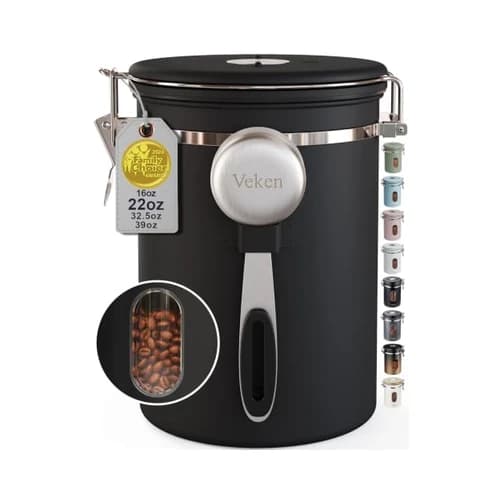
3. Veken Coffee Canister with Window
The Veken is the highest-rated container in this guide, 4.8 stars across 12,271 ratings, and the only one that lets you see how much coffee is left without opening it.
At $24.99 it gives you a steel body, an airtight gasket lid, a date tracker, a scoop and a view panel down one side.
That window is a convenience and a compromise. Light is fourth on the list of things that damage coffee, behind oxygen, moisture and heat, but it is still on the list. Keep the tin in a cupboard and the window becomes pure upside.
Veken Coffee Canister with Window, 22 oz
Rated 4.8 from 12,271 ratings
A steel canister with a level window, a date tracker and a scoop, holding the joint highest rating here.
Owners describe it as the tin that made them stop using the bag, which is the outcome that matters. The seal gets praised for the resistance you feel as the lid goes on, and the complaints are mostly about sizes being hard to picture from the listing.
Its honest weak point is the absence of a vent. Seal a dark roast in here three days off the roaster and the lid can get tight, because that gas has nowhere to go.
Open it daily and nothing happens. Fill it and leave it two weeks and you may hear it release. Buy this if you want the best-evidenced tin on the page and a cupboard to keep it in.
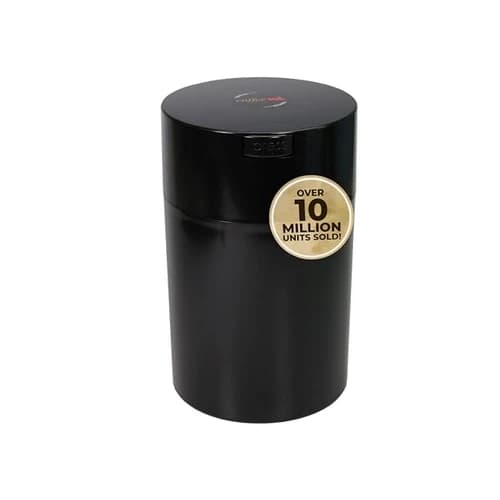
4. Coffeevac 1 LB
The Coffeevac is the cheapest container here that is honest about its size, and that turns out to be worth a lot.
Its listing states plainly that the 1 LB holds one pound of whole beans. At $18.00, with 4.6 stars across 7,042 ratings, it is the value pick on this page.
The lid is a patented push-button design with a two-way valve: press it down and it draws onto the seal, while the valve lets CO2 out. The opaque body blocks UV, and the container is NSF certified, a food-service standard rather than a kitchenware one.
Coffeevac 1 LB Airtight Coffee Container
Rated 4.6 from 7,042 ratings
A patented push-button container rated in pounds of coffee, with a two-way valve and a UV-blocking body.
The review base skews toward people who own several, which is the strongest signal a cheap container can send. Roasters and cafes appear in the reviews using them for retail stock, and the only consistent criticism is that it looks like the plastic it is.
The name also oversells the mechanism. Despite the word vacuum, this is a sealed container with a vent rather than a pump, and you should buy it as the former.
Taken for what it verifiably is, it is the best twenty dollars here, especially in the half-pound size against a 12 ounce bag.
Buy this if you want the sizing right and do not mind the looks, or if you want two so beans and decaf never share a jar.
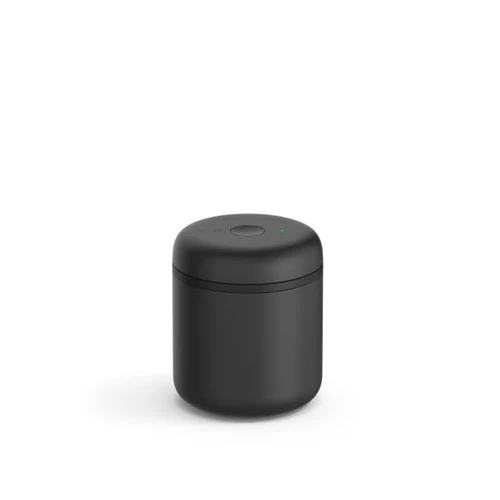
5. Fellow Atmos Electric Canister
The Fellow Atmos Electric is what the vacuum idea looks like when the habit is removed. A motor in the lid watches the seal and tops it up on its own.
At $69.95 it is the most expensive container in this guide, held at 4.4 stars by 491 owners. That review base is thin, and we would rather say so than round it up.
The mechanism matters here. A hand-pumped vacuum decays, which is the whole reason this version exists: an electric lid re-pulls the vacuum when it slips, and it charges over USB-C.
Fellow Atmos Electric Vacuum Canister, 0.7 L
Rated 4.4 from 491 ratings
The vacuum canister that maintains its own seal, so the thing manual vacuum owners forget is done by a motor.
The evidence we have is positive and shallow. Owners report the vacuum holding for weeks unattended, which is what they are paying for, and several charge the lid every few months rather than weekly.
We would treat the 4.4 as provisional until the count grows, and we would not pay $70 on 491 ratings unless set-and-forget is specifically what you need.
Two limits are worth naming before you spend. Fellow rates the 0.7 liter at 11 ounces of beans, so a standard American 12 ounce bag does not quite fit.
Fellow also states the Atmos is for whole beans only, because fine particles can clog the intake valve. Pre-ground buyers want the OXO POP instead.
Buy this if you keep a decaf, a second origin or a bulk bag that sits for weeks, and you would rather a motor remembered the seal than you did.
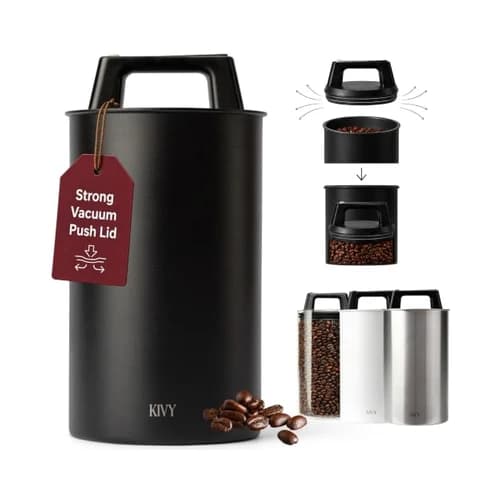
6. KIVY Vacuum Coffee Canister
The KIVY is the vacuum mechanism at a third of the Fellow price, and unlike the Atmos it will take ground coffee.
At $26.99 with 4.6 stars across 698 ratings, it is the cheapest way onto this page's vacuum column. The review base is modest, which is the trade.
The lid works by pressing down rather than pumping. You push, air leaves through the seal, the gasket holds what is left, and there are fewer parts to fail than on a pump. In practice it lands between the Airscape's displacement and a true vacuum.
KIVY Vacuum Coffee Canister
Rated 4.6 from 698 ratings
A push-down vacuum canister in opaque steel that takes ground coffee as well as whole beans.
Owners describe the seal as reassuring and the build as heavier than the price suggests, and several mention using it for tea and spices. The criticism worth weighing is that a light press leaves you thinking it is sealed when it is not.
The unresolved thing is the size. KIVY publishes no capacity in either coffee weight or fluid volume that we could verify, so we will not put a number on it.
If you buy it, fill it from a 12 ounce bag and check where the level lands before deciding whether the larger version was the one you wanted.
Buy this if you buy pre-ground and still want a vacuum seal, and you can live with a shallower review base.
7. Oggi Stainless Steel Canister
The Oggi is the container for people whose problem is volume. Sixty-two fluid ounces of it, in food-grade steel with a clamp lid, for $16.99.
That is 1.83 liters. Whole roasted beans run roughly 380 to 450 grams per liter going by Fellow's published capacities, so this tin takes around 700 to 820 grams.
Call it a pound and three quarters, which makes it the only container here that takes a 2 pound bulk bag in nearly one go. It sits at 4.5 stars across 8,480 ratings.
The clamp lid is the old preserving-jar mechanism: a lever pulls the gasket down hard and you feel the seal bite.
Oggi Stainless Steel Coffee Canister, 62 fl oz
Rated 4.5 from 8,480 ratings
A 62 fluid ounce steel canister with a clamp lid, the only one here big enough for a bulk bag in one pour.
Owners buy this for the size and stay for the clamp. Reviews mention flour, pasta and dog biscuits as often as coffee, and the recurring complaint is a gasket that needs wiping to keep sealing cleanly.
Its weak point is the same as its selling point. A container holding nearly two pounds is a container three quarters full of air by the last few days.
Use it as a holding vessel: decant the bulk bag, then move a week at a time into something smaller. Buy this if you buy big bags and want steel to keep them in.
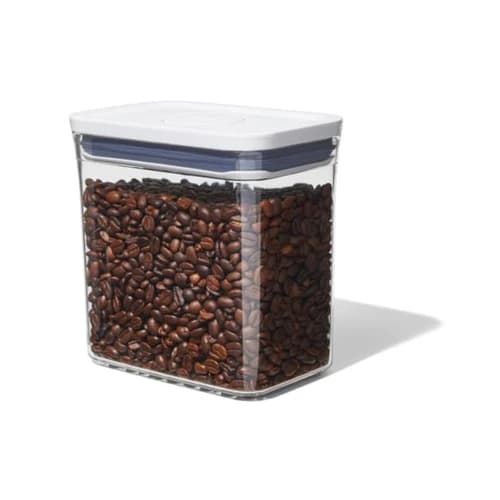
8. OXO Good Grips POP Container
The OXO POP is not a coffee product, and that is exactly why it belongs here. If you buy pre-ground coffee, the rules change.
At $15.95 for the 1.7 quart size, held at 4.6 stars by 17,673 owners, it has the deepest review base on this page by a wide margin.
One press on the button seals the gasket and the same button becomes the handle, making it the only one-handed container here.
Ground coffee has also lost most of the gas that protects it. Grinding releases between 26 and 59 percent of the carbon dioxide in the beans, so a vent has nothing left to do.
OXO Good Grips POP Container, 1.7 qt
Rated 4.6 from 17,673 ratings
The one-handed pantry container with a push-button gasket seal, and the right answer for pre-ground coffee.
Seventeen thousand ratings describe a container people forget they own, which is the highest praise a pantry item gets. The criticisms are minor: the gasket has to be dry before the lid goes on, and the clear body stains.
Its weak point here is transparency: a see-through container belongs in a cupboard, not on a windowsill.
For whole beans three days off the roast we would still reach for a vented tin. For pre-ground that is already past that stage, a hard seal and a small volume is the whole job.
Buy this if you buy ground coffee, or if you want a matched set of sizes so the container always fits the bag.
Headspace is the number nobody prints
Headspace is the air left in a container above and around your coffee, and it is the measurement that decides how well any of these work. No competing guide publishes it.
Staling is oxidation, and oxygen is what drives it, so headspace is the volume you are buying a tin to reduce. You cannot work it out from the label, because this shelf does not use one unit.
Three makers label in coffee, two in volume, and the rest tell you nothing usable. A 12 ounce bag is the line to measure against.
Three of the eight state capacity as a weight of coffee. Airscape rates its Classic at 500 grams, Coffeevac prints 1 LB, and Fellow publishes bean weights for each Atmos size.
Two state a volume instead. Oggi says 62 fluid ounces and OXO says 1.7 quarts, which tells you about the jar and nothing about the coffee.
The rest print a bare ounce figure without saying whether it means fluid ounces or coffee, and KIVY publishes nothing we could verify.
What the size on the label means
What the size on the label means
Container
What the label says
Beans that means
Against a 12 oz bag
Airscape Classic
500 g, sold as 1 lb
500 g
Fits, slack absorbed
Coffeevac 1 LB
1 lb of whole beans
454 g
Fits, room spare
Fellow Atmos Electric
11 oz of beans
312 g
Overfills by an ounce
Fellow Atmos 1.2 L
16 oz light or medium
454 g, less if dark
Fits, unless dark roast
Oggi
62 fl oz of volume
700 to 820 g
Fills under half
OXO POP
1.7 qt of volume
610 to 720 g
Fills about half
Veken
22 oz, unit unstated
250 or 620 g
Label cannot say
Coffee Gator
16 oz, unit unstated
180 or 454 g
Label cannot say
KIVY
None published
Unpublished
Fill it and look
Bean weights are the makers' own where published; volume conversions use 380 to 450 g of whole beans per liter, derived from Fellow's own capacities. The 1.2 L Atmos is listed for reference and is not one of our eight picks.
Two things fall out of that table and both change what you should buy.
First, the most expensive container here is sized against a bag America does not sell. The standard US specialty bag is 12 ounces, and Fellow's 0.7 liter body is rated at 11.
Second, where the unit is missing the spread is enormous. A 22 ounce label could mean 250 grams of coffee or 620, and nothing in the listing settles it.
The rule that survives all of this is short. Match the container to the bag you actually buy, and where the label is in volume, buy one size down from what looks right.
Four ways a lid removes the air
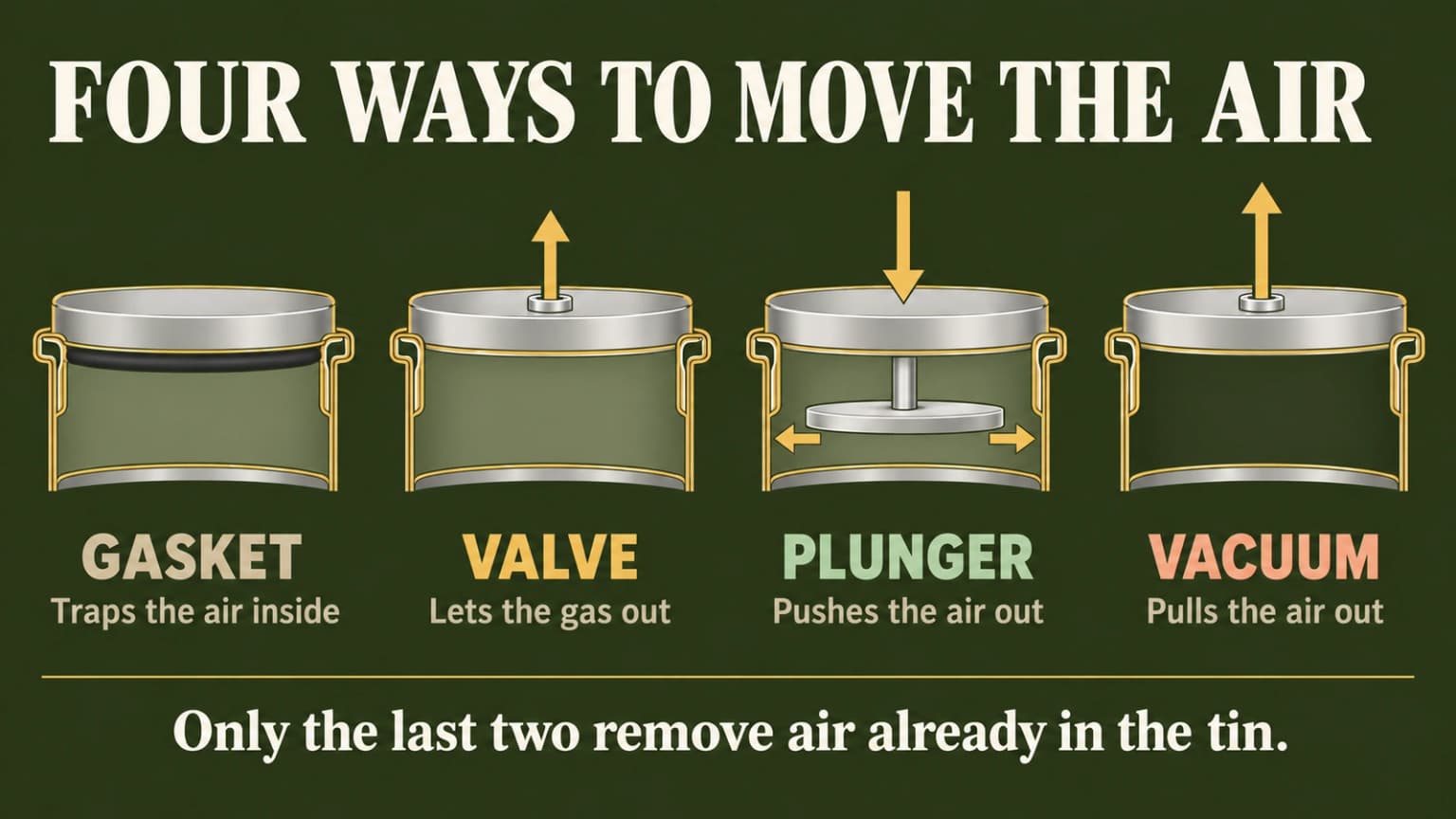
The containers here use four distinct mechanisms, and the differences are mechanical rather than marketing.
A gasket seal is the baseline. A silicone ring is compressed onto the rim by a clamp, screw or button, and the air already inside stays inside. The Oggi, Veken and OXO POP work this way.
A one-way or two-way valve adds an exit. Gas building up inside can leave but outside air cannot come back, so a fresh roast never pressurizes the tin. Coffee Gator and Coffeevac add this.
Displacement is the Airscape's idea: a second lid travels down onto the beans and the air above them is pushed out through a valve in its center.
Vacuum is the Fellow and KIVY approach. Air is pulled from between the beans as well as above them, the only mechanism that reaches the air the coffee actually sits in.
Each mechanism moves air differently. Only displacement and vacuum remove air that is already in the tin.
Ranked purely on how much oxygen ends up next to the beans, vacuum beats displacement, displacement beats a valve, and a valve beats a plain gasket.
Ranked on what you will still be doing in six months the order reverses almost exactly, because a gasket needs nothing and a vacuum needs a routine. That inversion is why the $44.00 Airscape outranks the $69.95 Fellow on our list.
The canister we did not rank
The Fellow Atmos is the canister most people picture when they think about coffee storage, and it is not on our list. We would rather explain that than let you notice a gap.
The Fellow Atmos in its 1.2 liter size costs $39.95 and sits at 3.9 stars across 6,867 Amazon ratings, below the 4.0 bar we hold every pick to. It is a real vacuum canister, it is beautifully made, and its own maker publishes the reason for the rating.
Fellow's guidance is to twist the lid every four to five days to maintain the vacuum. That is honest documentation of how a hand-pulled vacuum behaves, and it is not what most buyers expect from a $39.95 sealed jar.
The negative reviews bear that out. Owners describe pumping it, returning days later, and finding the indicator no longer showing a vacuum.
Nearly seven thousand people reporting the same disappointment outweighs a mechanism that works on paper.
One published Atmos detail deserves quoting anyway. Fellow rates the 1.2 liter at 16 ounces of light or medium roast and states that a full pound of dark roast will not fit, because dark roasts expand more in the roaster and the same weight takes more room.
That is the clearest proof we found that a canister's volume and a bag's weight are not the same currency.
Where a coffee storage container goes
The right container in the wrong place loses to the wrong container in the right place, and this is the cheapest correction available.
Heat is third on the damage list, after oxygen and moisture, and a kitchen has obvious hot spots people ignore.
The cupboard above the oven is the worst place in the room. So is the counter beside an espresso machine, which radiates heat for an hour after the last shot.
Light is fourth and only matters for the transparent containers. The Oggi's clear lid panel, the Veken's window and the OXO's clear body all want a closed cupboard, while the steel-bodied Airscape, Coffee Gator and KIVY are indifferent.
Then there is the place people ask about most, and the answer is a flat no. The refrigerator is humid, full of odors, and guarantees a condensation cycle every time the door opens.
Moisture outranks light and heat in the damage order, so the fridge trades a small gain for the second-worst problem on the list. The freezer is a different case and gets its own section below.
One more piece of geography gets missed: a bean-to-cup machine's hopper is a storage container with a weak seal and a clear lid.
Keep two or three days of beans in the hopper and the rest in a sealed tin, which is the same advice we give in our guide to espresso machines with built-in grinders, where clogged grinders from oily beans are a recurring owner complaint.
The case against a coffee canister
We would be selling, not writing, if we skipped this. For many people a coffee storage container solves a problem they do not have.
The argument is simple. An unopened roaster's bag with a one-way valve is already a good oxygen barrier, and if you finish a 12 ounce bag inside a week, storage never becomes the limiting factor.
Freshness is also not the only variable, and it is rarely the biggest one. A month-old bag ground correctly beats a week-old bag ground badly, and stale beans rank only seventh among the causes of bitter coffee.
If your coffee is disappointing and you own a blade grinder or buy pre-ground, the canister is the wrong purchase. A burr grinder is the right one, and our single dose grinder guide covers that shelf.
A container earns its place when you buy in bulk, keep more than one coffee open, run a bag past about ten days, or store it somewhere warm, bright or humid.
Any one of those and an airtight coffee container is worth the money. None of them and you are buying an object, which is a fine reason to buy something but not a freshness reason.
When the freezer beats the canister
Most competing pages on this keyword tell you not to freeze coffee. That advice is out of date, and the correction is the most useful thing here.
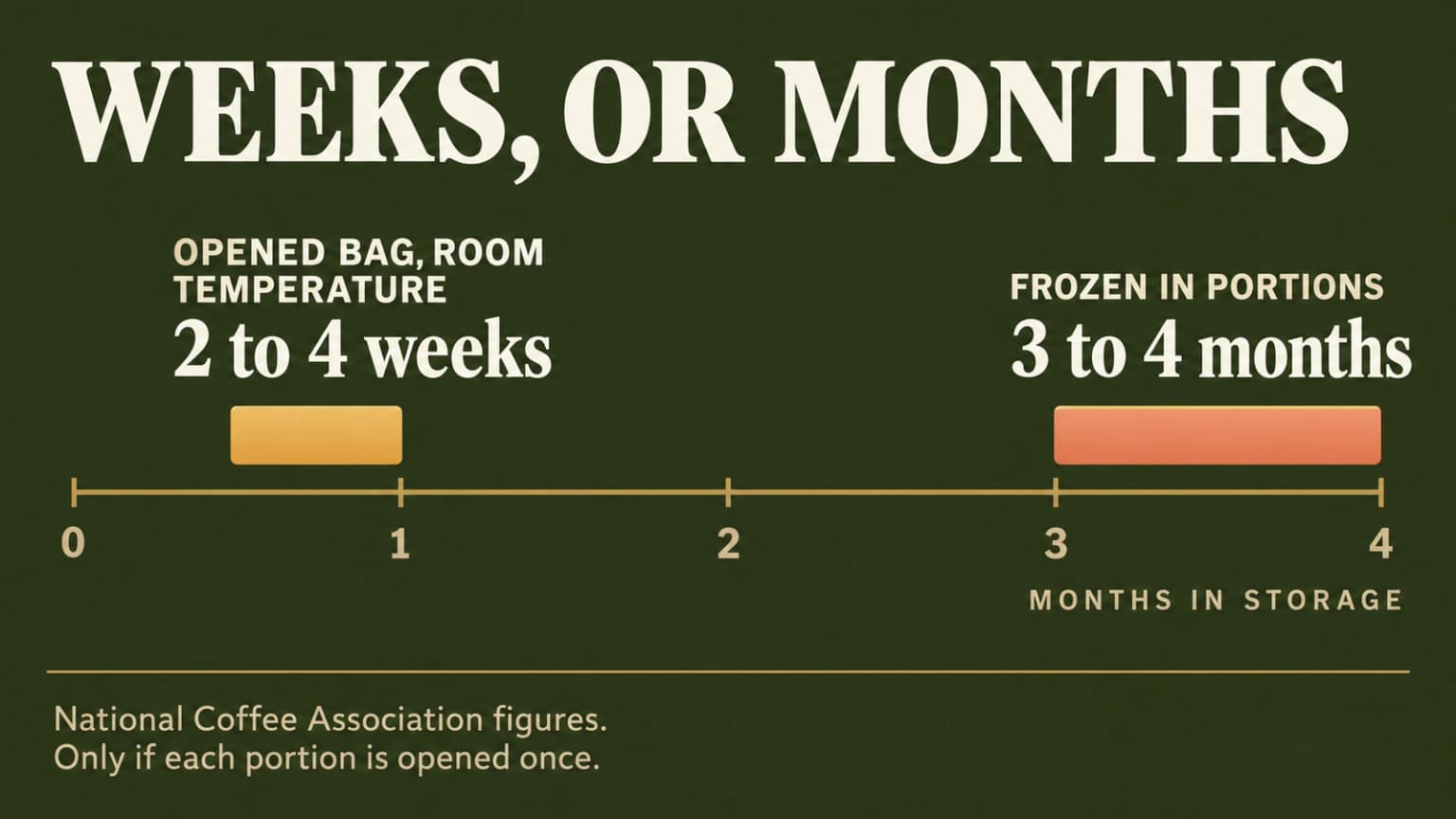
The National Coffee Association puts frozen shelf life at three to four months, against the two to four weeks an opened bag gets at room temperature. Its conditions are a truly airtight container and taking out a week's worth at a time.
The old advice had a real basis. Damage comes from the cycling rather than the cold, because each trip to room temperature condenses moisture onto the beans.
So the protocol that works is portioning, not storage. Split the bag into week-sized sealed portions on the day it arrives, freeze them all, and move one at a time into the tin on your counter.
Frozen portions buy months rather than weeks, but only if each portion is opened once.
There is a bonus that has nothing to do with freshness. A study in Scientific Reports in 2016 found that colder beans grind to a narrower particle size distribution and a smaller mean size, independent of where the beans came from.
A narrower distribution means fewer fines and fewer boulders, which is what you pay for when you upgrade to a benchmark hand grinder. Grinding from frozen is free.
The limits are worth stating plainly. None of the vacuum containers here are designed as freezer vessels, and the Oggi and OXO are too big to portion into.
What works is small sealed bags or jars, one per week, with a container from this page doing the daily work on the counter.
If your bag will be gone in two weeks, skip all of it. The freezer is for the bulk buyer, the decaf drinker and anyone who found a coffee they loved on sale.
What staling really costs you
The cost of storage is not the container. It is the coffee you paid full price for and then drank flat, and the arithmetic here is unusually kind.
A two-cup-a-day household at 15 grams a cup gets through roughly 32 bags of 12 ounces a year, or a little under $600 of coffee at $18 a bag.
Against that number every container here is a rounding error, spanning about 3 to 12 percent of one year's coffee.
Every container, priced in coffee
Every container, priced in coffee
Container
Price
Bags of coffee at $18
Cost per day over 3 years
OXO POP 1.7 qt
$15.95
0.9
1.5 cents
Oggi 62 fl oz
$16.99
0.9
1.6 cents
Coffeevac 1 LB
$18.00
1.0
1.6 cents
Coffee Gator
$21.99
1.2
2.0 cents
Veken with window
$24.99
1.4
2.3 cents
KIVY vacuum
$26.99
1.5
2.5 cents
Fellow Atmos 1.2 L
$39.95
2.2
3.6 cents
Airscape Classic
$44.00
2.4
4.0 cents
Fellow Atmos Electric
$69.95
3.9
6.4 cents
Our arithmetic from the prices we verified, at $18 a 12 ounce bag over 1,095 days. The 1.2 L Atmos is shown for reference and is not one of our eight picks; live prices above are the current numbers.
The last column is the one that matters. Even the electric Fellow costs under seven cents a day across three years, so if a container saves one or two bags a year from being drunk past their best, it has paid for itself and kept paying.
That is a different shape to most coffee purchases, where running costs dwarf the sticker. Here there are no consumables, no filters and no descaling. You buy it once.
It also means the honest ceiling in this category is low, and we would rather say so than manufacture an upgrade path. Nothing above roughly $50 buys more freshness. It buys convenience.
When to buy
Storage containers barely move on price, which makes the timing advice short.
The steel tins in the $16 to $27 band drift by a dollar or two and occasionally carry a percentage-off coupon, which is what the KIVY had when we checked.
Fellow and Planetary Design discount more visibly, and both turn up in the Prime Day and Black Friday cycles. If you want the Airscape or an Atmos, those two windows are where the real reductions land.
There is no reason to wait on anything under $25. At two cents a day, waiting a month for a three dollar saving is a bad trade against a month of flat coffee. The live prices here refresh daily, so the buttons always show the current number.
How to load a canister properly
Coffee bean storage looks like it needs no instruction, and then most people do two things that undo the point of buying a canister: decanting the whole bulk bag, and topping up rather than emptying.
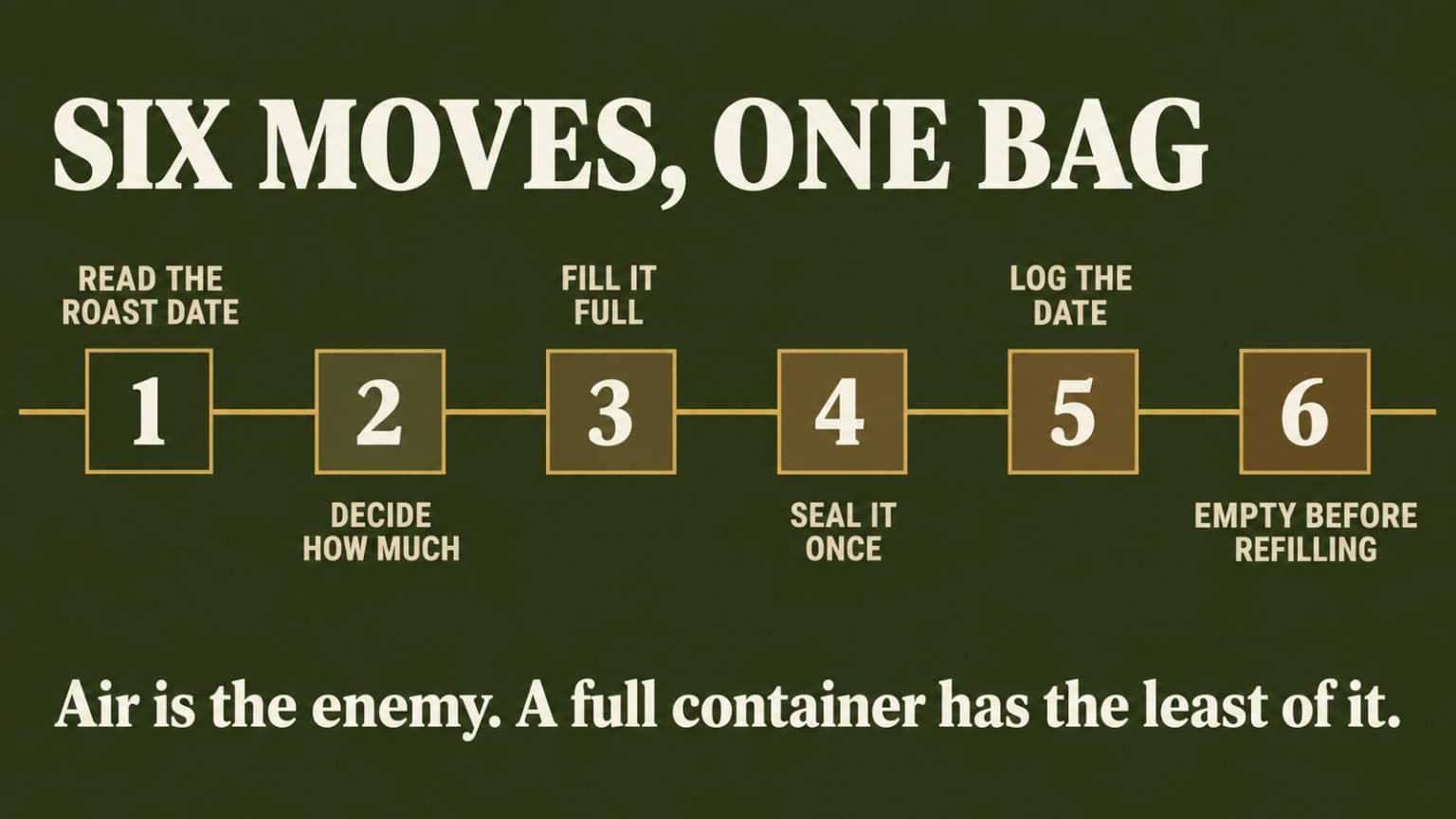
Decant what you will drink, seal it once, and finish it before the next bag goes in.
Filling a container, step by step
1
Read the roast date first
A bag within four days of roast is still off-gassing hard and belongs in a vented container or its own valve bag. Anything three weeks or older is ready for a vacuum.
Tip No roast date on the bag is itself the answer: that coffee is old, and no container will fix it.
2
Decide how much is coming out
Move about ten days of drinking into the container and leave the rest sealed in its bag or frozen in portions. A container you open daily should never hold a month of coffee.
3
Fill it as full as the coffee allows
Take it close to the maker's stated capacity rather than half way. Air is the enemy and a full container has the least of it.
Watch out Do not force beans past a fill line on a vacuum canister. Beans against the intake valve are what stops it sealing.
4
Seal it once and properly
Press, clamp or twist until the seal engages. On a plunger canister, push the inner lid down until air stops escaping through the valve.
Tip Wipe the rim and gasket dry first. One bean fragment on the seal is enough to leave it open.
5
Log the date, then leave it alone
Set the date wheel if the container has one, or write the roast date on tape. Then open it once a day for what you need rather than browsing it.
Tip Vacuum owners add one line: re-twist or re-pump on the maker's own schedule.
6
Empty it before the next bag
Finish what is in there, wipe it out, and only then decant the new bag. Topping up leaves a permanent layer of old coffee at the bottom.
Two of those steps do most of the work. Filling close to capacity is the biggest free reduction in headspace available to you.
Emptying before refilling is the one people resist, because running a container down feels wasteful. The alternative is coffee at the bottom that is two bags behind the coffee on top.
Washing oils out of a canister
Coffee leaves oil behind, and oil goes rancid. A container that is never washed starts flavoring everything you put in it, which is the failure mode owners describe months in rather than weeks.
The good news is that these things need almost nothing: no filters, no consumables, no schedules.
Keeping a container clean
1
Wipe the rim and gasket weekly
A dry cloth around the sealing surface removes the bean dust and oil film that stop a gasket closing cleanly. This is the habit that keeps a seal working.
Tip Do it when you swap bags and it never becomes a task of its own.
2
Wash the body between bags
Warm water, a drop of unscented dish soap, a thorough rinse. Dry it completely before the next coffee goes in, because residual water is worse than residual oil.
Watch out Keep scented soaps away from it. Coffee picks up odors readily, which is the same reason the fridge is a bad idea.
3
Treat the lid mechanism gently
Valve and vacuum lids are the parts that fail. Rinse them, never submerge an electric lid, and keep any valved lid out of the dishwasher.
Tip The OXO POP lid comes apart and is dishwasher safe, a real advantage over sealed mechanisms.
4
Check the seal twice a year
Look at the silicone ring for cracks, flat spots or stretching, and press the lid on to feel whether it still resists. A tired gasket has quietly stopped working.
The pattern in long-term negative reviews here is not broken containers. It is containers whose gaskets were never wiped and whose owners concluded the seal was poor.
A dry cloth once a week is the entire maintenance budget, and it separates three years of service from one. If yours smells stale when empty, that is rancid oil rather than a defect, and a wash brings it back.
Which coffee canister should you buy in 2026?
Buy the Airscape Classic at $44.00 if you want one coffee storage container and no further decisions.
We weighed headspace behavior, seal mechanism, light blocking, published capacity, owner evidence and price, then asked the question that decides it: how long will the coffee sit there?
The three we recommend first
Our pick
Airscape Classic
$44.00
You are
Buying one and stopping
Best at
Shrinking to fit the coffee
Evidence
4.8 stars, 6,250 ratings
Weak spot
Not a true vacuum
Coffee Gator
$21.99
You are
Spending sensibly
Best at
Opaque steel with a vent
Evidence
4.7 stars, 10,171 ratings
Weak spot
Fixed volume, growing air
Fellow Atmos Electric
$69.95
You are
Storing coffee for weeks
Best at
Holding a vacuum unattended
Evidence
4.4 stars, 491 ratings
Weak spot
Too small for a 12 oz bag
The three we recommend first
Specification
Our pick
Airscape Classic
$44.00
Coffee Gator
$21.99
Fellow Atmos Electric
$69.95
You are
Buying one and stopping
Spending sensibly
Storing coffee for weeks
Best at
Shrinking to fit the coffee
Opaque steel with a vent
Holding a vacuum unattended
Evidence
4.8 stars, 6,250 ratings
4.7 stars, 10,171 ratings
4.4 stars, 491 ratings
Weak spot
Not a true vacuum
Fixed volume, growing air
Too small for a 12 oz bag
Whatever you choose, match it to the bag in your kitchen rather than the one in the photograph. The rest of our coffee accessories and tools coverage takes the same line.
A container that fits your actual bag gets filled properly, and filled properly is where every one of these earns its price.
Frequently asked questions
What is the best way to store coffee beans?
Whole beans, in an opaque airtight container, at room temperature, with as little air in the container as you can manage. That is the National Coffee Association's own guidance and it has not changed in years.
The order of the enemies matters. Oxygen does the most damage, then moisture, then heat, then light, which is why a sealed steel tin in a cupboard beats a beautiful glass jar on a sunny counter.
Are coffee storage containers worth it?
They are worth it if you keep coffee longer than about a week after opening, or if you buy in bulk. They are close to pointless if you finish a 12 ounce bag in five days.
An unopened bag with a one-way valve is already a good oxygen barrier. What fails is the fold-over or zip reseal after you open it, and that is the gap a canister closes.
At $16 to $70 once, the whole shelf costs one to four bags of coffee, so the break-even is low.
Should you store coffee in the fridge or the freezer?
Never the fridge. It runs humid, it is full of odors, and every trip in and out lands the beans in a condensation cycle.
The freezer is a different story and the advice has moved. The National Coffee Association puts frozen shelf life at three to four months and says to take out no more than a week's worth at a time, then return the rest before condensation forms.
Freeze in small sealed portions, not in one big jar you open daily.
How long does coffee stay fresh in an airtight container?
Roughly two to four weeks for whole beans after the bag is opened, and days rather than weeks for pre-ground coffee.
A container slows the loss, it does not stop it. Grinding alone releases between 26 and 59 percent of the carbon dioxide still in the beans, and that gas is what holds the aroma in.
The date wheel on a Coffee Gator lid exists because the coffee's age matters more than the tin it sits in.
Is a vacuum canister better than an airtight one?
Only after the coffee has finished off-gassing, which takes one to three weeks depending on the roast. Before that, a vacuum pulls out the carbon dioxide blanket the roaster just paid to create.
Vacuum also asks something of you. Fellow's own instruction for the Atmos is to twist the lid every four to five days, because the seal bleeds down.
For a bag you will finish within two weeks, a plain airtight tin with a vent is the easier and better tool.
Can you store ground coffee in a vacuum canister?
Not in a Fellow Atmos. Fellow states plainly that the Atmos is for whole beans, that fine particles can clog the intake valve and stop it sealing, and that doing it may void the warranty.
Coffeevac, KIVY, OXO and the plain steel tins all take ground coffee without complaint.
If you buy pre-ground, pick a sealed container with the smallest headspace you can find.