Finding the Best Single Dose Coffee Grinder in 2026
We compared eight grinders backed by 4,500+ owner reviews to find the best single dose coffee grinder for 2026, from $80 to $400, espresso to travel.
By the CoffeeGearGuides team · USA · Updated Jul 25, 2026 · 35 min read
On this page20
The best single dose coffee grinder helps keep every measured batch fresh, distinct, and easy to repeat without leaving a hopper full of aging beans.
That promise covers two families. Electric grinders remove the labor, while manual grinders trade a crank for lower noise, simpler mechanics, and excellent burrs at a lower price.
The deeper tension is espresso versus filter. Espresso needs very small adjustment steps; filter coffee rewards clean particle distribution and enough coarse range for immersion brews.
We compared specifications, expert tests, owner discussions, service records, and critical reviews. The final eight for 2026 carry 4,543 Amazon reviews between them at the time of writing.
No grinder here was chosen because a listing called itself "zero retention." We looked at exchanged grounds, static, adjustment, burr character, cleaning, and the routine required to get a repeatable dose.
How we chose these single dose picks for 2026
We are a research-driven site and do not claim hands-on testing. Our about page explains the research method, evidence standards, and limits.
We began with grinders designed for measured doses, then included one clearly labeled hopper conversion where its service network adds real value.
Every Amazon US listing had to show a live price and stock through Amazon's product API. The site owner manually checked each public product page because the API does not provide dependable ratings.
We removed five credible grinders whose exact listings had only 2 to 47 reviews. Thin listings make it too easy for a promising launch to look proven.
The final cut required at least 4.0 stars and a meaningful review history. The ratings range from 4.1 to 4.8 stars, and every number in this guide is the owner's live figure at the time of writing.
We gave extra weight to three-star and measured critical reports. They reveal burr stalls, static, drift, awkward cups, weak magnets, and support problems that five-star summaries often miss.
Expert consensus set the performance floor. Manufacturer manuals and parts pages supplied specifications; coffee publications and long-term owner threads supplied context.
Each pick also had to own one job. We rejected two well-rated Timemore grinders because stronger products already covered their buyer, price, and brew range.
Best single dose coffee grinder types
This is the first fork because it changes price, sound, speed, and failure risk before burr geometry enters the conversation.
A manual coffee grinder places premium burrs and precise adjustment inside a small metal body. Your arm supplies the motor, so more of the purchase price reaches the parts that shape flavor.
The trade is physical. A filter dose is usually easy, but dense light-roast espresso can turn a quiet morning ritual into a demanding minute of cranking.
An electric coffee grinder wins when the household makes several drinks, when grip strength is limited, or when espresso must happen quickly.
Electric models add motor torque, heat, noise, electronics, and a larger chamber. Those parts can improve the routine, but they also create more places for coffee to hide or a machine to fail.
The burrs shape the cup, but the motor choice shapes every morning around it.
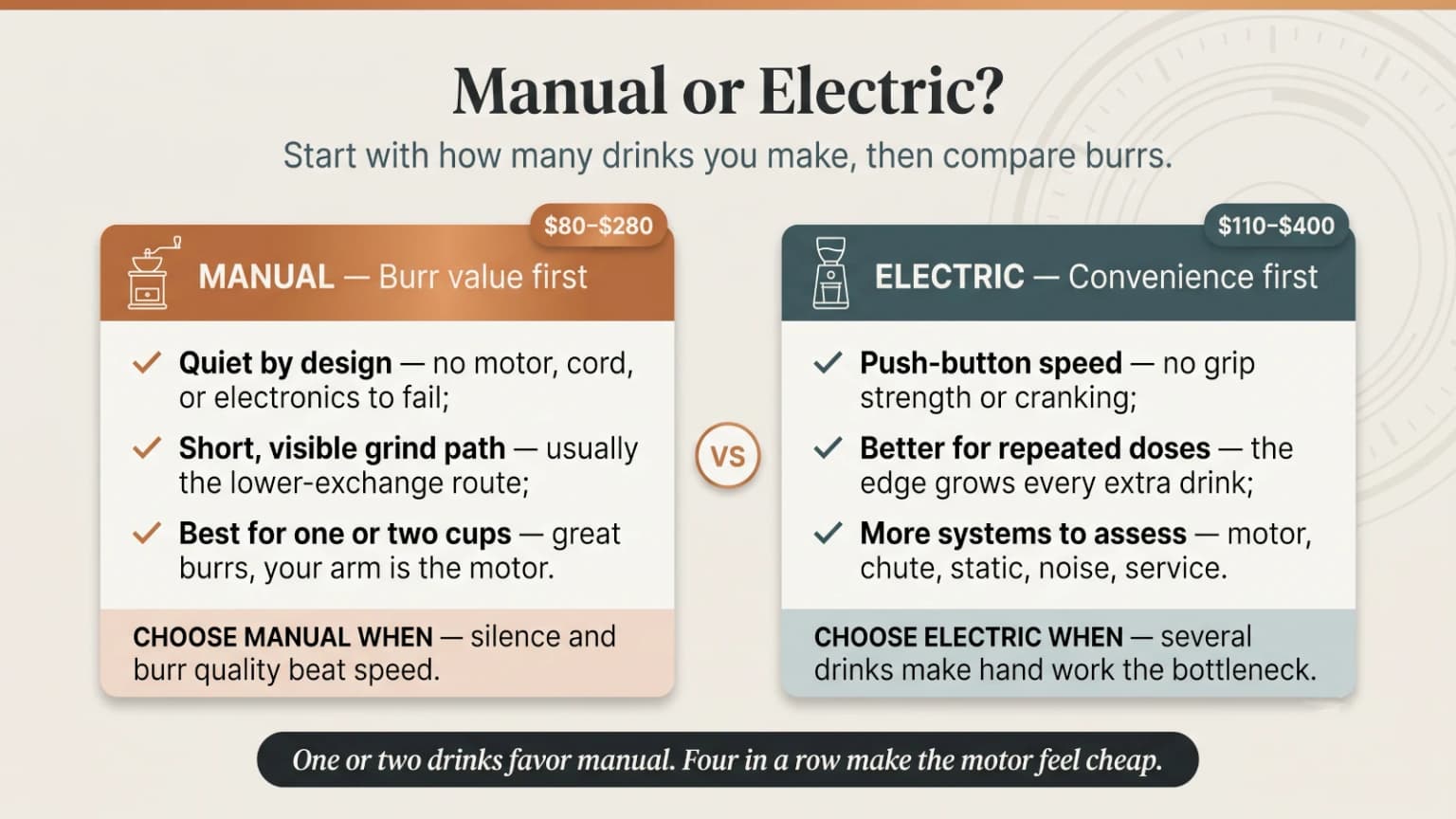
The right answer depends on dose count. One or two drinks favor a manual grinder; four back-to-back drinks make an electric motor feel inexpensive.
Think about switching frequency too. A manual grinder has a short, visible path and no hopper throat, which makes moving from regular beans to decaf almost frictionless.
Electric models can be nearly as clean when designed for the task. Anti-static systems, steep chutes, knockers, and small load bins matter more than a bellows added to a poor chamber.
Manual and electric grinders compared
Manual and electric grinders compared
What matters
Manual
Electric
Typical price here
$80 to $280
$110 to $400
Effort
30 to 90 seconds of cranking
Weigh, load, press
Noise
Conversation friendly
Short motor burst
Dose volume
Best for one or two cups
Better for repeated drinks
Retention path
Short and easy to brush
Longer chamber and chute
Service risk
Bearings and burr wear
Motor and electronics too
The final choice still depends on burrs and adjustment. This table describes the daily ownership difference.
Our default recommendation is simple. Buy manual if the work sounds pleasant or neutral; buy electric if it already sounds like a chore.
Do not expect motivation to grow at 6 a.m. The grinder that gets used correctly every day makes better coffee than the theoretically superior one left in a drawer.
The 8 best single dose coffee grinders
This ranking favors cup quality, honest low-exchange behavior, adjustment, owner confidence, and a clear reason to exist.
The prices were verified through Amazon's API on July 21, 2026. The site's live-price layer can update them, but ratings and review counts remain the owner's figures at the time of writing.
Amazon US ratings and review counts checked by the owner in July 2026. Prices were verified through Amazon's API. Amazon.com prices as of 15/09/2026. Details
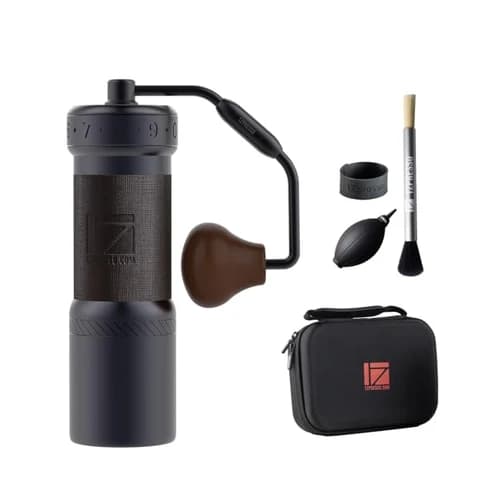
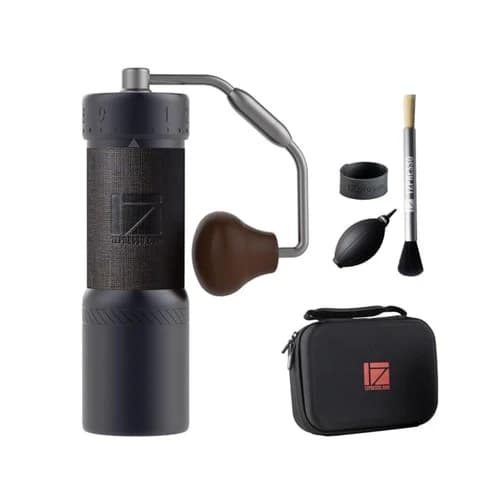
1. 1Zpresso K-Ultra
The K-Ultra takes first place because it can move from a bright V60 to a syrupy espresso without turning either drink into a compromise.
Its external ring offers 100 clicks per rotation at 20 microns each. At the time of writing, 347 Amazon owners rate the K-Ultra model 4.7 stars.
1Zpresso K-Ultra
Rated 4.7 from 347 ratings
A premium all-round hand grinder with an external dial, heptagonal conical burr, magnetic cup, and folding handle.
Key details
Heptagonal conical burr for a broad brew range
External numbered adjustment ring
100 clicks per rotation, 20 microns per click
Magnetic catch cup for quick dosing
Foldable handle and fitted carrying case
Tool-free disassembly with recalibration guide
What we like
Strong balance of clarity, sweetness, and body
Fast changes between espresso and filter settings
Very little chamber space for old grounds
Premium fit without an electric motor to service
Watch out for
Dense light-roast espresso still takes real effort
The positive owner pattern is unusually consistent: the dial is easy to read, grind changes are repeatable, and the magnetic cup keeps the routine quick. Many users stop keeping separate espresso and filter grinders.
Three-star reports focus less on grind quality and more on ergonomics. The body is wide, the textured grip can feel tiring, and hard light-roast beans demand firm control at espresso settings.
The honest weak point is effort, not precision. A fine 18-gram dose can take enough torque that anyone with wrist or grip problems should choose an electric model.
The 20-micron steps are fine enough for most home espresso baskets, although the J-Ultra gives more room between a fast and slow shot. The K burr returns a more open filter cup.
Buy this when one excellent grinder must cover every brewer and one or two doses at a time. It is the best single dose coffee grinder for buyers who value cup quality more than push-button speed.
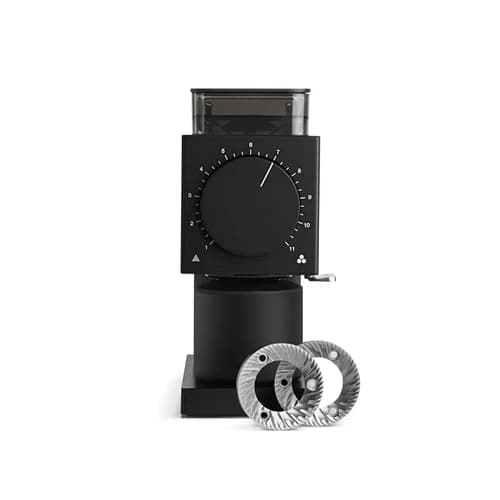
2. Fellow Ode Gen 2
The Ode Gen 2 is the electric choice for pour-over, drip, AeroPress, French press, and cold brew. Fellow explicitly says it is not intended for espresso.
Its 64mm flat burrs offer 31 positions and a 100-gram load bin. The Ode Gen 2 holds 4.1 stars across 824 Amazon reviews at the time of writing.
Fellow Ode Gen 2
Rated 4.1 from 824 ratings
A purpose-built electric brew grinder with 64mm flat burrs, anti-static control, auto stop, a knocker, and a magnetic catch cup.
Happy owners repeatedly mention flavor separation, low noise, and the satisfaction of a cup that snaps into place beneath the chute. Gen 2 also fixes much of the first model's static and overly coarse lower range.
Middle-rating reports reveal that "anti-static" is not "static-proof." Dry winter air, chaff-heavy beans, and a dirty ionizing area can still leave grounds on the chute or counter.
Some critical owners also report stalls with very dense beans or a motor that stops before every fragment clears. Hot starting and feeding light roasts steadily can reduce the load, but the manual should decide the method.
The non-espresso limit is absolute for normal use. Installing different burrs does not make the motor, range, and warranty intent a sensible espresso solution, so pair it with a second grinder if a portafilter is coming.
Buy the Ode when filter coffee is the main event and an electric motor matters. It costs more than the C40 MK4, but it removes hand work and handles batch doses gracefully.
3. 1Zpresso J-Ultra
The J-Ultra is the espresso specialist in this group. Its coated 48mm conical burr and 8-micron adjustment steps make small shot-time corrections easy to repeat.
The J-Ultra model holds about 35 to 40 grams and uses an external dial. At the time of writing, its 370 Amazon reviews average 4.6 stars.
1Zpresso J-Ultra
Rated 4.6 from 370 ratings
An espresso-first hand grinder with an 8-micron external adjustment, coated 48mm burr, folding handle, and magnetic cup.
Owners praise the tiny adjustment steps because espresso rarely lands exactly on a coarse dial mark. One click can make a useful correction without jumping from a thin shot to a stalled basket.
The three-star pattern centers on work and handling. Fine grinding is slower than filter grinding, the wide metal body can challenge smaller hands, and careless users can knock the magnetic cup loose.
Its weakness appears outside espresso. The burr distribution favors sweetness, texture, and fine-particle control, so delicate pour-overs can taste heavier than cups from the K-Ultra, C40, or Ode.
That specialization is a benefit when milk drinks dominate. Extra body carries chocolate and caramel notes through steamed milk, while the 8-micron dial leaves room to tune different baskets and roast ages.
Choose this single dose espresso grinder over the Encore ESP when silence, low exchange, and shot control matter more than physical convenience. Two or three back-to-back drinks favor the motor instead.
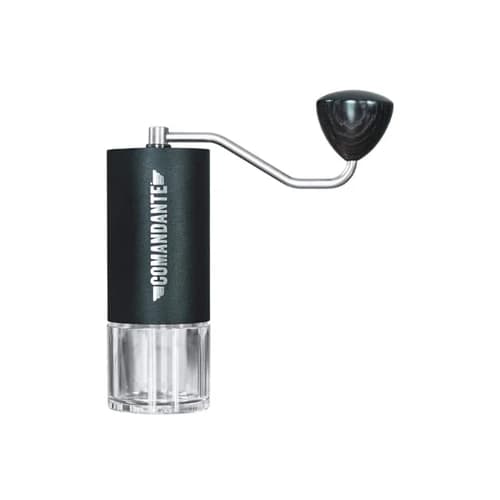
4. Comandante C40 MK4
The C40 MK4 is the established premium filter hand grinder. Its Nitro Blade burr, stainless core, and 40-gram jars favor a careful brew bar over rapid espresso duty.
The Comandante C40 MK4 model earns the highest score here: 4.8 stars from 445 Amazon reviewers at the time of writing. That owner record supports its long-running reputation.
Comandante C40 MK4
Rated 4.8 from 445 ratings
A German-made premium hand grinder with the Nitro Blade burr, internal stepped adjustment, and both glass and polymer catch jars.
Owners value consistency across years, not novelty across weeks. The shared click language also helps: many roasters and recipe writers publish a C40 starting point that gets a new bag close quickly.
Three-star criticism starts beneath the grinder. Changing settings requires removing the catch jar and counting clicks from the closed position, a slower routine than an external numbered ring.
Espresso is possible, but the stock adjustment and burr speed make it a patient exercise. The optional Red Clix system adds finer control, yet it also adds cost to an already expensive hand grinder.
The listing deserves a purchase warning. Amazon's live offer was sold by Fashion House Discount, not Amazon or Comandante, so confirm US warranty coverage and return terms before ordering.
Buy it for pour-over, cupping, and long-term ownership. The K-Ultra is faster to adjust, but the C40 remains compelling for buyers who value its cup profile and repairable simplicity.
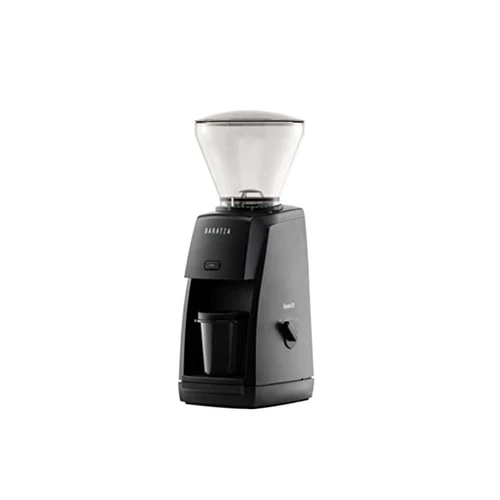
5. Baratza Encore ESP
The Encore ESP is not a purpose-built single-doser, and that distinction matters. It earns a place because Baratza sells a compatible single-dose hopper and makes routine parts easy to reach.
The ZCG495BLK model has 40 settings around a 40mm M2 conical burr. Its 1,317 Amazon reviews average 4.2 stars at the time of writing, the densest electric record here.
Baratza Encore ESP (ZCG495BLK)
Rated 4.2 from 1,317 ratings
A repair-friendly electric all-rounder with a dual-range dial and optional single-dose hopper, included as a conversion rather than a zero-retention design.
Key details
40mm M2 steel conical burr
Settings 1 to 20 give finer espresso steps
Settings 21 to 40 cover filter and immersion
Quick-release cone burr for dry cleaning
Dosing cup with 54mm and 58mm fit
Compatible with Baratza single-dose hopper
What we like
One motor covers espresso and filter coffee
Large owner base exposes long-term faults
Replacement parts and service guides are accessible
Owners like the familiar controls, broad range, and repair path. The upper burr lifts out without tools, and Baratza documents calibration and sells wear parts instead of treating the grinder as disposable.
Three-star reports describe static, clumpy espresso grounds, noise, and dose-to-dose leftovers in the chute. Those complaints align with expert measurements that found more retention than dedicated single-dose machines.
The honest weak point is exchange. A bellows may improve the final scale reading, but compacted grounds around the burr chamber can still mix into the next coffee.
Use the optional hopper, hot start only when Baratza permits it, and add a brief purge after large setting changes. Espresso also benefits from WDT, which breaks clumps before tamping.
Choose this over the T38 Plus for the bigger owner record, parts access, and mixed brew range. Choose a true single-doser when frequent bean switching is the main reason for buying.
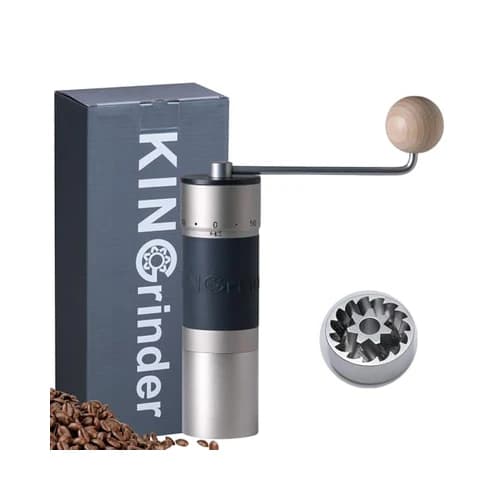
6. KINGrinder K6
The K6 is the value benchmark because its external 16-micron adjustment and metal construction land near premium hand-grinder behavior for $109.
The KINGrinder K6 model holds roughly 25 to 30 grams. At the time of writing, 883 Amazon owners give this listing 4.6 stars, the strongest value evidence in the ranking.
KINGrinder K6
Rated 4.6 from 883 ratings
A metal hand grinder with external 16-micron adjustment, a stainless conical burr, and enough range for espresso through French press.
Owners repeatedly describe the same pleasant surprise: the K6 does not feel like a grinder chosen only to save money. The dial clicks cleanly, the shaft feels stable, and recipes return to their previous mark.
Middle-rating criticism is practical. The screw-on grounds cup takes more time than a magnet, fine coffee can collect on its lip, and careless reattachment can catch the threads at an angle.
Espresso is the harder assignment. The grinder has enough adjustment, but its crank feel and speed are less refined than the J-Ultra when dense beans meet a fine setting.
For AeroPress, moka pot, pour-over, and occasional espresso, those compromises are small. The 16-micron steps also give more espresso control than the pricier K-Ultra, though burr flavor and ergonomics differ.
Buy it when $109 is the real budget, not a temporary stop before a $300 grinder. It is the best single dose coffee grinder value for readers willing to supply the motor themselves.
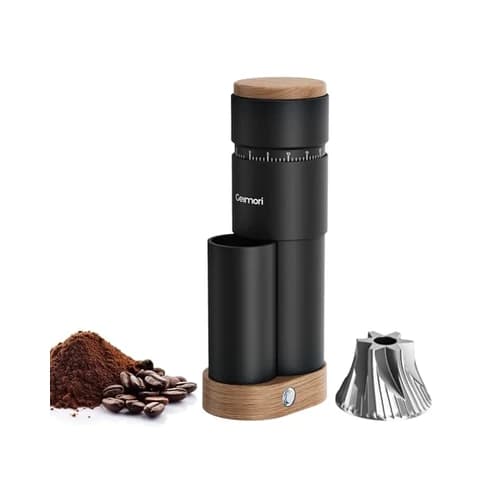
7. Wirsh Geimori T38 Plus
The T38 Plus is the inexpensive electric route to stepless espresso adjustment. It gives small kitchens a metal single-dose body, magnetic cup, and no hand cranking for $110.49.
The Geimori T38 Plus model earns 4.3 stars from 114 Amazon reviewers at the time of writing. That is the smallest review sample here, so we treat its owner score with extra caution.
Wirsh Geimori T38 Plus
Rated 4.3 from 114 ratings
A compact corded single-doser with a 38mm conical burr, continuous adjustment, anti-static design, and a magnetic dosing cup.
Key details
38mm stainless steel conical burr
Continuous collar with 65 marked positions
Plug-in 76W drive rated at 190 RPM
Anti-static exit design
Magnetic auto-aligning dosing cup
30g bean load and 40g dosing cup capacity
What we like
Electric espresso grinding near hand-grinder money
Positive owners value the simple ritual: weigh, load, start, and catch the grounds directly below. The compact vertical path also avoids the sprawling footprint common to budget hopper grinders.
Critical reports point to dial interpretation and occasional collar drift. Continuous adjustment is useful, but it lacks the crisp return points of a click ring when several recipes share the grinder.
Wirsh lists a 76W plug-in drive at 190 RPM for the Plus. That is a clear step above the battery T38, but "portable" means compact here, not cordless.
The honest weak point is evidence depth. A 114-review Amazon sample and limited multiyear service history cannot match the confidence behind Baratza or the established manual designs.
This is for one or two milk drinks a day when a hand grinder is a nonstarter. The small sample keeps it below the K6, but its electric convenience serves a different buyer.
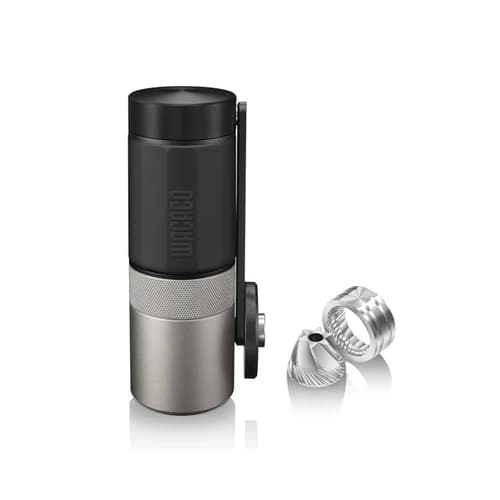
8. Wacaco Exagrind
The Exagrind is built around travel rather than permanent counter use. It is 5.6 inches tall, weighs 464 grams, and fits the dosing workflow of Wacaco's portable espresso makers.
The original Exagrind model holds 20 grams and moves the burr 33 microns per click. Its 243 Amazon reviews average 4.7 stars at the time of writing.
Wacaco Exagrind
Rated 4.7 from 243 ratings
A compact 20-gram travel grinder with 38mm steel burrs, dual bearings, a stowable handle, and direct compatibility with Wacaco brewers.
Owners like the dense feel, smooth bearings, and how neatly the cup transfers into a Picopresso or Nanopresso basket. The grinder is small without feeling like a disposable camping accessory.
Critical reviews identify two repeatable annoyances. Fine grounds cling to the lower chamber, and the handle's magnetic storage position can release when it rubs against other items in a bag.
One controlled review measured 0.5 gram retained from a 20-gram dose before tapping. Knocking the rubberized base reduced that result, but it confirms that manual does not automatically mean zero retention.
The 33-micron steps are broad for demanding unpressurized espresso. They suit Wacaco's intended portable workflow better than repeated micro-adjustments on a high-flow 58mm basket.
Choose it for flights, camping, office drawers, and compact portable brewers. At home, the K6 costs only $29.10 more and offers finer adjustment plus extra capacity.
Burr geometry and adjustment
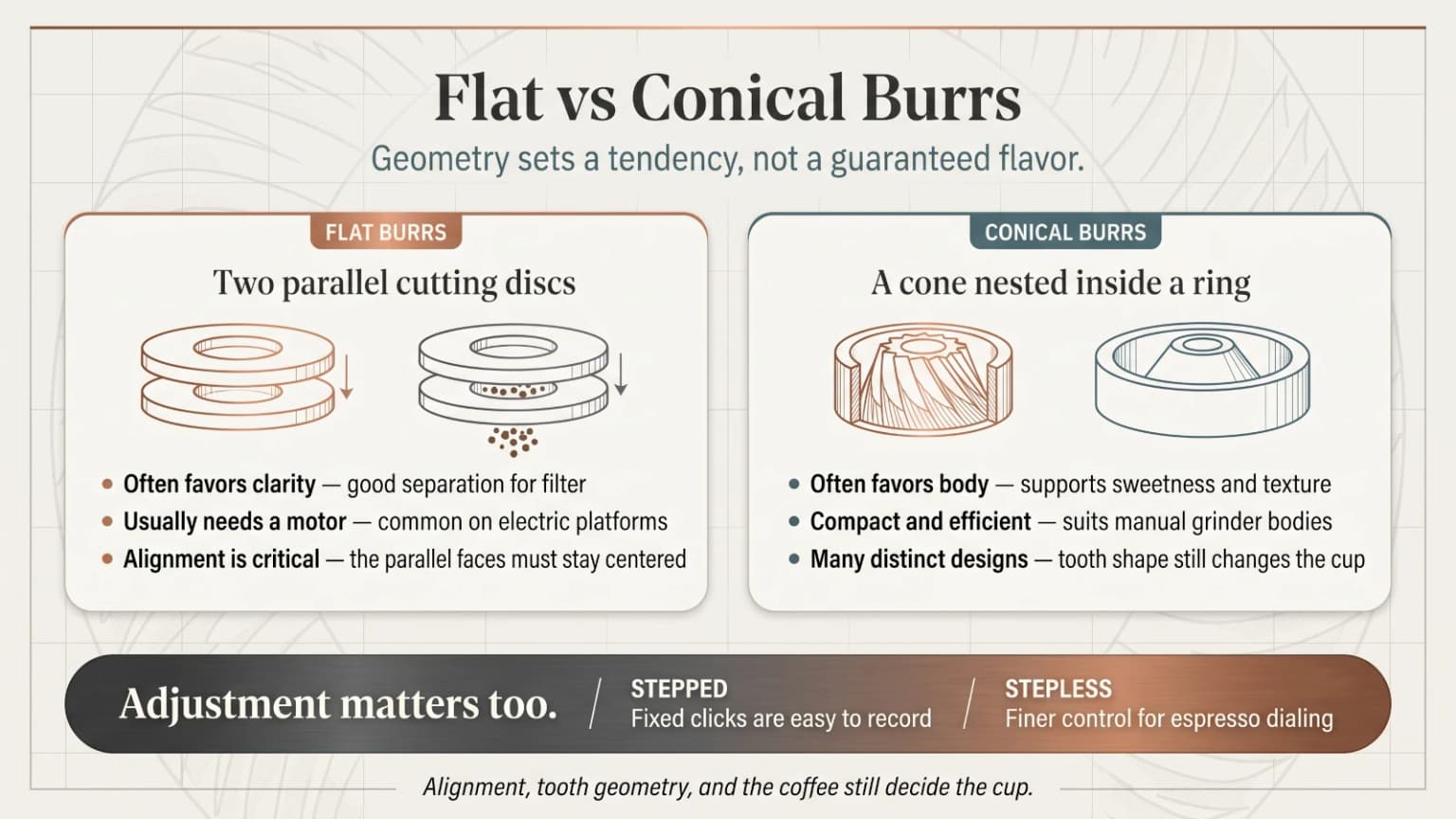
Burr shape influences flavor, but it does not write the whole recipe. Burr alignment, tooth geometry, speed, and the coffee itself can matter as much as the words flat or conical.
Conical burrs feed beans inward through a cone-shaped cutting path. They fit compact bodies, need modest torque, and often produce a mix of particle sizes that supports sweetness and body.
That profile explains their dominance in hand grinders. The K-Ultra, J-Ultra, C40, K6, T38 Plus, Exagrind, and Encore ESP all use conical architectures with very different results.
Flat burrs crush coffee between two parallel discs. A well-aligned set can produce tighter particle groups and clearer separation, which is why the Ode Gen 2 leads our filter picks.
Flat does not automatically mean clearer, and conical does not automatically mean muddy. Burr teeth and alignment decide how a particular grinder expresses acidity, sweetness, and texture.
Burr shape sets tendencies, not guarantees. Adjustment and alignment determine how useful those tendencies become.
Grind settings are easier to compare. A stepped grinder moves between fixed detents, so a setting is easy to record and recover after switching brewers.
A stepless grinder moves continuously. It can land between two stepped settings, which is valuable for espresso, but returning to an old point depends on clear marks and careful hands.
Microns per click describe burr movement, not the diameter of the final coffee particles. The number helps compare adjustment resolution within similar designs, but it is not a grind-size promise.
This distinction matters when marketing presents an 8-micron click as an 8-micron particle change. Coffee fractures irregularly, and one burr movement changes an entire distribution rather than one uniform size.
Burr and adjustment systems
Burr and adjustment systems
Grinder
Burr system
Adjustment
Best fit
K-Ultra
Heptagonal conical
External, 20 microns per click
Espresso through filter
Ode Gen 2
64mm flat steel
31 stepped positions
Filter and immersion
J-Ultra
48mm coated conical
External, 8 microns per click
Espresso
C40 MK4
Nitro Blade conical
Internal stepped dial
Filter and cupping
Encore ESP
40mm M2 conical
40 dual-range steps
Entry espresso and filter
K6
Stainless conical
External, 16 microns per click
All-round value
T38 Plus
38mm conical
Continuous marked collar
Medium-roast espresso
Exagrind
38mm steel conical
33 microns per click
Portable brewing
Manufacturer specifications describe burr movement and settings. Flavor labels reflect the design intent and expert consensus, not a universal rule.
For espresso, the J-Ultra's 8-micron clicks offer the finest repeatable control here. The T38 can move continuously, but its small markings are harder to restore after a large brew-method change.
For mixed brewing, the K-Ultra and K6 balance range with readable external rings. The Encore divides its first 20 settings into smaller espresso steps and reserves 21 through 40 for broader filter changes.
For filter only, burr quality outranks ultra-fine adjustment. Thirty-one Ode positions cover normal brew recipes, while the C40's familiar clicks make published recipes easy to share.
Do not buy extra resolution without a need. A French press does not benefit from hundreds of near-identical fine settings, and espresso does not forgive a coarse dial merely because its burr is expensive.
Retention systems compared
Retention is the category's most abused claim. A manufacturer can weigh 18 grams in and 18 grams out after using bellows, then call the grinder zero retention.
That result says little about what stayed inside before the bellows or which grounds came from yesterday. Three separate ideas produce a more useful picture.
Temporary retention is the difference between input and immediate output. Total retention is all coffee found during a deep clean. Exchange is old coffee displaced by the next dose.
Exchange is the flavor problem. A grinder can return the correct mass while replacing a fraction of the fresh dose with stale grounds from its chamber.
A low-retention grinder should minimize both temporary retention and exchange. Dose consistency matters more than one perfect output.
Manual grinders start with an advantage because the path is short. Coffee falls through the burr and into the cup, with no motor housing or horizontal chute required.
They are not spotless. Fine particles cling below the burr, threaded rims catch dust, and oily beans leave a film that can hold later grounds.
The Exagrind shows the difference clearly. An independent test found 0.5 gram missing from a 20-gram dose before tapping, despite its simple manual path.
Electric designs use several tools. A steep chute lets gravity work, an ionizer reduces static charge, a knocker releases loose grounds, and bellows push air through the chamber.
Each tool has limits. Bellows can blow hidden grounds into the cup, but that output may include old coffee. Ionizers need a clean contact area and can lose effect when residue builds.
Static is related but separate. Static makes light chaff and fines cling to surfaces; physical pockets hold larger grounds even when charge is controlled.
The Ode's anti-static system and knocker make normal filter grinding clean. In very dry air, owner reports still find chaff around the chute, which is a climate effect rather than proof the system never works.
The Encore has the longest and least direct path in this guide. Its optional single-dose hopper improves loading, but it cannot redesign the chamber beneath it.
Our practical test at home is repeatability, even without lab tools. Weigh input and output for five doses, then switch from dark beans to pale beans and inspect the next grounds for obvious color carryover.
Do not chase every tenth of a gram with aggressive knocking. A stable routine that returns within a narrow range is more useful than one perfect result earned by shaking the grinder across the counter.
Noise, fit, and daily workflow
A grinder lives beside the kettle, not on a specification sheet. Its width, height, sound, cup shape, and adjustment access become daily facts after burr excitement fades.
Manual grinders are the quiet choice. Crushing beans still makes sound, but a conversation can continue and a sleeping household is less likely to notice.
The trade moves into your hands. Wider bodies can challenge a small grip, straight cranks need clearance, and fine espresso makes every hard bean noticeable.
The Ode is the largest and heaviest pick here. Its low profile fits under many cabinets, but the cup, power cord, and front dial claim a permanent station rather than a drawer.
The Encore is narrow but tall with its stock hopper. Check overhead clearance before adding beans, and remember that the single-dose accessory changes height without changing chamber retention.
The T38 occupies little counter space and removes hand effort. It still needs its power adapter, so travel use requires reliable outlet access.
Cup design matters more than it appears. Magnetic cups are fast but should be supported with the other hand; threaded cups are secure but can trap fines and cross-thread.
Capacity deserves equal attention. Twenty grams suits most portable espresso recipes, yet it may force two batches for a large French press or strong two-cup pour-over. If the press is your main brewer, our guide to grinders for French press works through that arithmetic by pot size.
Measure the largest dose you actually brew, not the recipe you imagine using. A grinder that needs two loads for every Saturday pot is undersized.
For mixed households, write settings on the coffee bag or a note beside the scale. An external numbered ring makes this easy; an internal click dial demands counting from zero each time.
The case against single dosing
Single dosing is not the correct default for every coffee drinker. It adds weighing, loading, and an empty-hopper ritual to a task that a timed grinder can finish with one press.
If the household uses one medium roast for four lattes every morning, a filled hopper and repeatable timer may be faster. Grind-by-weight can be faster still while keeping dose variance low.
The freshness argument also gets overstated. A hopper exposed to light and warm air is poor storage, but a small daily quantity does not become stale the instant it leaves its bag.
The best storage remains the original sealed bag or an airtight coffee container in a cool cabinet. Single dosing helps because most beans stay there, not because the load bin grants special protection.
The routine can encourage unhelpful obsession. Weighing every speck twice and pumping bellows until no dust appears may add stress without producing a detectable cup difference.
Bean switching has a hidden cost too. Every new coffee needs a grind setting and recipe, so the freedom to rotate bags can create more dial-in waste than leaving one reliable coffee in a hopper.
Electric single-dosers also ask the motor to start and stop for every dose. A machine designed around that cycle handles it; a converted hopper grinder may not gain the same chamber geometry or workflow.
Manual options avoid the motor question but charge in time. Hand grinding one espresso can feel satisfying, while six drinks for guests can make the same tool feel badly chosen.
The enthusiast objection is therefore partly right. A dedicated single-doser optimizes control and bean switching, but a quality hopper grinder can serve a predictable household better.
Choose single dosing when changing beans, tracking recipes, or keeping decaf separate solves a real problem. Skip it when speed and one dependable house coffee matter more than experimentation.
What single dosing really costs
The grinder price is most of the bill, but it is not the whole setup. Accurate dosing needs a scale that reads at least 0.1 gram, plus a dry brush for routine cleaning.
Espresso users often add a WDT tool and may need a cup or funnel that fits the portafilter. Filter brewers can spend the same money on a better scale with a timer.
RDT needs only a tiny spray bottle or a wet spoon handle. Do not buy an elaborate device before seeing whether the grinder creates a static problem in your climate.
Replacement burrs are a long-term concern, not a yearly consumable for normal home volume. Motor brushes, bearings, and electronics are more model-specific, so parts access has value even when no failure is expected.
A scale and sensible workflow matter. Most extra accessories can wait until a real problem appears.
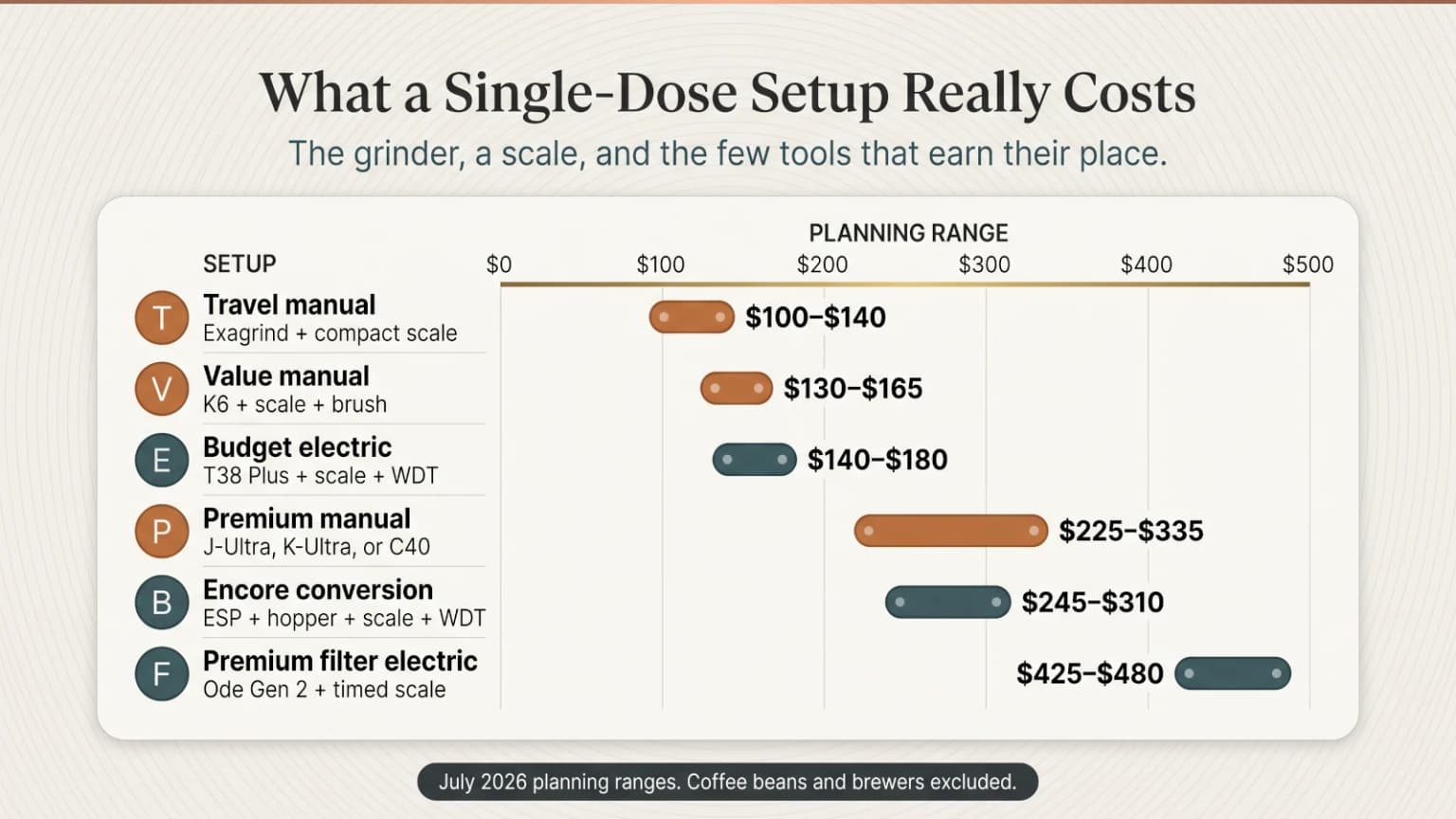
The table below is a planning range, not a shopping cart. Accessory quality and sale prices move, while the grinder prices reflect our verified Amazon offers.
Realistic single-dose setup costs
Realistic single-dose setup costs
Setup
Grinder price
Useful extras
Planning total
Value manual, K6
$109
Scale and brush
$130 to $165
Travel manual, Exagrind
$79.90
Compact scale
$100 to $140
Premium manual
$199 to $279.51
Scale, optional espresso tools
$225 to $335
Budget electric, T38
$110.49
Scale and WDT tool
$140 to $180
Encore conversion
$199.95
Single-dose hopper, scale, WDT
$245 to $310
Ode filter station
$399.95
Timed scale and brush
$425 to $480
Broad July 2026 planning ranges. They exclude beans and brewers because those costs do not belong to the grinder alone.
Manual ownership is inexpensive after purchase. Brushes and bearings may eventually need attention, but there is no motor, power board, or anti-static system to replace.
Electric ownership buys time. The value is largest in homes making several drinks, because every saved minute repeats across hundreds of mornings.
Coffee waste can outweigh accessories. Purging one gram twice a day uses more than 700 grams a year, so low exchange can save a meaningful portion of a specialty coffee subscription.
Do not turn that observation into false precision. Retention varies with roast, humidity, grind size, cleaning, and technique, so annual savings are personal rather than guaranteed.
When to buy
Manual grinder prices tend to move less than mainstream appliances. A fair in-stock offer from the brand or an authorized seller is often more valuable than waiting months for a small discount.
Electric grinders see more Prime Day and Black Friday movement. Fellow and Baratza also run direct promotions, so compare warranty terms rather than treating Amazon's lowest number as the only number.
The Comandante listing is the exception that deserves special care. Its current merchant is a third party, and a discount is not useful if it removes manufacturer support.
Buy when the chosen grinder solves today's brew problem and the return policy is clear. The live buttons can show current prices, while this ranking should not change because of a brief coupon.
How to single-dose accurately
A precise grinder can still produce inconsistent coffee when the loading routine changes every morning. The cure is a short sequence that controls dose, setting, and the way beans reach the burr.
Hot starting means turning an electric grinder on before beans enter. It can reduce the initial load on some motors, but it is suitable only when the manufacturer permits it.
RDT reduces static with one tiny droplet of water. It is optional, climate-dependent, and never a reason to put visibly wet beans near steel burrs.
Control the dose and setting first. Add tapping, RDT, or purging only when the grinder gives you evidence they are needed.
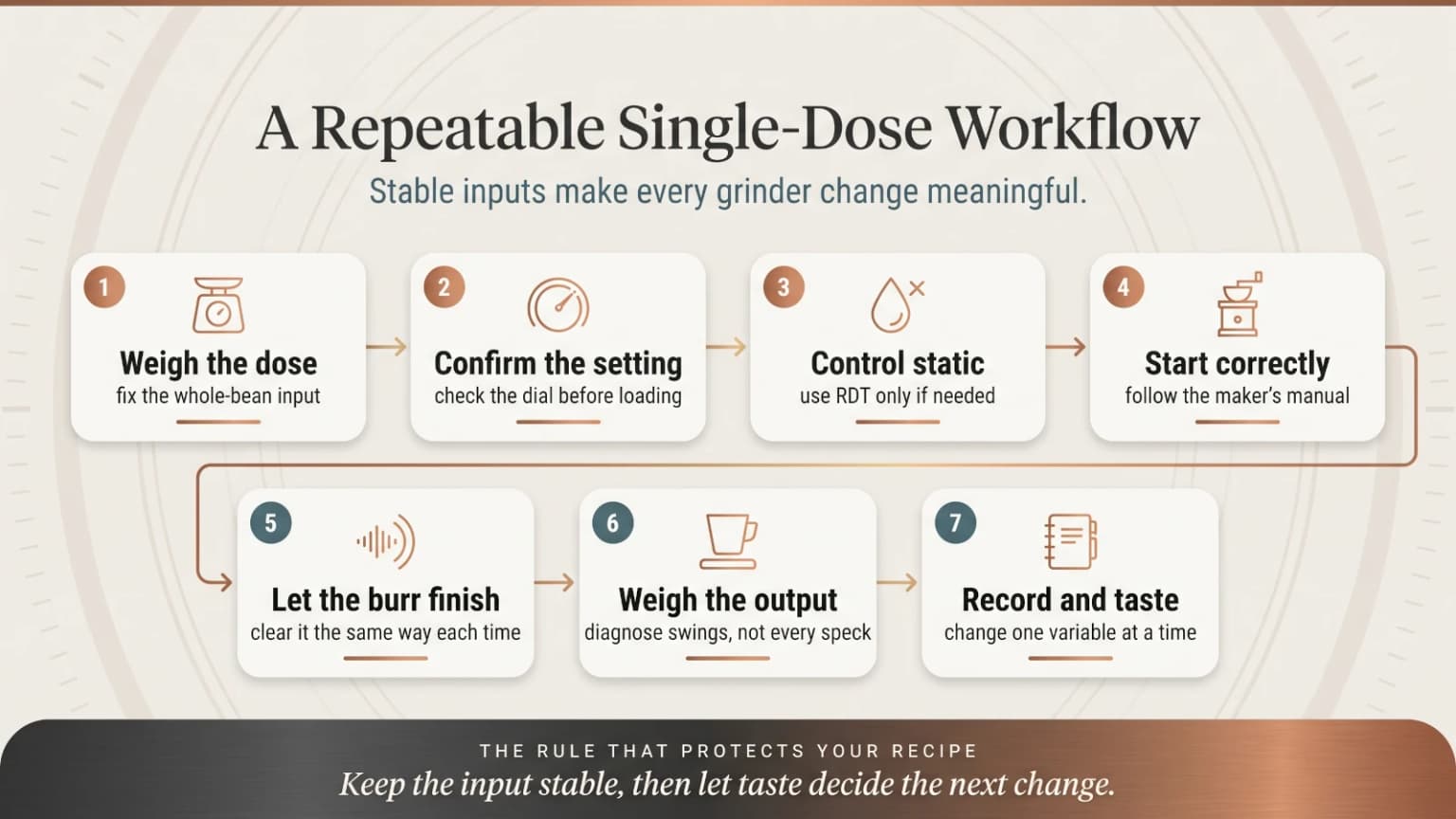
A repeatable single-dose workflow
1
Weigh the dose before touching the grinder
Weigh the whole coffee beans on a 0.1-gram scale and choose the dose from the brew recipe. Keep it fixed while adjusting grind size.
Tip Store the rest of the beans sealed and away from heat. The empty hopper is only part of the freshness benefit.
2
Confirm the recorded grind setting
Check the dial before loading beans. If changing methods, move to the saved number and clear any grounds caught near the exit.
3
Use RDT only when static requires it
Add one tiny droplet or fine mist, then shake the beans so no wet patch remains. Skip this step when dry grinding stays clean.
Watch out Follow manufacturer guidance. Excess water can damage steel parts, encourage buildup, or affect warranty coverage.
4
Start the grinder as its manual directs
Hot start only when permitted; otherwise load first and start normally. Hand grinders simply need the lid and cup secured before cranking.
5
Feed steadily and let the burr finish
Do not force dense beans into a small electric motor. Wait for the sound to fall before using a knocker, bellows, or gentle tap.
6
Weigh output for diagnosis, not ceremony
Check the first few doses and after cleaning. A stable small difference matters less than a result that swings from one grind to the next.
7
Record the recipe and taste
Write down coffee, dose, setting, water, time, and result. Change grind size before changing several variables at once.
Tip Espresso running fast usually needs a finer setting. A stalled or harsh shot usually needs a coarser one.
For espresso, weigh the liquid yield as well as the dry dose. A grinder setting earns its place only when the shot reaches the target ratio and tastes balanced.
For pour-over, record drawdown as a clue rather than a command. Excess fines can slow a brew, but pouring, filter paper, and agitation also change the clock.
When switching from a dark roast to a delicate light roast, inspect the first output. A short sacrificial purge may protect flavor better than pretending every chamber is exchange-free.
Consistency should simplify coffee, not turn breakfast into laboratory work. Once five doses behave the same way, stop weighing output daily and keep the input routine stable.
Maintenance for low exchange
Coffee oils and fines build slowly, then appear as stale flavor, wandering output, or a chute that suddenly clogs. A dry maintenance rhythm prevents most of that trouble.
Never rinse a burr assembly unless the manufacturer explicitly instructs it. Steel, bearings, motors, and trapped moisture are a costly combination.
The grinder maintenance rhythm
1
After each session: clear loose grounds
Use the built-in knocker, one gentle tap, or the normal hand-grinder finish. Wipe the cup rim so yesterday's fines do not enter tomorrow's dose.
2
Weekly: brush the exit path
Unplug electric grinders first. Brush the chute, cup, and visible burr area with a dry grinder brush, following the manual for safe access.
Tip Clean anti-static contacts carefully. A coating of coffee dust can make an ionizer appear ineffective.
3
Monthly: inspect the burr chamber
Open only the parts designed for user access. Remove compacted grounds, check seals and threads, then reassemble in the documented order.
4
After reassembly: verify calibration
External zero points can shift when a hand grinder is rebuilt. Follow the maker's calibration steps instead of forcing the burrs tightly together.
Watch out Do not overtighten a dial at zero. Burr lock and thread damage are not calibration methods.
5
When changing very different beans: inspect
Oily dark roasts leave more film, while pale dry beans create more chaff. Adjust cleaning frequency to evidence inside the grinder.
6
Yearly: review wear and support options
Listen for new scraping, check handle play, and inspect cables on electric units. Contact the manufacturer before a small issue damages other parts.
Grinder-cleaning pellets can help some electric models, but approval is model-specific. Never substitute rice, which can stress a motor and leave starch inside the chamber.
Hand grinder owners should keep track of washers and bearing orientation during disassembly. A phone photo at each layer is better insurance than memory.
Clean more often after oily beans or flavored coffee. Added flavoring can persist in burr surfaces and exchange into several later doses, which defeats the reason for single dosing.
The goal is not a burr that looks unused. It is a stable, dry path that does not carry stale flavor forward and returns to the same setting after service.
Which grinder should you buy in 2026?
The best single dose coffee grinder is the one that matches the drink, dose count, and amount of labor the household will accept.
We scored the eight on burr performance, adjustment, exchange risk, owner confidence, workflow, repair path, and value. The top three each win a different brew brief.
The three we recommend first
Our pick
1Zpresso K-Ultra
$259.00
You brew
Espresso and filter
Best at
One-grinder versatility
Workflow
Manual, external dial
Weak spot
Light-roast hand effort
Fellow Ode Gen 2
$399.95
You brew
Filter and immersion
Best at
Electric filter clarity
Workflow
Auto stop and knocker
Weak spot
No espresso range
1Zpresso J-Ultra
$199.00
You brew
Espresso first
Best at
Fine shot adjustment
Workflow
Manual, 8-micron clicks
Weak spot
Heavier filter profile
The three we recommend first
Specification
Our pick
1Zpresso K-Ultra
$259.00
Fellow Ode Gen 2
$399.95
1Zpresso J-Ultra
$199.00
You brew
Espresso and filter
Filter and immersion
Espresso first
Best at
One-grinder versatility
Electric filter clarity
Fine shot adjustment
Workflow
Manual, external dial
Auto stop and knocker
Manual, 8-micron clicks
Weak spot
Light-roast hand effort
No espresso range
Heavier filter profile
For more researched picks, browse the coffee grinder section. Start with the brewer you use most, then choose the grinder that serves it without an imagined upgrade path.
A good grinder makes freshly ground coffee easier to repeat. That reliable routine is more valuable than a longer feature list or a retention claim measured under ideal conditions.
Frequently asked questions
Is a single dose coffee grinder worth it?
Yes, if you switch beans, keep decaf beside regular coffee, or want every recipe measured by weight. Single dosing keeps the hopper empty and makes those changes easy.
It is less useful when one household finishes the same bag every week. A timed or grind-by-weight hopper grinder can be faster for repeated drinks.
The real benefit is control, not a magical improvement in burr quality. A good single-doser still needs accurate adjustment and an orderly exit path.
Which burr type is best for single dosing?
Conical burrs usually favor body, sweetness, compact size, and lower motor demands. They are common in hand grinders and espresso-focused electric models.
Flat burrs often give clearer flavor separation and suit filter coffee especially well. Their wider chambers can retain more grounds unless the grinder manages the exit path carefully.
Neither shape wins every cup. Choose the flavor profile and brew range first, then judge alignment, adjustment, and retention.
Can you single dose a hopper grinder?
You can weigh one dose and feed it through most hopper grinders, but the result may include grounds left from the previous batch. That exchanged coffee matters more than a simple input-output test suggests.
A short purge, bellows, or purpose-built single-dose hopper can reduce the problem. These are workarounds, not proof that the original chamber has zero retention.
The Baratza in this guide is the honest example. It supports a single-dose hopper, yet its chamber holds more coffee than the dedicated designs.
Is single dosing better for espresso or pour-over?
It helps both, but for different reasons. Espresso benefits from dose accuracy and tiny grind corrections, while pour-over drinkers gain an easy way to rotate coffees and recipes.
Espresso also exposes retained grounds more quickly because a fraction of a gram can change shot flow. Filter recipes are more forgiving, but stale exchange can still blur delicate beans.
The best grinder depends on the drink. Fine adjustment matters most for espresso, while burr flavor and coarse-range uniformity matter more for filter.
How do you reduce coffee grinder retention?
Start the motor before adding beans when the manufacturer permits it, then let the grinder finish before using its knocker or bellows. A light tap can free coffee from the chute.
A tiny mist of water can reduce static, but keep water away from burrs and electronics. Use only one small droplet for a normal dose and follow the grinder maker's guidance.
Brush the chute and burr chamber on schedule. Old compacted grounds create more exchange than the loose dust visible in a catch cup.
Should you spray beans before single dosing?
The Ross Droplet Technique, or RDT, uses a very small amount of water to reduce static. It can make dry-climate grinding noticeably cleaner.
More water is not better. Damp beans can encourage buildup, corrosion, or warranty disputes, so use a fine mist only when the manufacturer allows it.
Grinders with active anti-static systems may need no water at all. Try the grinder dry before adding another step to the routine.