Stop the Brew, Keep the Heat: 7 Insulated French Presses for 2026
Insulation keeps coffee hot and keeps it brewing. We read 387,000+ owner ratings to rank 7 insulated French presses for 2026, $27.99 to $144.99.
By the CoffeeGearGuides team · USA · Updated Sep 10, 2026 · 35 min read
On this page20
The best insulated French press solves the problem every glass press has, and creates a quieter one that almost nobody writing about this category mentions.
An insulated French press is the same immersion brewer you already know, built with a double wall or vacuum insulated stainless steel body in place of the glass beaker.
Steel holds the heat. That is the whole pitch, printed on every box: hot for an hour, hot for two hours, hot for four.
Here is what those boxes leave out. Pressing the plunger does not end the brew, it only pushes the grounds to the bottom, and the coffee resting on top of them keeps extracting.
In a glass press the pot cools and that second brew slows down on its own. In a vacuum insulated press nothing slows down at all, which is why the last cup out of a thermal press so often tastes like a different drink.
We spent the past few weeks reading listings, maker specifications, independent sediment tests and more than 387,000 owner ratings across the category.
This 2026 guide covers the seven presses worth buying, the two that are actually built to end the brew, and the one habit that fixes the rest.
How we chose these insulated presses for 2026
We research rather than test, and we think saying so plainly is worth more than a photograph of a kitchen. You can read exactly how we work on our about page.
For this guide we compared maker specifications and listing copy line by line, read independent sediment and heat comparisons, and worked through the full spread of Amazon owner reviews.
We paid the most attention to three star reviews. That is where owners describe a real flaw without either rage or a honeymoon.
Three rules shaped the list. Every press had to be in stock on Amazon US with a live price and a dense review base, checked the day we published.
Every press had to clear 4.0 stars with a review base deep enough to mean something. Eleven carried ratings we could read, and one fell there: a well-known outdoor brand with only eighteen ratings behind its press.
And every press had to earn its slot from a different buyer. Three more were cut for duplicating a press already on the list without beating it, because an eighth entry that repeats the second helps nobody.
Prices were verified through Amazon at publication and they move. The buttons show the live figure.
Will you drink it now or over an hour?
Answer that honestly, because it decides which press you need. Drink the pot within twenty minutes and any decent mesh filter will serve you well.
Come back to it over the next hour and you want an insulated French press whose filter seals the grounds off, not simply a wall that holds heat.
Every press here keeps coffee hotter than glass does. The difference is what that heat is doing while the coffee waits.
Choosing the wrong side is why thermal French presses collect so many reviews about bitterness.
If you press and pour straight into mugs, insulation is a comfort. It keeps the second cup as hot as the first and stops the pot going lukewarm while you find the milk.
If you come back to the pot across the morning, insulation is the entire purchase, and it works against you without one of two fixes.
Insulation keeps the brew hot after plunging. Decanting or a sealing filter separates the drink from the grounds.
The first fix is free and takes four seconds: decant. Pour whatever you are not drinking now into a warmed carafe, a flask or a second mug, and the grounds stop mattering.
The second fix is a filter that traps the grounds instead of resting on them, which is what the ESPRO P7 basket is for.
That is what the top of this market is really selling you, even though the box prefers to talk about hours.
Two ways people drink a pot
Two ways people drink a pot
What matters to you
Poured within minutes
Sipped over an hour
What insulation buys
A hot second cup
The whole reason to buy
Filter you need
Any decent mesh
One that seals the bed
What ruins the pot
Grinding too fine
Leaving it on the grounds
Where the coffee goes
Straight into mugs
A warmed second vessel
Presses that suit
Secura, Bodum, Stanley
ESPRO P7, YETI Rambler
Typical spend
$28 to $100
$110 to $145
Most households do both across a week. Buy for the morning you have most often, not the one you imagine.
The 7 best insulated French presses
Seven presses, ranked by how well each one handles the whole life of a brew rather than the first four minutes of it. Prices run from $27.99 to $144.99.
At a glance
Best insulated French presses, compared
1
Editor's choice
ESPRO P7 32 oz
Best for The cleanest cup, and a real stop to the brew
Ratings and review counts recorded on Amazon US at the time of writing. Prices move; use the buttons for the live number. Amazon.com prices as of 15/09/2026. Details
1. ESPRO P7 32 oz
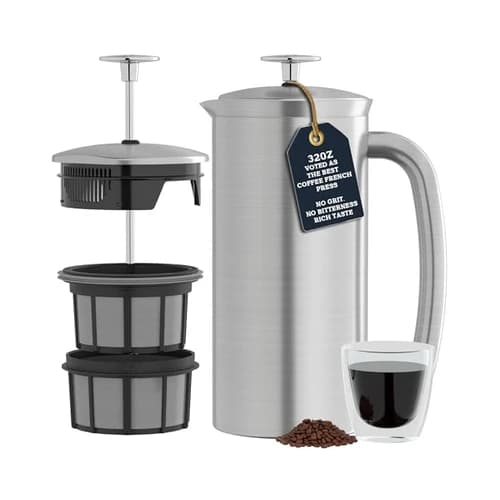
The ESPRO P7 is the only press in this guide whose filter is a container rather than a screen. Two micro-filter baskets nest inside each other and seal against the wall of the pot as you press.
That single design decision changes what a French press is. The grounds finish the brew locked inside the basket instead of sitting under the coffee, so the drink you pour twenty minutes later is the drink you made.
ESPRO P7 French Press, 32 oz, Brushed Stainless Steel
Rated 4.4 from 1,891 ratings
A vacuum insulated steel press built around a sealing double micro-filter basket, which ends the extraction at the plunge instead of slowing it down.
Key details
Two nested micro-filter baskets that seal to the wall
Mesh that ESPRO rates far finer than a standard press screen
Ten paper micro-filters included for a near pour-over cup
Double wall vacuum insulated stainless steel body
32 oz brew capacity, roughly four cups
Also sold as an 18 oz press for one or two cups
What we like
The cleanest cup any press in this guide produces
Extraction stops when you press, not when the pot cools
The paper option gets close to a filter brew from a press
Vacuum wall holds temperature through a long pour
Watch out for
Needs a large fill, so it is poor at a single mug
The filter assembly is the fiddliest here to clean
Owner reviews of the P7 divide cleanly along one line. People who came from a glass press describe the cup as unrecognizably clean, with almost none of the silt a mesh screen leaves in the bottom of a mug.
People who bought it for one person describe a different experience. The basket has to be submerged to work, so a small brew leaves the filter sitting above the coffee and the press behaves like an ordinary one.
The three star reviews are consistent about the second real flaw, which is cleanup. The lid, the outer basket and the inner basket all come apart, and residue in the seal is what causes the flow complaints that appear later in the review history.
The honest weak point is price. $144.99 buys a press, and the same money buys a very good single dose grinder, which changes more about your coffee than any filter does.
We would still start here. The P7 is the only press on this page that makes the twenty minute question stop mattering, and that is the question this whole category is quietly failing.
2. Secura 34 oz French Press
The Secura looks, on the evidence, like the most widely owned insulated press in the United States. It carries 363,003 owner ratings at 4.7 stars, which is more owner evidence than every other press in this guide put together.
At $27.99 it is also the cheapest way to stop breaking glass beakers. The body is 18/8 304 stainless steel inside and out, and the box includes two spare screens.
Secura 34 oz Stainless Steel Insulated French Press
Rated 4.7 from 363,003 ratings
The most heavily reviewed insulated press on Amazon US, built from 304 stainless inside and out, with a three-layer screen stack and two spare screens in the box.
Key details
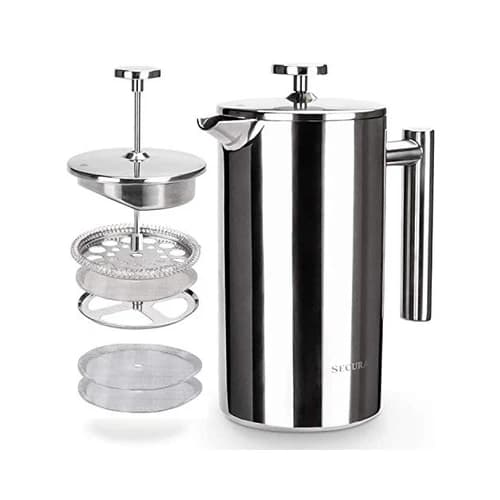
18/8 304 stainless steel inner and outer walls
Three-layer stainless screen stack in the plunger
Two spare screen sets supplied
34 oz capacity, about four cups
Cool touch handle and knob
Filter screen disassembles for cleaning
What we like
The deepest owner evidence of any press here, by a wide margin
Costs less than a set of spare filters for some rivals
Spare screens included, so the first wear item is already covered
Light enough to carry and cheap enough not to worry about
Watch out for
Double wall only, with no vacuum claim from Secura
A three-layer mesh still passes noticeable sediment
Nothing about the filter ends the brew when you press
With that many reviews the pattern is unusually reliable. Owners describe a press that does what it says for years and is replaced through loss rather than failure.
The complaints are equally consistent and they are all about heat. Secura's own copy claims 60 minutes, the shortest number anyone here publishes.
That is the honest signature of a double wall press with no vacuum between the layers.
Sediment is the other recurring note. Three layers of mesh is more than most presses carry, and it is still mesh, so a grinder that produces a lot of fines will show up in the cup.
The fix for that sits upstream, not in the plunger. A burr grinder set up for coarse work removes sediment that no screen in this guide can catch.
The real catch is that this press needs the decanting habit more than any other here. It holds enough heat to keep extracting and not enough to be a flask, which is the worst of both.
Buy it if you press and pour. At $27.99 it is the best value on this page and it is not close.
3. YETI Rambler 34 oz
The YETI Rambler is the other press built to end the brew, and YETI is unusually direct about it. Its listing states that the GroundsControl filter separates grounds from the brew and stops the brewing process.
That filter is a solid disc rather than a screen. Instead of straining coffee through a mesh, it pushes the bed to the base and closes over it.
YETI Rambler 34 oz French Press Coffee Maker
Rated 4.4 from 1,110 ratings
A vacuum insulated press with a solid GroundsControl filter that YETI states stops the brewing process, wrapped in the toughest body in this guide.
Key details
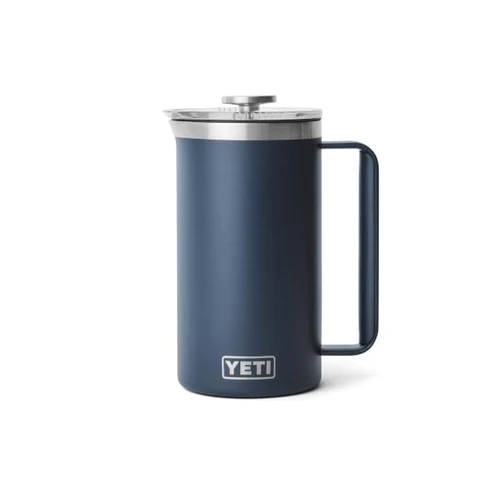
Solid GroundsControl filter that closes over the grounds
Double wall vacuum insulation
18/8 kitchen grade stainless steel body
Dishwasher safe, including the plunger
Rust and puncture resistant by design
34 oz capacity, about four cups
What we like
One of only two presses here designed to stop extraction
The toughest body in this guide by a long way
Dishwasher safe, which most sealing filters are not
Holds temperature across several pours
Watch out for
The plunge takes noticeably more effort than a mesh press
Some owners report the plunger stopping short of the base
Owners describe the plunge as the first surprise. A solid filter has to displace liquid rather than let it through, so the push is slower and heavier than any mesh press, and owners say it loosens with use.
The recurring three star complaint is that the plunger sometimes stops before the base, leaving a wet layer of grounds and a little liquid behind it. It is a small waste rather than a fault, and it matters more on a small brew than a full one.
Cleaning is where this press quietly wins. Sealing filters usually mean hand washing, and YETI puts the whole thing in the dishwasher, though rinsing the silicone by hand is the safer habit.
The fair question at $110.00 is what you are actually buying. Some of that is the filter and a lot of it is the body, which is built for a truck bed rather than a counter.
Buy it if the press travels. For a kitchen that never moves, the ESPRO P7 filters better for $35 more.
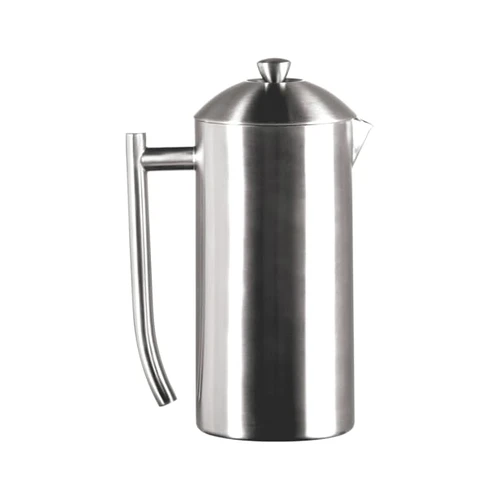
4. Frieling 36 oz Coffee Press
The Frieling is the press for people who want a clean cup without a sealing basket in the way. Its patented two-stage dual screen is the most effective conventional filter in this guide.
It is also the one press here with no plastic anywhere in the brew path. The body, the plunger, the screens and the frame are all stainless steel.
Frieling Double-Walled Stainless Steel French Press, 36 oz
Rated 4.4 from 3,511 ratings
A vacuum insulated press with a patented two-stage dual screen and no plastic in the brew path, built to a standard nothing else here matches.
Key details
Patented two-stage dual screen filter
Double wall vacuum insulated stainless steel
No plastic anywhere in the brew path
36 oz capacity, about four and a half cups
Brushed and polished finishes available
Doubles as a loose leaf tea press
What we like
The cleanest cup of any conventional mesh press here
Nothing plastic touches the coffee at any point
Built to outlast every other press in this guide
Wide mouth makes the grounds easy to clear out
Watch out for
Press slowly or coffee escapes past the spout
The lid does not seal, so it is not a flask
Premium money for a press that still needs decanting
The dual screen is the reason people keep these for decades. Two stages of filtration catch a great deal of what a single mesh passes, and owners moving from a Bodum describe the difference immediately.
The recurring complaint follows directly from that fit. Reviewers report that the screen sits tightly enough in the body for a fast press to send coffee out through the spout.
That is a technique problem rather than a defect. Slow the plunge to fifteen or twenty seconds and it goes away, which is good practice on any press and mandatory on this one.
The one thing it does not do is seal. Frieling holds heat well while the coffee sits, but it is not a thermos, and it still needs the same decanting habit as the cheaper presses.
Buy it if you plan to own one press for the rest of your life. Nothing else on this page is built to that standard.
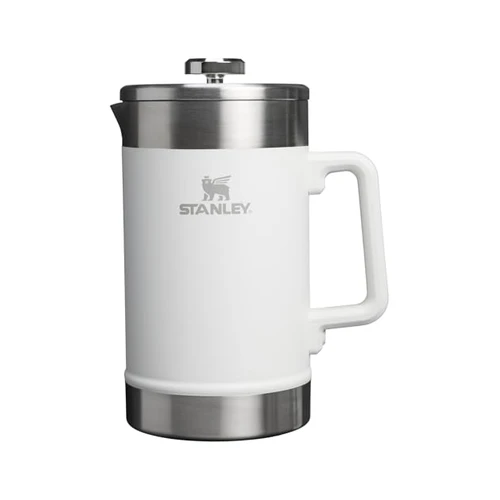
5. Stanley Classic Stay-Hot 48 oz
The Stanley Classic Stay-Hot carries the boldest heat claim in this guide: five minute brew, four hours hot. Two layers of 18/8 stainless with a vacuum between them make that plausible.
It is also the big pot of this group. At 48 oz it fills roughly six mugs, which suits a work crew, a campsite or a household that wakes up in shifts.
Stanley Classic Stay-Hot French Press, 48 oz
Rated 4.4 from 6,637 ratings
A double vacuum insulated 48 oz press from the brand that built the category of things that stay hot, with the longest heat claim on this page.
Key details
48 oz capacity, roughly six mugs
Double vacuum insulated 18/8 stainless walls
Mesh filter screen with a plunge-through plunger
BPA-free throughout
Dishwasher safe body and plunger
Stanley claims a five minute brew and four hours hot
What we like
The strongest heat retention claim of any press here
A genuinely large pot at a mid-range price
Built to the same standard as Stanley vacuum flasks
Replacement screens are cheap and widely stocked
Watch out for
Nothing stops the brew, and four hours of heat magnifies that
Owner reviews read like reviews of a Stanley flask, which is to say they are about survival. Dropped, frozen, left in a vehicle, and still working several years later.
The bitterness complaints are the interesting part of the review history, and they cluster exactly where this guide predicts. People who brew 48 oz, drink two mugs and come back at hour three are drinking something that brewed for three hours.
That is not a fault in the press, it is the press doing precisely what the box promises. A simple mesh screen and four hours of retained heat is the sharpest version of the trade this whole category makes.
The awkward part right now is stock. The black finish is unavailable and only the brighter colorways are buyable, which matters on a $70.00 object that lives on a counter.
Buy it if you need volume and heat, and you will pour the pot out into flasks or mugs. Buy something else if you plan to sip from it all morning.
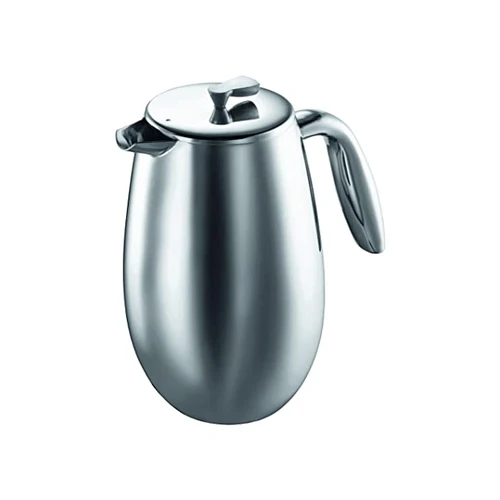
6. Bodum Columbia 34 oz
The Bodum Columbia is the shape everyone pictures when they hear French press, executed in double wall steel. It has been on the market long enough to outlive several of its rivals.
Its plunger is the notable part. A silicone edge rides against the wall instead of bare mesh, which scrapes the sides more completely than a plain screen does.
Bodum Columbia 34 oz Thermal French Press, Chrome
Rated 4.5 from 4,281 ratings
The classic Bodum silhouette in double wall stainless steel, with a silicone-edged plunger that clears the wall, at a price well below the premium tier.
Key details
Double wall stainless steel body
Silicone-edged mesh plunger
Bodum claims up to two hours of heat
34 oz capacity, about four cups
Cool touch handle
Also offered in a 51 oz size
What we like
The most familiar press to use, with no learning curve
Silicone edge clears the wall better than bare mesh
A Bodum you are not going to break
Sensible price for a name with real history
Watch out for
Reviewers who weigh sediment find more solids through it
Bodum claims up to two hours of heat, which sits sensibly between Secura at one hour and Stanley at four, and matches what a good double wall without a vacuum should manage.
Sediment is the recurring criticism from people who measure it. Reviewers who weigh what comes through report more solids from this plunger than from the dual screen presses, which is the trade for a filter designed to be simple.
The other pattern in the review history is the lid. Several owners report the assembly loosening or failing after repeated dishwasher cycles, which is worth knowing before you make it a habit.
The honest problem is that this press does nothing better than the alternatives around it. The Secura costs less and holds similar heat, and the Frieling filters far better.
Buy it if you want the Bodum shape and the Bodum feel in a body that survives a tiled floor. That is a real reason and this is the press that serves it.
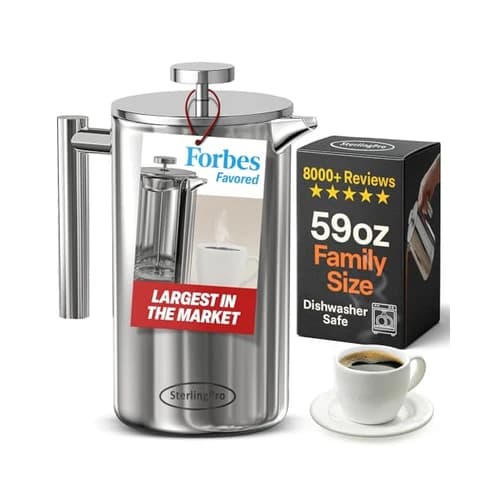
7. SterlingPro XXL 64 oz
The SterlingPro XXL exists for one situation: a table of people who all want coffee at the same time. At 64 oz it is the largest press here by a wide margin.
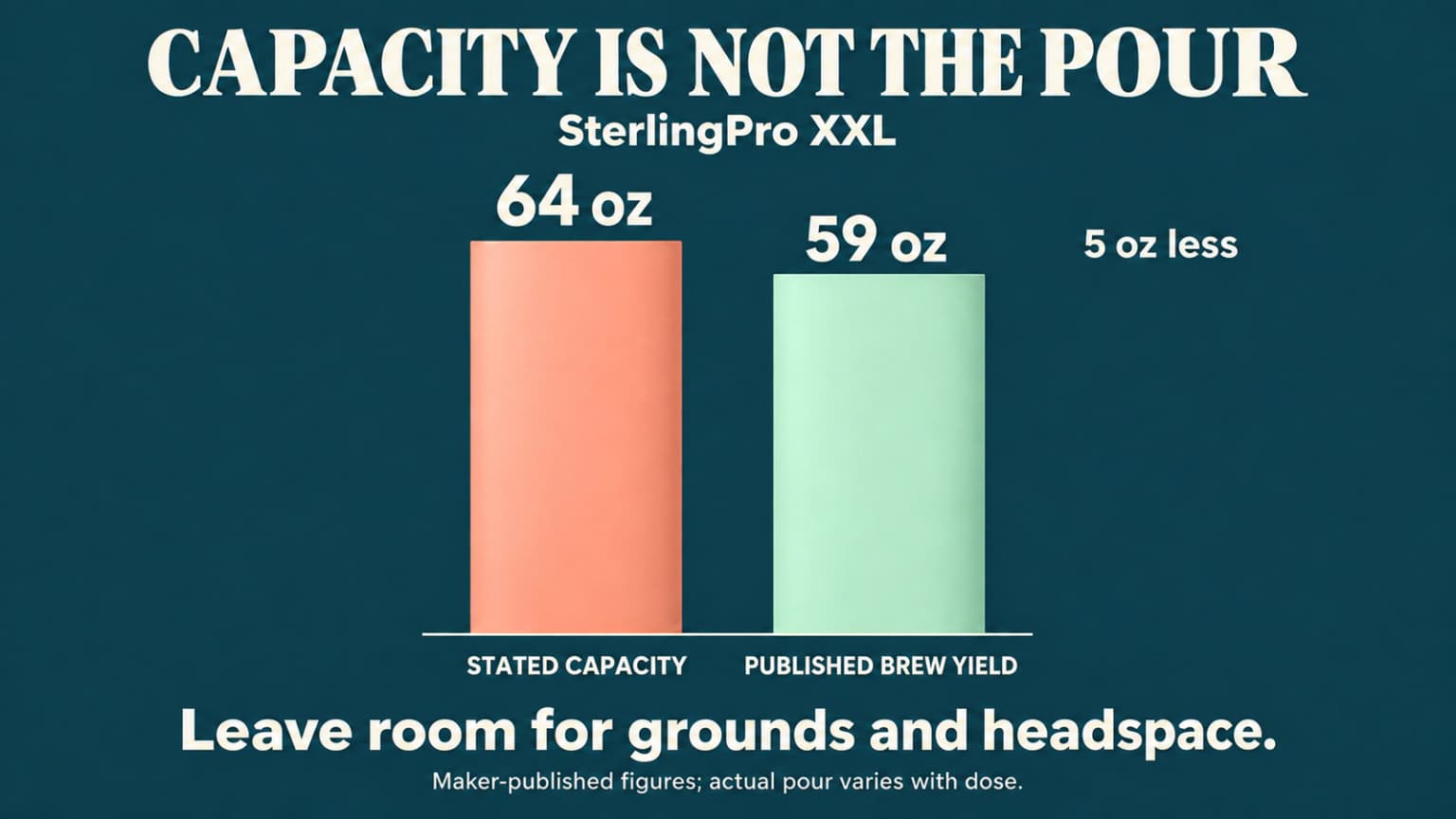
It is also the only press in this guide that publishes what it actually pours. SterlingPro states 64 oz of capacity and a 59 oz brew yield, which is a level of honesty nobody else in the category offers.
SterlingPro XXL 64 oz Insulated Stainless Steel French Press
Rated 4.6 from 7,165 ratings
A half gallon double wall press with a dual screen filter and a published brew yield, built for a full table rather than a single morning cup.
Key details
64 oz stated capacity with a published 59 oz brew yield
Dual filter system for a large bed of grounds
Double wall stainless steel construction
Plastic free brew path
Mirror polished exterior
Roughly eight mugs from one brew
What we like
The only press here that serves a whole table at once
Publishes its real brew yield, which almost nobody does
Dual screens cut sediment against a single mesh
Strong owner evidence at 4.6 stars across 7,165 ratings
Watch out for
Far too large for one or two people
Double wall without a vacuum claim from SterlingPro
A full brew has to be decanted or it will over-extract
Owners buy this for holidays, offices and large families, and the reviews reflect that. It gets used hard a few times a month rather than every morning.
The dual screen is a genuine step above the single mesh presses, and at this volume it matters more than usual, because a large bed of grounds gives fines more chances to escape.
The honest weak point is arithmetic. Nobody drinks 59 oz of coffee inside twenty minutes, so a full SterlingPro brew is guaranteed to sit on its grounds unless you pour the whole thing out.
That makes it the press on this page where the decanting habit is not optional advice, it is the operating instruction. Brew it, press it, empty it into flasks, and it is excellent.
Buy it if you regularly brew for five or more. For anything smaller, a 34 oz press brewed twice tastes better and washes up faster.
The filter decides, not the vacuum wall
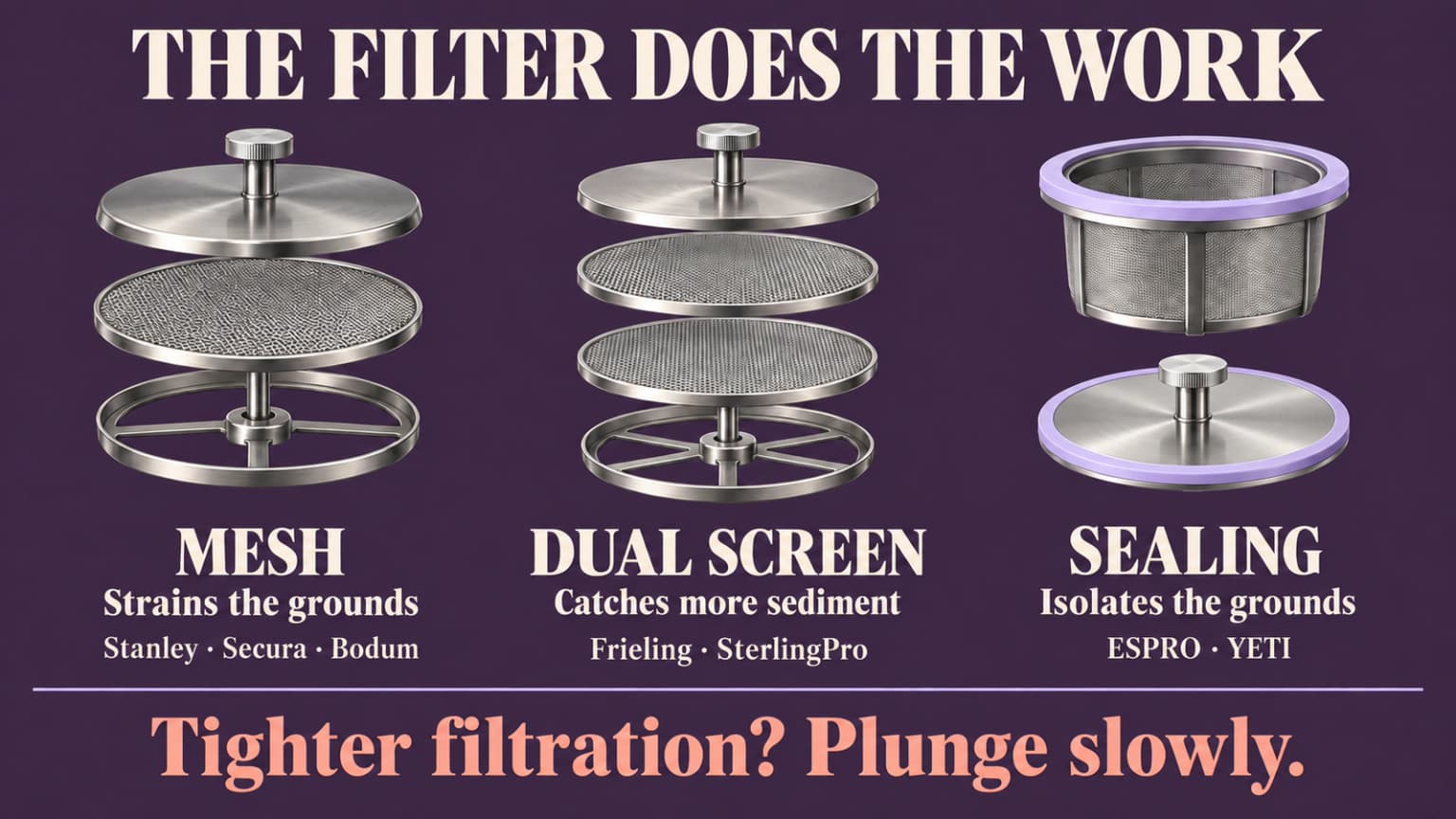
The filter on the end of the plunger decides whether an insulated French press improves your coffee. The vacuum insulated wall only decides how long the pot stays hot.
A press is an immersion brewer, so the cup rests entirely on when the coffee and the grounds stop touching. Everything the box advertises sits on the outside of the pot.
A conventional French press filter is a strainer. It lets liquid through and holds most of the grounds back.
That is all it was ever designed to do, and it leaves those grounds sitting submerged in the coffee.
A sealing filter is a lid. It closes over the coffee bed or traps it inside a basket, which takes the grounds out of contact with the drink.
Schematic filter families; assemblies vary by model. Tighter filtration calls for a slow, deliberate plunge.
That resistance is not a side effect, it is the mechanism. Anything that blocks fine particles also blocks liquid, so a filter that cleans the cup makes the plunger harder to push.
Which is why plunge technique changes from press to press. A tight mesh sends coffee past the seal if you rush it, and a solid filter simply refuses to move at speed.
What sits between you and the grounds
What sits between you and the grounds
Press
Filter stack
Ends the brew?
ESPRO P7
Two nested micro-filter baskets plus a lid screen
Yes, the basket seals to the wall
YETI Rambler
One solid GroundsControl disc
Yes, YETI states it stops brewing
Frieling
Patented two-stage dual screen
No, it strains rather than seals
SterlingPro XXL
Dual screen system
No
Secura
Three-layer screen stack, two spares
No
Bodum Columbia
Silicone-edged mesh plunger
No
Stanley Stay-Hot
Single mesh screen
No
Filter descriptions taken from each maker's own listing copy at the time of writing. Only two makers claim anything about ending extraction.
Notice what that table does to the price ladder. The two presses that end the brew are the first and third most expensive here, and neither one advertises that as its headline feature.
None of this rescues a bad grind. A press has no paper between the coffee and the cup, which is why a grinder chosen for French press does more for sediment than any filter here.
Three ways a press ends the brew
There are exactly three: cooling, separation and sealing. Every press ever sold leans on one of them, and naming them makes the category legible.
The first is cooling, which is what a glass press does. Extraction slows as the pot loses temperature, so a glass beaker on a cold counter reaches a rough kind of stability within fifteen minutes.
A vacuum insulated wall removes that mechanism entirely. That is the sentence the marketing on these boxes never gets around to writing.
The second is separation, which is you, pouring the coffee somewhere else. It is free, it works with every press ever made, and it takes about four seconds.
The third is sealing, which is what the ESPRO basket and the YETI disc do mechanically. It is the only one of the three that survives you forgetting about the pot.
Most buyers of an insulated press unknowingly remove the first mechanism, never adopt the second, and did not pay for the third.
That combination produces most of the bitterness complaints in this category. It is textbook over-extraction, and a brew that ran too long ranks second in our nine causes of bitter coffee.
The fix costs nothing. Pick the second mechanism or the third, deliberately, before you buy.
Stated capacity is not what you pour
Press capacities are measured to the brim of an empty pot, which is not a state any press is ever in. By the time there is coffee, water, a plunger and a headspace, the number on the box has stopped describing the object.
The gap is bigger than people expect, and every press loses volume for a slightly different reason.
SterlingPro publishes a 64 oz capacity and 59 oz brew yield. Actual poured volume also depends on the dose and water retained by the grounds.
Grounds are the first deduction. Sixty grams of coffee absorbs roughly twice its own weight in water, so a 34 oz press gives back noticeably less than 34 oz of drink.
Then there is the cup count, which quietly does the same thing. Bodum counts a cup as 4 oz, so a 51 oz press is advertised as twelve cups and a 64 oz SterlingPro as sixteen.
What the number on the box is measuring
What the number on the box is measuring
Press
Stated
What limits the pour
ESPRO P7
32 oz
Needs a deep fill or the basket sits above the coffee
Secura
34 oz
Grounds and headspace take their share
YETI Rambler
34 oz
Owners report the plunger stopping short of the base
Frieling
36 oz
Press quickly and some of it leaves by the spout
Bodum Columbia
34 oz
Its own listing bullets claim 1.5 L and twelve cups
Stanley Stay-Hot
48 oz
A full pot needs two hands to pour steadily
SterlingPro XXL
64 oz
SterlingPro publishes a 59 oz brew yield
Stated capacities are the makers' own figures. Where a listing contradicts itself, as the Bodum one does, we have used the figure in the product title.
The practical rule is to buy one size larger than the volume you want. A 34 oz press is a comfortable two-mug press, not a four-mug press, whatever the cup count says.
The exception runs the other way. The ESPRO P7 has a minimum useful fill as well as a maximum, so buying it too large is a real mistake rather than a harmless one.
What a steel body hides from you
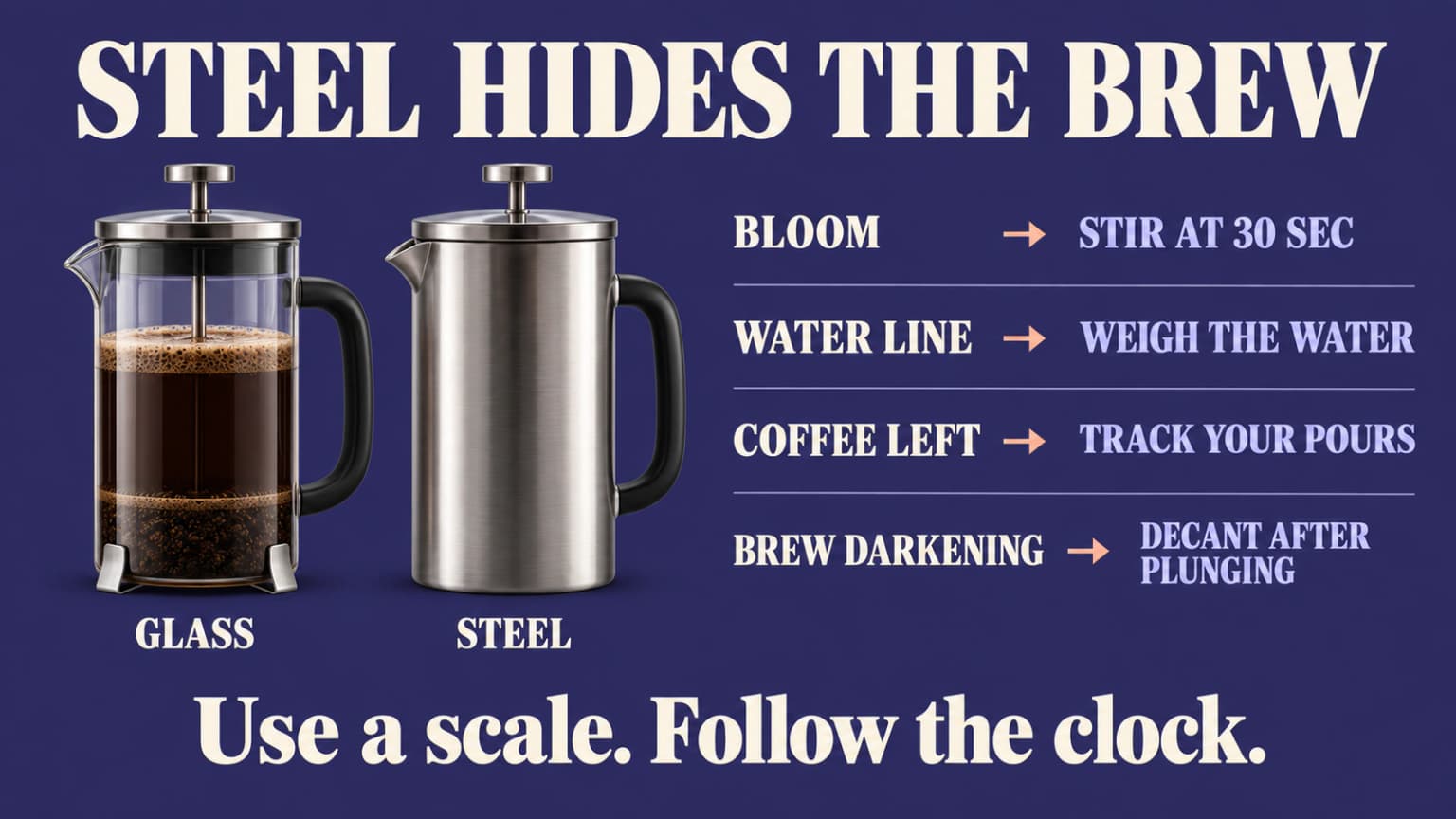
Every French press technique ever written assumes you can see through the pot. Watch the bloom, judge the crust, check the water line, see how much is left.
A steel press deletes all four. It is the least discussed consequence of switching from glass and the one that changes your routine most.
An opaque body hides the brew. A scale, timed stirring and a decanting habit replace the visual cues.
The bloom goes first. In glass you watch the bed swell and know the coffee is fresh; in steel you set a timer for thirty seconds and stir on the clock instead.
The water line goes next, and it is the one that costs people the most. Without a line to pour to, dose and water drift apart from one brew to the next, which is exactly the variable that makes coffee taste different every morning.
Put the press on a kitchen scale and pour to a weight. It replaces the missing water line completely and it is the single habit that makes a steel press repeatable.
The third cue is the remaining volume. Steel presses are heavy when empty, so hefting the pot tells you very little, and running out mid-pour is normal for the first week.
The fourth is the strangest. You cannot see the coffee darkening after the plunge, so the visual reminder that something is still happening in there never arrives.
The case against an insulated French press
The specialty coffee argument against this whole category is coherent, and it deserves stating properly rather than waving away.
It runs like this. The correct way to make press coffee is to brew it, press it, and immediately pour all of it into a warmed serving vessel, and a press that does that job needs no insulation at all.
By that logic an insulated press is a solution to a problem created by bad technique. Spend the money on a grinder, keep a $30 glass press, and decant into a flask you already own.
There is a third route that argument never mentions. If you want hot coffee with no technique at all, an SCA certified coffee maker brews into a thermal carafe and decants for you.
We think this argument is right about the coffee and wrong about people. The decanting step is a habit, and the review histories of these presses are a long record of people not forming it.
There is a second objection worth taking seriously. Steel hides the brew, and for someone learning to make coffee, watching it happen is genuinely useful feedback that glass gives you for free.
And a third, which is that most of the money in this category buys wall construction rather than filtration. That is the wrong end of the object to spend on, and it is why our top pick is the press with the best filter rather than the best thermos.
What a press costs you over ten years
Almost nothing beyond the press itself, plus roughly $10 of replacement screens. A French press takes no pods, no paper, no descaling schedule and nothing you have to rebuy monthly.
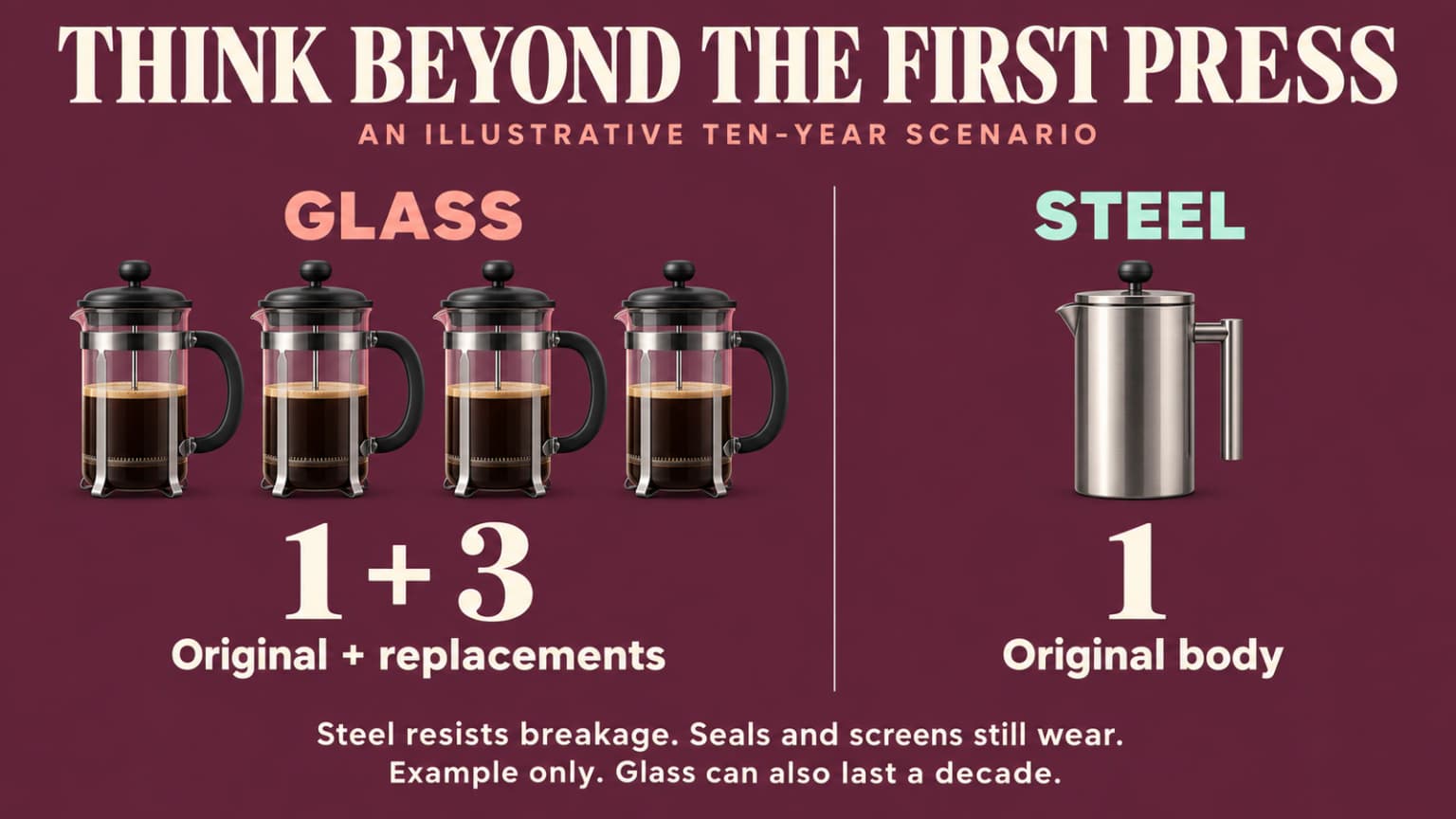
The real spending here is replacement, and it splits along one line. Glass presses get bought more than once, and stainless steel presses generally do not.
An example, not a measured replacement rate: glass can last a decade, while steel still needs seal and screen maintenance.
That is the argument for the expensive presses, and it is the only cost argument in their favor that survives scrutiny. A Frieling bought once is genuinely cheaper than four glass beakers bought across the same period.
It is not a certainty. Nobody publishes breakage rates, and plenty of people own the same glass press for a decade without incident.
Steel wins on the same logic that makes a stovetop moka pot a twenty-year object. There is no fragile part to lose.
The spend behind a press, over ten years
The spend behind a press, over ten years
What you buy
Glass press
Insulated steel press
Buying in
Roughly $20 to $40
$27.99 to $144.99
Spare screens
Around $10 a multi-pack
Around $10 a multi-pack
Replacement carafe
Sold separately, the usual reason to rebuy
Nothing to break
A second warmed vessel
Needed from day one
Only for a sealed-filter press
Routine care
Rinse and dry
Rinse, dry, and strip the filter
What eventually ends it
A cracked or dropped beaker
A perished or lost gasket
Screen and spare prices checked on Amazon US at the time of writing. Nobody publishes breakage rates, so the glass column describes the pattern in owner reviews rather than a measured figure.
Third-party replacement screens are widely stocked for the popular presses, which quietly matters. Screens for the Stanley are sold in multi-packs for around $10, so a worn filter is a minor purchase rather than a reason to replace the press.
When to buy
Presses are not a seasonal category and they rarely move much on price. The exceptions are the outdoor brands, which follow camping demand rather than kitchen demand.
On the outdoor brands the finish in stock changes far more often than the price does, as the Stanley colorways show right now. Buy the color that is available at a fair price rather than holding out for a specific one.
How to brew in an insulated French press
Weigh everything and work to the clock. That one change replaces every visual cue a steel press takes away, and the routine below is the same for all seven presses.
Only the final step changes from press to press.
A repeatable brew in an opaque press
1
Preheat with kettle water, not tap water
Fill the press while the kettle finishes, then tip it out. A cold steel body takes heat out of the brew that you never get back.
Tip This matters most on the heaviest presses. The Frieling and ESPRO bodies have real mass to warm up.
2
Weigh the coffee, because you cannot judge it by eye
About 14 g per 8 oz of water is Bodum guidance and a sound starting point. A 34 oz press takes roughly 60 g.
3
Grind coarse, around the texture of raw sugar
A press has no paper filter, so fines go straight into the cup. Coarser also makes the plunge lighter on a tight filter.
4
Pour to a weight, not to a line
Steel has no water line to read. Stand the press on a scale and pour until the water weight matches your ratio.
5
Stir at thirty seconds, then fit the lid
You cannot watch the crust form, so stir on the clock instead. The lid keeps the heat you just spent money to preserve.
6
Press slowly, over fifteen to twenty seconds
A fast plunge sends coffee past the seal on tight-filtered presses and drives fines through on loose ones.
Watch out If you feel the plunger fighting you, stop pushing and let it settle. Forcing it is how coffee ends up on the counter.
7
Decant everything you are not drinking now
Pour the rest into a warmed carafe or flask. Only the ESPRO P7 and the YETI Rambler are built to make this step optional.
Four minutes is the standard steep and a good default, though the roast level in the bag shifts it either way. Longer suits a coarser grind and a bigger pot, but an extra minute matters far less than leaving the pot on its grounds for thirty.
If the cup tastes thin, grind finer before you steep longer. Extra time pulls the harsh compounds faster than the sweet ones, which is why the forgotten pot tastes the way it does.
Every press here makes cold brew as well, and the same rule holds at the other end of the scale. Separate the grounds when the steep is finished, not whenever you happen to reach it.
Keeping a sealed filter sealed
Cleaning a stainless steel French press is mostly about the plunger. The body needs almost nothing, and the better the filter, the more attention the plunger needs.
The filter maintenance rhythm
1
After every brew: rinse the screen from both sides
Coffee oil sets as it cools and it sets fastest on the underside, where you cannot see it. Thirty seconds of hot water is the whole job.
2
After every brew: dry the gasket, not just the mesh
On sealing filters the silicone edge is the working part. A wet seal left assembled is where the smell and the stiffness come from.
Tip Leave the plunger apart on the drying rack rather than reassembling it wet.
3
Weekly: take the plunger fully apart and soak it
Unscrew every layer and soak them in hot water with a little dish soap. The ESPRO baskets and the Frieling dual screen both come apart by hand.
4
Monthly: check the silicone for hardening
Run a fingertip around the edge. A seal that has gone hard or shiny no longer rides the wall, which is what lets grounds slip past.
5
When the plunge changes: replace the screens
A plunge that suddenly got harder or easier is a filter telling you something. Multi-packs for the common presses cost around $10.
6
Before the dishwasher: check the plunger, not the pot
Every body here is dishwasher safe. Bodum lid assemblies and silicone seals are the parts owners report losing to repeated cycles.
Dark, oily roasts pull every one of these intervals forward. The oil that makes a French roast taste rich is the same oil that films a screen and stiffens a seal.
The pattern in negative long-term reviews is remarkably consistent across all seven presses. Filters described as failing are almost always filters that were never taken apart.
Which insulated press should you buy in 2026?
Buy the ESPRO P7 at $144.99. It is the only press here that removes the question this entire category avoids, because its basket seals the grounds away the moment you press.
We weighed filtration, what each press does after the plunge, heat claims against wall construction, capacity honesty, and the shape of the owner evidence behind each one.
Then we asked the question that settles it: how long does the pot sit before you finish it?
The three we recommend first
Our pick
ESPRO P7 32 oz
$144.99
You are
Coming back to the pot
Best at
Ending the brew properly
Serves
Two to four cups
Weak spot
Minimum fill, fiddly wash
Secura 34 oz
$27.99
You are
Pressing and pouring at once
Best at
Value, by a long way
Serves
Two to four cups
Weak spot
No vacuum, mesh sediment
YETI Rambler 34 oz
$110.00
You are
Taking it out of the kitchen
Best at
Surviving anything
Serves
Two to four cups
Weak spot
Heavy plunge, price
The three we recommend first
Specification
Our pick
ESPRO P7 32 oz
$144.99
Secura 34 oz
$27.99
YETI Rambler 34 oz
$110.00
You are
Coming back to the pot
Pressing and pouring at once
Taking it out of the kitchen
Best at
Ending the brew properly
Value, by a long way
Surviving anything
Serves
Two to four cups
Two to four cups
Two to four cups
Weak spot
Minimum fill, fiddly wash
No vacuum, mesh sediment
Heavy plunge, price
Whichever you choose, buy it alongside the rest of your manual brewing setup rather than in isolation, because a press is the least fussy part of the chain in front of it.
Grind, water and timing decide the cup. The press decides how long that cup stays the way you made it.
Frequently asked questions
Is an insulated French press better than glass?
For heat and durability, yes. A double wall steel body holds brewing temperature through the whole steep and survives being knocked off a counter, which a glass beaker does not.
For the coffee itself, it depends entirely on what you do at the four minute mark. Glass cools quickly, which quietly slows the extraction that keeps running after you press.
Steel does not cool, so the same forgotten pot keeps extracting at full speed. Insulation is better only if you decant or buy a press that seals the grounds off.
Do you have to decant coffee from a French press?
Unless the filter seals the grounds away from the liquid, yes. Pressing the plunger moves the grounds to the bottom; it does not separate them from the coffee sitting on top.
In a glass press the pot cools and extraction slows on its own. In an insulated press it does not, so anything you are not drinking in the next few minutes should go into a warmed carafe or flask.
Two presses in this guide are built to make decanting optional. The ESPRO P7 traps grounds inside a sealed basket, and YETI states that its GroundsControl filter stops the brewing process.
How long does coffee stay hot in an insulated French press?
Roughly an hour in a plain double wall press, and several hours in a vacuum insulated one. That gap between the two wall types is the pattern that holds across the category.
The published claims run from one hour to four, and they are not measuring the same thing. Secura says 60 minutes, Bodum says up to two hours, and Stanley says four.
None of those figures are gathered under a shared standard, and none of them say what temperature still counts as hot. Treat them as a ranking rather than as a specification.
Why does my French press coffee taste bitter at the bottom of the pot?
Because the last cup brewed for far longer than the first one. Every minute the coffee sits on the grounds it keeps pulling the compounds that arrive late, and those are the harsh ones.
An insulated press makes this worse rather than better, because the temperature that drives extraction never falls away.
Decant the whole brew as soon as you press. The cup you pour twenty minutes later then tastes like the cup you poured first.
What grind size does an insulated French press need?
Coarse, and no coarser than the screen can handle. Around the texture of raw sugar is the usual starting point, and it is the same target as any other press.
What changes is the cost of getting it wrong. A press has no paper filter, so every fine particle your grinder makes ends up in the cup.
A press with a dual screen or a sealed basket forgives an uneven grind more than a single mesh does, but no filter here fixes a blade grinder.
Are stainless steel French presses easy to clean?
Yes, the body is the easy part. Steel is dishwasher safe on every press in this guide and there is no glass beaker to handle carefully.
The plunger is where the work is. A single mesh screen rinses in seconds, while a sealed filter has to come apart so the gasket and both faces of every screen get cleaned and dried.
That is the real trade for a cleaner cup. The presses that filter best are the presses that take longest to wash.