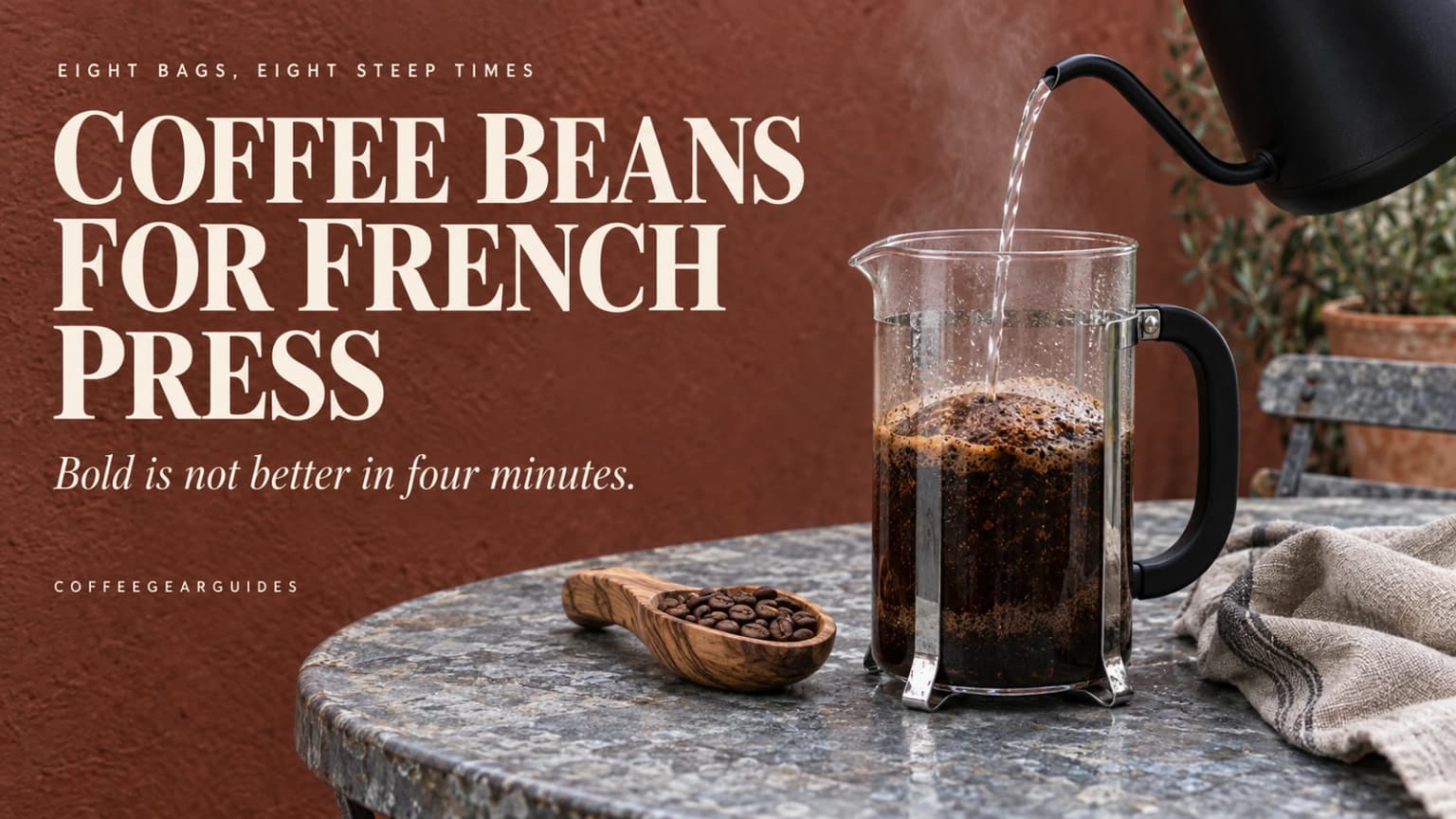
The Best Coffee Beans for French Press Are Not the Boldest in 2026
Bold is not better in a four-minute steep. We read 47,000+ owner ratings to rank 8 coffee beans for French press in 2026, from $14.89 to $56.50.
By the CoffeeGearGuides team · USA · Updated Sep 15, 2026 · 37 min read
On this page21
The best coffee beans for French press are rarely the boldest bag on the shelf, and the reason is the four minutes your press hands to every single ground.
A pour over lets you steer a brew while it runs. A press does not.
Once the water goes in, the coffee sits in it until you plunge, so the bag you bought has already decided most of what that cup will taste like.
That splits the shelf in two. Medium roasts hold their shape through a long immersion, while dark roasts give up their solubles faster and need the clock cut short.
We spent the past weeks comparing roaster specifications, expert consensus, long term owner reports, and more than 47,000 Amazon ratings across eight whole bean coffees sold in the US.
This 2026 guide covers the eight bags we would brew ourselves, the steep time each one asks for, and what a press habit really costs across a year.
How we chose these French press beans for 2026
We are a research-driven site, and we think that is a strength when it is done in the open. You can read exactly how we work on our about page.
For this guide we read roaster specifications and published tasting notes, plus assessments from established coffee publications.
We also read community threads from people who brew the same bag every week, and the full Amazon rating base behind every listing.
Three rules shaped the list. Every coffee had to be sold as whole beans, because a French press is the brewer that punishes a factory grind hardest.
Every coffee had to be in stock on Amazon US with a live price and a review base deep enough to mean something, not a listing with twenty ratings behind it.
And every coffee had to suit a four minute immersion on its own terms. A bag built for a pressurized twenty five second extraction is a different product, and we say so plainly further down this page.
One pick sits outside the usual pattern. The Onyx Southern Weather holds 4.3 stars from 178 ratings, a thin base next to the thousands behind every other bag here.
We kept it because it is the one genuinely specialty blend here and 4.3 across 178 buyers is still a real signal. Treat it as the least evidenced pick on the page.
Prices were checked on the day we published and coffee moves with harvest and shipping. The links let you see the current number yourself.
Will you change the bean or the clock?
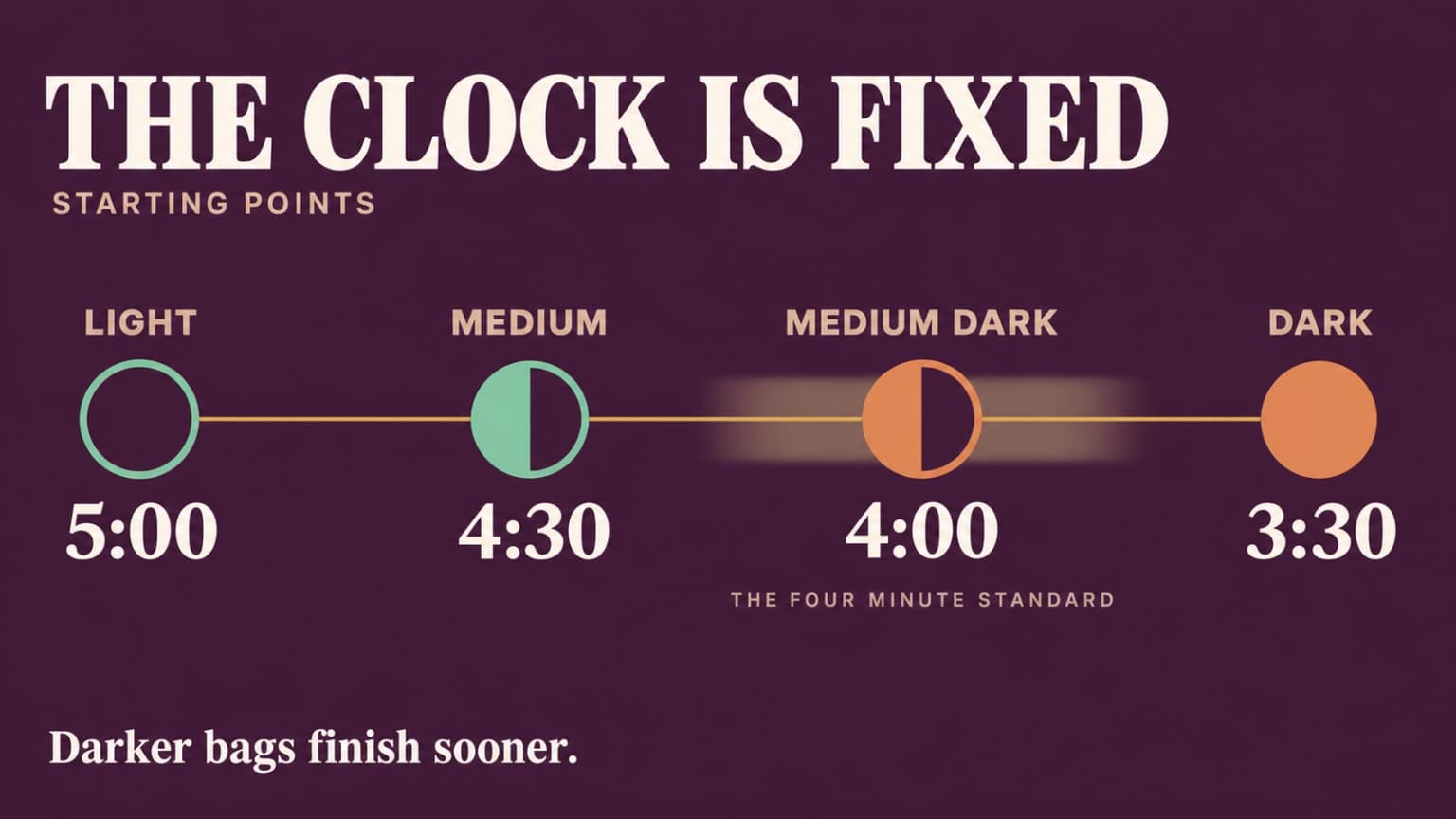
Change the clock. Steep time is the fastest lever a French press gives you, and the roast level printed on the bag tells you which way to move it.
Every coffee here can make an excellent press cup. The split is what you are willing to adjust, and getting it wrong is why people give up on press coffee.
One route is to buy a forgiving medium roast and leave your routine alone. Grind coarse, pour, wait about four and a half minutes, plunge. The bag absorbs your imprecision.
The other route is to buy the bold dark bag you actually enjoy smelling, then run a shorter steep to suit it. Three and a half minutes, sometimes three, and the heavy body arrives without the ashy finish.
These are starting points, not measured finish times. The four-minute reference falls at medium dark; start lighter roasts longer and darker roasts shorter, then adjust to taste.
A medium roast is more tolerant of a steep that runs long because you got distracted, which in a real kitchen happens most mornings.
A dark roast delivers more body and more of the chocolate and toast people buy a press for, but it converts a forgotten pot into a harsh one much faster.
Two ways to buy for a press
Two ways to buy for a press
What matters to you
Buy the medium roast
Buy the dark roast
Steep to start at
About 4 min 30 s
About 3 min 30 s
If you forget it
Still drinkable at 6 min
Harsh by 5 min
Body in the cup
Medium, sweeter
Heavy, chocolatey
Acidity you taste
Present and bright
Mostly roasted away
Grind tolerance
Forgiving
Wants a touch coarser
Typical spend
$14.89 to $56.50
$15.97 to $22.49
Starting points, not laws. Every bag below carries the steep time we would begin with and the direction to move it.
If you read that and thought you would rather not watch a timer, you are a medium roast buyer. If you read it and thought three and a half minutes sounds easy, the dark bags are open to you.
The 8 best coffee beans for French press
The lineup below runs from the bag we would hand to most people up to the specialty splurge. Every link was verified live and in stock through Amazon's own product API on the day we published.
The steep column is the part no competing guide publishes, and it is the single change that makes a bag taste the way its roaster intended.
The bag column matters more than it looks. At press doses a 10 ounce bag is under five brews, which is why the cheapest coffee per ounce here is not the cheapest coffee per cup.
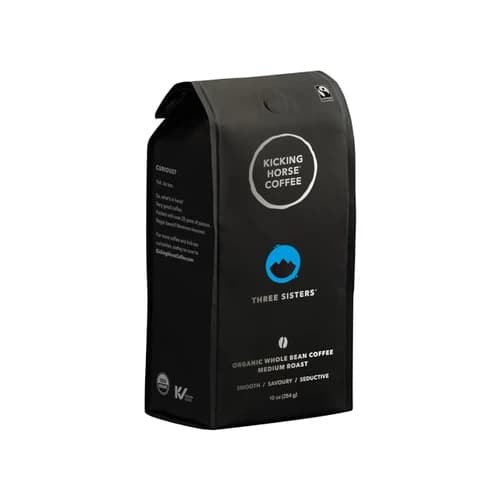
1. Kicking Horse Three Sisters
Ask a room of press drinkers to name one bag that never lets them down, and a Kicking Horse medium roast comes up more than anything else at this price.
Three Sisters is the one we would start with. It is organic, Fairtrade, roasted in British Columbia, and held at 4.4 stars by 3,111 owner ratings at the time of writing.
The reason it suits a French press is temperament rather than pedigree.
Independent reviewers describe it as low in acidity with a smooth finish and a strong body, which is the profile that survives a steep running long.
Kicking Horse Coffee Three Sisters, Medium Roast
Rated 4.4 from 3,111 ratings
An organic Canadian medium roast with cocoa and stone fruit notes, forgiving enough that a steep running long still gives you a sweet cup.
Key details
Medium roast, 10 oz whole bean bag
Roaster notes of stone fruit and cocoa
Aroma of dried fruit, toasted coconut and chocolate malt
Certified organic and Fairtrade
Roasted in the Canadian Rocky Mountains
Kosher certified
What we like
The most forgiving bag here if your steep time wanders
Independent tasting write-ups land in a consistent place: fruit, cocoa and a sweet tobacco edge, malty rather than sharp.
The one criticism that recurs is that it reads slightly tart in a press, which is a grind and time question more than a bean question.
The honest weak point is the bag, not the coffee. Ten ounces is the smallest pack in this guide, and at a 60 gram press dose that is under five brews, so a daily drinker reorders about once a week.
That makes it the second most expensive coffee here per pound, which is a strange sentence about a bag costing $14.89.
Buy this one if you want a single bag you can hand to anyone in the house and trust the result. Start at four and a half minutes and you will rarely need to touch it again.
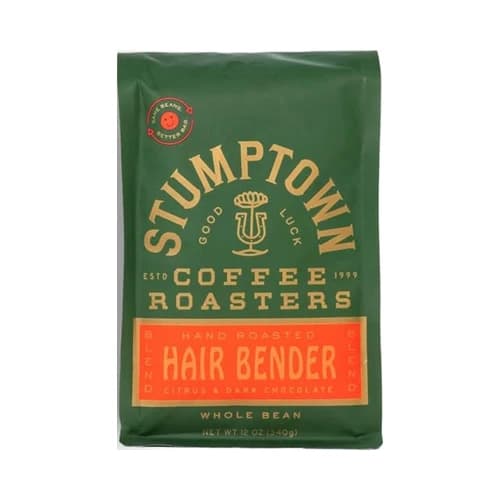
2. Stumptown Hair Bender
Hair Bender is the blend that built Stumptown, and it is the bag on this page with the most to say in the cup.
It pulls from Latin America, Indonesia and Africa, an unusually wide spread for a house blend.
At 4.2 stars across 3,818 ratings it also carries the joint lowest average here, and the reason is worth understanding before you buy.
Stumptown Hair Bender, Medium Roast
Rated 4.2 from 3,818 ratings
The blend that made Stumptown, built from three continents, with more going on in a press than anything else near this price.
Key details
Medium roast, 12 oz whole bean bag
Coffees from Latin America, Indonesia and Africa
Roaster notes of citrus and dark chocolate
Bought through a published Direct Trade program
Sold ground and whole bean, whole bean is the one to buy
Short stated best by window
What we like
The most complex cup in the lineup under $20
Citrus and cocoa both survive a four minute immersion
Direct Trade sourcing is documented, not just claimed
Sold at a supermarket price for a specialty blend
Watch out for
Retail channel bags are often weeks older than direct ones
The recurring complaint in community threads is not the roast, it is the calendar.
Buyers comparing a retail bag against one ordered direct report a real gap in age, and Stumptown prints a short best by window that makes an old bag obvious.
The second complaint is acidity. Hair Bender is brighter than most medium roasts, and a press hands all of that brightness straight through to the cup with no paper to soften it.
The honest weak point is that this bag rewards attention and punishes stockpiling. It is the wrong coffee to buy three of.
Buy one bag, drink it inside a few weeks, and start at four and a half minutes. If the citrus tips into sourness, add thirty seconds rather than grinding finer.
This is the bag for someone who wants to taste where a coffee came from.
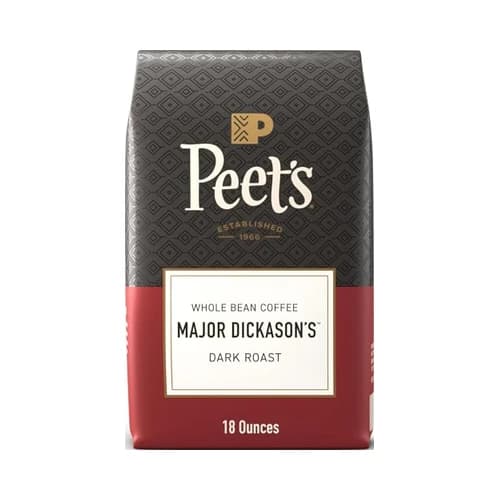
3. Peet's Major Dickason's Blend
Major Dickason's Blend is the American dark roast that most other American dark roasts are measured against, and its 4.6 stars across 8,420 ratings put it among the best evidenced bags in this guide.
It is also the bag whose own packaging tells you to grind it coarse like sea salt, and then says nothing at all about how long to leave it.
That gap is the whole reason this page exists. A dark roast held for five minutes tastes like the reason people give up on presses.
Peet's Coffee Major Dickason's Blend, Dark Roast
Rated 4.6 from 8,420 ratings
The benchmark American dark roast, full bodied and deep, provided you plunge it early rather than letting it run the standard four minutes.
Key details
Dark roast, 18 oz whole bean bag
100% arabica
Blended with a Peet's customer, sold since the 1960s
Packaging specifies a coarse grind for press brewing
Widest grocery availability of any bag here
About 8.5 full press brews per bag
What we like
Best price per brew of the eight at about $1.88
Deep, full bodied cup that suits milk and cream
8,420 ratings at 4.6 stars is serious evidence
An 18 oz bag lasts a daily drinker about a week and a half
Watch out for
Goes harsh fast if the steep runs past four minutes
Roast level flattens origin character
Supermarket channel bags print a best by, not a roast date
Published tasting notes and owner sentiment agree closely: full bodied, smooth and earthy, with a lingering sweetness rather than a sharp finish.
The people calling it bitter and the people calling it smooth are describing two different steep times.
One independent brewing write-up recommends about 50 grams into 32 ounces of water at four to five minutes. We would start at the short end of that and go down, not up.
The honest weak point is what the roast takes away. Major Dickason's is a blend built for consistency across decades, so it will never tell you anything about a particular farm or harvest.
Buy this if you want the classic diner-strength press cup at the lowest cost per brew on this page. Start at three and a half minutes, taste it, and only add time if the cup reads thin.
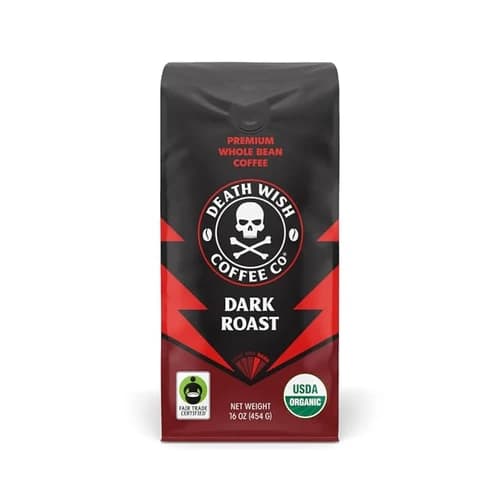
4. Death Wish Organic Dark Roast
Death Wish has 19,125 ratings at 4.6 stars, the deepest review base on this page by a wide margin, and a reputation built almost entirely on caffeine rather than flavor.
The blend is arabica and robusta together, which is unusual on a US specialty shelf and is the actual reason it behaves the way it does in a French press.
Death Wish Coffee Organic Dark Roast
Rated 4.6 from 19,125 ratings
An organic arabica and robusta dark roast with the deepest owner evidence in this guide, built for people who want the cup to be strong.
Key details
Dark roast, 16 oz whole bean bag
Arabica and robusta blend
USDA Organic and Fair Trade Certified
Brand states about 180 mg of caffeine per 6 oz cup
Sold with a satisfaction guarantee
About 7.5 full press brews per bag
What we like
19,125 ratings at 4.6 stars, the deepest evidence here
Robusta adds body and a thicker crema-like head
Organic and Fair Trade certified at a mid price
Stands up to milk better than any other bag here
Watch out for
Costs more than comparable dark roasts of the same strength
The caffeine claim is the selling point, not the flavor
Two criticisms come up repeatedly and both are fair. The first is price, since an Italian dark roast of similar intensity sells for noticeably less per pound.
The second is the promise, because a number of people report that the energy hit did not match the marketing.
What nobody disputes is the body. Robusta carries more soluble solids and less sweetness than arabica, so it builds a heavy, low-acid cup that holds its shape under milk.
That same chemistry is the honest weak point. Robusta turns rubbery when it is pushed, so this is the bag least forgiving of a forgotten pot in the entire guide.
Buy it if you want the strongest cup your press can make and you are willing to plunge at three and a half minutes.
If the appeal is the label rather than the coffee, the Don Pablo gives you more coffee for less money.
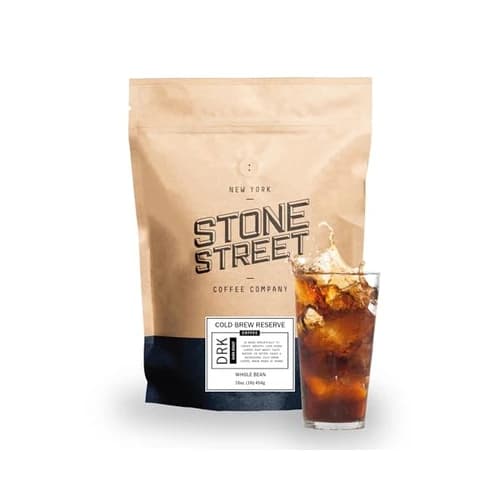
5. Stone Street Colombian Cold Brew
Every other bag in this guide was roasted for coffee in general. Stone Street Colombian Cold Brew was roasted for a long soak, which makes it the closest thing on Amazon to a purpose-built immersion coffee.
Cold brew and a French press are the same process at different temperatures. Both drop coarse grounds into water and wait, which is why a bag formulated for one behaves so predictably in the other.
Stone Street Colombian Cold Brew, Dark Roast
Rated 4.6 from 1,259 ratings
A Brooklyn-roasted Colombian Supremo blended specifically for long immersion, which is exactly what your press does with hot water.
Key details
Dark roast, 16 oz whole bean bag
Colombian Supremo grade beans
Blended specifically for immersion brewing
Roaster describes it as bold, low acid and slightly sweet
Three-layer foil-lined bag with a one-way valve
Small batch roasted in Brooklyn
What we like
Formulated for the exact brew process a French press uses
Valved, foil-lined bag protects the beans properly
4.6 stars across 1,259 ratings
Low acidity makes it easy to drink black
Watch out for
At $22.49 a pound it is mid-priced for a dark roast
Marketed for cold brew, so hot brewing guidance is thin
One flavor profile, with no origin character to explore
The packaging is the detail worth paying for. A three-layer foil-lined bag with a one-way valve lets roasting gas escape without letting oxygen in.
That is the difference between a bag still good in week three and one that is not.
Most supermarket-channel coffee in this guide ships in bags that do less. If you have read our guide to coffee storage containers, this is the same argument arriving from the roaster's side.
The honest weak point is that the roaster wrote its brewing advice for a twelve hour cold soak. You are running a four minute hot one, so start at four minutes flat rather than following anything on the bag.
Buy it if you want the most predictable hot press cup in the guide, or if you brew cold in summer and hot in winter out of the same bag.
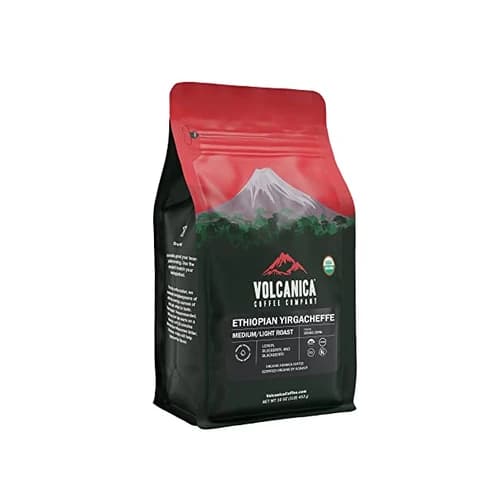
6. Volcanica Ethiopian Yirgacheffe
This is the bag for anyone who has only ever drunk blends. Yirgacheffe is the most recognizable single origin in coffee, and a press is a genuinely good way to meet it.
Volcanica roasts weekly in small batches near Atlanta and states that nothing ships more than two weeks past roast, which matters more for a light roast than for anything else here.
Volcanica Ethiopian Yirgacheffe, Organic
Rated 4.2 from 1,702 ratings
A USDA Organic single origin Yirgacheffe roasted medium to light, for the press drinker who wants fruit and florals instead of chocolate.
Key details
Medium to light roast, 16 oz whole bean bag
100% Ethiopian Yirgacheffe, single origin
USDA Organic and Kosher certified
Roaster notes of fruit and wine, with round acidity
Lab tested for mould, quality and safety before sale
Roasted in small weekly batches near Atlanta
What we like
The only true single origin in the guide
Fruit and floral notes a dark roast cannot give you
Published mould and safety testing is unusual at this price
Fresher through this channel than most specialty bags
Watch out for
Joint lowest star average here at 4.2
Needs the longest steep, about five minutes
Light roast body can read thin to dark roast drinkers
Coffee Review has assessed a Volcanica Yirgacheffe and found gentle round acidity and a satiny mouthfeel, alongside dark chocolate, caramel and orange zest.
A press keeps more of those separate flavors than a paper filter does.
Owner sentiment splits along a predictable line. People who came looking for a bright, fruity coffee are delighted; people who expected a conventional breakfast cup find it thin and slightly sour.
The honest weak point is that a lighter roast is the least soluble bean in this guide, so it needs the clock pushed out rather than pulled in. Five minutes is our starting point and six is not unreasonable.
The record on roast dates is not quite consistent either. The roaster states it prints them and at least one independent review reports a bag without one, so check yours when it lands.
Buy this if you already like your coffee bright and you are curious what your press does with an origin rather than a blend.
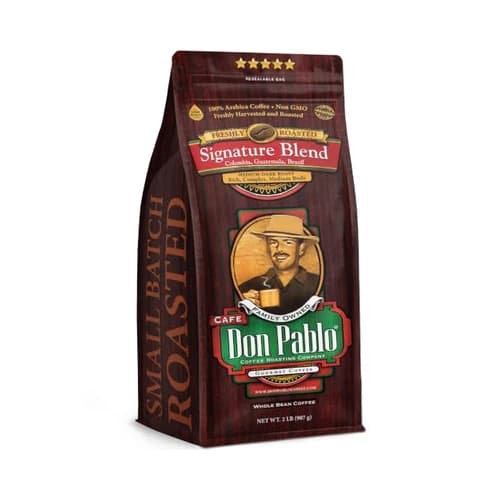
7. Café Don Pablo Signature Blend
Signature Blend is the bag that makes the arithmetic work. Two pounds of medium-dark whole bean for $29.99 is under two dollars a full press, the second cheapest brew in this guide.
It also carries 4.6 stars across 9,540 ratings, so the value is not coming at the cost of evidence.
Café Don Pablo Signature Blend, Medium Dark
Rated 4.6 from 9,540 ratings
Two pounds of low acid medium-dark arabica from three origins, the bag to buy when a full press disappears every morning.
Key details
Medium-dark roast, 2 lb whole bean bag
Blend of Colombia, Guatemala and Brazil
100% arabica and GMO free
Roaster describes it as low acid with a cocoa finish
About 15 full press brews per bag
Sold in a 5 lb size with the same review base
What we like
About $1.98 per full press, second cheapest here
Low acidity suits people who find coffee harsh
9,540 ratings at 4.6 stars
One bag lasts a daily drinker roughly two weeks
Watch out for
A 2 lb bag will go stale before a light drinker finishes it
Medium-dark roast gives you body rather than nuance
The blend runs Colombia, Guatemala and Brazil, and the roaster calls the result medium to full bodied with a smooth cocoa finish and low acidity.
In a press that becomes a rounded cup that does not need milk to be comfortable.
The honest weak point is the size working against you. Two pounds is fifteen full presses, which is excellent value if you brew daily and a staling problem if you do not.
If you drink one press every few days, the Peet's 18 ounce bag costs less per brew than this one does once you account for the last third going flat.
Buy the two pound bag if you empty a 34 ounce press most mornings. Start at four minutes, and keep the coffee in a sealed container rather than the bag it arrives in.
8. Onyx Coffee Lab Southern Weather
Southern Weather is Onyx's house filter blend and the one genuinely specialty coffee in this guide.
It is a seasonal blend of washed Colombian and Ethiopian arabica, rebuilt through the year to hold one flavor target.
It is also the least evidenced pick on the page, and the most expensive, so both of those need saying before anything else.
Onyx Coffee Lab Southern Weather, Medium Roast
Rated 4.3 from 178 ratings
The house filter blend from one of the most decorated roasters in the US, seasonal, complex, and priced accordingly at 32 ounces.
Key details
Medium roast, 32 oz whole bean bag
Seasonal blend of washed Colombian and Ethiopian arabica
Roaster notes of chocolate, plum and walnut with a citrus finish
Served as the house filter coffee in the roaster's own cafes
Composition changes through the year to hold one profile
A 10 oz bag of the same coffee is also listed
What we like
The most complex cup in the guide by a clear margin
Medium roast holds up to a standard four and a half minutes
Two pounds of specialty coffee in one order
Roasted by a nationally recognized specialty roaster
Watch out for
Only 178 ratings, and they are shared with the 10 oz listing
At $56.50 it is the most expensive bag here by far
A seasonal blend changes, so a repeat order is not identical
Be clear about the evidence here. The 4.3 star average rests on just 178 ratings.
Amazon also pools that figure across the 32 ounce listing and a 10 ounce one, so it is one pool covering two sizes rather than two verdicts.
Every other bag here is backed by four figures of owner feedback. This one is not, and we would rather say so than rank it on reputation.
What the reputation is built on is real. Published tasting notes across several outlets land in the same place.
Milk chocolate, plum, candied walnut, a juicy citrus finish, and a body fuller than most medium roasts manage.
The honest weak point beyond the evidence is the seasonality. Onyx rebuilds the blend through the year to hold its profile, so the bag you love in March is not made of the same coffees in October.
Buy this if a press is how you take coffee seriously and $56.50 for two pounds reads as reasonable. If you want to test that before committing, the 10 ounce listing is the cheaper way in.
Why a dark bean runs out of road first
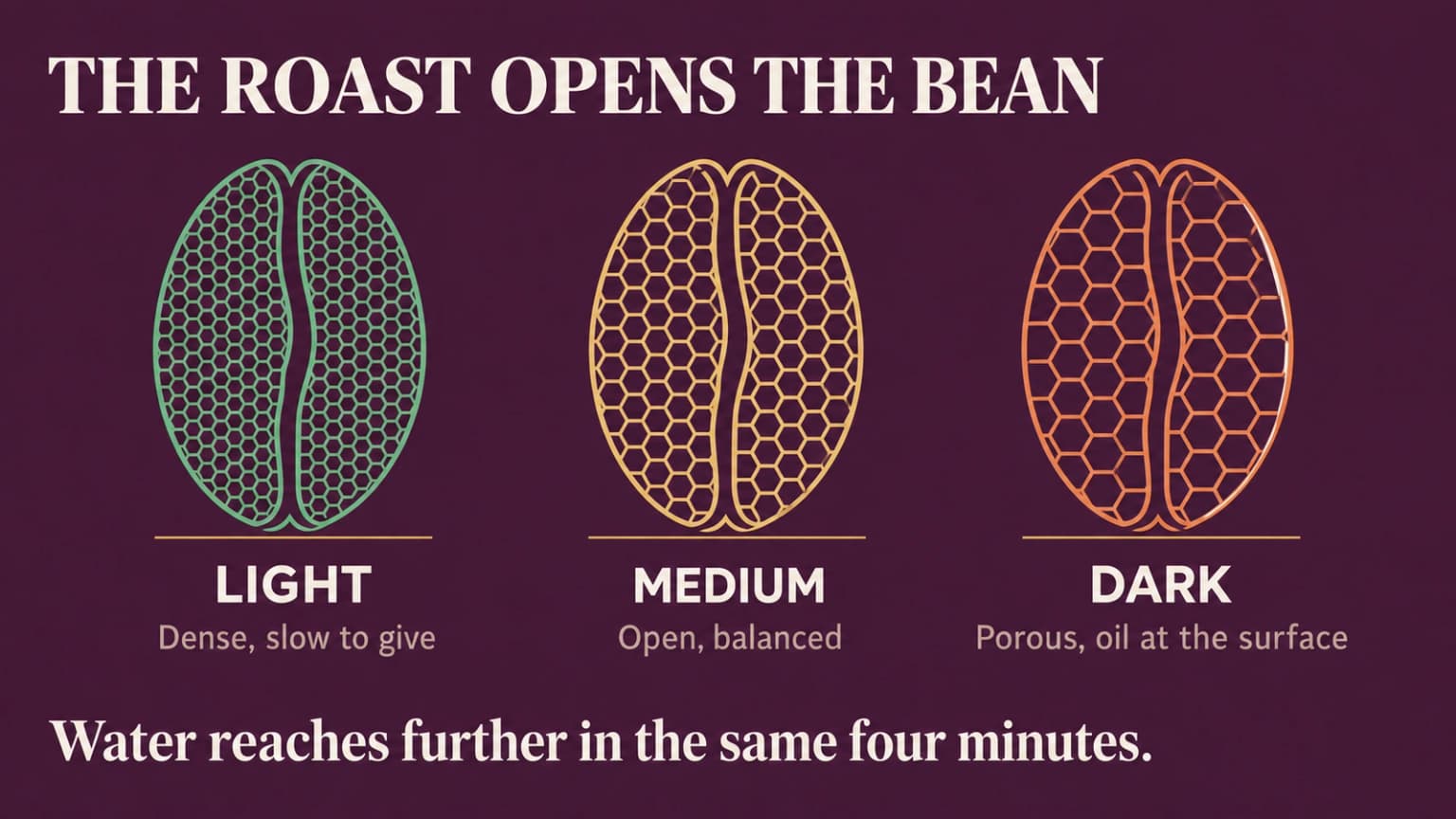
A dark bean is a more porous object than a light one, so the same four minutes pulls more out of it. That is the mechanism behind every steep time on this page.
Roasting is a controlled demolition of the inside of a seed. Water is driven off, sugars caramelize, and the cell walls break down a little further with every extra second in the drum.
The longer that runs, the more porous and the more brittle the bean becomes.
A dark roast is structurally a weaker object than a light one, and hot water gets into it faster. That single fact explains most of what happens in your press.
Roast progress opens the bean up. The same four minutes reaches much further into a dark bean than a light one.
Extraction is not a switch, it is an order of service. The sweet, acidic compounds come out first, the sugars and body next, and the dry, woody, bitter ones last.
Give a bean more time and you move further down that list. Give a bean that is already porous the same time and you arrive at the bitter end sooner.
This is why steeping everything for four minutes produces such different results.
Four minutes is not one dose of extraction. It is one duration applied to beans that absorb at different rates.
There is a second consequence people meet without recognizing it.
A darker bean has lost more mass in the roast, so it is less dense. A level scoop of dark roast holds fewer grams than the same scoop of a medium.
Measure by volume and you under-dose the bag that needed the shorter steep, which gives you a cup that is weak and harsh at once.
What each roast gives a four minute steep
What each roast gives a four minute steep
Roast level
What you get
How it goes wrong
Start the clock at
Light
Fruit, florals, tea-like body
Thin and sour if rushed
5 min or more
Medium
Balance, sweetness, some origin
Flattens slowly, rarely harsh
4 min 30 s
Medium dark
Cocoa, body, low acidity
Dries out past 5 min
4 min
Dark
Heavy body, toast, smoke
Ashy and drying past 4 min
3 min 30 s
Starting points for a coarse grind at roughly 14 g of coffee per 8 oz of water. Move in 30 second steps and taste between each.
The last piece is the oil. Surface oil appears at darker roasts and a press has no paper to catch it, so it reaches the cup and gives press coffee the heavy mouthfeel people brew one for.
That same oil is the first thing in a bag to go stale, which is the best argument here against buying a dark roast in bulk.
The darkest bag in this guide, Death Wish, travels furthest down that order of service in the shortest time. That is why its steep starts at three and a half minutes.
If your cup is coming out harsh whatever you buy, the roast is only one of nine causes worth checking. Our guide to why coffee tastes bitter ranks them by how much difference each one makes.
One lot, or several in the pot?
Seven of the eight coffees here are blends and one is a single origin, and that ratio is not an accident of what Amazon stocks. It reflects what each one is for.
A blend is an engineering product. A roaster picks components that cover each other's gaps, then rebuilds the recipe as harvests change so the bag tastes the same in December as it did in June.
A single origin is a snapshot. One country, often one region or one washing station, sold as it is, with whatever that harvest gave.
One lot, or several in the pot
One lot, or several in the pot
What you are judging
Blend
Single origin
Consistency bag to bag
High, by design
Varies with the harvest
Margin for error
Wider, components cover gaps
Narrow, nothing to hide behind
What you taste
A target profile
A place and a season
Best steep window
Forgiving either side
Tighter, worth timing
Price in this guide
$14.89 to $56.50
$22.99
Neither is better coffee. A blend is the safer daily bag and a single origin is the more interesting weekend one.
Immersion changes how that distinction lands. In a press everything goes in together and comes out together, so a blend's internal averaging is doing work you cannot do yourself.
That is why the blends here are the easier recommendation, and why the Volcanica Yirgacheffe is the one bag that rewards paying attention.
Seasonal blends sit in an interesting middle. The Onyx Southern Weather is rebuilt through the year to hold one flavor target.
It stays consistent in taste while changing in composition, which is worth knowing before you reorder expecting identical coffee.
The bags that do not belong in a press
Four kinds: espresso roasts, pre-ground coffee, flavored coffee, and beans that are visibly oily in the bag.
Each is sold for a different machine or a different shelf life.
Espresso roasts come first, because competing guides recommend them constantly. A bag marketed as an espresso blend or a crema blend was built for a fine grind under pressure for about twenty five seconds.
Put that same bean in a four minute immersion and you are giving a coffee designed for a sprint the contact time of a marathon.
It is not dangerous, it is just miscast, and it is where a lot of "my press makes bitter coffee" comes from.
Pre-ground coffee is second and more damaging. Almost all of it is milled at a drip grind, which is far finer than a press wants.
Those fines pass straight through the mesh filter, keep extracting in your mug after the pour, and settle as sediment at the bottom.
Our guide to grinders for French press covers the particle side of this properly, because the grinder is the only filter a French press has.
Flavored coffee is third. Flavoring is carried in oil sprayed onto roasted beans, and a press passes oils straight through rather than trapping them in paper.
The result is heavier than the same bag through a drip machine, and the flavoring hides the staleness that would have told you to buy fresher.
Very oily dark roasts are the fourth, and this one is a matter of degree rather than a ban. A bean visibly slick in the bag has surface oil already oxidizing, and oil is the first thing in coffee to turn.
The same beans cause a different problem in a bean-to-cup machine, where the oil clogs the chute. Our guide to beans for superautomatic machines covers that side of it.
A press dose empties a bag fast
A full 34 ounce French press takes about 60 grams of coffee, following Bodum's own guidance of roughly 14 grams for every 8 ounces of water. That number reframes every price on this page.
Sixty grams is a large dose. A pour over for one is around 22 grams, so a household emptying one press a morning gets through nearly three times the coffee of a single pour over drinker.
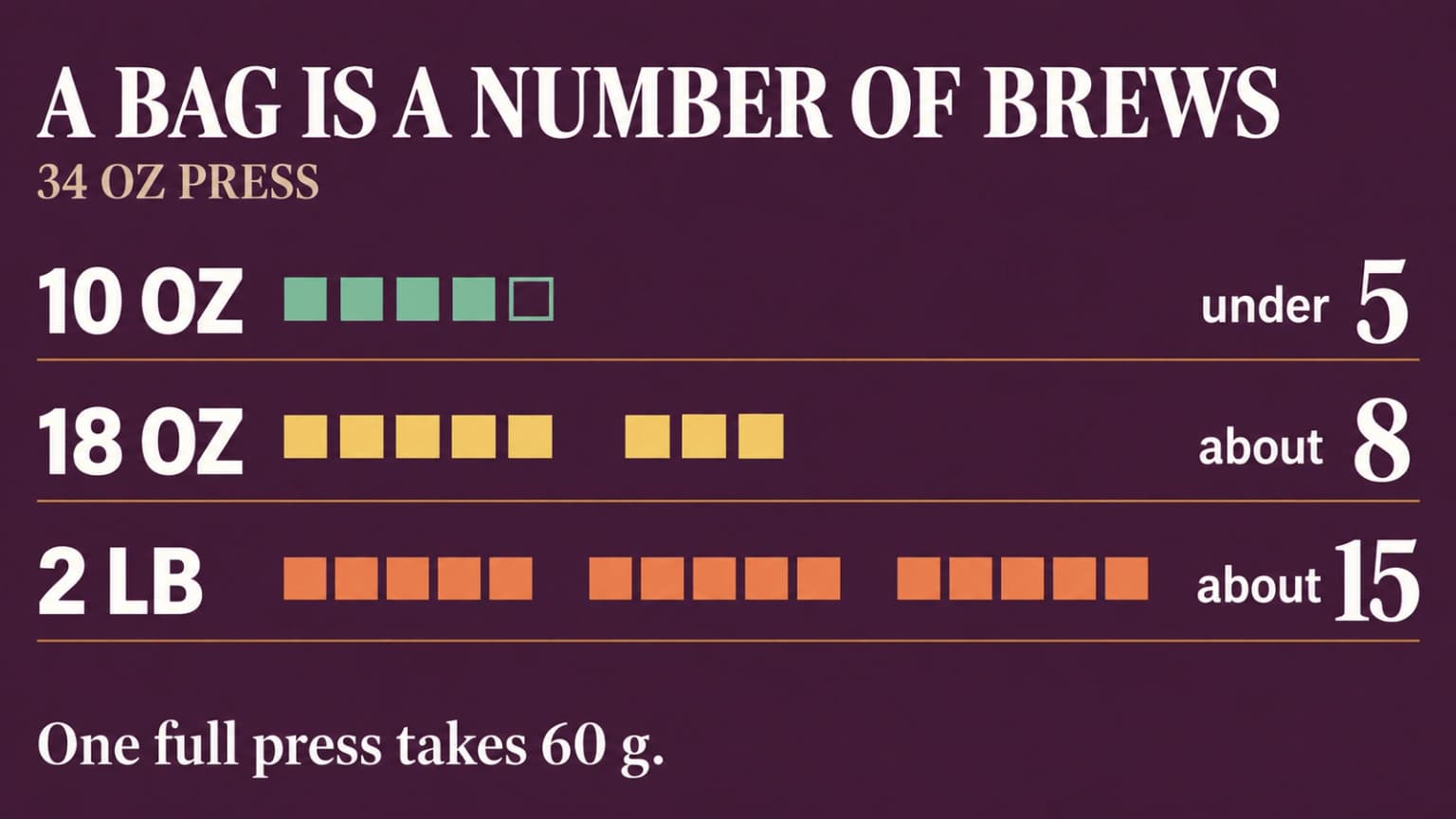
At a 60 gram dose, a 10 ounce specialty bag is under five brews. Squares group the brews in fives; the outline marks a partial brew.
A 10 ounce bag is under five full presses. An 18 ounce bag is about eight and a half. A two pound bag is around fifteen.
For a household brewing one full press a day, that is a reorder every five days, every week and a half, or every fortnight.
A smaller press changes that arithmetic. A 12 ounce press takes about 21 grams, so the same 10 ounce bag stretches to thirteen brews rather than five.
If you are still choosing the press itself, our guide to insulated French presses covers what each stated capacity actually pours, which is rarely the number on the box.
The case against press-specific beans
The strongest objection to this entire page comes from people who know coffee well, and it deserves a straight answer rather than a defensive one.
The objection is this: there is no such thing as a French press bean. No roaster grows a coffee for immersion.
Any fresh, well made coffee will produce a good cup in a press if you grind it coarse and do not forget it.
That is almost entirely correct and we agree with it. What we would add is that a press removes two safety nets other brewers give you.
There is no paper filter to catch fines and oils, and no flow rate to adjust once the water is in.
So the bean is not press-specific, but the consequences of the bean are sharper here than anywhere else in your kitchen.
A stale bag tastes stale faster, an oily bag tastes heavier, and a dark roast reaches its limit sooner.
That is why this guide is organized around steep times rather than around a secret category of coffee. We are not selling you a special bean, we are telling you what clock each bag wants.
If you take nothing else from this section, take the ranking. Freshness beats origin, origin beats roast level, and roast level beats the name on the bag.
A two week old supermarket medium roast beats a four month old specialty single origin in a press every time.
It is also why the Stumptown Hair Bender is the bag here we would buy one of and drink quickly, rather than the bag we would stockpile on offer.
What a press habit costs in beans
Coffee looks cheap on the shelf and stops looking cheap once you multiply it by a 60 gram dose and 365 mornings. The spread across this guide is close to double.
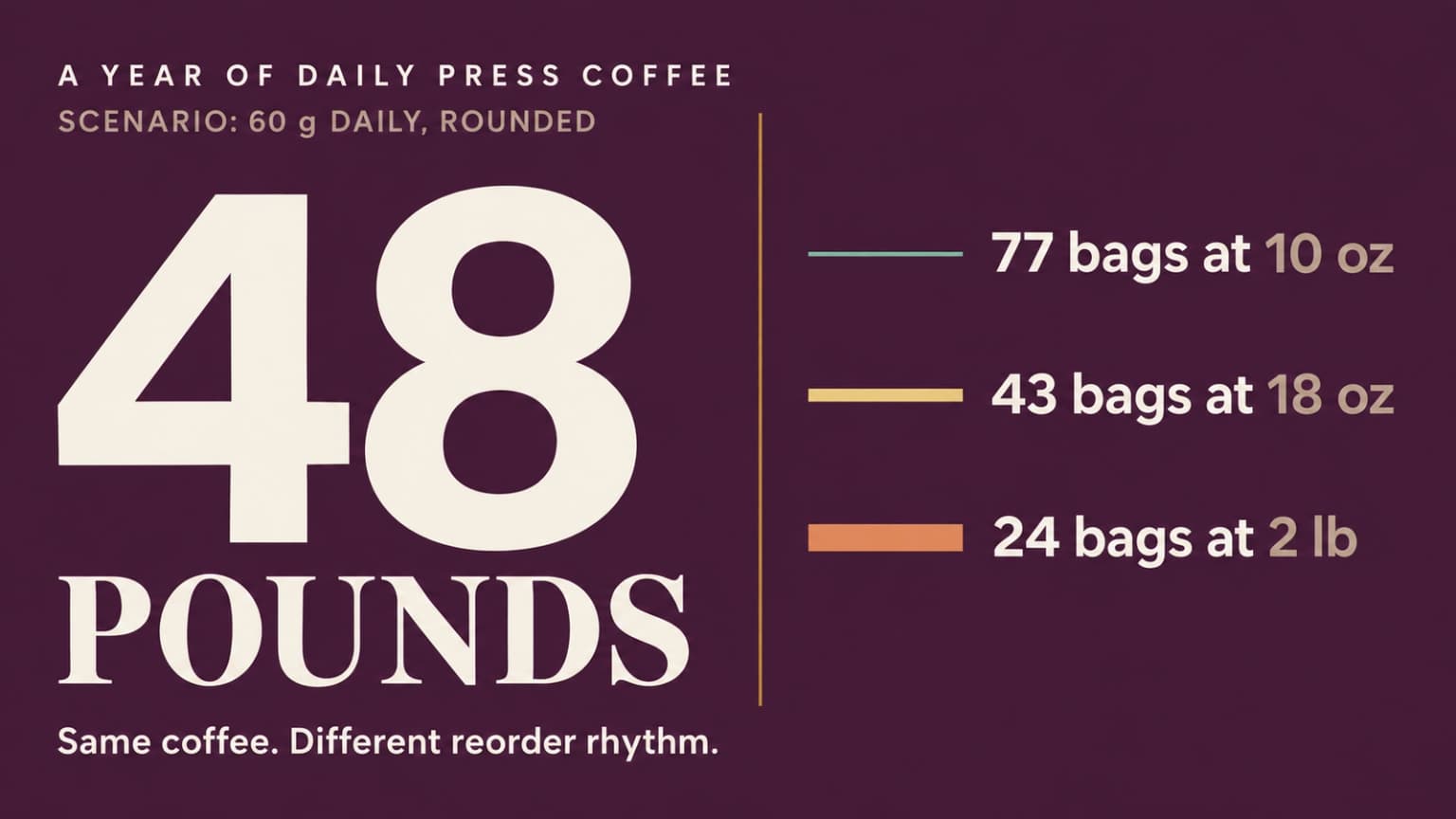
A year of one full press a day is about 48 pounds of coffee. That is 77 of the 10 ounce bags, 43 of the 18 ounce ones, or 24 two pound bags.
At 60 grams a day, a year uses about 48 pounds: roughly 77 ten-ounce bags, 43 eighteen-ounce bags, or 24 two-pound bags. Bag size changes the reorder rhythm.
What each bag costs to keep brewing
What each bag costs to keep brewing
Coffee
Per pound
Per full press
A year, one press a day
Peet's Major Dickason's
$14.20
$1.88
$686
Café Don Pablo Signature
$15.00
$1.98
$724
Death Wish Dark Roast
$18.13
$2.40
$875
Stumptown Hair Bender
$19.99
$2.64
$965
Stone Street Cold Brew
$22.49
$2.97
$1,086
Volcanica Yirgacheffe
$22.99
$3.04
$1,110
Kicking Horse Three Sisters
$23.82
$3.15
$1,150
Onyx Southern Weather
$28.25
$3.74
$1,364
Rounded figures, calculated from the prices we verified, a 60 g dose and one full 34 oz press a day. A single drinker running a half press halves every figure.
A full press pours about three mugs once the grounds have taken their share of the water, so the per brew column divides by three to reach a cup. That puts Peet's near 63 cents a mug and the Onyx near $1.25.
Both are a fraction of a coffee shop, but the gap between them is the one that matters once you are already brewing at home.
Notice what the table does to the rankings. Kicking Horse Three Sisters is our first pick and the second most expensive coffee here to run, purely because it comes in a 10 ounce bag.
That is a defensible trade if you value a bag you cannot get wrong.
It is a bad trade if you brew for four people every morning, and that is when Don Pablo stops being the value option and becomes the obvious one.
When to buy
Coffee has no Black Friday in the way appliances do, but the shelf still moves.
Specialty roasters discount around new crop arrivals, when last season's blend components are cleared. Supermarket brands like Peet's cut deepest around major holidays.
The one thing not worth waiting for is a subscription discount on a bag you have never tasted. A fifteen percent saving on a coffee you do not enjoy is not a saving.
How to dial a new bag into a press
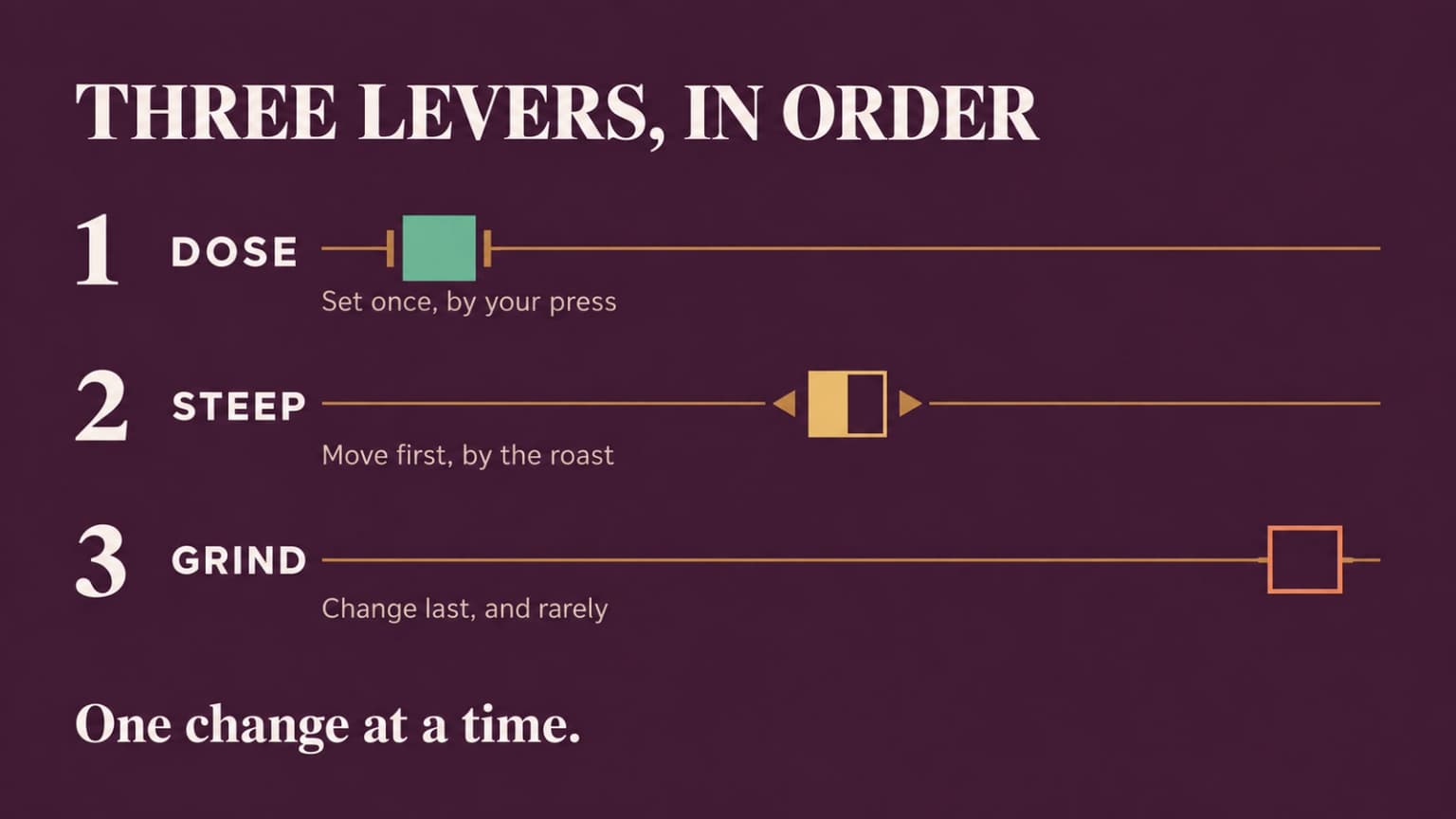
Move one variable at a time, and move the clock before the grinder. Most people change three things at once when a cup disappoints, then cannot tell which change helped.
Three levers, in order. The dose is set by your press, the clock is set by the roast, and the grind is the last thing to touch.
Dialing in a new bag
1
Fix the dose to your press, once
About 14 g of coffee per 8 oz of water. That is roughly 21 g for a 12 oz press and 60 g for a full 34 oz one, and it should not change again.
Tip Weigh it. A level scoop of dark roast holds fewer grams than the same scoop of a medium.
2
Set the clock from the roast, not the habit
Start a light roast at five minutes, a medium at four and a half, a medium dark at four, and a dark at three and a half. Four minutes for everything is where most press coffee goes wrong.
3
Grind coarse and brew one pot unchanged
Aim for a coarse, even grind and resist adjusting anything mid-brew. You need one clean reference cup before you can tell what a change did.
Watch out Do not break the bloom and then plunge immediately. Let the grounds settle for about 30 seconds or you push fines straight through the mesh filter.
4
Taste it, then move the clock 30 seconds
Thin, sharp or sour means it needs longer. Drying, ashy or hollow at the finish means it needs less. Change nothing else on this pot.
Tip Taste it at drinking temperature. Coffee that is too hot reads flatter than it really is.
5
Only change the grind when the clock runs out
If you have reached six minutes and it is still thin, move grind size one step finer. If you are down at three and it is still harsh, go one step coarser.
6
Write down what worked
Note the bag, the dose and the time that settled it. A press is repeatable once you know its number, and every new bag starts from its roast level again.
That last step is the one people skip. Six bags in, you will know the clock for each roast level in your own kitchen.
Buying beans on a rhythm, not on empty
A press drinker gets through coffee faster than almost anyone else at home, so buying a bag only when the last one runs out keeps you permanently drinking coffee at its worst.
The fix is arithmetic rather than discipline. Work out your weekly consumption once, then let the bag size follow it.
Setting a bean rhythm
1
Count your grams for one week
Multiply your dose by how many brews you actually make. One full 34 oz press a day is about 420 g a week, and half a press a day is about 210 g.
2
Buy a bag you will finish in three weeks
Whole beans hold their character for a few weeks after roasting, not months. Pick the bag size that lands inside that window rather than the one with the best price per pound.
Tip One full press a day means a 2 lb bag is right. Half a press a day means an 18 oz bag is closer.
3
Split a large bag the day it arrives
Move about ten days of coffee into a sealed container and leave the rest closed in its original bag. Opening one bag daily for a month stales all of it.
4
Reorder before you are empty, not after
Set a reminder for two thirds of the way through a bag. That gives the new one time to arrive without forcing you into a supermarket emergency purchase.
Watch out Do not let a subscription run faster than you drink. A shelf of unopened bags is a shelf of coffee quietly getting worse.
5
Keep one backup bag, never three
A single sealed spare covers a delivery that slips. Anything beyond that is storage, and coffee does not reward being stored.
Buy in the rhythm your press actually consumes, and the bag you chose starts doing the work you paid it for.
Which press beans should you buy in 2026?
Kicking Horse Three Sisters, for most people. It is a medium roast that still makes good coffee on the morning you forget about it.
We weighted the field on how each bag behaves in full immersion, the depth of owner evidence behind it, what it costs to keep brewing, and how much it forgives a steep that runs long.
The three we recommend first
Our pick
Three Sisters
$14.89
You are
Buying one bag for everyone
Best at
Forgiving a long steep
Steep
Start at 4 min 30 s
Weak spot
Under five brews a bag
Major Dickason's
$15.97
You are
After the classic dark cup
Best at
Cost per brew, deep body
Steep
Start at 3 min 30 s
Weak spot
Harsh if you forget it
Don Pablo Signature
$29.99
You are
Brewing a full press daily
Best at
Two pounds of low acid coffee
Steep
Start at 4 min
Weak spot
Too much bag for one drinker
The three we recommend first
Specification
Our pick
Three Sisters
$14.89
Major Dickason's
$15.97
Don Pablo Signature
$29.99
You are
Buying one bag for everyone
After the classic dark cup
Brewing a full press daily
Best at
Forgiving a long steep
Cost per brew, deep body
Two pounds of low acid coffee
Steep
Start at 4 min 30 s
Start at 3 min 30 s
Start at 4 min
Weak spot
Under five brews a bag
Harsh if you forget it
Too much bag for one drinker
You can browse the rest of our coffee beans coverage for the other brewers in your kitchen, because the bag that suits a press is rarely the bag that suits an espresso basket.
Frequently asked questions
What coffee is best for a French press?
A medium roast whole bean coffee, ground coarse, and steeped for about four and a half minutes. Medium roasts hold their shape through a long immersion instead of collapsing into bitterness halfway through it.
Our first pick is Kicking Horse Three Sisters, a medium roast held at 4.4 stars by 3,111 owner ratings at the time of writing.
Dark roasts work well too, but they are finished sooner. Cut the steep to about three and a half minutes and they stay sweet.
Should you use light or dark roast in a French press?
Either works, but they are not interchangeable at the same steep time. A darker roast is more porous and more brittle, so it releases its solubles faster than a light one.
Run a dark roast for the same four minutes that suits a medium and you are extracting past the sweet part of the cup.
The practical rule is that the darker the bag, the shorter the clock. Lighter roasts want five minutes or more, medium roasts about four and a half, dark roasts about three and a half.
Can you use pre-ground coffee in a French press?
You can, and it is the most common reason press coffee tastes muddy. Nearly all pre-ground coffee is milled at a drip grind, which is far finer than a French press wants.
Those small particles slip through the metal screen, keep extracting in your mug, and settle as sludge at the bottom.
If pre-ground is your only option, look for a bag that specifically says coarse or French press grind, and shorten the steep by about a minute.
How much coffee do you use in a French press?
About 14 grams for every 8 ounces of water, which is Bodum's own guidance for the presses most American kitchens own.
That works out to roughly 21 grams for a 12 ounce press and about 60 grams for a full 34 ounce one, which is a large dose compared to other brewers.
Does French press coffee need special beans?
No bean is sold that only works in a press, and any fresh, well roasted whole bean coffee will make a good cup in one.
What changes is the margin for error. A press has no paper filter and no flow rate to adjust, so a bag that is stale, oily or ground too fine has nothing to hide behind.
Buying coffee beans for a French press is mostly about buying whole beans you can grind coarse, then matching the steep to the roast on the label.
How long should coffee steep in a French press?
Four minutes is the standard starting point, and it is a starting point rather than a rule. The right number depends on the roast in front of you.
Start a light roast at five minutes, a medium at four and a half, and a dark at three and a half. Then move in thirty second steps.
Taste the result before changing anything else. Steep time is the fastest lever on a French press and the one most guides never mention.