SCA Certified Coffee Makers in 2026: 7 That Earn the Badge
We analyzed 37,000+ ratings to find the best SCA certified coffee makers for 2026, from $150 to $365, for small batches, iced coffee, and full pots.
By the CoffeeGearGuides team · USA · Updated Jul 25, 2026 · 35 min read
On this page19
The best SCA certified coffee maker should deliver the temperature, timing, and extraction that good drip coffee needs without turning every morning into a manual brewing exercise.
That still leaves two useful families. Glass-carafe machines favor visibility and easy cleanup, while thermal-carafe machines protect a pot without continuing to heat it.
Batch size creates the second split. A 25-ounce brewer can suit two mugs beautifully, but a 60-ounce brewer earns its counter space when a household or office empties a large pot.
We compared official test criteria, manufacturer manuals, expert measurements, repair information, and recurring owner feedback. The seven 2026 finalists are backed by a combined 37,207 Amazon ratings.
We did not treat that total as 37,207 identical votes. We traced repeated patterns, weighted balanced three-star reports, and rejected every candidate below 4.0 stars at the time of writing.
How we chose these makers for 2026
CoffeeGearGuides is research-driven. We do not imply that a week with a loaner can reveal what thousands of kitchens expose over years, and our about page explains the method in full.
We began with brewers tied to the SCA Certified Home Brewer program, then checked the exact US model rather than trusting a family name or an old retailer badge.
The program uses independent laboratory testing against defined brewing requirements. It is valuable evidence, but its three-year licensing cycle means the current directory is not a complete history of every model that passed.
Next came practical evidence. Manuals confirmed capacity, controls, cleaning steps, and warranty terms, while expert measurements helped separate marketing language from repeatable brewing behavior.
We then mapped recurring owner complaints, with extra weight on three-star reviews. Those reports tend to preserve the good parts while naming awkward lids, drips, scale problems, hotplate limits, and slow support.
Ratings were the hard gate. Every final listing held 4.0 stars or better when checked at the time of writing, and six had more than 2,000 ratings on the exact Amazon listing.
The seventh has 453 ratings because it is a specialized 60-ounce brewer at about $360, not a mass-market 10-cup machine. That is a meaningful sample for its narrow role, and we disclose it instead of inflating the evidence.
Finally, each pick had to serve a distinct buyer. Extra buttons did not earn a place unless they changed the daily workflow, batch range, holding method, or audience.
Prices were verified through Amazon's product data on publication day. They can change around Prime Day, Black Friday, and color-specific promotions, so use each button to see the live offer.
Choose the best SCA certified coffee maker
Capacity labels create needless confusion. Several premium brewers count a coffee "cup" as four or five ounces, not the eight-ounce measuring cup or the 12-ounce mug on your desk.
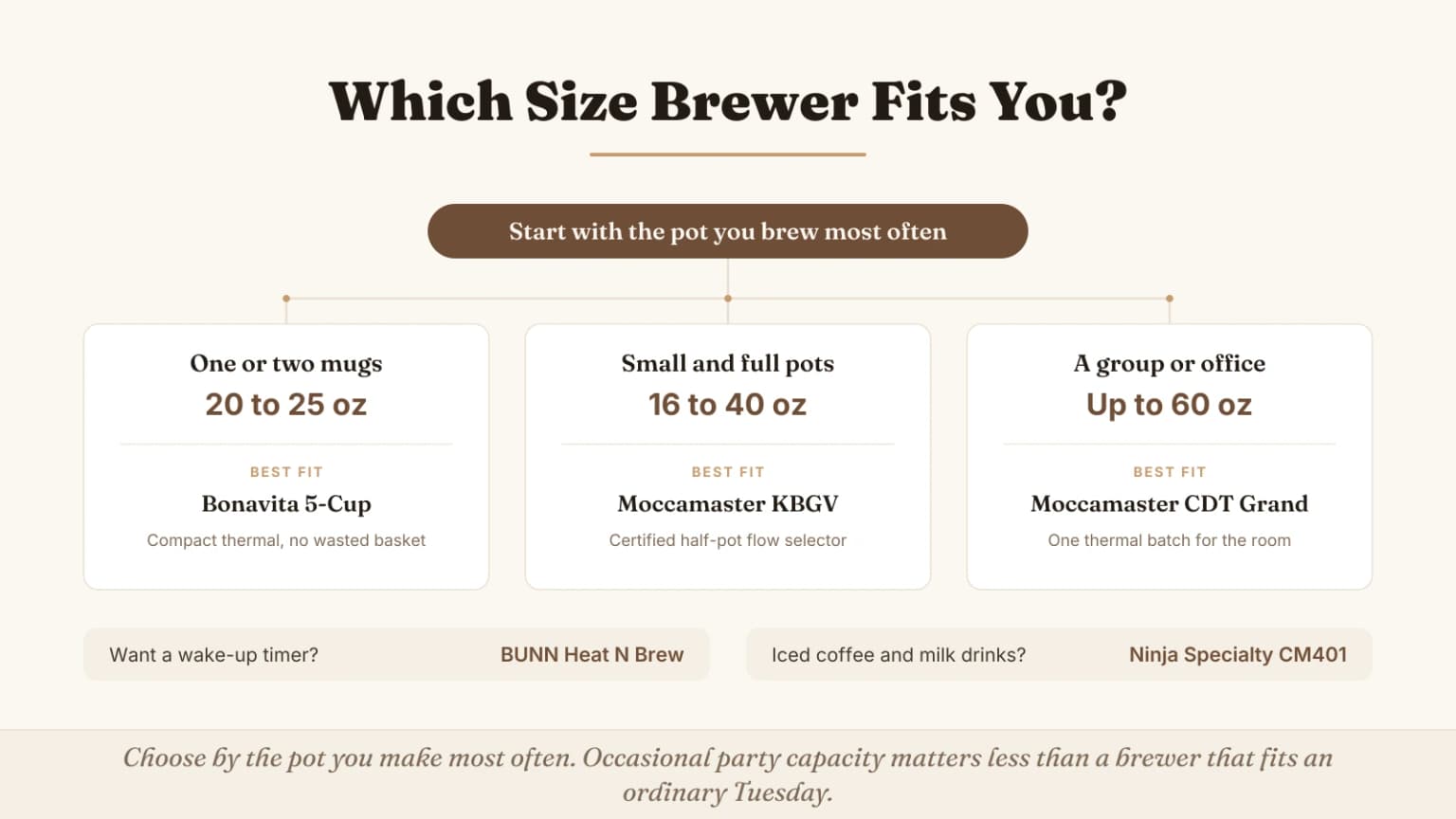
Start with the amount you actually brew. One large mug or two smaller mugs points toward 20 to 25 ounces, two or three drinkers fit 40 to 50 ounces, and a group can justify 60 ounces.
The Bonavita 5-Cup is designed around the first case. It does not ask a large basket and spray pattern to behave well with a token puddle of water.
The KBGV Select occupies the useful middle. Its selector changes the flow for a 16 to 20-ounce half pot or a full 40-ounce batch, so the smaller brew does not simply rush through.
At the other end, the Moccamaster CDT Grand makes sense only if 60 ounces disappear. Buying it for an occasional single mug wastes coffee and counter depth.
Choose by the pot you make most often. Occasional party capacity is less important than a brewer that fits an ordinary Tuesday.
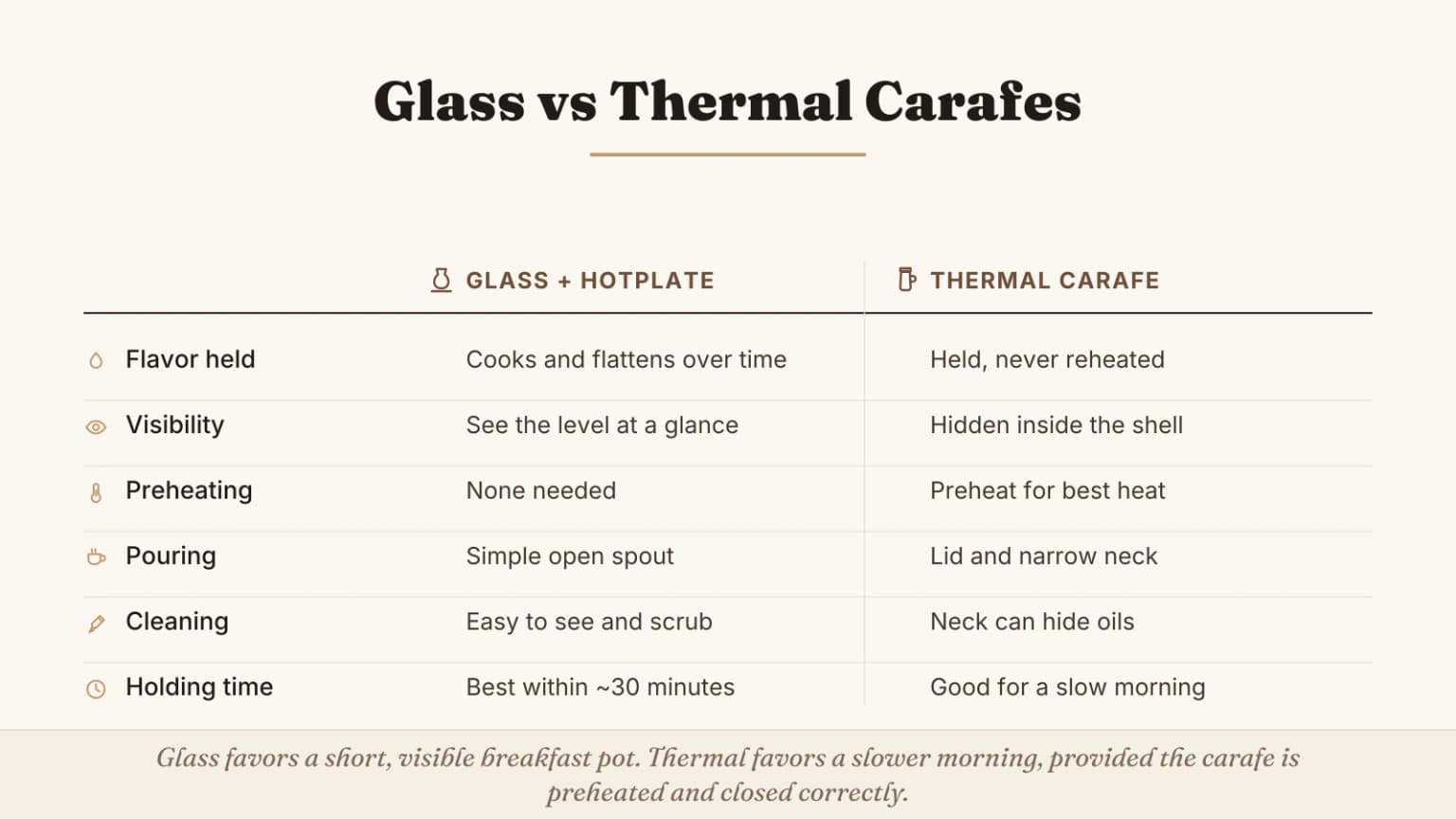
Carafe choice comes next. Glass is simple to see and scrub, but its warming plate keeps adding heat after brewing has finished.
Thermal carafes hold by insulation. They avoid that cooked flavor, yet reward preheating and often have narrower openings, more complicated lids, and a less obvious fill level.
The right answer depends on pace. Glass works when the pot is gone in roughly half an hour, while thermal is safer when cups are spread across a longer morning.
Match the brewer to your morning
Match the brewer to your morning
Your real need
Best system
Why it fits
One or two mugs
25 oz thermal
A small basket stays inside its intended recipe
Small and full pots
16 to 40 oz selector
Flow changes with the batch setting
Iced and milk drinks
Multi-size glass system
Concentrated modes and a frother add range
Coffee waiting later
40 oz thermal
Insulation holds heat without cooking flavor
Scheduled wake-up pot
Programmable glass
A clock starts the heating cycle for you
Office or large group
60 oz thermal
One cycle serves more people
Coffee-maker cup counts are not standard. Compare ounces, then check the minimum useful batch and the carafe type.
The last fork is control. The BUNN Heat N Brew offers scheduled brewing, while the Moccamaster thermal models favor switches, mechanical parts, and direct routines.
Neither philosophy is inherently better. A timer saves a morning step, but a simpler brewer gives electronics fewer jobs and usually makes diagnosis easier.
The 7 best SCA certified coffee makers
The ranking rewards cup quality first, then batch fit, owner evidence, carafe behavior, serviceability, and value. A lower-ranked machine can still be the better purchase when its role matches your routine.
Amazon US ratings and review counts were recorded in July 2026. Prices were API-verified at publication and may change. Amazon.com prices as of 15/09/2026. Details
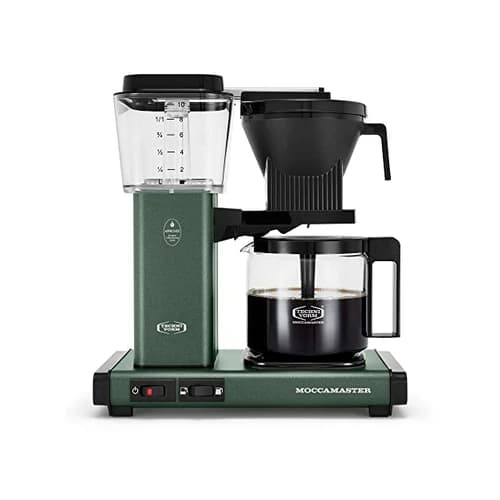
1. Technivorm Moccamaster KBGV Select
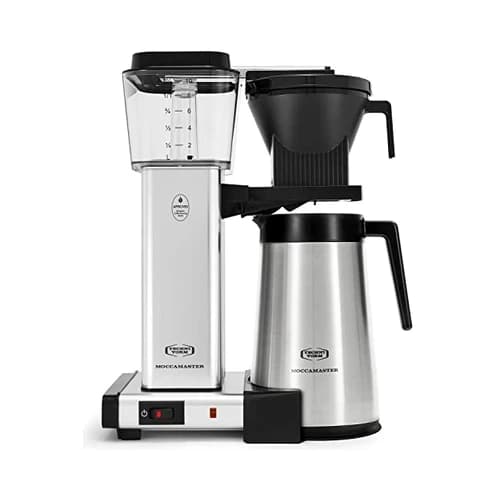
The Moccamaster KBGV Select wins because it handles the batch most households make and the smaller batch they often settle for, without burying either one behind menus.
Its 4.2-star average across 4,964 Amazon ratings, at the time of writing, adds useful long-term evidence to a design built around replaceable parts and a five-year limited warranty.
Technivorm Moccamaster KBGV Select
Rated 4.2 from 4,964 ratings
A fast glass-carafe brewer with certified half and full batches, simple switches, and a serviceable modular build.
The KBGV Select model changes more than volume when its switch moves. The restricted half-pot flow gives a smaller dose enough contact time, which is the feature that separates it from a plain on-off brewer.
Balanced owner reports praise speed, clean flavor, and parts that lift off without tools. The recurring friction is equally mundane: an awkward carafe lid, no wake-up timer, and a shower arm that may leave the bed's perimeter drier.
The honest weak point is the hotplate. Its lower setting is gentler for a half pot, but any plate keeps changing brewed coffee, so move a slow-drinking pot into an insulated server rather than holding it for hours.
Buy it if you alternate between two mugs and a household pot, value repairability, and prefer mechanical clarity to programming. Skip it if coffee must be waiting before you enter the kitchen.
2. Ninja Specialty CM401
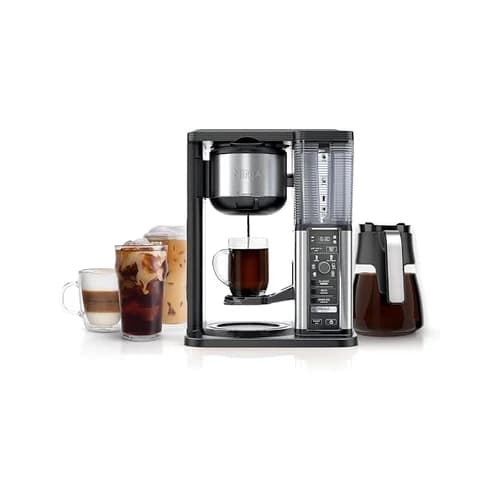
The Ninja Specialty CM401 is the broadest coffee station here. It moves from a cup to a 50-ounce carafe, adds iced and concentrated modes, and folds a milk frother against the side.
At the time of writing, 19,660 Amazon ratings average 4.6 stars. That is both the largest and highest-rated owner base in this guide, at a verified price far below the Moccamaster models.
Ninja Specialty Coffee Maker CM401
Rated 4.6 from 19,660 ratings
A flexible glass-carafe system for classic drip, concentrated specialty drinks, iced coffee, and six serving sizes.
The CM401's strongest trick is range without capsules. Over Ice brews hot coffee at a concentration meant to survive melting cubes, while Specialty produces a small concentrate for milk drinks rather than true espresso.
Owners repeatedly value that versatility, the removable tank, and coffee that arrives properly hot. Three-star reports focus on the clean light, drips around the basket or carafe, and the number of pieces competing for drying space.
The fold-away whisk is useful, but it introduces air only. Heat milk separately if you want a hot latte, and do not mistake the concentrate for a nine-bar espresso shot with crema.
Buy it for iced coffee culture, mixed drink preferences, and genuine value. Skip it if your only goal is one consistent 40-ounce pot in the fewest possible steps.
3. Technivorm Moccamaster KBT
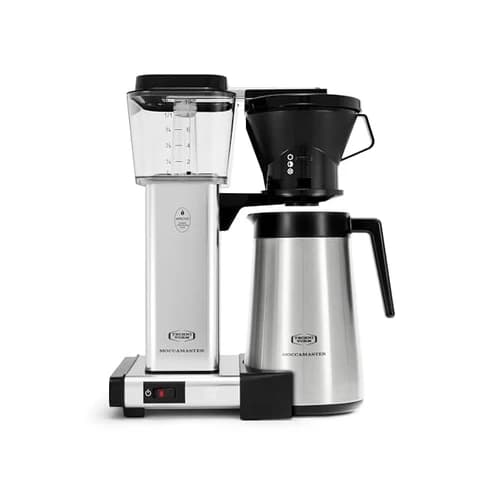
The Moccamaster KBT pairs a 40-ounce thermal carafe with a manual brew-basket lever. That lever is a small but meaningful advantage for people willing to manage bloom and flow.
Its Amazon listing held 4.2 stars across 3,281 ratings at the time of writing. The evidence points to a durable brewer whose quirks come mainly from the same manual control that enthusiasts appreciate.
Technivorm Moccamaster KBT
Rated 4.2 from 3,281 ratings
A 40-ounce thermal brewer with a three-position basket control for open, restricted, or stopped flow.
Key details
40 oz batch capacity
Double-wall thermal carafe
Three-position manual drip stop
Copper boiling element
Brew-through and travel lids
Five-year limited warranty
What we like
Thermal holding without a hotplate
Manual flow control supports bloom and small adjustments
The KBT model lets you close the basket for a short bloom, restrict the outlet for a smaller batch, or open it for a full pot. That control can improve contact, but it also makes the user part of the safety system.
Three-star feedback often starts with excellent coffee and ends with a puddle. The usual risk is walking away while the outlet remains closed, allowing the basket to fill above the filter.
The weak point is convenience, not extraction. You remove a lid to brew, install another to hold or travel, and clean through a narrower neck than a glass pot offers.
Buy it if you want a durable thermal machine and enjoy one small moment of manual control. Choose the KBGT instead if another household member might forget the basket lever.
4. BUNN Heat N Brew
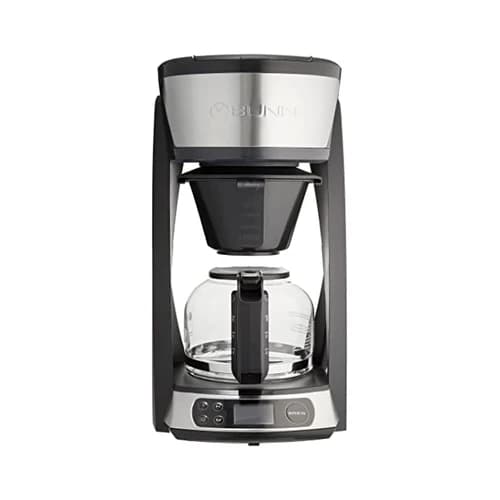
The BUNN Heat N Brew is the practical answer for buyers who want certified brewing and a clock without paying premium European prices. It can schedule the heating and brewing process before wake-up.
At the time of writing, its 3,675 Amazon ratings averaged 4.2 stars. The $175 verified price places it close to the Ninja, but its purpose is a straightforward 20 to 50-ounce glass-carafe pot.
BUNN Heat N Brew
Rated 4.2 from 3,675 ratings
A programmable 10-cup brewer that heats water before release, with a glass carafe and delayed-start clock.
The HB model separates heating from water release. That avoids sending cooler early water through the grounds, but it also means the apparent brew cycle includes several minutes before coffee starts entering the carafe.
Owner praise centers on hot, full-flavored coffee and the timer. More balanced reviews mention a small-feeling handle, splashing while filling the top reservoir, and surprise at the preheat wait.
The long-term weak point is scale around the temperature-controlled release valve and sprayhead. If water begins dripping too early or the cycle slows, cleaning and descaling are the first checks, not a stronger dose.
Buy it if a ready-on-waking full pot matters and you will maintain the water path. Skip it for frequent sub-20-ounce brews or a counter tucked tightly under low cabinets.
5. Bonavita 5-Cup BV1500TS
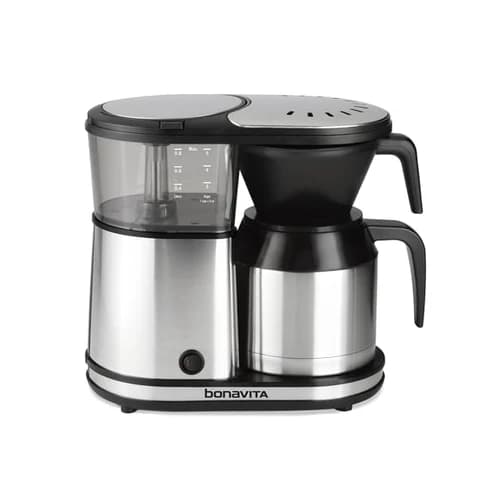
The Bonavita 5-Cup BV1500TS solves a problem most buying guides ignore: a full-size brewer is often the wrong tool for one or two people, even when it can technically accept less water.
Its listing averaged 4.1 stars across 3,081 ratings at the time of writing. The $149.99 verified offer makes it the least expensive finalist, though the Amazon seller was a third party when checked.
Bonavita 5-Cup BV1500TS
Rated 4.1 from 3,081 ratings
A compact 25-ounce thermal brewer with one-button operation and an optional pre-infusion mode for freshly roasted coffee.
The BV1500TS model targets about 25 ounces and completes the job in roughly six minutes. Its optional pre-infusion pauses early flow so fresh grounds can release gas before the main extraction.
Owners like the compact body, hot brew, and lack of menus. Three-star reports often accept the coffee but criticize pouring without the lid, moisture trapped around parts, or plastic in the hot-water path aging over time.
The real caution is the listing, not the recipe. Because the verified offer came from a marketplace seller, confirm the seller, return window, and written US warranty coverage before ordering.
Buy it if 20 to 25 ounces is genuinely your normal output. Do not buy it as a compact-looking substitute for a 40-ounce family machine; two cycles erase much of its convenience.
6. Technivorm Moccamaster KBGT
The Moccamaster KBGT takes the KBT's 40-ounce thermal idea and removes its manual basket lever. An automatic drip stop closes when the carafe moves away and reopens when it returns.
Its 2,093 Amazon ratings averaged 4.2 stars at the time of writing. That owner base is smaller than the KBT's but comfortably deep enough to expose the carafe, basket, and daily-fit complaints that matter.
Technivorm Moccamaster KBGT
Rated 4.2 from 2,093 ratings
A one-switch 40-ounce thermal brewer with an automatic basket stop and the serviceable Moccamaster platform.
The KBGT model is the safer shared-kitchen choice. There is no lever to leave closed, and the carafe presses the basket mechanism as it slides into place.
That convenience creates its own owner pattern. If the carafe or base plate is misaligned, coffee can collect in the basket; if grounds reach the valve, the stop can begin sticking or dripping.
The honest limit is batch flexibility. It will accept less water, but it lacks the KBGV Select's certified half-pot flow change and the KBT's manual restriction.
Buy it for a simple full thermal pot that several people can operate. Choose the KBT for active flow control or the KBGV Select when smaller certified batches matter more than insulated holding.
7. Technivorm Moccamaster CDT Grand
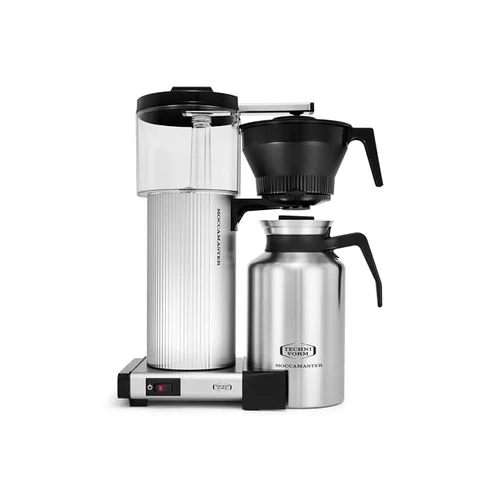
The Moccamaster CDT Grand is not a bigger brewer for the sake of a bigger number. Its 60-ounce capacity and large flat-bottom basket are aimed at offices, meetings, and households that empty two ordinary pots.
At the time of writing, 453 Amazon ratings averaged 4.2 stars. That is the lightest evidence base here, but it is several hundred ratings on a mature, specialized machine rather than a handful on a new listing.
Technivorm Moccamaster CDT Grand
Rated 4.2 from 453 ratings
A high-capacity 60-ounce thermal brewer for groups, built around a large basket and the familiar copper-element platform.
The CDT Grand model changes the basket as well as the tank. That matters because a deep dose in an undersized cone can stall, while a broad bed gives a large batch a more workable path.
Positive owners describe the relief of filling one carafe for a group. More measured reviews mention the machine's height, the amount of coffee required, and a carafe that must be tipped farther near the end.
The weakness is specialization. A 60-ounce system is expensive and clumsy if most days require 20 ounces, and its 453-rating sample gives less certainty than every other finalist.
Buy it when large batches are routine and a thermal carafe will circulate among people. For occasional guests, a 40-ounce brewer plus a second quick batch is the more sensible appliance.
What SCA certification actually tests
The Specialty Coffee Association badge is useful because it asks a machine to prove measurable brewing behavior. It is not awarded because a brand writes "barista" or "gold cup" on a box.
Manufacturers submit a specific brewer for third-party laboratory evaluation. The program then checks whether that unit can produce coffee inside defined ranges under controlled conditions.
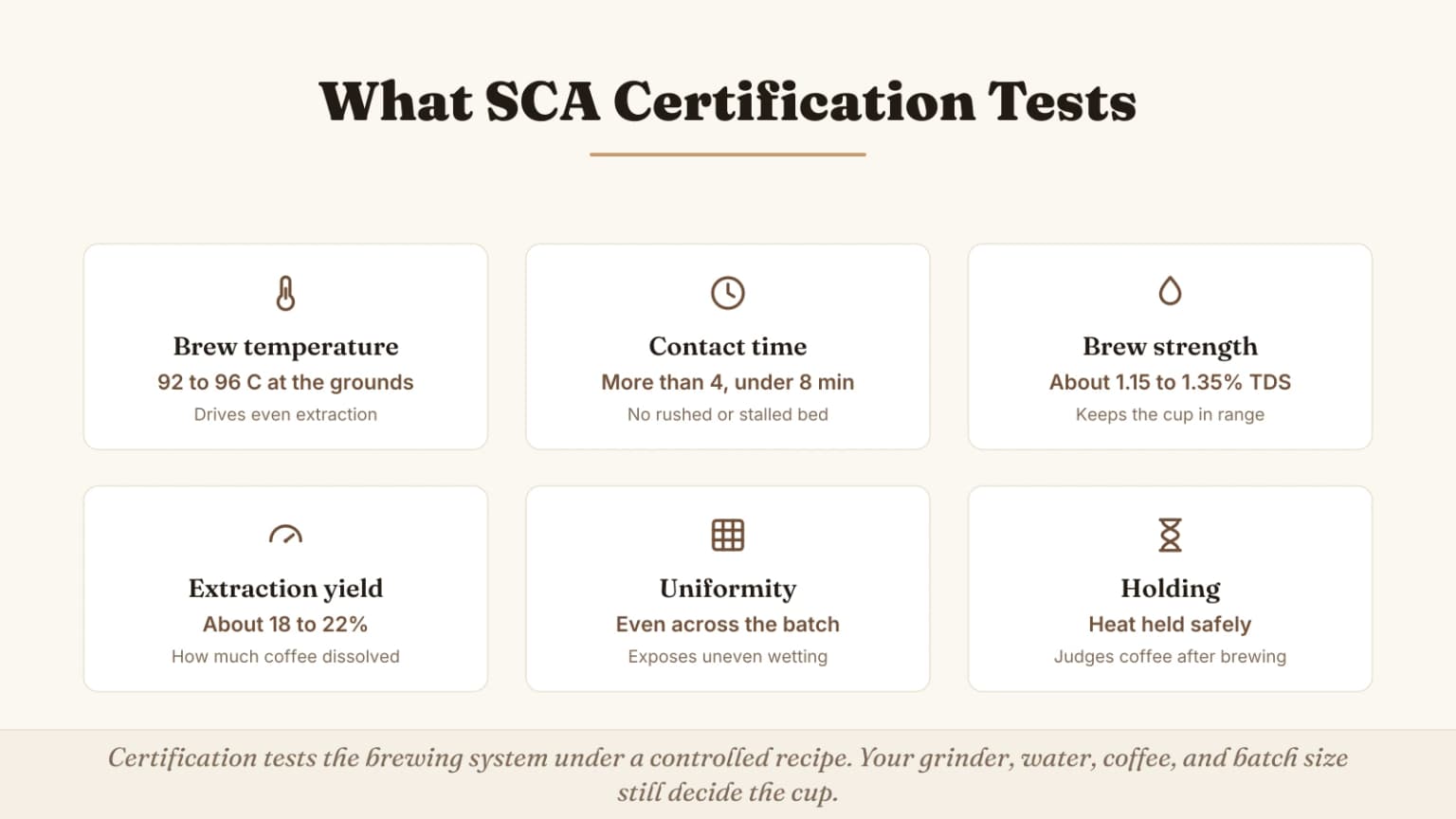
Temperature is the best-known test. Water at the grounds should reach 92 degrees C within the first minute and remain between 92 and 96 degrees C, roughly 198 to 205 degrees F, during brewing.
Contact time also matters. The requirements target more than four and less than eight minutes, which limits both a fast rinse that under-extracts and a stalled basket that pulls excessive bitterness.
The laboratory does not stop a timer and declare victory. It evaluates the beverage's dissolved strength, extraction yield, temperature uniformity, and consistency across the brewed batch.
The familiar targets are about 1.15 to 1.35 percent dissolved coffee solids, or TDS, and 18 to 22 percent extraction yield. Those ranges describe balanced filter coffee, not an instruction to make every roast taste identical.
Water distribution and holding behavior matter too. A mixed carafe can hide local failures in the bed, while no laboratory can make stored coffee taste as fresh as the first cup.
What the SCA test tells you
What the SCA test tells you
Measured area
Program target
Why it matters
Brew temperature
92 to 96 C at the grounds
Supports efficient, repeatable extraction
Contact time
More than 4, less than 8 minutes
Avoids a rushed rinse or stalled bed
Brew strength
About 1.15 to 1.35% TDS
Keeps the cup within a recognized drip range
Extraction yield
About 18 to 22%
Checks how much soluble coffee entered the cup
Uniformity
Measured across the basket and batch
Exposes uneven wetting and temperature
Holding
Heat and safety checks
Assesses coffee after brewing is complete
Targets summarize the SCA Certified Home Brewer requirements. They describe controlled test performance, not a guarantee for every bean, grind, dose, or batch.
The dose assumption is easy to miss. The basket must accommodate a recipe near 55 grams of coffee per liter at full capacity, so certified brewing is not a license to use a tiny scoop for a large pot.
For a 40-ounce batch, that ratio is roughly 65 grams. A 60-ounce batch lands near 98 grams, which explains why the CDT Grand needs a large basket.
Certification tests the brewing system under a controlled recipe. Your grinder, water, coffee, and chosen batch still determine the result at home.
Certification is model-specific. A glass and thermal version can require separate submissions, and a similar name in another voltage or region should not be assumed to share the same record.
The licensing period is three years. When an older brewer disappears from the current directory, the absence can reflect an expired license or a changed program cycle rather than proof that it never passed.
This guide therefore distinguishes current program visibility from documented certification history. We also judge the exact machine on owner evidence, not on a halo borrowed from its brand.
The KBGV Select has especially clear documentation at both half and full settings. For older models, keep any certification record attached to the exact unit you buy.
The badge verifies a capable brewer under test conditions; it does not certify your grinder, water, recipe, carafe habits, warranty service, or morning patience.
That limitation is healthy. It turns certification into strong technical evidence without asking one logo to answer questions it was never designed to answer.
Glass versus thermal carafes
Glass and thermal brewers can produce the same first cup. The difference appears after brewing, when one system adds heat and the other tries to conserve it.
A glass carafe is transparent, light, and easy to rinse. You can see the remaining level from across the kitchen, catch sediment quickly, and usually find a simpler shape around the rim.
Its weakness is the warming plate. Even a well-regulated plate drives aroma out of the liquid and changes the balance as water evaporates, especially when a shallow final cup sits across a broad hot base.
If your household finishes 40 to 50 ounces during breakfast, glass is reasonable. Pouring into mugs over 20 or 30 minutes gives the plate little time to become a taste problem.
If one pot is expected to bridge several meetings, thermal has the better physics. Double walls slow heat transfer without reheating the liquid from below.
The same physics governs an insulated French press, with one extra catch. A press still has grounds sitting in it, so held heat keeps extracting.
Thermal is not maintenance-free magic. A room-temperature carafe absorbs heat immediately, and a lid left open lets warmth and aroma escape through the neck.
Preheat with hot tap water while grinding the beans. Empty it just before brewing, fit the brew-through lid when the design requires one, then close the serving lid after the cycle.
Carafe ergonomics differ sharply. The KBT has separate lids, the KBGT depends on correct placement, and the Bonavita pours most cleanly with its lid installed.
Glass favors a short, visible breakfast pot. Thermal favors a slower morning, provided the carafe is preheated and closed correctly.
Cleaning pushes the trade the other way. A glass pot tolerates visual inspection and a soft bottle brush, while a narrow thermal neck can hide coffee oils that smell stale before they look dirty.
Use fragrance-free dish soap where the manual permits it, rinse until no foam remains, and let every lid dry open. Soaking a valve lid without checking its manual can trap water inside chambers.
Replacement risk belongs in the decision. Glass can break in one drop but is easy to identify; a dented thermal shell may still work, while a damaged inner liner or seal can quietly reduce heat retention.
For the best SCA certified coffee maker overall, we accept glass because the KBGV Select's half-batch behavior is unusually useful. For slow drinkers, we would move the fresh pot into a separate server.
The KBT is our preferred thermal choice for an engaged owner. The KBGT suits a shared kitchen, while the CDT Grand protects a 60-ounce group batch without a large hotplate.
Counter space, noise, and daily use
Coffee-maker dimensions rarely tell the whole fit story. The footprint may clear your counter while the open reservoir lid, raised basket, or tilted carafe collides with the cabinet above it, a trap that also catches dual coffee makers.
Measure three positions: closed for storage, open for filling, and extended for removing the carafe. Include the outlet arm on Moccamaster models and the side frother on the Ninja.
Noise is modest because none of these machines contains a grinder. Expect heater clicks, water movement, basket drips, and hotplate sounds rather than the sharp motor burst of a bean-to-cup machine.
Timed brewing changes that calculation. The BUNN can start before you wake, but only if grounds sit in the basket overnight and your grinder ran the evening before.
Filling method matters every day. Removable reservoirs travel to the sink, while fixed tanks ask you to use the carafe or another vessel and pour into an opening under the cabinets.
Filter handling also shapes the mess. Seat the paper flat against the basket, keep grounds below its edge, and choose the taller paper BUNN specifies for its faster water delivery.
The KBT makes valve state visible but relies on memory. The KBGT and KBGV trade that task for alignment, so slide the carafe fully into position before leaving the basket unattended.
Daily practicality is therefore a chain, not one feature. Reservoir access, filter shape, basket valve, carafe lid, holding method, and cleaning space all repeat more often than certification paperwork.
The case against an SCA brewer
An enthusiast can make a fair case that certification receives too much credit. A careful pour-over offers direct control of bloom, agitation, flow, and temperature for less money.
A brewer also cannot repair mediocre inputs. Stale pre-ground coffee, a blade grinder, heavily chlorinated water, or a dose guessed with a tiny scoop will flatten the advantage of excellent temperature control.
The badge measures a submitted recipe, usually near full capacity. It does not mean a 60-ounce machine will brew 12 ounces well or that every selectable mode on a multi-function machine passed separately.
Price is the other hard objection. A Moccamaster costs $300 to $365 before a grinder and scale, and it does not produce coffee six times better than a $50 manual brewer.
There is also a current-status trap. Retailers may keep an SCA badge in old copy after a three-year license cycle, while a historically tested machine may vanish from the newest directory.
If current certification is a purchasing requirement, verify the exact model in the live SCA directory. Do not infer it from a sibling machine, a brand-wide claim, or a similar product photo.
Who should skip this whole list? A person making one small cup with time to enjoy the process may be happier with an AeroPress or pour-over, a grinder, a scale, and a kettle.
Someone who wants espresso, true crema, or steamed microfoam also needs a different category. The Ninja's concentrate and unheated frother are useful, but they do not turn a drip brewer into an espresso machine.
Our case for these machines is narrower and stronger. They automate a recognized filter-coffee recipe for people who value repeatable batches, especially when more than one mug is involved.
Five-year ownership costs
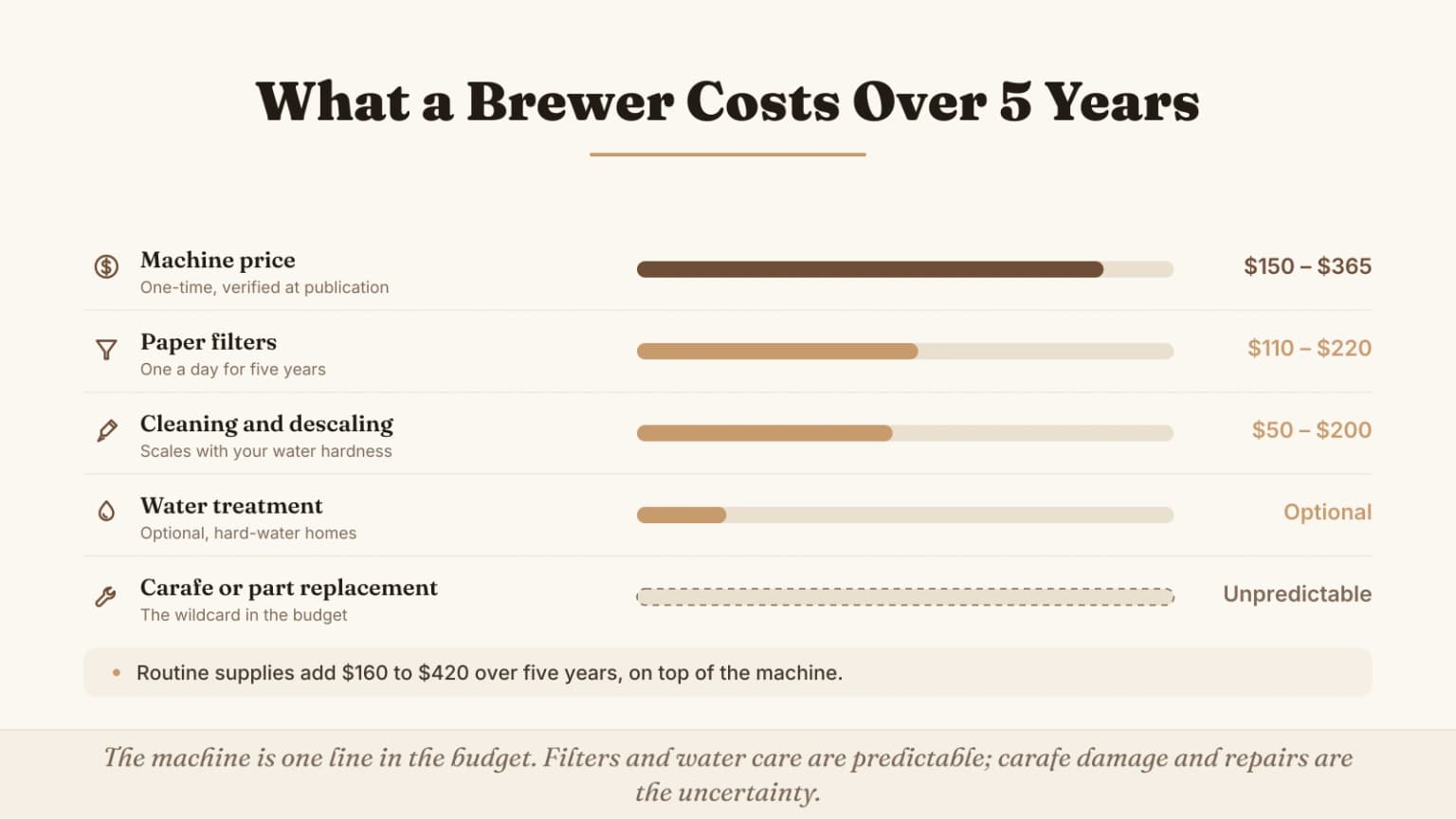
The sticker price is only the visible part of a drip setup. Paper filters, cleaner, descaler, water treatment, and an occasional broken carafe can matter across five years.
Coffee dominates the true household cost, but it should not distort a machine comparison. Every brewer uses roughly the same beans for the same water volume when the recipe is held constant.
We therefore exclude coffee, grinders, electricity, sales tax, and optional accessories. The estimate below isolates the supplies needed to keep the brewer operating and tasting clean.
Our baseline assumes one paper filter on 365 days each year. At roughly 6 to 12 cents each, five years of paper costs about $110 to $220.
Cleaning and descaling vary with water hardness. Allowing $10 to $40 per year creates a five-year range of $50 to $200 without pretending that a soft-water home and a hard-water home need the same schedule.
Together, that is $160 to $420 in routine supplies. A reusable filter can cut paper cost, but it changes sediment and oil in the cup and still requires cleaning.
Five-year cost before coffee
Five-year cost before coffee
Brewer
Verified price
Routine supplies
Five-year baseline
Bonavita 5-Cup
$149.99
$160 to $420
$310 to $570
Ninja CM401
$160.00
$160 to $420
$320 to $580
BUNN Heat N Brew
$175.00
$160 to $420
$335 to $595
Moccamaster KBT
$300.61
$160 to $420
$461 to $721
Moccamaster KBGT
$338.42
$160 to $420
$498 to $758
Moccamaster CDT Grand
$359.87
$160 to $420
$520 to $780
Moccamaster KBGV
$365.09
$160 to $420
$525 to $785
Baseline equals the verified machine price plus estimated paper filters and cleaner or descaler for five years. Coffee, grinder, electricity, repairs, and tax are excluded.
This table is a budgeting range, not a failure forecast. One broken glass carafe can add cost early, while a carefully handled unit may need nothing beyond filters and cleaner.
Repairability can reverse the cheapest-first story. A replaceable switch, basket, lid, or carafe may keep a premium brewer useful after a more integrated appliance would be uneconomical to service.
The machine is one line in the budget. Filters and water care are predictable; carafe damage and repairs are the uncertainty.
If white deposits appear quickly in a kettle, use the machine's harder-water maintenance interval. Prevention costs less than diagnosing a valve or heater after flow has slowed.
When to buy
Buy when the right model meets your actual batch need, not when a countdown timer creates panic. Coffee makers are durable goods, so a wrong carafe at 25 percent off remains the wrong carafe.
Prime Day and Black Friday can produce useful US discounts, especially on mass-market Ninja and BUNN listings. Moccamaster promotions may apply only to selected colors, so compare the exact ASIN and warranty seller.
A 10 to 15 percent reduction on an authorized listing is meaningful. If finish is flexible, compare colors while confirming that the model number, voltage, carafe, and included parts stay identical.
The best buying moment is often one week before the old brewer becomes unusable. That gives time to verify seller terms, inspect the package, and return a damaged carafe without losing morning coffee.
How to brew better automatic drip
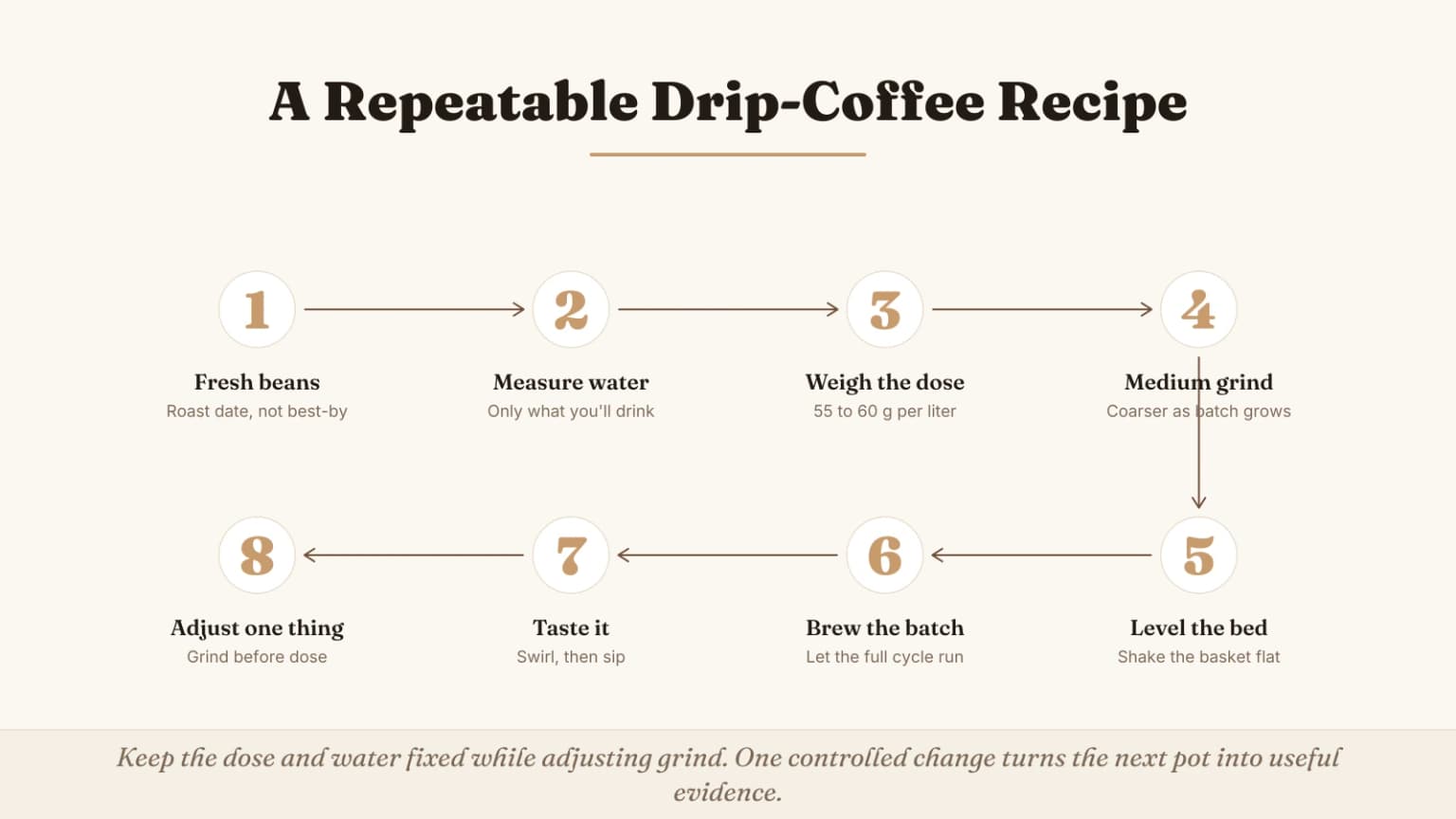
An SCA certified machine narrows the equipment error, which makes recipe errors easier to see. A simple repeatable process will improve the cup more than random changes to every variable.
Start by treating mass as the language of brewing. Scoops measure space, not coffee, and two roasts can fill the same scoop at noticeably different weights.
A useful starting ratio is 55 to 60 grams of coffee per liter of water. That means about 33 to 36 grams for 20 ounces, 65 to 71 grams for 40 ounces, and 98 to 106 grams for 60 ounces.
Those numbers are starting points, not commandments. Dark roasts often taste full at the lower end, while a light roast may benefit from a little more coffee or a finer grind.
Keep the dose and water fixed while adjusting grind. One controlled change turns the next pot into useful evidence.
A repeatable automatic-drip recipe
1
Choose fresh coffee that suits the machine
Use beans with a clear roast date when possible. Medium and medium-light roasts reveal temperature and grind changes without coating the basket in heavy surface oil.
Tip Buy an amount you can finish while the aroma is still lively, then keep the bag sealed away from heat and sunlight.
2
Measure the water you intend to drink
Use the reservoir marks for convenience, but verify them once with a kitchen scale or measured pitcher. Do not fill a 60-ounce brewer for a single mug.
3
Weigh a starting dose
Begin at 55 to 60 grams per liter. Record the exact coffee and water weights so a better or worse cup can be repeated or corrected.
Tip One gram of water is close enough to one milliliter for an everyday brew recipe.
4
Set a medium to medium-coarse grind
Use medium for a small flat-bottom basket and move coarser as batch depth grows. The finished bed should drain without a deep pool or a rapid central crater.
5
Prepare the filter and thermal carafe
Seat the correct paper fully against the basket. If using thermal, preheat the carafe with hot water and empty it immediately before brewing.
Watch out Use the taller filter specified for the BUNN. A short paper wall can let grounds escape when water rises quickly.
6
Level the bed before starting
Shake the basket gently until the grounds lie flat. A sloped bed gives water an easier side and makes an automatic spray pattern work harder.
7
Select the correct batch control
Use half-pot on the KBGV Select for the smaller 16 to 25-ounce range, open the KBT lever for a full pot, and confirm every automatic valve is moving freely.
Watch out Never leave the KBT basket closed through a full unattended cycle. It can fill beyond the filter and overflow.
8
Let the cycle finish before judging it
Coffee entering early is stronger than coffee entering late. Swirl the carafe gently after the final drip so the served cup represents the complete extraction.
9
Adjust one variable by taste
If the cup is sharp and thin, grind one step finer. If it is dry, harsh, or slow to drain, grind one step coarser before changing the dose.
10
Protect the finished coffee
Close a thermal lid promptly or serve glass-carafe coffee while fresh. Transfer a slow pot off its hotplate instead of asking added heat to preserve it.
Change grind before changing dose because it preserves beverage strength while steering extraction. If the balance becomes good but the cup remains weak, add coffee while keeping water fixed.
For iced coffee on the Ninja, fill the serving vessel with the ice the mode expects and let the concentrated hot brew melt part of it. Brewing ordinary-strength coffee and adding ice later produces a thinner drink.
Finally, write down the recipe. Bean, dose, water, grind, mode, and one tasting note fit on a small card and prevent every new morning from becoming a fresh experiment.
Cleaning and descaling schedule
Most long-term complaints begin as small flow changes. Coffee oils narrow a basket valve, mineral scale insulates a heater, and fines collect where a quick rinse cannot reach.
Cleaning removes coffee residue. Descaling dissolves mineral deposits. They solve different problems, so running extra descaler will not remove rancid oil from a carafe lid.
The manual controls the safe chemical and interval for each model. The schedule below is a practical framework, with frequency tightened when water is hard or the machine sees several pots a day.
The maintenance rhythm
1
After every pot: discard and rinse
Remove the paper and grounds after they cool. Rinse the basket, valve area, carafe, and lid before oils dry into a film.
Tip Leave washed parts open to air. A closed damp thermal lid can hold odor even when it looks clean.
2
Daily: wipe the machine dry
Wipe the shower arm, hotplate, carafe seat, and exterior with a soft damp cloth. Clear stray grounds before they enter a drip-stop mechanism.
Watch out Unplug and cool the brewer before cleaning around a hotplate, outlet arm, or electrical base.
3
Weekly: inspect every water opening
Remove the showerhead or sprayhead if the manual allows it. Rinse visible holes and test the basket valve by hand without forcing it.
4
Weekly: remove coffee oils
Wash approved removable parts with mild, fragrance-free soap. Use a soft bottle brush for the carafe and rinse until no scent or foam remains.
5
Monthly: check flow and cycle time
Time a normal batch and watch distribution. New sputtering, early dripping, a slower cycle, or water left in the tank can signal scale or blockage.
Tip A baseline time recorded when the brewer is new makes gradual slowing easier to notice.
6
As needed: descale the water path
Use the product and dilution approved in the manual, then run the required fresh-water rinses. Hard water may need this far more often than soft water.
Watch out Do not mix cleaning chemicals or assume vinegar is approved. Odor, seals, and rinse requirements differ by machine.
7
Every few months: audit loose parts
Check lids, seals, valves, baskets, and the glass carafe for wear or chips. Replace a compromised part before heat and a full pot make failure expensive.
8
After storage: flush before brewing
If the machine sat unused, inspect for odor and run fresh water through the clean system. Wash the carafe and basket again before adding coffee.
Moccamaster's removable outlet arm and basket make the water path unusually visible. That helps diagnosis, but the metal arm carries very hot water and belongs in your hands only when cool.
A brewer that suddenly tastes weak is not automatically dirty. Confirm the dose and grinder first, then compare cycle time and water delivery before reaching for chemicals.
Maintenance works best as observation rather than punishment. A one-minute rinse after each pot prevents the unpleasant monthly rescue that makes an otherwise simple machine feel demanding.
Which SCA coffee maker should you buy in 2026?
Choose the machine whose normal batch, carafe, and controls fit the coffee you already make. Certification makes the brew systems credible; fit determines which one stays pleasant after the novelty fades.
For most households, the KBGV Select covers the widest useful range with the fewest questionable compromises. Its premium is easiest to defend when both half and full pots happen every week.
The Ninja is the rational value winner. It costs less than half as much, owns the strongest rating record, and adds iced, concentrated, cup-size, and milk-texturing options.
The KBT is the thermal choice for someone who enjoys a little control. Its lever rewards attention, while the insulated carafe protects a slower pot without a hotplate.
The three we recommend first
Our pick
Moccamaster KBGV Select
$365.09
Best for
Half and full household pots
Carafe
Glass with two heat settings
Owner evidence
4.2 stars, 4,964 ratings
Weak spot
No timer or thermal holding
Ninja Specialty CM401
$160.00
Best for
Value, iced coffee, mixed sizes
Carafe
Glass with warming plate
Owner evidence
4.6 stars, 19,660 ratings
Weak spot
More parts and plastic
Moccamaster KBT
$300.61
Best for
Manual control and thermal holding
Carafe
Double-wall thermal
Owner evidence
4.2 stars, 3,281 ratings
Weak spot
Basket can be left closed
The three we recommend first
Specification
Our pick
Moccamaster KBGV Select
$365.09
Ninja Specialty CM401
$160.00
Moccamaster KBT
$300.61
Best for
Half and full household pots
Value, iced coffee, mixed sizes
Manual control and thermal holding
Carafe
Glass with two heat settings
Glass with warming plate
Double-wall thermal
Owner evidence
4.2 stars, 4,964 ratings
4.6 stars, 19,660 ratings
4.2 stars, 3,281 ratings
Weak spot
No timer or thermal holding
More parts and plastic
Basket can be left closed
For a timer, choose the BUNN. The Bonavita fits one or two drinkers, the KBGT fits a shared thermal pot, and the CDT Grand belongs only where 60 ounces is routine.
You can browse the same-region coffee maker guides as the library grows. We keep recommendations tied to US listings, pricing, voltage, and availability.
The best purchase is not the machine with the longest feature list. It is the one that makes the right amount, holds it the way you drink it, and stays easy enough to clean every week.
Frequently asked questions
What does SCA certified mean for a coffee maker?
An SCA certified coffee maker has passed independent tests based on the Specialty Coffee Association's brewing standards. Those checks cover brew temperature, contact time, extraction, strength, uniformity, and holding performance.
Certification applies to a tested model and configuration. It does not promise perfect controls, an easy carafe, or years without repairs, so the badge should be the start of a buying decision rather than the end.
Is an SCA certified coffee maker worth it?
It is worth paying for when you want repeatable drip coffee without managing a pour-over. The certification removes much of the risk that a brewer runs too cool, too quickly, or distributes water badly at its tested capacity.
It is less valuable if you rarely weigh coffee, use stale grounds, or leave a glass carafe cooking on its hotplate. Fresh beans, a burr grinder, suitable water, and a sensible recipe still control much of the flavor.
Which SCA certified coffee maker is best for small batches?
The Bonavita 5-Cup BV1500TS is the clearest fit for one or two drinkers. Its 25-ounce capacity avoids forcing a large brewer to work below the batch size for which it was designed.
The Moccamaster KBGV Select is the more flexible choice if you alternate between half and full pots. Its selector changes the flow and hotplate behavior for batches from 16 to 40 ounces.
Does SCA coffee maker certification expire?
The SCA program uses a three-year certification and licensing period. A brewer can therefore have passed the program in an earlier cycle without appearing in the newest directory.
Check the exact model number when current certification matters to you. A brand name alone is not proof, and a different carafe or regional version may be a separate submitted product.
Is a thermal or glass carafe better?
A thermal carafe is better for holding coffee because it preserves heat without cooking the drink. It works best when preheated, and its lid and narrow opening can make pouring and cleaning less convenient.
A glass carafe is easier to see, rinse, and replace. It suits households that finish a pot promptly, but flavor becomes harsher when brewed coffee sits on a hotplate for too long.
What grind size works in an SCA certified brewer?
Start around medium for a smaller 25-ounce basket and medium-coarse for a full 40 to 60-ounce batch. Grinder labels vary, so drawdown and taste are better guides than a numbered setting.
Grind coarser if water drains slowly and the coffee tastes dry or bitter. Grind finer if the brew finishes quickly and tastes thin, sharp, or weak, changing only one step at a time.