The Breville Bambino Has No Grinder: 7 That Fit Its Basket in 2026
The best grinder for a Breville Bambino or Bambino Plus: we read 17,000+ owner ratings to rank seven 2026 picks, $109 to $599, hand or electric.
By the CoffeeGearGuides team · USA · Updated Oct 15, 2026 · 37 min read
On this page20
The best grinder for Breville Bambino owners is the Breville Smart Grinder Pro. It grinds straight into the Bambino's 54mm portafilter, it times each dose to a fifth of a second, and 7,017 Amazon owners rate it 4.5 stars.
The Bambino is an excellent small machine with one omission. It heats in about three seconds and runs a gentle pre-infusion before full pressure, but it ships without a grinder.
What it does ship with is a choice. Breville packs two kinds of 54mm basket: pressurized dual-wall baskets for pre-ground coffee and non-pressurized single-wall baskets for beans you grind fresh. The grinder you buy decides which of the two you can really use.
If you are still choosing between the Bambino and the Bambino Plus, our guide to espresso machines for latte art ranks both. Everything below applies to either, because they share the same portafilter and the same baskets.
We read Breville's current US manuals for both machines, manufacturer specifications for every grinder, independent espresso reviews, and the owner ratings on 32 grinder listings, more than 17,000 ratings in all.
This 2026 guide covers the seven grinders we would put beside a Bambino ourselves, the famous one we left out, and how to dial in your machine on the basket it was designed around.
How we chose these Bambino grinders for 2026
Our method is research, not hands-on testing, and every claim below rests on a source we can name. You can read how we work on our about page.
For this guide we leaned on three kinds of evidence. The first was Breville's current US manuals for both Bambinos, which set out the baskets, the dose and the shot timing a grinder has to serve.
The second was manufacturer specifications and independent espresso reviews of every grinder, read alongside long-running owner threads on Home-Barista.com and other espresso forums.
The third was the full Amazon rating base, which we read directly from 32 grinder listings.
We did not build this list from written Amazon reviews. We used the star average and the size of each rating base, then weighed both against what the expert and forum evidence says about the grinder.
Four rules shaped the final seven. Every grinder had to reach a true espresso fine with steps small enough to correct a Bambino shot, which ruled out most filter grinders at a glance.
Every grinder had to be in stock on Amazon US at a live price checked through Amazon's own product API. It also had to hold 4.0 stars or better on a rating base deep enough to mean something.
Every grinder had to work with a 54mm Breville portafilter, either directly or with an inexpensive funnel we name. And each one had to serve a different kind of owner; where two grinders suited the same person, we kept the one with the stronger evidence.
The grinder most often recommended for a Bambino elsewhere failed the rating rule. We name it, with its numbers, further down.
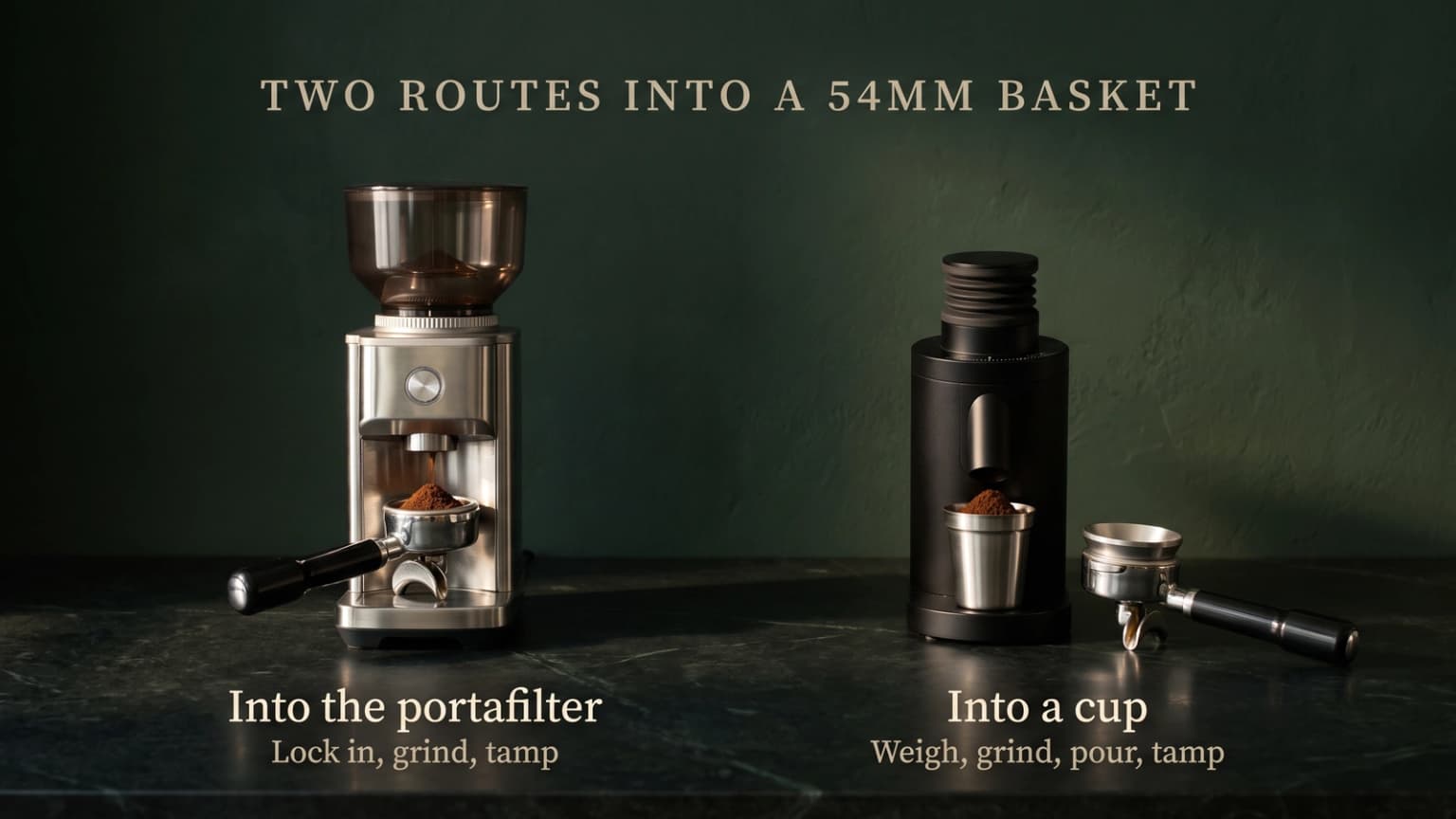
Into the portafilter, or into a cup?
A Bambino grinder either fills the 54mm portafilter directly or fills a cup that you pour into the basket. That route shapes your morning more than any burr specification does.
A portafilter-fed grinder holds the Bambino's handle in a fork or cradle under the chute. You press a button or push the handle, the grounds land in the basket, and you tamp.
The Smart Grinder Pro and both Eureka Mignons work this way. They keep beans in a hopper, so the next shot is always one press away.
A cup-fed grinder drops its grounds into a dosing cup or catch cup instead. You weigh the beans for one shot, grind them, then pour the cup into the basket.
The DF64 and all three hand grinders work this way. They are built for single dosing, which suits anyone who changes beans often or wants nothing waiting in a hopper. Our guide to single-dose coffee grinders covers that workflow in depth.
Two routes into the same 54mm basket. One saves steps on a busy morning; the other leaves nothing behind in the grinder.
Here is the trade in plain terms. Portafilter-fed grinders win on speed, and on making the third drink of the morning as easy as the first.
Cup-fed grinders win on freshness and control, because the coffee you weigh in is the coffee that comes out. The MiiCoffee DF64 II lists its retention, the coffee left inside after grinding, at under a tenth of a gram.
Two routes into a 54mm basket
Two routes into a 54mm basket
What changes
Into the portafilter
Into a cup
Steps per shot
Lock in, grind, tamp
Weigh, grind, pour, tamp
Where beans wait
In a hopper on top
In the bag, weighed per shot
Changing beans
Purge the old coffee first
Any time, nothing to purge
Coffee left inside
A little in the chute
Close to none
Suits
Several milk drinks a day
One or two careful shots
In this guide
Smart Grinder Pro, both Mignons
DF64 II and three hand grinders
Generalizations across the seven grinders in this guide. The reviews below cover each one's quirks.
Count the drinks your household makes on a weekday. Three or more points to a hopper and a fork; one or two leaves the cup route wide open.
One Bambino detail tips the balance for some owners. The Bambino Plus includes Breville's Razor trimming tool, which shaves a tamped dose down to a set height, so a slightly generous timed dose is easy to correct.
The 7 best grinders for a Breville Bambino
The seven best grinders for a Breville Bambino are the Smart Grinder Pro, 1Zpresso J-Ultra, Eureka Mignon Notte, MiiCoffee DF64 II, KINGrinder K6, 1Zpresso K-Ultra and Eureka Mignon Specialita.
Every link was checked live and in stock through Amazon's own product API on the day we published.
Ratings and rating counts read on Amazon US at the time of writing. Prices change daily; the buttons show the current number. Amazon.com prices as of 29/10/2026. Details
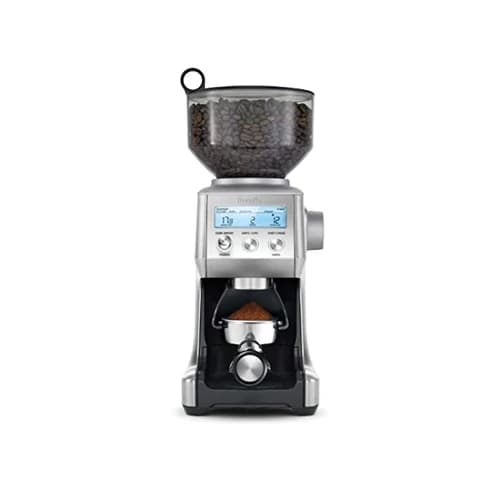
1. Breville Smart Grinder Pro
The Breville Smart Grinder Pro is the grinder Breville built to sit beside its own small machines, and on a Bambino it shows. It ships with a portafilter cradle for 50 to 54mm handles, so the Bambino's portafilter sits under the chute straight out of the box.
It also has by far the largest rating base in this guide, at 4.5 stars across 7,017 Amazon owners. No other espresso-capable grinder we found comes close to that much evidence.
The formula of the BCG820 is simple: stainless steel conical burrs, 60 numbered grind settings, a one-pound hopper and a timer you set in 0.2-second steps.
Breville Smart Grinder Pro (BCG820)
Rated 4.5 from 7,017 ratings
The natural partner for a Bambino: a 60-setting conical-burr grinder with a 54mm portafilter cradle and timed dosing in fifth-of-a-second steps.
Reviewers and owner threads describe an easy setup and a grinder that fades into the routine once the dose is set.
The complaints cluster at the fine end of the dial. Medium and dark roasts sit comfortably inside its espresso range, but a light roast in the single-wall basket may need a setting that falls between two steps.
Breville planned for that. The manual describes a removable upper burr that ships at position 6 and can be moved one position at a time, which shifts the whole range finer when the dial runs out.
The honest weak point is retention. Like most hopper grinders it keeps a little coffee in the chute overnight, so a short purge before the first shot of the day comes with owning one.
One limit matters only if you also brew French press. Independent reviewers find its consistency falls away at the coarse end, which is why our French press grinder guide leaves it out.
Buy it if you want the Bambino to work as a complete system on day one. Look further down the list if straight light-roast espresso is the drink you care about most.
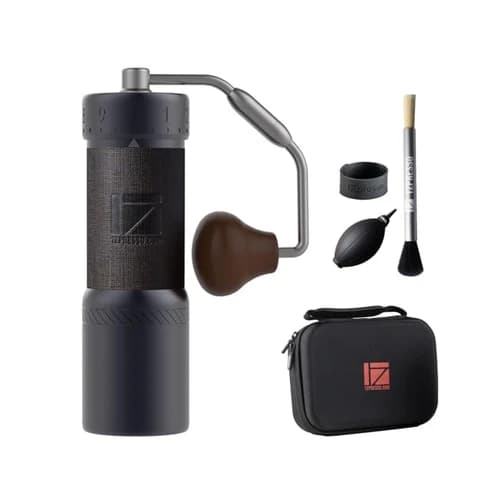
2. 1Zpresso J-Ultra
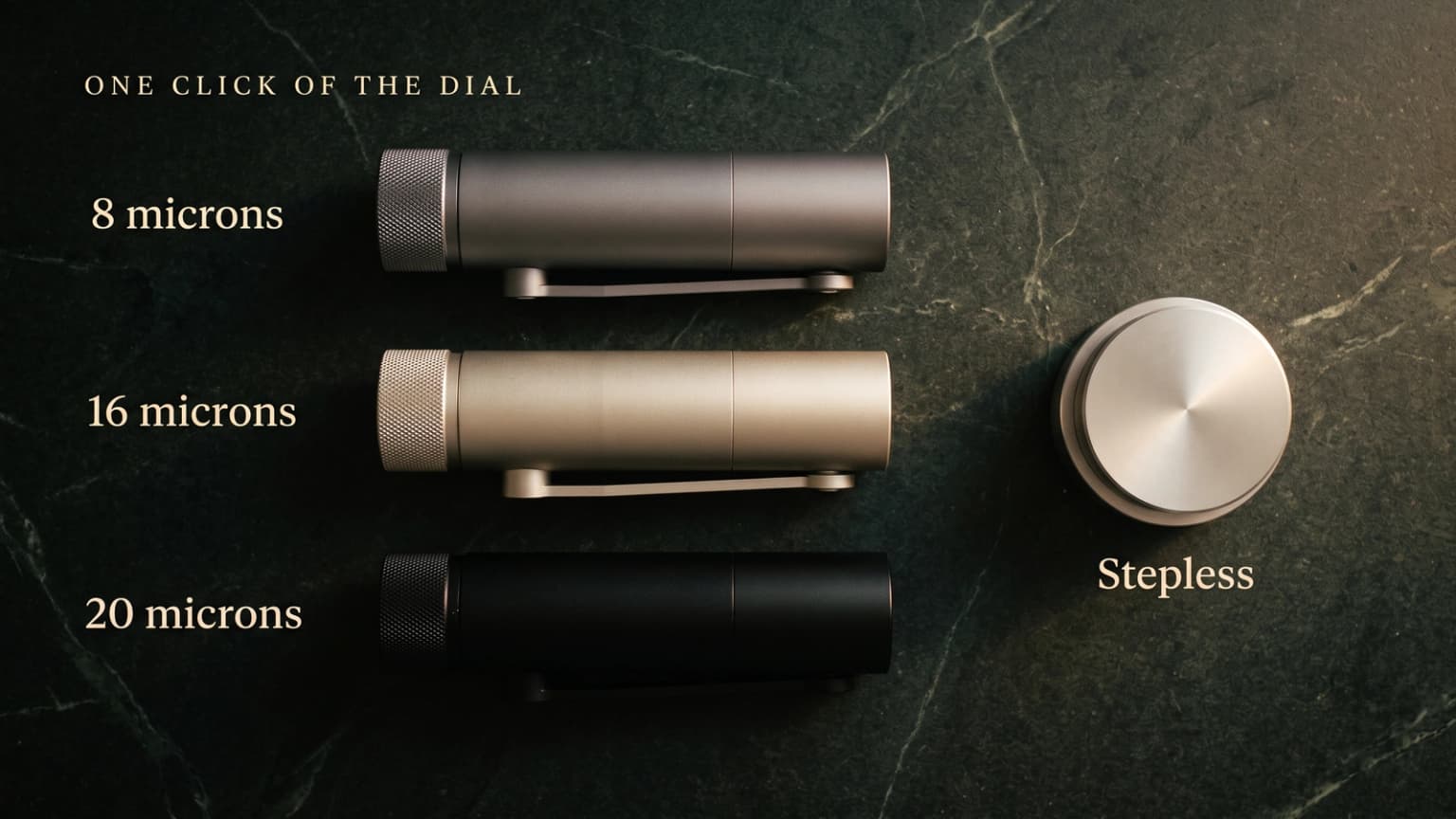
The 1Zpresso J-Ultra is the most precise grinder in this guide for the money, and it has no motor at all. Each click of its external dial moves the burrs 8 microns, the finest stepped adjustment we found at any price here.
That precision is the whole case for it on a Bambino. A single-wall basket rewards tiny corrections, and the J-Ultra makes them in smaller steps than any stepped electric grinder in this guide.
Its 400 Amazon ratings average 4.6 stars at the time of writing.
1Zpresso J-Ultra Manual Grinder
Rated 4.6 from 400 ratings
An espresso-first hand grinder with a coated burr and 8-micron clicks, built for the small corrections a single-wall basket demands.
Key details
Coated conical burr designed for espresso
External dial moving 8 microns per click
Magnetic catch cup holding 35 to 40 grams
Folding handle and fitted travel case
Tool-free disassembly, brush and blower included
Rated by 1Zpresso for 100 to 200 kg of coffee
What we like
The finest stepped adjustment in this guide
Espresso quality that rivals electric grinders costing more
Silent, so an early shot wakes nobody
Small enough to live in a drawer beside the Bambino
Watch out for
Grinding an espresso dose takes real effort
Built for espresso first and slower at filter settings
Two drinks back to back means two rounds of cranking
1Zpresso markets the coated burr; reviewers tend to praise the dial. Those who have used the older J-Max describe the J-Ultra as an improvement in both feel and precision.
Where reviewers find fault, it is rarely with the coffee. It is with the work, because an espresso dose is the slowest job any hand grinder does, with the burrs set as close as they go.
For one shot a day that is a pleasant ritual. For three milk drinks before a commute it becomes a chore.
On a Bambino the workflow is tidy. The catch cup pulls off on a magnet and pours into the basket, and a 54mm dosing funnel on the portafilter keeps the rim clean.
Buy it if straight espresso matters to you and the Bambino makes one or two drinks a day. Choose an electric grinder if speed matters more than the last few microns.
3. Eureka Mignon Notte
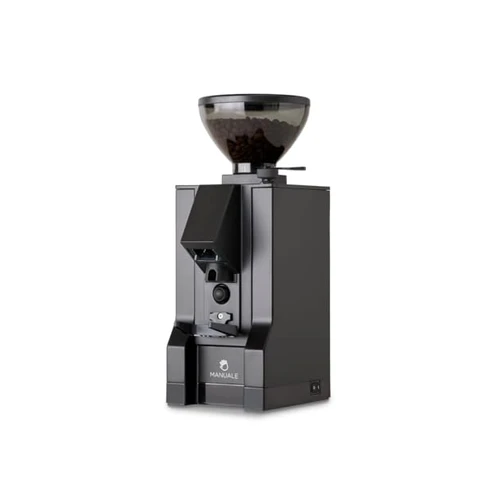
The Eureka Mignon Notte is the least expensive grinder in this guide with flat burrs, stepless adjustment and a motor. On a Bambino it is the electric step up we would make first.
Its 50mm steel flat burrs are espresso-focused by Eureka's own description, and the adjustment is stepless. The dial has no clicks at all, so you can set the burrs anywhere along the range.
That avoids the problem the Smart Grinder Pro can run into with light roasts, where the ideal grind falls between two settings.
Owners rate the Notte 4.5 stars across 169 Amazon ratings at the time of writing, a thinner base that fits a grinder sold mostly through specialist dealers.
Eureka Mignon Notte Espresso Grinder
Rated 4.5 from 169 ratings
The entry point to the Mignon family: 50mm flat steel burrs, stepless adjustment and a metal case, started by pushing the portafilter in.
Key details
50mm espresso-focused flat steel burrs
Stepless adjustment with a free-moving knob
Grinds while the portafilter presses the switch
Lower-burr adjustment keeps your setting through cleaning
150-gram (5.5 oz) bean hopper
ACE anti-clump system to calm static
What we like
Flat burrs and stepless control at the lowest price here
A metal case that feels built to last
Cleaning the burrs does not lose your setting
Narrow enough to sit tight beside a Bambino
Watch out for
No timer, so the dose is judged by scale or by habit
The Notte's design choice is to leave things out. There is no timer and no screen; you push the Bambino's portafilter against a switch and it grinds until you pull it away.
That makes the dose a matter of judgment until you own a scale, which is the first accessory we would add. Weigh 18 grams for the first few shots, learn how long the push takes, and the habit settles.
Eureka adjusts the lower burr rather than the upper one. In practice you can lift the top burr out to clean it and drop it back without losing the setting you worked to find.
The honest weak point is the narrow job description. Eureka built the Notte for fine settings, and it is not the grinder for a Sunday pour over.
Buy it if every drink in your house starts as a Bambino shot. Choose the Smart Grinder Pro if the same grinder also has to feed a drip machine.
4. MiiCoffee DF64 II
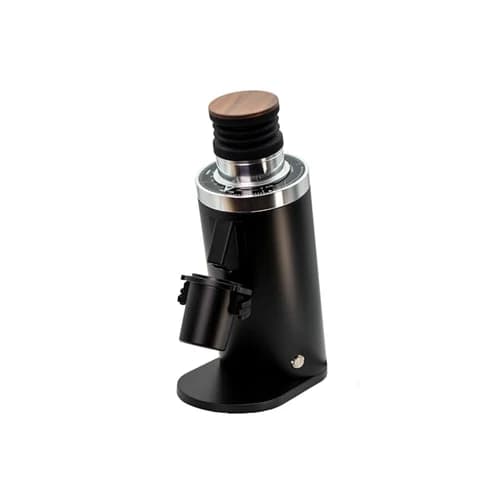
The MiiCoffee DF64 II is the grinder for an owner who suspects the Bambino will not be their last espresso machine. Its 64mm flat burrs are the largest in this guide, and its single-dose design keeps almost nothing behind.
MiiCoffee lists retention at under 0.1 gram and fits a plasma ionizer inside the exit chute to cut static. It holds 4.4 stars across 278 Amazon ratings at the time of writing.
This listing is version 2.6, with an anti-popcorn disc that keeps beans feeding steadily into the burrs. The burrs can also be swapped for aftermarket SSP sets, which is part of why the DF64 has such a large following.
MiiCoffee DF64 II Single Dose Grinder
Rated 4.4 from 278 ratings
A single-dose grinder with 64mm flat steel burrs, stepless adjustment and a plasma ionizer, built to outlast the first machine it sits beside.
Key details
64mm stainless steel flat burrs, upgradable to SSP
Stepless adjustment with a chrome indicator dial
Retention listed at under 0.1 gram
Plasma ionizer inside the exit chute
Integrated anti-popcorn disc
58mm aluminum dosing cup included
What we like
The largest burrs in this guide at a mid-range price
Close to nothing left behind between shots
Changes beans as easily as it changes doses
Ready for a 58mm machine when you upgrade
Watch out for
The included cup is 58mm, wider than a Bambino basket
Owner reports of uneven burr alignment on some units
Sold by MiiCoffee, so returns run through the seller
Read the listing closely and you find the one Bambino-specific catch. The dosing cup is 58mm, and MiiCoffee itself recommends using the cup rather than the portafilter rest when your handle is not 58mm.
A 58mm cup is wider than the Bambino's 54mm basket, so grounds spill at the rim. A 54mm dosing funnel on the portafilter solves that for a few dollars, and it belongs in the same order as the grinder.
The second issue is quality control. Long-running owner threads report that some DF64 units arrive with burrs slightly out of alignment, which shows up as shots that will not repeat, while many other owners report excellent results.
Our reading is that the grinder is very good and the variance is real. Check the return window before you order, and pull a week of shots while it is still open.
Buy it if you want a grinder that will still be the best part of your setup after the Bambino has gone. Choose the Notte if you want a hopper and less tinkering.
5. KINGrinder K6
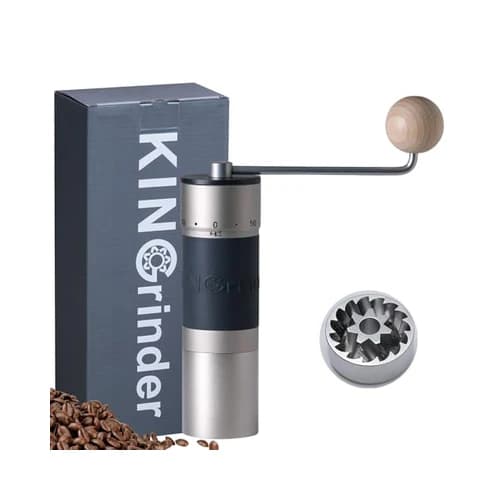
The KINGrinder K6 is the least expensive grinder in this guide, and it carries the deepest rating base of any hand grinder here at 4.6 stars across 1,020 owners. At $109.00 it costs about a third of a Bambino.
Its external dial moves 16 microns per click, with 60 clicks to a full turn and up to four turns of range. That is twice the step of the J-Ultra, and still small enough to move a Bambino shot by a few seconds.
KINGrinder K6 Manual Grinder
Rated 4.6 from 1,020 ratings
The value benchmark for espresso by hand: an all-metal body, a stainless burr and an external dial that moves 16 microns per click.
Key details
External adjustment, 16 microns per click
60 clicks per rotation, up to four rotations
Stainless steel burr set on dual bearings
Aluminum body, about 630 grams
Holds 25 to 35 grams of beans
Tool-free disassembly for cleaning
What we like
Real espresso control for about a third of a Bambino
The deepest owner evidence of any hand grinder here
All-metal build that never feels like a budget tool
Covers pour over settings too
Watch out for
Heavier going than the J-Ultra at espresso settings
The value case is simple arithmetic. A Bambino and a K6 together cost less than a Bambino Plus on its own, and the pair grinds every shot fresh.
The trade-off is physical. Espresso settings are where any hand grinder works hardest, and reviewers who compare the two describe the K6 as heavier to turn than the J-Ultra at fine settings.
Its steps are also twice the size. On a medium or dark roast that rarely matters; on a light roast in the single-wall basket, the shot you want can sit between two clicks.
Buy it if budget is the deciding line and the Bambino makes one or two drinks a day. Step up to the J-Ultra if you already know straight espresso is your main drink.
6. 1Zpresso K-Ultra
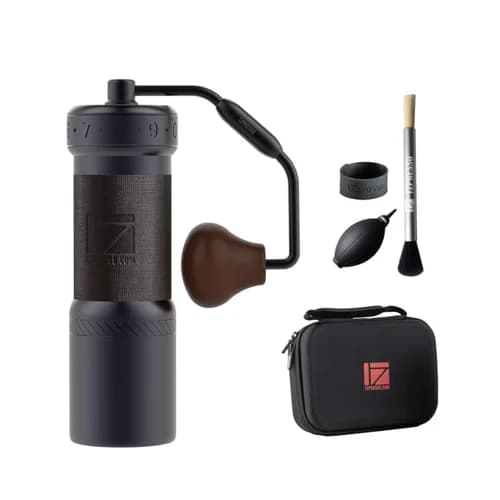
The 1Zpresso K-Ultra is the hand grinder for a Bambino owner who also brews filter coffee. If a pour-over cone lives beside the machine, this is the one we would choose.
Its 48mm heptagonal burr covers espresso through French press, and each click moves about 20 microns, with 100 clicks to a turn. That is coarser stepping than the J-Ultra, and it is the price of a grinder that crosses the whole brew range quickly.
Owners rate it 4.6 stars across 401 ratings on this iron gray listing at the time of writing. The silver finish sits on a separate listing with its own, smaller rating base.
1Zpresso K-Ultra Manual Grinder
Rated 4.6 from 401 ratings
The all-rounder: a 48mm heptagonal burr, an external dial of about 20 microns per click, and a range that runs from espresso to press.
Key details
48mm heptagonal stainless conical burr
External dial, about 20 microns per click
100 clicks per rotation
Magnetic catch cup holding 35 to 40 grams
Folding handle and carrying case
Tool-free disassembly for cleaning
What we like
One hand grinder for the Bambino and a pour-over cone
Moves between espresso and filter settings quickly
Strong owner rating on a deep base
Brisk at filter settings, which hand grinders rarely are
For a Bambino the choice between the two 1Zpressos is simple. If espresso is all you make, the J-Ultra's finer steps serve you better for less money.
If the weekend also means a V60 or a Chemex, the K-Ultra is the better single tool. Twenty-micron steps still let you nudge a medium-roast shot by a few seconds.
Weighing it against the Comandante C40, the other hand grinder enthusiasts debate most? Our Comandante C40 vs 1Zpresso K-Ultra comparison sets the two side by side on espresso and filter.
7. Eureka Mignon Specialita
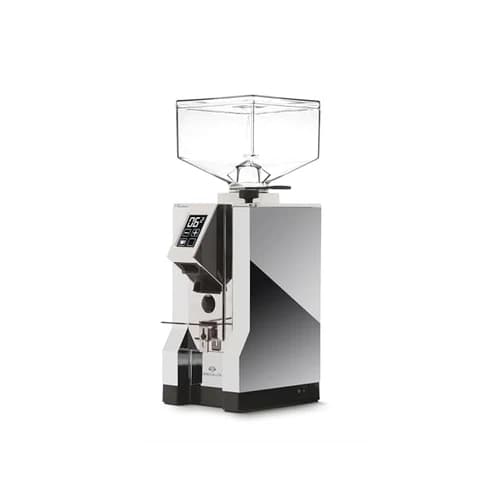
The Eureka Mignon Specialita is the premium hopper grinder in this guide and the quiet one. Eureka builds it with a sound-insulated case, 55mm hardened steel flat burrs, and a backlit touchscreen timer for single, double and continuous grinding.
It is also the most expensive grinder here at $599.00 for this chrome finish, which is twice the price of a Bambino.
Owners rate it 4.2 stars across 202 ratings at the time of writing. The matte black finish shares that same rating base and was out of stock when we checked.
Eureka Mignon Specialita (Chrome)
Rated 4.2 from 202 ratings
The quiet, timed Mignon: 55mm hardened steel flat burrs, stepless adjustment, a sound-insulated case and a touchscreen for repeatable doses.
Key details
55mm hardened steel flat burrs, the largest Mignon set
Stepless adjustment from below the motor mount
Touchscreen timer for single, double and continuous
Sound-insulated case
Adjustable portafilter fork
300-gram bean hopper
What we like
The quietest electric grinder here by design
Timed doses with flat-burr quality
Holds a Bambino portafilter in its adjustable fork
Handbuilt in Italy with a metal body
Watch out for
Costs twice what a Bambino does
The lowest rating in this guide, though above 4.0
A hopper grinder, so some coffee waits in the chute
What the extra money buys over the Notte comes down to three things: larger burrs, a timer that repeats your dose without a scale, and a case designed to keep the noise down.
For a household where the grinder runs while someone sleeps, the last of those is the reason to buy. It is the only electric grinder here that its maker builds around quiet.
The 4.2 rating is the lowest in this guide, and we read it carefully. The base is 202 owners, which is respectable for a dealer-sold grinder, and it sits clear of our 4.0 bar.
Buy it if you make several Bambino drinks a day, want them timed and quiet, and expect to keep the grinder through a machine upgrade. For one Bambino and no plans beyond it, the Notte gets you most of the way for half the money.
The size of one click, grinder by grinder
The number that matters most on an espresso grinder is not how many settings it has. It is how far the burrs move between one setting and the next.
Espresso punishes small errors in grind. Breville tells Bambino owners that espresso should start to flow 8 to 12 seconds after pressing the button, and a grinder whose smallest step jumps clean over that window leaves you guessing.
Hand grinders publish this figure in microns, and it is the cleanest comparison available. The electric grinders mostly do not, so we describe them by how their adjustment works instead.
Smaller steps mean smaller corrections to a shot. A stepless dial removes the step entirely, at the cost of having no clicks to count.
How each grinder adjusts
How each grinder adjusts
Grinder
Adjustment
One step
Worth knowing
Smart Grinder Pro
Stepped dial, 60 settings
Not published
Upper burr shifts the whole range
J-Ultra
Stepped external dial
8 microns
Finest steps in this guide
Mignon Notte
Stepless knob
No steps
Lower burr moves, setting survives cleaning
DF64 II
Stepless dial
No steps
Indicator marks your position
KINGrinder K6
Stepped external dial
16 microns
60 clicks per turn
K-Ultra
Stepped external dial
About 20 microns
100 clicks per turn
Mignon Specialita
Stepless knob
No steps
Lower burr moves, setting survives cleaning
Step sizes are the makers' published figures. Breville does not list a micron figure for each Smart Grinder Pro setting.
Three things follow from that table. First, among hand grinders the J-Ultra stands apart for straight espresso, and the gap matters most with light roasts.
Second, the stepless grinders remove the problem rather than shrink it. The Notte, the DF64 II and the Specialita let you set the burrs anywhere, so no shot is ever stuck between two clicks.
The price of stepless is memory. There is no number to write down, so owners pencil a mark on the dial or note its position against an indicator, which is exactly why MiiCoffee fits one.
Third, the Smart Grinder Pro is the only stepped electric grinder here, and its upper burr is the way out. If its finest settings still run fast, the manual's one-position move is the fix to try before blaming the beans.
Bambino baskets: single wall or dual wall?
Breville's current US manuals for both Bambinos list four filter baskets in the box: single-wall and dual-wall baskets, each in 1-cup and 2-cup sizes. The 2-cup single-wall basket ships fitted in the portafilter.
The two kinds do different jobs. Breville says to use single-wall baskets when you grind fresh whole beans and dual-wall baskets with pre-ground coffee, and the Bambino Plus manual draws the line at about 30 days from roast.
A dual-wall basket, often called a pressurized basket, has a second floor with one small exit, and that exit builds pressure however coarse or uneven the grind is. That is why pre-ground coffee still makes a crema-topped shot in it.
A single-wall basket, the non-pressurized kind, has no such help. The bed of coffee has to supply the resistance itself, so the grind has to be fine, even, and adjustable in small steps.
That is the whole reason a Bambino owner buys a grinder. Every grinder in this guide drives both baskets, but how comfortably each one drives the single-wall basket varies.
Where each grinder is comfortable
Where each grinder is comfortable
Grinder
Dual wall
Single wall, medium roast
Single wall, light roast
Smart Grinder Pro
Easily
Comfortably
May need the upper burr moved
J-Ultra
Easily
Comfortably
Its strongest case
Mignon Notte
Easily
Comfortably
Comfortably, stepless
DF64 II
Easily
Comfortably
Comfortably, stepless
KINGrinder K6
Easily
Comfortably
Workable, larger steps
K-Ultra
Easily
Comfortably
Workable, larger steps
Mignon Specialita
Easily
Comfortably
Comfortably, stepless
Our reading of maker specifications and owner reports, not our own testing. Very light roasts are the hardest job any of these grinders face.
The table hides one practical point. A dual-wall basket makes a grinder upgrade nearly invisible, because it flattens the difference between a good grind and a poor one.
So if you buy any grinder on this list and leave the dual-wall basket in, you will be disappointed for the wrong reason. Switch to the single-wall basket in the first week; the steps to do it are further down this page.
Why the Encore ESP is not on this list
The Baratza Encore ESP is the grinder paired with a Bambino on more competing lists than any other, and we expected to rank it.
At $199.95 it is an espresso-tuned Encore. Its dial spends the first 20 settings on fine espresso steps and the last 20 on larger filter steps.
Its Amazon rating is 3.9 stars across 1,423 owners at the time of writing, below our 4.0 bar. That base is deep enough that the number reflects years of ownership rather than a few unlucky buyers.
The recurring complaints in published reviews and owner threads are static at fine settings and stiff controls on the current version. Some owners also report plastic burr-holder tabs breaking after a few years of heavy use.
Its newer sibling fares worse so far. The Encore ESP Pro, at $299.95, reads 3.3 stars across 94 owners, though a base that young can still move.
We hold the line even for a popular grinder. A deep rating base is evidence of what ownership is actually like; popularity on other lists is not.
Three more names deserve a line. The original Fellow Opus reads 3.8 stars across 1,763 owners and was out of stock when we checked.
Eureka's own Mignon Silenzio rates 4.5 across 134 owners, and Baratza's Sette 270 rates 4.3 across 791. Both are well regarded for small machines, and neither was in stock in any listing we found.
A grinder beside a 7.7-inch machine
The Bambino is about 7.7 inches wide and 12.2 inches tall, and that small footprint is much of its appeal. Most of the grinders in this guide are taller than the machine they serve.
The Smart Grinder Pro stands about 15.5 inches with its hopper fitted, the Specialita about 13.8 and the Notte about 13. That is fine under most wall cabinets, but the hopper lid has to open, so measure the gap before you order.
The bigger daily question is the transfer into a 54mm basket. Portafilter-fed grinders hold the Bambino's portafilter directly, and the Smart Grinder Pro's smaller cradle is made for exactly that handle size.
Cup-fed grinders need one more move. The hand grinders' catch cups and the DF64's 58mm dosing cup all get poured into the basket, and a 54mm dosing funnel on the portafilter catches whatever misses.
Static is the mess factor, and it is worst at espresso fineness. The DF64 II's ionizer and Eureka's anti-clump system both exist to fight it, and RDT helps on any grinder here.
Noise is the other daily reality. The three hand grinders make almost none, the Specialita is the only electric grinder whose maker builds the case around quiet, and the rest are as loud as any grinder for the few seconds they run.
The case against a separate grinder here
We would be writing an advertisement rather than a guide if we skipped this. There are two honest arguments against buying a grinder for a Bambino, and one of them is about not buying a Bambino at all.
The first is for anyone still deciding. A Bambino plus a Smart Grinder Pro comes to about $500. A Breville Barista Express usually sells for more, but it puts the grinder inside the machine and saves a whole appliance's worth of counter.
The pair still has the higher ceiling, because either half can be replaced on its own. If counter space and one plug matter more to you, our guide to espresso machines with a built-in grinder covers that route properly.
The second argument is the enthusiast's, and it is half right. The Bambino gives you no control over brew temperature or pressure, so beyond a certain grinder quality the machine, not the burrs, sets the limit on your shot.
Where that point sits is open to debate. Our reading is that the better grinders here, from the J-Ultra to the DF64 II, already have more to give than a Bambino can take, which makes anything beyond it a purchase for the next machine.
The half that is wrong is the framing. A grinder is not a Bambino accessory; it is the part of an espresso setup most likely to survive an upgrade, which is the argument the next section puts numbers on.
There is also a simpler option. If you only make milk drinks from a medium-dark roast, fresh pre-ground coffee in the dual-wall basket is a legitimate way to own a Bambino, and Breville designed that basket for exactly this.
Buy for this Bambino, or the next machine?
A Bambino is often a first espresso machine, and first machines get replaced. A good grinder usually is not, which is why the real cost of a Bambino grinder depends on what happens next.
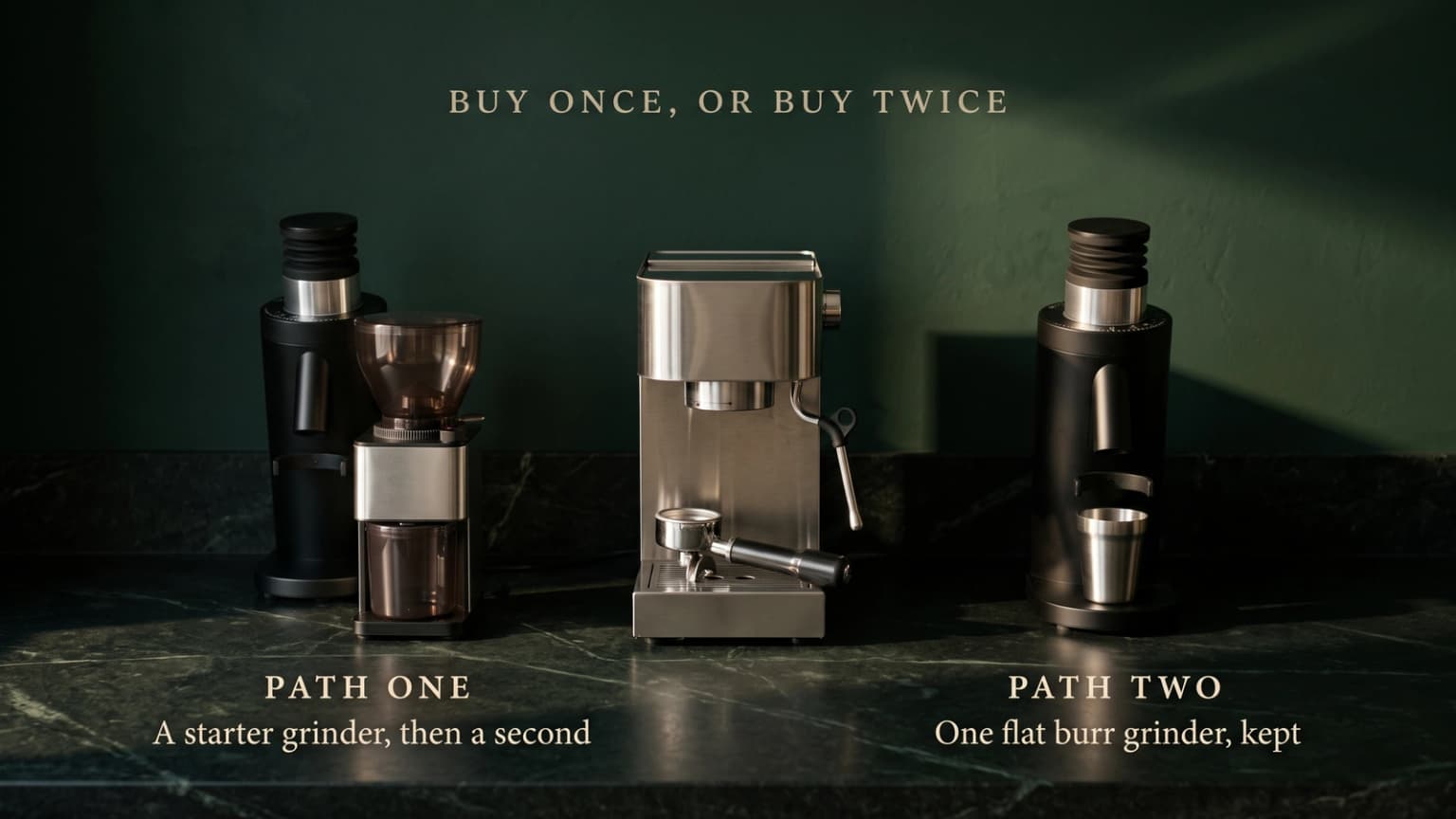
There are two sensible ways to spend. The first is to buy for the Bambino you own, and the second is to buy once for the machine you expect to own after it.
Neither path is wrong. The second costs more on day one and less if a bigger machine arrives within a few years.
Path one is the Smart Grinder Pro or a K6 now, and a second grinder if you move to a bigger machine and lighter roasts. It is the cheapest start and the most expensive outcome if that upgrade happens.
Path two is a flat-burr grinder now: the Notte, the DF64 II or the Specialita. It looks expensive beside a $300 machine, but it is the grinder you keep when the Bambino goes.
What each grinder carries to the next machine
What each grinder carries to the next machine
Grinder
Price
Works with a 58mm machine?
Likely to stay after an upgrade?
Smart Grinder Pro
$199.95
Yes, 58mm cradle included
For medium roasts, often
J-Ultra
$199.00
Yes, grinds into a cup
Yes, as an espresso grinder
Mignon Notte
$299.00
Yes, grinds into any handle
Yes, built for espresso
DF64 II
$399.00
Yes, its cup is already 58mm
Yes, it is built for it
KINGrinder K6
$109.00
Yes, grinds into a cup
Often, as a second grinder
K-Ultra
$259.00
Yes, grinds into a cup
Yes, as a filter grinder
Mignon Specialita
$599.00
Yes, adjustable fork
Yes, it is built for it
Prices at the time of writing; the buttons above show today's. Grinders need no consumables, so the purchase price is most of the cost.
There is one small running cost worth knowing. Hopper grinders hold a little coffee in the chute overnight, and most owners grind and discard a little before the first shot of the day.
Purge 2 grams a morning and that is 730 grams a year, about a pound and a half of coffee. Single-dose and hand grinders skip that cost, which narrows the price gap more than it first appears.
Beyond beans, grinders cost almost nothing to run. There is no filter, no descaler and no capsule, so the purchase price is effectively the whole cost for all seven.
When to buy
Grinders discount on the same calendar as espresso machines. Prime Day, Black Friday and the December gifting weeks are when Breville prices move most, and its grinders often appear in those sales.
The dealer-sold grinders are harder to time. We found no reliable sale pattern for the Eureka or DF64 listings, so for those the right moment is when you need one.
A discount of about 15 percent off the usual price is worth acting on. At full price with no sale in sight, a few weeks of patience rarely costs you anything.
The prices on this page refresh daily, so the buttons always show the current figure. On the dealer-sold grinders, check who the seller is before you buy, because returns go through them.
How to dial in a Bambino on single wall
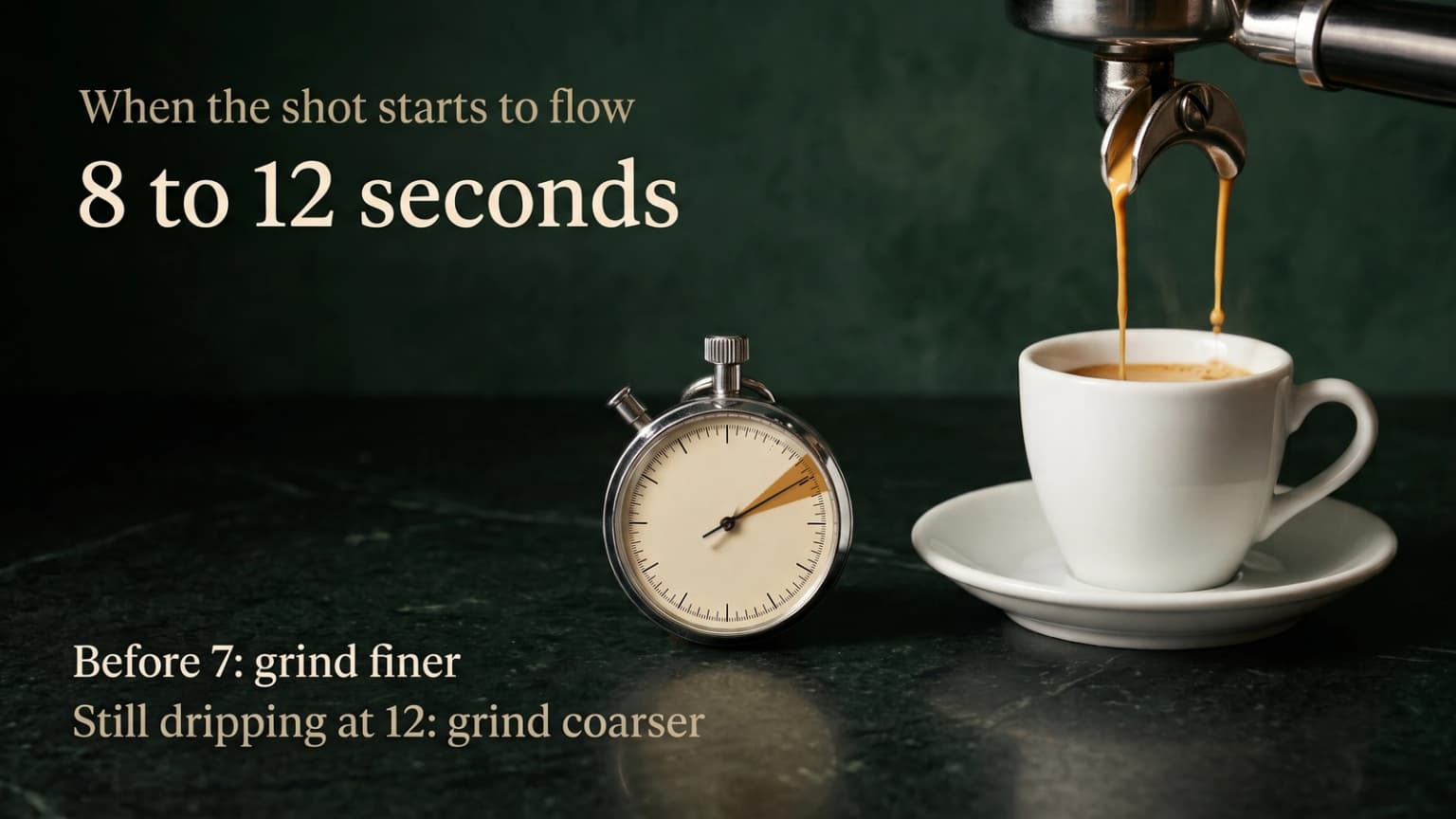
To dial in a Bambino, fit the single-wall basket, dose 18 grams, and change the grind size until espresso starts to flow 8 to 12 seconds after you press the button. That timing is Breville's own test, from its manual.
It is easier to read than a full shot time. Flow before 7 seconds means the grind is too coarse or the dose too light, which Breville calls under-extracted; a shot still only dripping at 12 seconds is too fine and over-extracted.
Breville's own test for the Bambino. Flow before 7 seconds means grind finer; still only dripping at 12 seconds means grind coarser.
From dual wall to single wall
1
Fit the 2-cup single-wall basket and weigh 18 grams
Breville designs the 2-cup basket for 16 to 19 grams and quotes 18 for a full-flavored shot. Weigh it on a scale that reads to 0.1 gram and keep it fixed while you adjust.
Tip Buy the scale before a fancier tamper. The dose is the number owners get wrong most often.
2
Start where the maker suggests
On the Smart Grinder Pro, Breville's espresso starting point is setting 12. On the other grinders, start at the fine end of the maker's espresso range and work from there.
3
Break up clumps, then tamp level
Stir the grounds with a thin needle tool (WDT) to break up clumps, tap the portafilter to settle them, and tamp level. Breville's guide is that the top of the tamper should sit level with the basket rim afterward.
Watch out Never tamp a lopsided bed. Water channels through the thin side, the shot gushes, and you will blame a grind that was fine.
4
Press the 2 Cup button and start a timer
Watch the spouts. The Bambino runs a low-pressure pre-infusion before full pressure, so a few seconds with nothing in the cup is normal.
5
Read when the flow starts, then adjust
Flowing before 7 seconds: grind finer. Still only dripping at 12 seconds: grind coarser. Move one click, or a small turn on a stepless dial, and repeat with the same dose.
6
Stop the shot by weight, then set the button
Aim for roughly twice the dose in the cup, about 36 grams from 18, and press the button again to stop. To store that volume, hold the 1 Cup and 2 Cup buttons for two seconds and follow the manual.
Tip Write the setting down. On a stepless grinder, a pencil line on the dial does the job.
A new bag from the same roaster usually needs a small move at most. A new roaster or a new roast level means dialing in again from your last recorded setting.
If shots still behave strangely, rule out the machine before the grinder. Breville also asks you to run a short flush through the group head before locking in the portafilter, which settles the temperature for the shot.
Burr care beside a daily Bambino
Brush the burrs weekly, clear the oils monthly and keep water away from the grinder; that covers most grinder care beside a Bambino. Skipping it is the most common reason a grinder that started well begins to drift.
A grinder routine for Bambino owners
1
After every session: clear the chute or cup
Tap the chute or catch cup to drop loose grounds, then brush the fork, cradle or funnel. Fine espresso grounds cake far faster than filter grounds.
2
Weekly: brush the burrs on an electric grinder
On the Mignons the top burr lifts out without losing your setting, because Eureka adjusts the lower burr. On the Smart Grinder Pro the upper burr comes out once the hopper is off.
Watch out Keep grinder parts out of water and out of the dishwasher. Breville says so in its manual, and moisture plus coffee oil sets hard on burr faces.
3
Weekly: open a hand grinder fully
Both 1Zpresso and KINGrinder design for tool-free disassembly. Brush the burr and the threads, and use the blower where one is included.
4
Monthly: clear the oils
Run food-safe grinder cleaning tablets through an electric grinder, then grind and discard a small dose of coffee. Dark, oily roasts need this more often.
5
When beans change: purge or single dose
Hopper grinders hold some of the old coffee. Grind and discard a few grams after switching beans, or empty the hopper and weigh each dose until the new bag settles in.
The Bambino's own cleaning matters to the grinder too. A dirty shower screen makes water run unevenly through the puck, and owners often blame the grinder for what is really a group head that needs a wipe.
Which Bambino grinder should you buy in 2026?
The best grinder for a Breville Bambino, for most owners, is the Breville Smart Grinder Pro at $199.95. It fits the Bambino's portafilter out of the box, it times the dose for you, and 7,017 owners stand behind its 4.5-star rating.
We weighed espresso adjustment, the route into a 54mm basket, what each grinder carries to a future machine, and owner sentiment. Then we asked the question that settles it: how many drinks does your Bambino make on a weekday?
Three grinders, three kinds of Bambino owner
Our pick
Smart Grinder Pro
$199.95
You are
Making several drinks a day
Best at
Fitting the Bambino as sold
Route
Into the portafilter
Weak spot
Light roasts, stepped dial
1Zpresso J-Ultra
$199.00
You are
Pulling one or two straight shots
Best at
Precision per dollar
Route
Into a catch cup
Weak spot
Effort per dose
Mignon Notte
$299.00
You are
Ready for flat burrs
Best at
Stepless electric espresso
Route
Into the portafilter
Weak spot
No timer, espresso only
Three grinders, three kinds of Bambino owner
Specification
Our pick
Smart Grinder Pro
$199.95
1Zpresso J-Ultra
$199.00
Mignon Notte
$299.00
You are
Making several drinks a day
Pulling one or two straight shots
Ready for flat burrs
Best at
Fitting the Bambino as sold
Precision per dollar
Stepless electric espresso
Route
Into the portafilter
Into a catch cup
Into the portafilter
Weak spot
Light roasts, stepped dial
Effort per dose
No timer, espresso only
Grinders for other brewers live in our coffee grinders section, from French press to single dosing.
If the Bambino ever moves on, keep the grinder. In most kitchens it turns out to be the better half of the pair.
Frequently asked questions
What grinder do the Bambino and Bambino Plus need?
Both need a burr grinder that reaches a true espresso grind size, with steps small enough to change a shot by a few seconds. Blade grinders and most filter-only burr grinders cannot do that reliably.
How fine it must go depends on the basket. Both machines ship with pressurized dual-wall baskets that forgive a coarse grind and single-wall baskets that do not.
The Bambino Plus uses the same 54mm portafilter and baskets, so the same grinder suits either machine. Below about $100 the realistic choices narrow to hand grinders such as the KINGrinder K6.
Can you use pre-ground coffee in a Breville Bambino?
Yes. Breville includes dual-wall filter baskets for exactly that, and its manual says to use them with pre-ground coffee.
The pressurized dual-wall basket builds pressure at one small exit, so it makes a crema-topped shot even from a grind that was never tuned to the machine.
The catch is the ceiling. Pre-ground coffee in a dual-wall basket makes a decent milk drink and a flat straight shot, which is why most owners end up buying a grinder.
Which Bambino basket should you use, single wall or dual wall?
Use the single-wall basket once you grind fresh beans on a grinder that reaches a true espresso grind. That is Breville's own guidance, and the Bambino Plus manual adds that the beans should be under about 30 days from roast.
Use the dual-wall basket for pre-ground coffee, older beans, or a grinder that cannot grind fine enough for espresso.
The single-wall basket rewards a good grinder and exposes a weak one. That is why the grinder you buy decides which basket you can really use.
What setting should a Smart Grinder Pro use for a Bambino?
Breville gives setting 12 as the espresso starting point on the Smart Grinder Pro. From there, go finer if espresso starts flowing before 7 seconds and coarser if it is still only dripping at 12.
Keep the dose fixed at about 18 grams in the 2-cup basket while you adjust, so the grind is the only thing changing.
If the finest settings still run fast, the grinder's removable upper burr can be moved one position toward fine, as the manual describes.
Is a hand grinder good enough for a Breville Bambino?
For espresso quality per dollar, yes. The 1Zpresso J-Ultra moves 8 microns per click, finer steps than any stepped electric grinder in this guide.
The cost is time and effort. An espresso dose is the slowest job a hand grinder does, because the burrs sit at their closest.
Choose a hand grinder for one or two shots a day. Choose an electric one if the Bambino makes drinks for a whole household.
How much should you spend on a grinder for a Bambino?
For most owners, about what the machine cost is a sensible ceiling. A Bambino sells for around $300, and the grinders from $109 to $399 on our list already grind finer and more evenly than it needs.
Spend more only if a bigger espresso machine is likely within a few years. A good grinder usually outlives the first machine it sits beside.
The figure to avoid is nothing at all. Pre-ground coffee in the dual-wall basket holds the Bambino well below what it can pour.