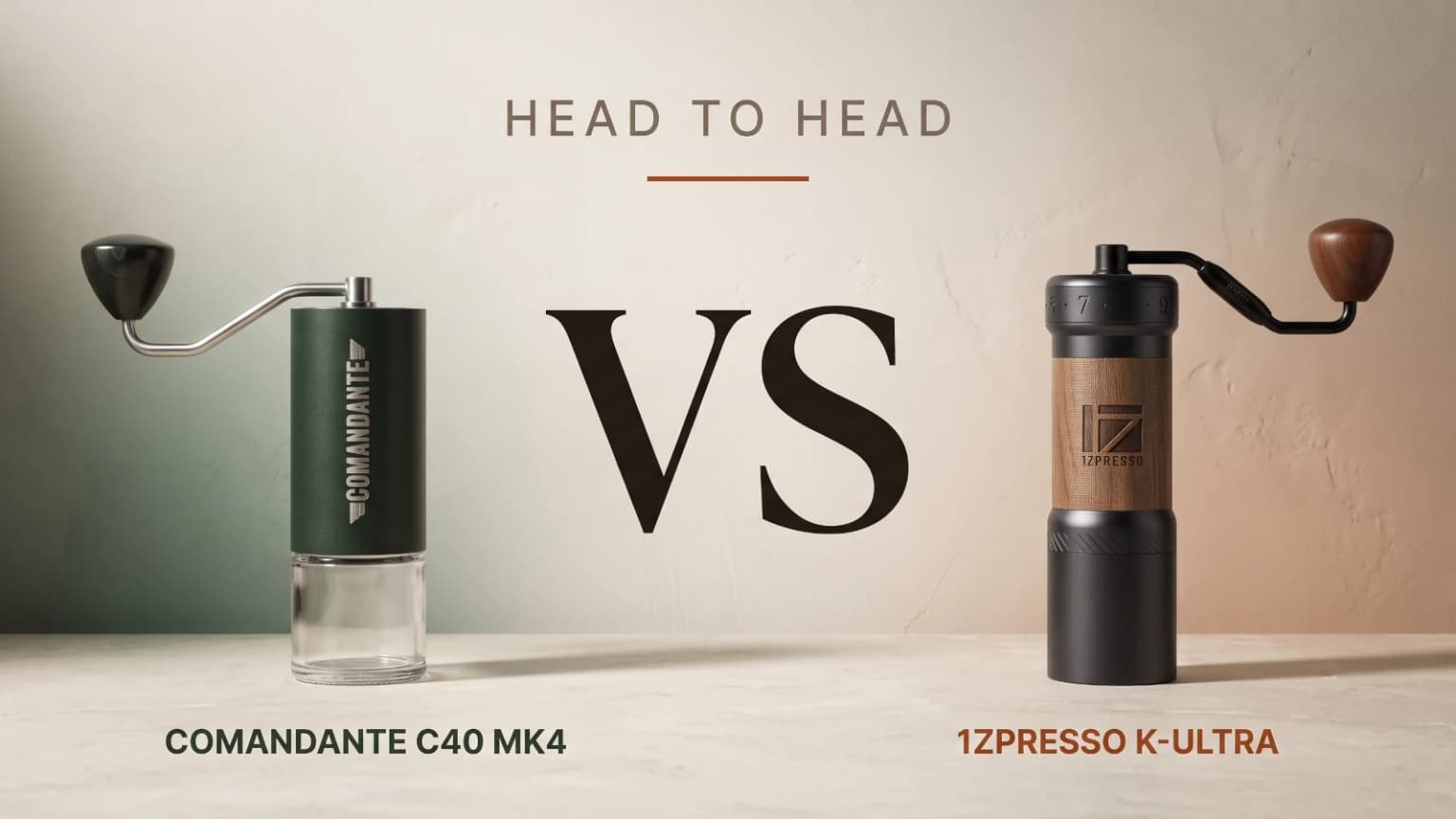
The Comandante C40 MK4 and the 1Zpresso K-Ultra are the two hand grinders people cross-shop at the top of the manual market. They are genuinely hard to separate on a spec sheet.
Both cost around $260 to $280, and both will out-grind an electric burr grinder costing twice as much. The difference between them is not quality. It is philosophy.
It shows up in exactly one place: where you go to change the grind size, and how big a change you get when you do.
That one decision cascades into everything else, from how long espresso takes to dial in to whether a single grinder can cover both a V60 and a double shot. Our full single dose coffee grinder guide ranks eight machines, and these two finished first and fourth.
Comandante C40 vs K-Ultra at a glance
The specifications that actually differ
Comandante C40 MK4
$279.95
Burr
39 mm conical, Nitro Blade
Adjustment
Internal, under the jar
Step size
About 30 microns
Steps per turn
About 40
Capacity
About 40 g
Catch
Glass and polymer jars
Handle
Fixed crank
Made in
Germany
Owner rating
4.8 from 445
Our pick
1Zpresso K-Ultra
$259.00
Burr
48 mm heptagonal conical
Adjustment
External numbered dial
Step size
20 microns
Steps per turn
100
Capacity
35 to 40 g
Catch
Magnetic cup
Handle
Folds flat
Made in
Taiwan
Owner rating
4.7 from 347
The specifications that actually differ
Specification
Comandante C40 MK4
$279.95
Our pick
1Zpresso K-Ultra
$259.00
Burr
39 mm conical, Nitro Blade
48 mm heptagonal conical
Adjustment
Internal, under the jar
External numbered dial
Step size
About 30 microns
20 microns
Steps per turn
About 40
100
Capacity
About 40 g
35 to 40 g
Catch
Glass and polymer jars
Magnetic cup
Handle
Fixed crank
Folds flat
Made in
Germany
Taiwan
Owner rating
4.8 from 445
4.7 from 347
Read that table twice and one row explains most of this page: Adjustment. The C40 asks you to remove the catch jar and count clicks from closed. The K-Ultra asks you to read a number.
Both are stepped grinders rather than stepless, so both move in fixed clicks. What differs is how big each click is and whether you can see where you are.
The highlighted column marks the grinder we recommend to more people, which is not the same as the better grinder. We come back to that distinction, because it is the whole argument.
Why these two premium hand grinders
Hand grinders are a crowded category, so it is worth saying why the choice narrows to this pair so often.
Comandante is a small German manufacturer that has made essentially one grinder for over a decade, refining it across four generations rather than replacing it.
The C40 is what happens when a company decides a product is finished, then spends ten years proving it.
1Zpresso is a Taiwanese engineering company that took the opposite route. It ships several grinder families, each tuned to a different job, and iterates quickly on adjustment mechanisms and burr geometry.
Above this pair the market thins out fast. Below it, grinders start giving up refinement, alignment consistency, or adjustment resolution.
At roughly $260 to $280 you are at the point where hand grinders stop compromising, and the only question left is which compromise you were never going to make.
How we compared these two for 2026
We do not test gear with our own hands, and we will not pretend otherwise. What we do is read the owner record at scale, cross-check published specifications against the manufacturers, and look for the places where the two designs genuinely diverge.
For this comparison that meant the Amazon rating base for both listings, the manufacturers' own specification pages, and the recurring themes in three-star reviews, which are far more useful than five-star ones.
Both listings were live and in stock at the time of writing. The Comandante holds 4.8 stars from 445 raters and the K-Ultra 4.7 from 347, and prices on this page refresh from Amazon daily.
Where we could not verify a number we say so rather than rounding a guess into a fact. Published weights are the clearest example, and both land close enough that neither wins on mass alone.
Burr size and what it actually does
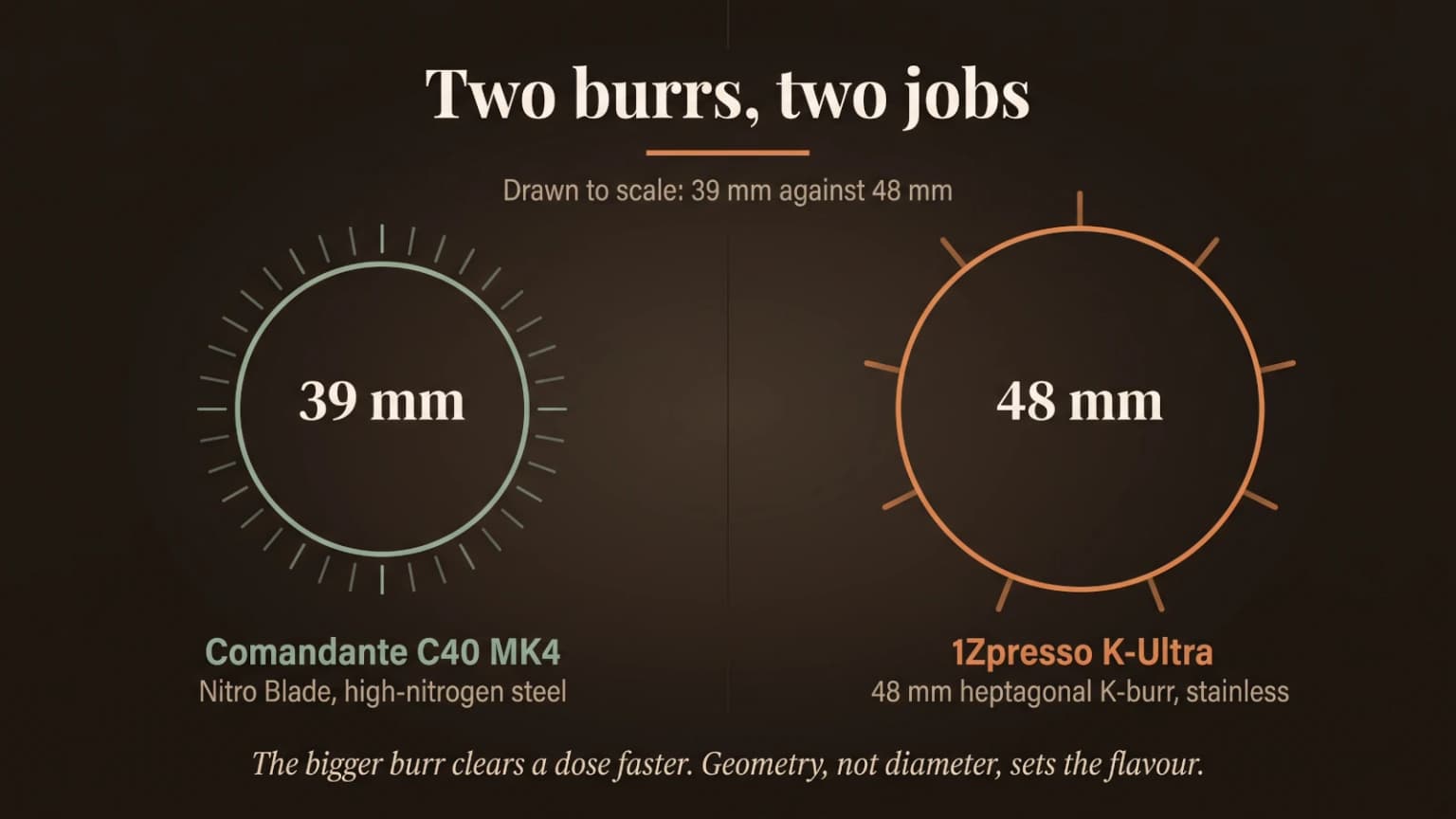
Nine millimeters of diameter is worth more in speed than in flavor.
The K-Ultra runs a 48 mm heptagonal conical burr, seven cutting edges in stainless steel. The C40 runs a 39 mm outer and 30 mm inner conical set in high-nitrogen martensitic steel, the burr Comandante trademarked as the Nitro Blade.
The size gap is real and it matters, but not in the way most buyers assume. A bigger burr does not automatically make a better cup. It moves more coffee per rotation, which is a speed and effort advantage rather than a flavor one.
Flavor comes from burr geometry: the angle of the cutting teeth, the length of the crushing zone, and how cleanly particles exit. This is where the two burrs were designed toward different targets.
Particle distribution follows from that geometry. Both burrs produce a tight distribution with few fines, which is what separates this price band from budget grinders, but they center that distribution differently.
The Nitro Blade was built around filter brewing, and the cup it produces is the reason the C40 has held its reputation for a decade. Reviewers describe it as sweet and rounded with clean separation between flavors.
The K-Ultra burr was built to cover more ground. It gives up a little of that rounded filter character and buys the ability to make a genuinely good espresso, which the C40 does not do comfortably in stock form.
Grind adjustment is the real divide
Across the same travel, the K-Ultra gives you half again as many places to stop.
Here is the sentence that should decide this purchase for most people. The C40 adjusts internally, and the K-Ultra adjusts externally.
On the C40 you lift off the catch jar, turn the dial at the base of the burr shaft until it closes, then count clicks back out. There is no number to read, only a count you have to remember or write down.
On the K-Ultra you turn a numbered ring on the outside of the body and read the setting off it. Ten numbers, one hundred clicks per rotation, twenty microns per click.
If you brew one thing every morning, the C40's routine costs you nothing. You set it once and never touch it again, and the internal mechanism is one fewer thing to knock out of alignment.
If you brew a V60 on Saturday and pull shots on Sunday, that routine becomes a tax you pay twice a week. Moving hundreds of microns by counting clicks blind is exactly as tedious as it sounds.
Resolution compounds the problem. The C40 moves about 30 microns per click and the K-Ultra 20, so the K-Ultra lands closer to where you actually wanted to be.
For filter recipes, 30 microns is fine. Pour-over is forgiving enough that a single click rarely ruins a brew, which is why C40 owners so rarely complain about this. For espresso it is a genuine problem.
Espresso: the K-Ultra wins outright
This is the least ambiguous section on the page. If espresso is part of your week, buy the 1Zpresso K-Ultra.
The C40 physically reaches espresso fineness. Most owners find their range somewhere around 10 to 15 clicks from closed. Range is not the issue.
Resolution is. At roughly 30 microns per click, one click can move a shot from 22 seconds to 34 seconds, and the setting you actually wanted sits somewhere in between where the grinder cannot go.
That is what makes dialing in an espresso on a stock C40 frustrating. You are not chasing a taste, you are stuck between two settings that both miss.
Comandante's own answer is the Red Clix RX35, a replacement axle and dial that halves the step to about 15 microns and doubles the number of settings. It works, and owners who pull shots on a C40 almost universally recommend it.
It also costs money, roughly $45 to $50 at US specialty retailers, and it has to be installed by stripping the grinder down. That is a fine Saturday project, but it is an upgrade the K-Ultra never asks for.
The K-Ultra's 20 micron steps are fine enough for the vast majority of home baskets straight out of the box. Our full K-Ultra review goes deeper on how the dial behaves across the espresso range.
The honest caveat is effort. A fine 18 gram dose of a dense light roast takes real torque on any hand grinder, and the K-Ultra's wide body can tire smaller hands. Anyone with wrist or grip problems should be looking at an electric grinder, or at a machine that grinds for them, like the ones in our espresso machines with built-in grinders guide.
1Zpresso K-Ultra
Rated 4.7 from 347 ratings
The all-rounder of this pair. A bigger burr, a dial you can read, and espresso resolution that needs no upgrade part.
Key details
48 mm heptagonal conical burr
External numbered dial, 20 microns per click
100 clicks across one rotation
Magnetic catch cup, 35 to 40 g
Handle folds flat, fitted case included
Tool-free strip down and recalibration guide
What we like
Espresso and filter from one grinder, no accessories
Reverse the question and the answer reverses with it. If you brew pour-over and nothing else, the Comandante C40 MK4 is the more celebrated grinder, and the people who own one are unusually attached to it.
Its 4.8 star average across 445 Amazon raters is the highest score in our entire grinder guide, and that record has been built slowly rather than on a launch spike.
What owners describe is a cup with rounded sweetness and clean separation, the kind where individual flavors stay distinct instead of blurring together. That is the Nitro Blade doing what it was designed to do.
There is a practical advantage too, and it gets overlooked. The C40 click language is a shared standard, so roasters and recipe writers publish starting points in C40 clicks.
That means a new bag of coffee often comes with a setting you can dial in directly, which is a genuine convenience no amount of engineering on the K-Ultra can replicate.
The K-Ultra is not far behind here. It is our top overall single dosing pick precisely because its filter cup is excellent, just described more often as open and clear than as round and sweet.
Whether you prefer clarity or sweetness is a taste question, not a quality question, and the gap is smaller than the internet suggests. A change of roaster moves your cup further than swapping between these two burrs will.
Comandante C40 MK4
Rated 4.8 from 445 ratings
The filter specialist. A famous burr, German construction, and a design meant to be repaired rather than replaced.
Key details
39 mm Nitro Blade conical burr set
High-alloyed, high-nitrogen stainless steel
Internal stepped adjustment, about 30 microns
Stainless body, axle, crank, and sealed bearings
Amber glass and polymer jars, about 40 g each
Red Clix RX35 axle available separately
What we like
The most admired filter burr at this price
Highest owner rating in our grinder guide
Built to be serviced, not discarded
Recipe writers publish settings in C40 clicks
Watch out for
Espresso needs the paid Red Clix upgrade
Changing grind means removing the jar and counting
Every one of these is a starting point. Taste, then move.
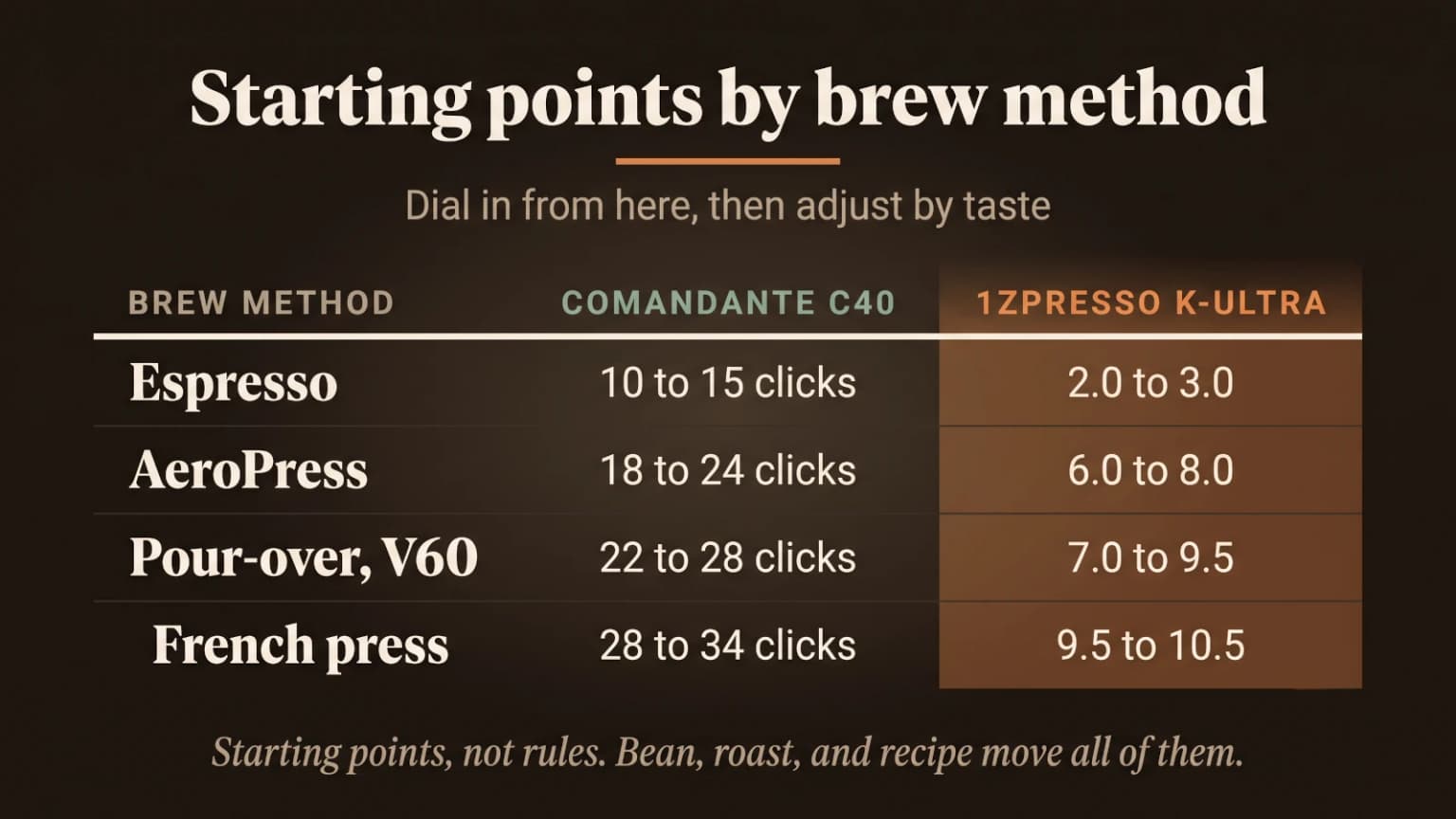
The two grinders speak different languages, which is one more small friction if you ever own both. The C40 counts clicks from closed. The K-Ultra reads as rotation, number, and click, so 7.5 means seven full numbers and five clicks.
Where to start on each grinder
Where to start on each grinder
Brew method
Comandante C40
1Zpresso K-Ultra
Espresso
10 to 15 clicks
2.0 to 3.0
Moka pot
14 to 18 clicks
3.0 to 4.5
AeroPress
18 to 24 clicks
6.0 to 8.0
Pour-over, V60
22 to 28 clicks
7.0 to 9.5
French press
28 to 34 clicks
9.5 to 10.5
Published starting points from each maker and the wider owner community. Bean density, roast level, and recipe all move them.
Treat these as the first guess, not the answer. A dark roast grinds coarser than a light roast at the same setting because it fractures more easily, so the same number produces a different particle size.
Moka drinkers should note that the window is narrow on both grinders, which is why grind matters so much for that brewer. Our induction moka pot guide covers the rest of that setup.
Switching brew methods in practice
Everything above is theory until you actually own one and want a different drink than you had yesterday. Here is what that morning looks like on each grinder.
Going from espresso to pour-over
1
On the C40, lift the jar off
The adjustment dial sits under the burr shaft, so the catch jar has to come off before you can reach it. Grounds from the last dose are usually still in it.
2
Close the burrs, then count back out
Turn the dial until the burrs touch, then count clicks outward to your filter setting. There is no marking to read, so the count is the only reference you have.
Tip Write your two or three regular settings on a piece of tape inside a cupboard door. Almost every long-term C40 owner ends up doing something like this.
3
Reassemble and check the first brew
Put the jar back, grind, and taste. If the count slipped by a click or two you will find out in the cup rather than on the grinder.
4
On the K-Ultra, turn the ring to the number
The dial is on the outside of the body and it is printed. Move it from 2.5 to 8.0, grind, done. Nothing comes apart and there is nothing to remember.
That is the entire difference, and it is worth being clear about how much it should weigh. If this sequence happens twice a year, it is irrelevant. If it happens twice a week, it is the whole decision.
There is a second-order effect too. Owners who find changing the grind tedious tend to stop changing it, which quietly narrows what they brew.
Grind speed and the effort involved
Speed follows burr size, so the K-Ultra wins. A 48 mm burr set moves more coffee per rotation than a 39 mm set, and over a full dose the difference is easy to feel.
For a filter dose the gap is modest, perhaps a handful of extra turns on the C40. Both grinders finish quickly enough that nobody times them.
At espresso settings the gap opens up. Fine grinding is where hand grinders demand the most torque and the most rotations, and the smaller burr spends longer in the hardest part of the job.
Effort is not the same as speed, and here the two are closer than the numbers suggest. The C40's slimmer body is easier for small hands to hold securely, while the K-Ultra's wider grip gives larger hands more leverage.
Retention, static, and cleaning
Both grinders are built for single dosing, so both have very low retention. There is no hopper holding yesterday's beans and no wide chamber for grounds to hide in.
In practice you will find a few tenths of a gram left in either one, mostly in the chute and around the exit path. A tap on the body or a quick puff from a blower clears most of it.
That low retention is the real reason single dosing suits both grinders. Stale grounds from the last dose never carry into the next one, so a bag change tastes like a bag change.
Static behaves the same way on both, which is to say it depends far more on your climate and your beans than on the grinder. Dry winter air makes grounds cling to any catch cup.
The Ross Droplet Technique, or RDT, helps if you need it. One fine mist of water on the beans before grinding is enough, and more than that risks buildup inside the burr chamber.
Cleaning favors the K-Ultra slightly, because it strips down without tools and ships with a recalibration guide so you can put it back exactly where it was. The C40 also comes apart, but reassembly asks a little more care.
Build quality and long-term durability
The C40 is the more impressive object, and Comandante has never pretended otherwise. Stainless body, stainless axle and crank, sealed micro ball bearings, and German manufacture.
Those twin sealed bearings are the part that matters most for burr alignment. They hold the axle steady under load, which is what keeps a hand grinder cutting evenly years into its life.
It is designed to be rebuilt rather than replaced. Burrs, axles, bearings, and jars are all available, and the service network behind it is the deepest in hand grinding.
That matters more than it sounds. A grinder you can repair in year eight is a different purchase from one you replace in year five, and a large part of the C40's price is buying into that.
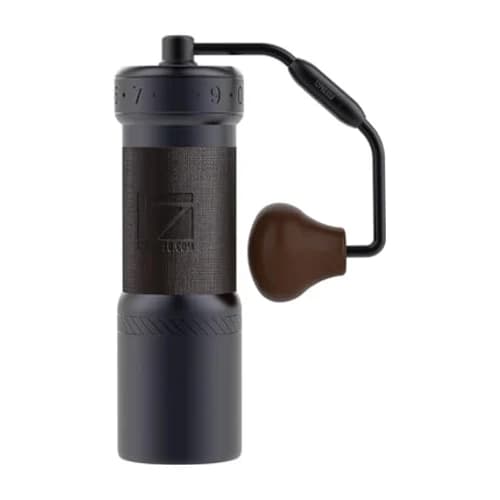
The K-Ultra is very well made and clearly built to a plan, with a wood-and-metal body and a fit and finish that justifies its price. It is simply younger, so its long-term record is shorter.
What it does offer is genuinely tool-free maintenance. The whole grinder comes apart by hand, and the included recalibration guide means taking it apart does not cost you your settings.
Neither grinder has a motor, a controller, or firmware. That absence is the real longevity story for both, and it is why either one will likely outlast an electric grinder bought on the same day.
The trade is capacity. Neither holds enough beans for a full press in one load, which is why our French press grinder guide sends larger-pot brewers to a hopper instead.
What owners complain about in both grinders
Five-star reviews tell you a product works. Three-star reviews tell you what it is like to live with, which is the more useful question when two grinders are both clearly good.
For the C40, the criticism is almost never about the coffee. It is about the routine underneath it: taking the jar off, counting from closed, and having no number to check your work against.
The second recurring theme is espresso. Owners who bought a C40 expecting it to be an espresso grinder describe a lot of patience, a lot of turns, and eventually a Red Clix order.
The third is price sensitivity around accessories. Buyers who paid a premium for the grinder are not delighted to find that better resolution is a separate purchase, and they say so.
For the K-Ultra, the complaints are physical rather than functional. The body is wide, the textured grip can tire smaller hands, and dense light roasts at espresso settings take real force.
The other recurring theme is expectations. It is a hand grinder at an electric grinder's price, and some buyers only feel that after the tenth morning of cranking.
What is striking is what almost nobody complains about on either grinder: grind quality, alignment, or build. Both clear that bar comfortably, which is why this comparison comes down to workflow instead.
Travel: one folds, one does not
The K-Ultra wins this comfortably. Its handle folds flat against the body and it ships with a fitted case, so it goes in a bag like a water bottle instead of a piece of equipment.
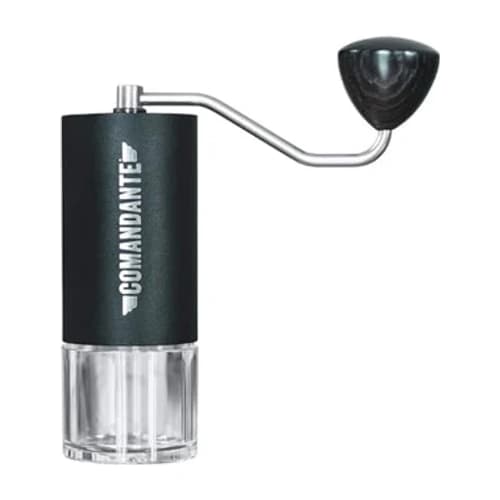
The C40 has a fixed crank that sticks out, and its nicest catch jar is amber glass. The polymer jar solves the fragility, but the crank still dictates how much space the grinder needs.
Weight is close enough to ignore. Both sit around 700 g, which is more than anyone wants in a daypack and fine in a suitcase. If the grinder never leaves your counter, none of this matters.
What each one really costs
This is where the comparison shifts, and it is the part most head-to-heads skip. The sticker prices are close. The prices you actually pay depend on what you brew.
The cost of reaching each capability
The cost of reaching each capability
What you want
Comandante C40
1Zpresso K-Ultra
Filter coffee only
Grinder alone
Grinder alone
Espresso, usable resolution
Grinder plus Red Clix axle
Grinder alone
Both, switched often
Grinder plus axle, plus a recount every switch
Grinder alone
Travel ready
Add a case, use the polymer jar
Case included
The Red Clix RX35 sells for roughly $45 to $50 at US specialty retailers. Live grinder prices are shown on the buttons above.
For a filter-only buyer the two are within about twenty dollars of each other, and that gap is small enough to ignore in favor of whichever cup you prefer.
For an espresso buyer the C40 is meaningfully more expensive, because the axle is not really optional. Add it up and you are paying a clear premium to reach a capability the K-Ultra ships with.
The head-to-head scorecard
A six to two scoreline looks decisive, and it would be misleading to leave it there. Look at which two the C40 takes.
Filter cup quality and long-term build are the two criteria a dedicated pour-over drinker weights most heavily, and the C40 does not merely edge them. It wins both clearly.
The K-Ultra's wins cluster around flexibility: adjustment, speed, travel, and cost to reach espresso. If you never need that flexibility, most of its margin is worth nothing to you. The scorecard measures the grinders; only you know which rows matter.
Before you buy either one
One practical warning applies to the Comandante, and it is the kind of thing that never makes it into a spec comparison.
At the time of writing, the live Amazon offer for the C40 MK4 was sold by a third-party merchant rather than by Amazon or Comandante. We flagged the same thing in our grinder guide, and it has not changed.
That is not automatically a problem, and the seller may be perfectly good. It does mean you should confirm US warranty coverage and the return window before ordering, because a discount is worthless if it removes manufacturer support.
For a grinder whose main argument is decades of service, warranty coverage is not a detail, so an authorized Comandante retailer is the safer route if the price is close.
The K-Ultra listing did not have this issue at the time of writing. Sellers change, so check both before you commit.
Which hand grinder should you buy in 2026?
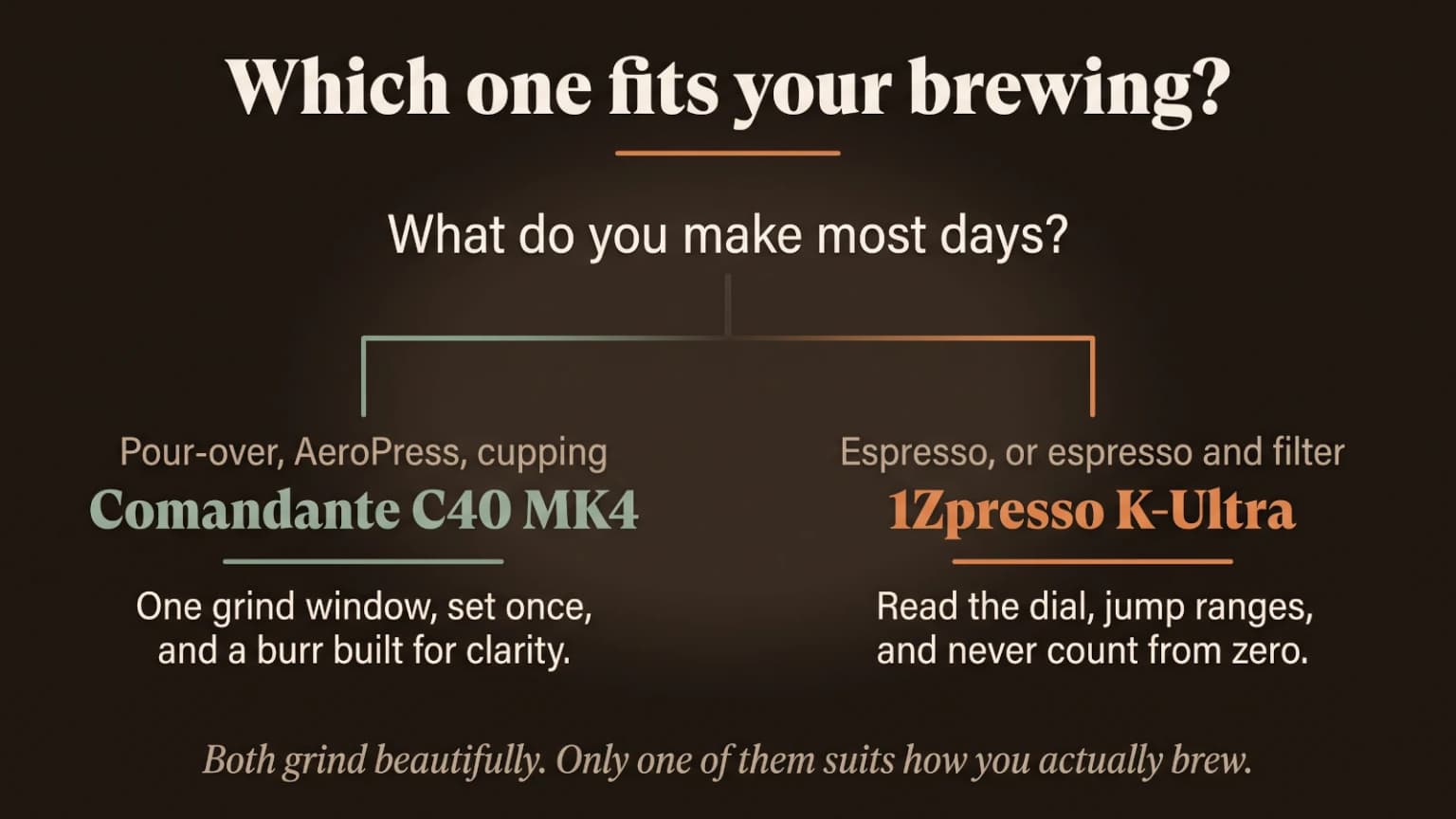
One question settles it for most buyers.
If you have read this far hoping one of them is simply better, the honest answer is that neither is. They are two correct answers to two different questions.
If you are still undecided, use the cheaper question: what did you brew this morning, and what will you brew tomorrow? The grinder that suits those two answers is the right one.
If neither one is right for you
Two premium hand grinders is a narrow field, and plenty of buyers land here and realize they wanted something else.
If you like the 1Zpresso approach but only pull espresso, the K-Ultra is more grinder than you need. The J-Ultra costs less and steps in 8 micron increments, which is finer than either grinder here, at the cost of being tedious to move to filter settings.
If hand grinding is the part you do not want, an electric single doser solves it. The Fellow Ode Gen 2 is the filter-focused option in our guide, and the Baratza Encore ESP is the flexible one.
If you want to spend less and still grind well, the KINGrinder K6 covers most of what C40 MK4 and K-Ultra owners actually do, at well under half the price. It gives up refinement, not competence.
And if the real goal is better coffee rather than better gear, the beans move the cup more than the burr does. A fresher roast will do more for a morning V60 than nine millimeters of burr diameter.
Frequently asked questions
Is the Comandante C40 worth the extra money?
For filter coffee, many owners say yes. The Nitro Blade burr has a reputation for sweetness and clean separation in pour-over that has survived a decade of challengers, and the 4.8 star average from 445 Amazon raters is the highest in our grinder guide.
For espresso the answer changes. You pay more, then often pay again for the Red Clix axle to get usable resolution, which pushes the real cost well past the K-Ultra.
The other part of the value case is time. The C40 is built to be rebuilt, so buyers who keep gear for a decade are not really comparing the same purchase as buyers who upgrade every few years.
Can the Comandante C40 grind fine enough for espresso?
Yes, it reaches espresso fineness. Most owners start somewhere around 10 to 15 clicks from closed and adjust from there.
The problem is not range but resolution. At roughly 30 microns per click, one click can be the difference between a 22 second shot and a 34 second one, which leaves you without a setting in between.
That is the gap the Red Clix RX35 axle exists to fill. It halves the step to about 15 microns and makes dialing in far less frustrating.
Do you need the Red Clix upgrade for the C40?
Only if you pull espresso. For pour-over, immersion, and cupping the stock axle has more resolution than those recipes need.
If espresso matters, treat the axle as part of the purchase price rather than an optional extra. It sells for roughly $45 to $50 at US specialty retailers.
Add that to the grinder and the C40 becomes clearly the more expensive way to reach espresso control the K-Ultra already has out of the box.
Is the 1Zpresso K-Ultra good for pour-over?
It is very good, and it is the reason the K-Ultra tops our single dose guide. The 48 mm heptagonal burr produces a clean, well separated filter cup that most drinkers would be happy with for years.
Compared side by side with the C40, tasters tend to describe the K-Ultra as slightly more open and the C40 as rounder and sweeter. Those are small differences, and roast and recipe move the cup further than the burr does.
If pour-over is genuinely all you brew, the C40 is the more celebrated filter burr. If pour-over is most of what you brew, the K-Ultra gives up very little and adds real espresso ability.
Which grinder is faster, the C40 or the K-Ultra?
The K-Ultra is faster, and the reason is simple geometry. A 48 mm burr set moves more coffee per turn than a 39 mm set, so a filter dose clears in noticeably fewer rotations.
The gap widens at espresso settings, where fine grinding takes the most turns and the most torque. It narrows at coarse settings, where both grinders feel quick.
Neither is effortless with a dense light roast. If grip strength is a concern, an electric grinder is the honest answer rather than either of these.
How long do these hand grinders last?
Both are built to outlive the average electric grinder, because there is no motor or controller to fail. Burrs, axles, bearings, and jars are the parts that wear, and both makers sell them.
The C40 has the longer proven record and the deeper parts and service network, which is a real part of what its price buys. Owners routinely report grinders still in daily use many years on.
The K-Ultra is newer, but it strips down without tools and ships with a recalibration guide, so routine maintenance is straightforward.
Is the K-Ultra or C40 better for travel?
The K-Ultra, and it is not close. The handle folds flat against the body and it comes with a fitted case, so it packs like a water bottle rather than a piece of equipment.
The C40 has a fixed crank and its nicest catch jar is glass. Neither is a disaster in a bag, but both ask for more care and more space.
If the grinder lives on a counter, this difference stops mattering entirely.