Induction Moka Pots in 2026: 6 That Pass Both Tests
We compared products backed by 57,458 owner reviews to find the best moka pot for induction stove setups, with six 2026 US picks from $32.99 to $89.34.
By the CoffeeGearGuides team · USA · Updated Jul 25, 2026 · 37 min read
On this page18
The best moka pot for induction stove use must pass two tests that product pages often collapse into one: the base must be magnetic, and the cooktop must be willing to detect its size.
That second test is where a pot marked for induction can still fail before it warms a drop of water.
There are two sensible routes. Buy a moka pot with a magnetic base, or keep a trusted aluminum pot and add an induction adapter that your cooktop recognizes.
Direct pots respond faster and leave fewer hot parts on the stove. An adapter protects an existing routine, but it adds thermal lag and another surface that stays hot.
Our 2026 shortlist comes from manufacturer manuals, published dimensions, expert coverage, parts catalogs, and owner feedback across listings totaling 57,458 Amazon reviews.
We paid closest attention to three-star reports. They reveal the leaks, detection failures, awkward handles, and replacement-part gaps that five-star summaries rarely mention.
How we chose these induction pots for 2026
We are a research-driven publication. We do not claim that a few test brews can establish years of seal life, valve reliability, or cooktop compatibility.
For this guide, we started with the cooktop rather than the coffee pot. We read appliance manuals to learn how induction zones recognize cookware and why minimum pan diameters vary.
Then we checked each pot against manufacturer specifications, instruction sheets, independent reviews, parts catalogs, and long-term owner discussions.
Amazon ratings supplied by the site owner formed the final gate. Every rating and review count below is reproduced verbatim and described as it stood at the time of writing.
The first cut contained ten products. We removed listings with only 41, 57, or 213 reviews, plus a duplicate capacity that added no distinct buyer.
Every finalist is rated at least 4.1 stars. The smallest review base is 827, while the two largest Bialetti listings have more than 17,000 and 31,000 reviews.
We also required a clear job. A pot had to solve for classic moka character, compact value, group volume, safer handling, pressure-valve foam, or visible flow.
Price did not decide the ranking. The $32.99 glass model is sixth because uncertain parts support matters more than a low checkout total.
Likewise, a $326 designer pot left the list when its verified Amazon listing showed only 57 reviews. Premium construction does not excuse weak evidence.
Finding the best induction moka pot fit
An induction zone does not heat the glass first. Its coil creates a changing magnetic field that induces current in suitable cookware above it.
That is why aluminum moka pots need a magnetic steel layer or a separate adapter.
Yet suitable metal is only the opening requirement. The cooktop also looks for enough responsive material over the coil before it supplies sustained power.
Minimum detection sizes differ sharply. One appliance manual may accept a 90 mm bottom on its small zone, while another recommends 120 mm or more.
A printed zone ring is not the same as the detection threshold. Only the manual for the exact cooktop model settles the question.
Induction compatibility has two gates. The pot must respond to a magnet, and its responsive footprint must satisfy the cooktop.
The fridge-magnet test remains useful. A strong pull across the flat central base suggests that the pot contains the ferromagnetic layer a conventional induction zone requires.
Test the area that touches the glass. A magnet clinging only to a decorative side wall tells you little about heating performance.
Next, measure the flat magnetic contact patch. Rounded shoulders and raised rings may make the pot look wider than the surface the coil actually sees.
Finally, compare that measurement with the manual. If the pot falls below the published minimum, do not assume a premium cooktop will be more permissive.
Some high-end zones are designed around large cookware and can be less tolerant of a tiny coffee pot.
The two compatibility gates
The two compatibility gates
Check
What counts as a pass
Magnetic material
A magnet grips the flat heating surface firmly
Contact diameter
Flat magnetic area meets the manual minimum
Zone choice
Pot is centered on the smallest suitable zone
Power stability
Zone stays active at the intended brew setting
Manual approval
No cookware-shape or adapter warning applies
Pass every row before assuming a moka pot and induction cooktop are a dependable pair.
Pot size creates the uncomfortable trade. A wider 10-cup model is easier for many hobs to detect, but moka pots are not designed like variable-volume drip brewers.
The basket works best filled level, without tamping. Buying a large pot only to half-fill it can produce a weak, unstable brew and waste the advantage you bought.
Choose for the intersection of detection and drinking volume. If those needs conflict, an approved adapter or a small conventional hot plate can be more rational than an oversized pot.
The 6 best moka pots for induction stoves
The ranking favors dependable compatibility, owner evidence, brew usefulness, and repair prospects. It does not reward novelty for its own sake.
All prices were live when verified through Amazon's product API. Ratings and review counts are the owner's exact figures from the linked US listings at the time of writing.
Amazon US ratings and review counts supplied July 22, 2026. Check your cooktop's minimum pan size before ordering any model. Amazon.com prices as of 15/09/2026. Details
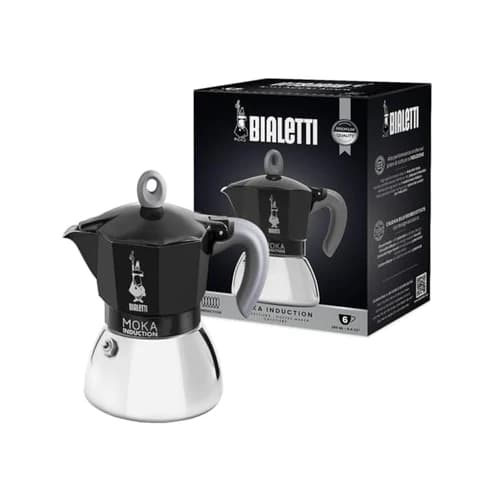
1. Bialetti Moka Induction 6 Cup
The Moka Induction 6 Cup is the most complete answer for someone who wants familiar Bialetti construction without placing an adapter between the pot and the hob.
At the time of writing, its Amazon listing holds 4.4 stars across 17,110 reviews. That is both a strong score and a deep record for a manual brewer.
Model 6936 pairs an aluminum upper collector with a boiler whose outer steel layer responds to induction. The food-contact interior remains aluminum.
Bialetti publishes an indicative yield around 280 ml for this size. That is enough for two short milk drinks or one substantial diluted cup.
Bialetti Moka Induction 6 Cup (6936)
Rated 4.4 from 17,110 ratings
A hybrid aluminum and steel moka pot that brings the familiar Bialetti format to induction while keeping a practical six-cup yield.
Key details
Six-cup format with about 280 ml indicative output
Aluminum collector and food-contact boiler interior
Magnetic steel outer boiler for induction heating
Approximately 100 mm published base diameter
Inspectable Bialetti safety valve
Thermoplastic handle and lid knob
What we like
Strongest blend of owner evidence and useful capacity
Classic Bialetti brew path without a separate adapter
Wide availability of six-cup rings and filter plates
Works on gas, electric, ceramic, and compatible induction zones
Watch out for
A 100 mm base is too small for some induction sensors
Hand washing without detergent is required
Exact replacement kits can be awkward to source in the US
Three-star feedback tends to split into two groups. Some buyers love the coffee but discover that their induction zone cannot recognize the base consistently.
That is not evidence that every unit is defective. It is evidence that the phrase "induction compatible" describes the pot's material, not every pot-and-hob pairing.
The other complaints concern sealing. Owners describe steam escaping at the joint when the rim carries a stray ground, the gasket is misplaced, or the chambers are not tightened evenly.
Those are common moka-pot failure points, but a new pot should still seal without heroic force. Return a unit with a visibly uneven rim or repeat leakage after careful assembly.
The hybrid boiler is the reason to buy this model and its main care constraint. It supplies a magnetic exterior while retaining aluminum on the water side.
That means no dishwasher and no aggressive detergent. Rinse it after cooling, dry the pieces separately, and avoid scouring the interior.
The honest weak point is its roughly 100 mm base. Several cooktops accept that size, but manuals with 120 mm or 140 mm minimums rule it out on paper.
Do not buy it first and investigate later. The larger all-steel option offers more detection margin if its volume suits you.
For a compatible hob, this is the benchmark. It has the clearest parts path, enough output for a couple, and none of the Brikka's extra valve sensitivity.
Buy it if six moka cups match your morning and your smallest zone accepts a 100 mm magnetic base.
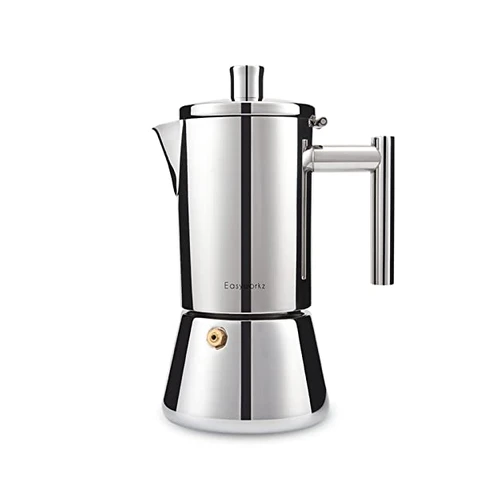
2. Easyworkz Diego 4 Cup
The Diego 4 Cup earns second place by solving the two objections people raise after seeing the Bialetti price: it costs less and keeps the brew path in stainless steel.
Its 4.4-star rating across 5,109 reviews matches the winning score here. At $39.99 when verified, it is also $32.14 below our top pick.
Easyworkz specifies a 200 ml capacity, 18/8 stainless construction, and a heavy magnetic base. The polished body has a hollow metal handle rather than a molded side handle.
The listing identifier is B08GJDQH9P. Easyworkz does not publish the flat magnetic contact diameter as clearly as Bialetti publishes dimensions for its main lines.
Easyworkz Diego 4 Cup
Rated 4.4 from 5,109 ratings
A polished 18/8 stainless moka pot with a magnetic base, hollow insulated handle, and a reducer for brewing below the full four-cup dose.
Key details
Four-cup format with 200 ml advertised capacity
Polished 18/8 stainless steel construction
Heavy-gauge magnetic induction base
Hollow insulated metal handle and lid grip
Coffee-basket reducer included
Safety valve and dishwasher-safe claim
What we like
Excellent 4.4-star score across more than 5,000 reviews
Reducer gives a smaller household two useful dose options
No painted aluminum surface to protect from detergent
Strong value at the verified $39.99 price
Watch out for
Flat magnetic contact diameter is not clearly published
Polished steel shows fingerprints and water spots
Dedicated replacement-parts support trails Bialetti
Owners repeatedly praise the substantial feel. That weight helps the pot sit flat, and many reports say the base is recognized promptly on their induction zones.
The important qualifier is "their." A successful report on one cooktop cannot override a larger minimum pan size in another cooktop's manual.
The reducer is more meaningful than it looks. Most moka pots expect a level, full basket, while this insert is designed to reduce the coffee bed without leaving a loose half dose.
That makes the four-cup body useful for a couple and for one person who sometimes wants less caffeine. It is a cleaner solution than buying the 12-cup Diego and underfilling it.
Middle reviews mention small usability annoyances rather than a single fatal flaw. The mirror finish marks easily, the maximum line can be hard to read, and damp grounds can cling beneath the basket lip.
Some owners also find the hollow metal handle less reassuring than a thick molded grip. It reduces flame exposure on gas, but metal can still grow warm during a long induction cycle.
Use the body, not the handle, as leverage when unscrewing a cooled pot. That habit protects the handle joint on every moka design in this guide.
The less visible compromise is the parts ecosystem. Easyworkz sells complete pots and includes the reducer, but its US catalog is not as mature as Bialetti's model-specific ring and filter range.
Measure the gasket before ordering a generic replacement. "Four cup" is a serving label, not a universal gasket standard.
Choose this pot if you want stainless steel, a compact dose, and strong owner sentiment without paying for the Bialetti name.
Skip it if your cooktop manual requires a broad base and you cannot confirm the Diego's flat contact area before the return window closes.
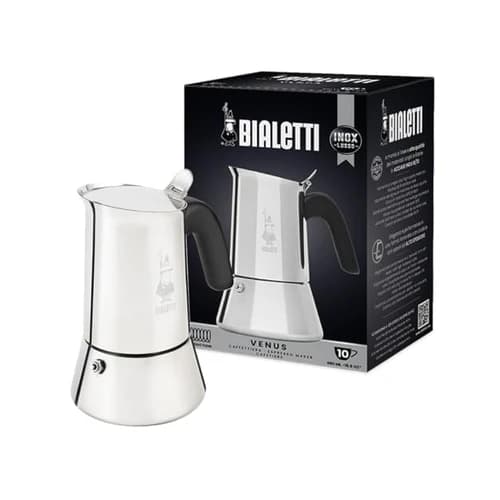
3. Bialetti Venus 10 Cup
The Venus 10 Cup is the compatibility-first choice for a household that will actually drink a large batch. Its broad base gives many induction zones more material to recognize.
At the time of writing, 31,344 Amazon reviews average 4.1 stars. No other finalist has a deeper owner record, though the score signals more caveats than our top two.
Model 0007256/CN uses a stainless collector and an AISI 430 magnetic stainless boiler. Bialetti lists roughly 570 ml in the boiler and about 460 ml delivered.
Published product dimensions put the base near 128 to 130 mm. That is useful detection margin, but it still does not overrule the cooktop manual.
Bialetti Venus 10 Cup (0007256/CN)
Rated 4.1 from 31,344 ratings
A high-capacity stainless moka pot with a broad magnetic boiler, a curved collector, and enough output for several short coffees or milk drinks.
Key details
Ten-cup format with about 460 ml indicative output
Stainless collector and magnetic stainless boiler
Approximately 128 to 130 mm published base width
Bialetti safety valve and silicone sealing ring
Heat-resistant handle with hinged lid
Dishwasher-safe listing, though hand washing is gentler
What we like
Broadest published base among the six finalists
Large enough for a family brunch or several milk drinks
Massive owner record across more than 31,000 reviews
Model-specific 10-cup gasket and filter kits exist
Watch out for
Far too much coffee and grounds for most solo drinkers
The strongest owner theme is capacity satisfaction. Buyers who serve several people like making one batch instead of resetting a smaller pot while the first cups cool.
That convenience reverses for one person. Moka cups are small, but 460 ml of concentrated coffee is still a serious batch and consumes a full ten-cup basket of grounds.
Do not interpret the cup label as ten American mugs. Think several espresso-size servings, or enough concentrated base for multiple Americanos and milk drinks.
Three-star comments often describe a slow first flow. A large steel pot and a conservative induction setting can take time, especially when started with cold water as the instructions direct.
Raising the cooktop to boost is the wrong correction. It can make the final phase abrupt, push bitter spray through the chimney, and overheat the handle area.
Other reports mention brown marks, rainbow discoloration, or suspected rust inside the boiler. Stainless steel resists corrosion; it is not immune to chloride, hard-water deposits, or trapped moisture.
Some marks clean away as scale, while genuine pitting deserves a warranty claim. We would not dismiss every report as poor care.
Rinse the boiler promptly and dry it open. Avoid chlorine cleaner, and do not leave spent water sitting in the base between brews.
The nominal dishwasher approval is convenient, yet a machine cycle is harder on the polished finish and gasket than a short hand rinse. Removing the gasket before a deep wash is prudent.
The wide base is its strategic advantage. If your hob asks for about 120 mm and your household needs the volume, the Venus is a far cleaner answer than balancing a small pot on a hot adapter.
Buy it for groups, not as compatibility insurance for one coffee drinker. The correct volume matters every morning; the detection test happens only once.
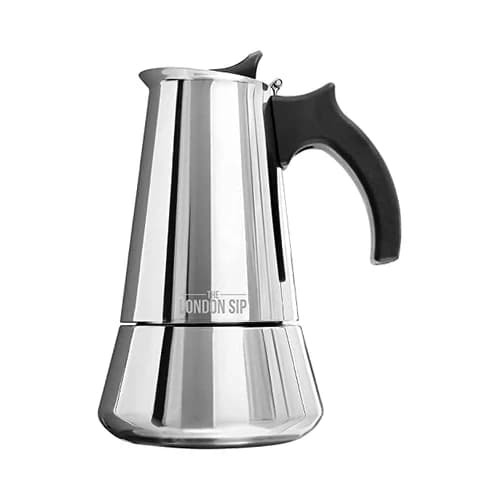
4. The London Sip 6 Cup
The London Sip 6 Cup is shaped around a practical issue that spec tables underrate: keeping fingers away from a hot boiler and neighboring cooking zones.
Its Amazon US listing shows 4.3 stars from 2,074 reviews at the time of writing. The $39.95 verified price puts it within four cents of the Diego.
Model EM6S is advertised at 300 ml and built from stainless steel. Its outward handle creates more room between the hand, the pot wall, and the cooktop glass.
The brand also advertises double filtration. That term describes its screen arrangement, not paper filtration or a sediment-free cup.
The London Sip 6 Cup (EM6S)
Rated 4.3 from 2,074 ratings
A 300 ml stainless moka pot with an extra-large outward handle, reusable metal filtration, and a magnetic base for all common stove types.
Key details
Six-cup format with 300 ml advertised capacity
Stainless steel boiler and collector
Magnetic base for compatible induction zones
Extra-large outward heat-resistant handle
Reusable double-screen filtration design
Steam safety valve in the boiler wall
What we like
Handle gives broad clearance from the hot pot body
Strong 4.3-star sentiment across more than 2,000 reviews
Useful middle capacity for two milk drinks
Replacement EM6 gasket and filter sets are listed
Watch out for
Flat magnetic contact diameter is not specified clearly
Positive owners like the balance. The handle stays separated from the steel wall, and the 300 ml body pours enough for a couple without approaching the Venus's batch size.
The shape is also easier to grip with a fuller hand than the narrow loops on some polished-steel pots. That matters when the collector holds hot coffee.
Middle and lower reviews raise two concerns. A small group describes the handle as lighter or more flexible than the substantial steel body suggests.
Others report a new unit that built heat but sent no coffee upstairs. Assembly mistakes can cause that symptom, but a malformed basket, seal, or valve can do it too.
If a new pot remains silent after the normal brew window, turn off the heat and let it cool completely. Never open a hot pressurized moka pot to diagnose it.
Check the filter plate, gasket order, basket rim, and safety valve after cooling. Return a unit that repeats the failure with a clean rim and correct grind.
The London Sip has a better repair story than many secondary brands. Six-cup replacement sets containing gaskets and a filter plate appear in its catalog.
That is not the same coverage as Bialetti, but it gives the EM6S a named part route rather than leaving the owner to guess from dimensions.
Its honest limitation is pre-purchase base information. Published overall dimensions do not identify the exact flat magnetic area touching the hob.
Pick it if handle clearance and a 300 ml stainless format matter most. Choose the smaller value pick if the included reducer matters more.
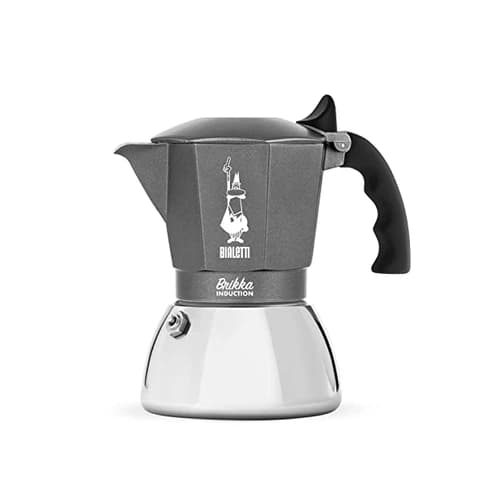
5. Bialetti Brikka Induction 4 Cup
The Brikka Induction 4 Cup is not a standard moka pot with a different badge. A membrane valve in the chimney delays flow and changes how coffee exits into the collector.
That produces a foamier surface and a more concentrated impression. It also makes water measurement and heat control less forgiving than on our top pick.
At the time of writing, model 7317 carries 4.1 stars from 994 Amazon reviews. Its $89.34 verified price is the highest in this six-pot field.
Bialetti indicates roughly 160 ml of delivered coffee. The included graduated cup matters because the Brikka does not use the standard fill-to-the-safety-valve rule.
Bialetti Brikka Induction 4 Cup (7317)
Rated 4.1 from 994 ratings
A hybrid induction moka pot whose silicone membrane valve delays flow to create a more concentrated cup with a visible layer of coffee foam.
Key details
Four-cup format with about 160 ml indicative output
Silicone membrane flow-control valve
Steel outer and aluminum inner boiler construction
Approximately 115 mm published base width
Graduated water measuring cup included
Inspectable boiler safety valve
What we like
Distinct foamier result without an espresso machine
Wider published base than the Moka Induction 6 Cup
Compact output suits one strong drink or two short cups
Bialetti sells compatible ring and filter sets
Watch out for
More sensitive to water volume and heat than standard moka
Owners who learn its routine describe a heavier cup and enjoy the foam. That layer is not espresso crema, because the brewer does not operate like a nine-bar espresso machine.
The distinction matters. Buy the Brikka for its moka variation, not as a loophole that replaces a portafilter and grinder.
Three-star reports focus on inconsistency. One batch forms the expected foam, another runs slowly, and a third surges through the top or threatens to overflow.
Water volume explains many failures. Filling to the boiler safety valve, as people do with a standard moka pot, can overfill this collector when the delayed flow releases.
Use the supplied measuring cup and the model manual. If that cup disappears, replace its measured volume rather than improvising from the boiler wall.
Heat is the other lever. Too little energy may never trigger a decisive release, while high induction power can store enough heat in the base to turn release into a rush.
Start at medium power and reduce it as soon as the valve opens. Record the setting that produces a controlled release on your hob.
The foam system adds a part that can collect coffee residue. Rinse the chimney assembly as directed, and do not probe or modify the membrane to chase more pressure.
Our verified listing was sold through an Amazon Germany merchant. Import handling, returns, and warranty support deserve a check before paying the premium.
Choose this model if you specifically value its valve-controlled result and enjoy tuning a manual brewer. For repeatable standard moka, the overall winner is easier to recommend.
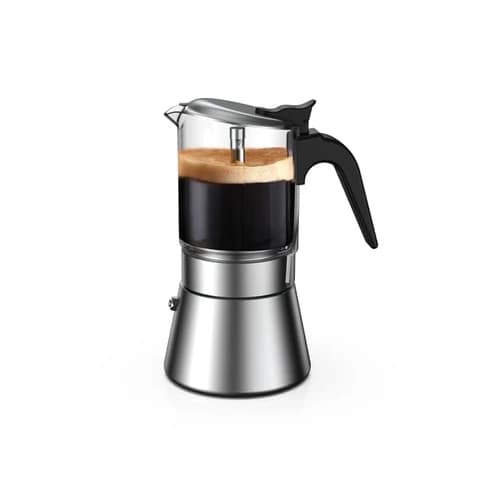
6. SIXAQUAE Glass-Top 6 Cup
The SIXAQUAE Glass-Top 6 Cup solves a different induction problem: it lets the brewer see the coffee rise instead of inferring progress from a closed metal collector.
Its listing shows 4.2 stars from 827 reviews at the time of writing. That clears our evidence floor, but it remains the least established product in the final six.
Amazon identifies this 240 ml version with ASIN B08ZKF27NQ. The listing combines a borosilicate-glass collector, stainless boiler, heat-resistant handle, and safety valve.
Brand data is inconsistent across commerce feeds, where the same listing can appear under SIXAQUAE or TWOCE. That ambiguity affects our confidence in parts and warranty continuity.
SIXAQUAE Glass-Top 6 Cup (B08ZKF27NQ)
Rated 4.2 from 827 ratings
A 240 ml moka pot with a borosilicate-glass collector that exposes the flow, paired with a stainless induction boiler and heat-resistant handle.
The clear collector is more than decoration. New moka users can see pale early flow deepen, accelerate, and begin to blond near the end.
That visual feedback makes it easier to learn when to reduce power and remove the pot. It is especially useful on an induction hob whose coil cycles quietly beneath the glass.
Owners like the theater and the absence of a hidden upper chamber. Several report using the view to stop the batch before harsh sputtering.
The middle-review risk is quality control. Reports around glass-top moka pots include poor seals, incomplete valve assemblies, and units that heat without moving water.
Those symptoms are serious even when uncommon. Inspect the valve, gasket, filter plate, glass, and threaded joint before the first conditioning brew.
Never continue heating a pot that should have begun flowing but remains empty. Switch off the zone, move away, and wait until the brewer is completely cold before inspection.
Glass also changes cooling practice. Do not place a hot collector on a wet stone counter, rinse it under a cold tap, or knock a spoon against its wall.
Borosilicate glass tolerates temperature changes better than ordinary serving glass, but "better" does not mean immune to impact or thermal shock.
The largest weakness appears after the warranty window. We found no dependable US catalog for a model-specific gasket, filter, glass collector, or handle.
That makes a cheap pot potentially disposable after one specialized part fails. The Bialetti and London Sip choices have clearer repair routes.
Buy this one if seeing the brew is the feature that will improve your technique. Skip it if durability, easy parts ordering, or consistent brand support ranks first.
Why magnetic is not enough
The six product listings all say induction in some form. Only three publish a sufficiently clear base-width figure for us to compare without pretending that overall package dimensions equal magnetic contact area.
That missing data is itself a finding. A buying guide should not turn an unlisted measurement into a confident compatibility promise.
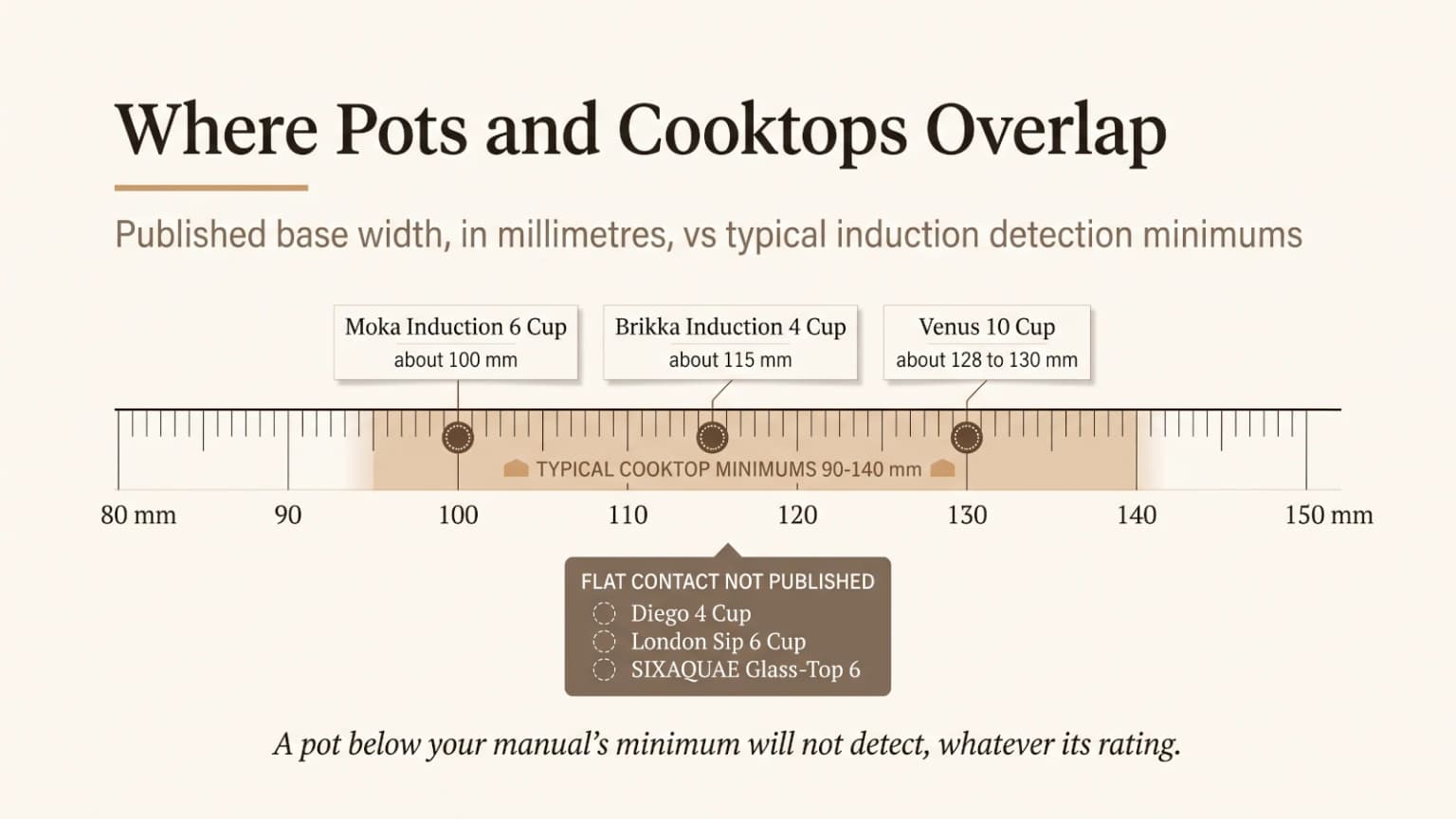
For the known models, the numbers range from about 100 mm to about 130 mm. Cooktop manuals can specify minimums across that same span.
The overlap explains why two owners can report opposite results with the same pot and both be correct.
Known pot widths and cooktop thresholds overlap. Confirm the flat magnetic area and the exact appliance manual before ordering.
The Moka Induction 6 Cup is published near 100 mm. It may work perfectly on a small zone that accepts 90 or 100 mm cookware.
It is a poor bet for a manual that recommends 120 mm. No rating count can change that geometry.
The Brikka Induction 4 Cup is listed near 115 mm across its base. That gives modest extra margin, not universal acceptance.
The Venus 10 Cup sits around 128 to 130 mm. It is the safest published footprint here for detection, yet some large zones still specify a higher minimum.
We distinguish base width from flat contact diameter because a rolled edge or curved shoulder can sit outside the surface that couples with the coil.
When a manufacturer publishes only overall width, we label the critical measurement unknown.
What the base evidence supports
What the base evidence supports
Pot
Induction construction
Published base evidence
Compatibility decision
Moka Induction 6
Steel outer, aluminum inner
About 100 mm base
Avoid if manual minimum is above 100 mm
Diego 4
Magnetic stainless base
Flat contact size not found
Confirm with seller or preserve return option
Venus 10
Magnetic stainless boiler
About 128 to 130 mm base
Best known margin, still check manual
London Sip 6
Magnetic stainless base
Flat contact size not found
Do not infer it from overall product width
Brikka Induction 4
Steel outer, aluminum inner
About 115 mm base
Check closely around 110 to 120 mm limits
SIXAQUAE Glass-Top 6
Stainless induction boiler
Flat contact size not found
Inspect and test within return window
Published figures are approximate model dimensions, not a guarantee of detection on any particular induction zone.
Detection can also change with placement. A small pot sitting off-center may couple with too little of the coil even when its diameter technically passes.
Center it on the smallest approved zone. Keep the glass and base clean so a crumb or dried spill does not tilt the contact surface.
Some cooktops pulse at low settings. The display can remain active while power cycles on and off, which is normal unless the pan-detection symbol appears or the zone shuts down.
A pot that repeatedly disappears from the display is not a stable match. Moving it around until the sensor wakes each morning is not the reliable workflow this guide promises.
Three induction base systems
The word "steel" hides three different thermal paths in this ranking. They do not behave identically once the coil begins cycling.
The first is a layered boiler. The Moka Induction and Brikka place magnetic steel outside an aluminum food-contact interior, with an aluminum collector above.
The coil energizes the steel shell, which passes heat into the aluminum interior and water. Aluminum spreads heat readily, while the steel supplies the magnetic response.
This construction keeps the upper body familiar to users of traditional Bialetti pots. It also inherits aluminum care rules, including hand washing and avoidance of caustic cleaner.
The second path is an all-steel body. The Venus, Diego, and London Sip put stainless steel through most or all of the brewer.
Steel is durable and straightforward to clean, but its heating behavior depends on grade, thickness, base construction, and the cooktop's power cycle.
A heavy base can smooth short pulses, then continue feeding heat after the setting drops. That stored energy is why the owner should lower power before the first surge, not after it.
The third path separates a steel boiler from a glass collector. The SIXAQUAE makes the upper flow visible, but the glass does not improve magnetic coupling below.
Its compatibility still depends on the stainless base. Its longevity also depends on protecting a specialized glass part that other moka pots do not contain.
Three paths carry induction energy from the coil to the water. Construction changes response, care, and replacement risk.
None is automatically best for taste. Bean choice, grind, water volume, seal quality, and flow control have a larger and more defensible effect than vague claims about a "pure" metal flavor.
Our ranking reflects systems, not material folklore. The hybrid Bialetti wins on evidence and parts; the Diego wins value; the Venus wins published base margin.
The glass model wins visibility and loses repair confidence. Each trade belongs to its construction rather than to a universal hierarchy.
Pulsing, hum, and small-zone fit
Induction can make a moka pot sound different from gas. A soft hum, tick, or intermittent buzz often comes from the cooktop and magnetic base, not escaping pressure.
The distinction is behavioral. Normal electrical noise follows the cooktop's power cycle; a seal leak produces steam, moisture, or hissing at the threaded joint.
Low settings may pulse the coil. The coffee can begin, pause, and resume as heat moves through the base, especially with a light pot.
Do not chase each pause by jumping several power levels. That stores excess heat and turns the next cycle into a fast, pale surge.
Use the smallest approved zone and center the pot. A bridge zone is designed for broad cookware, not automatically for a narrow boiler.
Check handle clearance as carefully as base fit. The handle should not sit above an active neighboring zone or touch a hot pan.
The London Sip creates the most hand clearance. The Venus offers the broadest stance, but its ten-cup body also occupies more vertical and lateral space.
Moka pots are quiet beside electric grinders. The endpoint is not silent, though: a calm flow gives way to bubbling and then the sharp sputter that tells you the useful extraction is over.
The case for your old moka pot
Buying a new induction pot is not the only defensible answer. A well-sealed aluminum moka pot that already fits your dose may be better understood than any replacement.
A magnetic adapter plate lets that pot stay in service. The plate is recognized by the cooktop, heats, and transfers energy into the aluminum boiler by contact.
This route makes sense when the old pot has a fresh gasket, a clean valve, and years of predictable results. It also avoids buying a large steel brewer only to satisfy a sensor.
The case against the adapter is control. The plate adds mass between the coil and water, responds slowly to power changes, and remains hot after the zone is reduced.
That lag can keep driving a brew toward sputtering. Removing the moka pot from the plate becomes more important than merely switching off the hob.
An adapter also adds a hot object and handle to a crowded glass surface. It must sit flat, match the cooktop manual, and remain stable beneath the pot.
If the adapter plus your existing pot fits the manual better than a direct pot, it is not a compromise; it is the correct system.
Do not assume every cooktop maker approves converter plates. Some manuals restrict them because of overheating, sensing, or glass-surface concerns.
Buy direct if you want faster response, one object on the hob, and a clean daily routine. Keep the adapter route if your present pot and dose are already right.
The parts question nobody asks
Moka-pot ownership is inexpensive until one small sealing part becomes impossible to identify. The boiler and collector may last for years while the gasket slowly hardens.
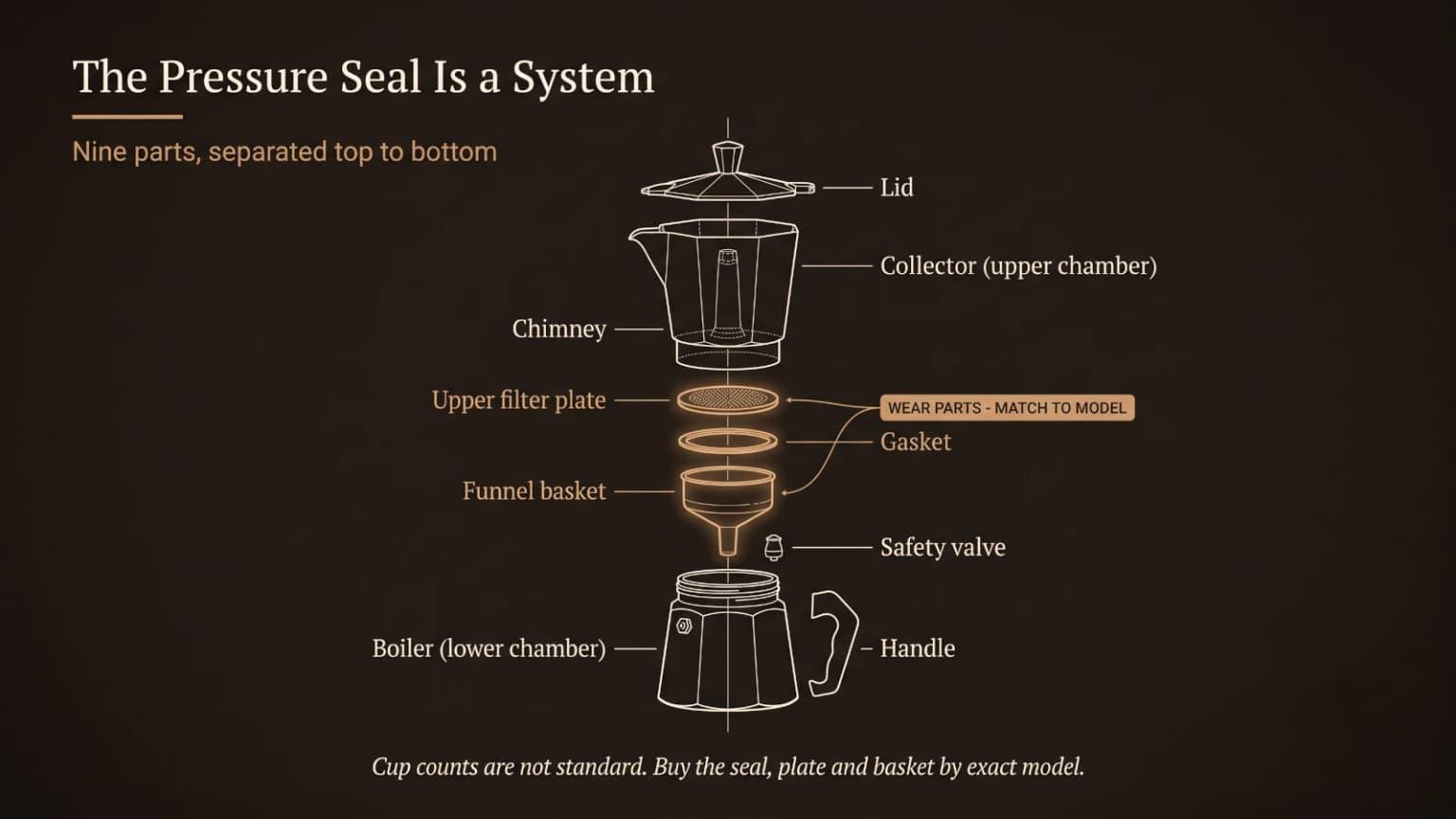
The gasket, upper filter plate, funnel basket, valve, handle, and lid knob do different jobs. "Replacement seal" is not a complete repair plan.
A flattened gasket can leak at the joint. A bent filter plate can keep the gasket from loading evenly, while a damaged basket rim can route pressure around the coffee bed.
Replacing only the visible rubber ring may therefore leave the original fault untouched.
The best ownership value comes from a pot whose parts are named by model and capacity. Cup counts are not standardized enough to buy by label alone.
The pressure seal is a system. Match the gasket, plate, and basket to the exact model before diagnosing the boiler.
The repair path behind each pot
The repair path behind each pot
Pot
Likely wear item
Named replacement path
Parts confidence
Moka Induction 6
Gasket and filter plate
Bialetti six-cup Induction kit
High, but US stock varies
Diego 4
Gasket and filter plate
Match dimensions; no mature US catalog found
Low to moderate
Venus 10
Gasket and filter plate
Bialetti ten-cup stainless kit
High
London Sip 6
Gasket and filter plate
EM6 replacement parts set
Moderate
Brikka Induction 4
Seal, plate, and flow valve
Confirm kit for model 7317
Moderate to high
SIXAQUAE Glass-Top 6
Seal, filter, or glass collector
No stable model catalog found
Low
Parts availability was checked by model family. Confirm current fit and stock before ordering because seller catalogs change.
The two Bialetti standard designs lead because their ring and plate sets are documented. The London Sip also has a six-cup replacement set tied to its EM6 family.
The Brikka needs closer attention. Its flow-control assembly is not a generic safety valve, so the correct part must match the current four-cup generation.
Easyworkz and SIXAQUAE cost less upfront, but the uncertainty moves risk into later years. One unavailable glass collector can end the whole brewer.
That does not make either pot a bad purchase. It means the low price should be evaluated as a potentially shorter repair horizon, not guaranteed lifetime value.
When to buy
Buy when three things align: the pot fits your cooktop manual, its capacity fits your normal dose, and a replacement seal path exists or the price reflects its absence.
Prime Day and Black Friday can move Amazon prices, especially on the large Bialetti listings. A discount is useful only after compatibility is settled.
For the Brikka, check the seller and return address before comparing price. The verified offer was an imported listing, so a modest discount may not offset harder warranty handling.
For a Bialetti, consider ordering the correct gasket-and-filter pack while its identifier is fresh. Store the unopened kit flat and away from heat.
For the glass model, inspect the collector immediately inside the return window. A chip, star crack, crooked thread, or incomplete valve is a return, not a maintenance project.
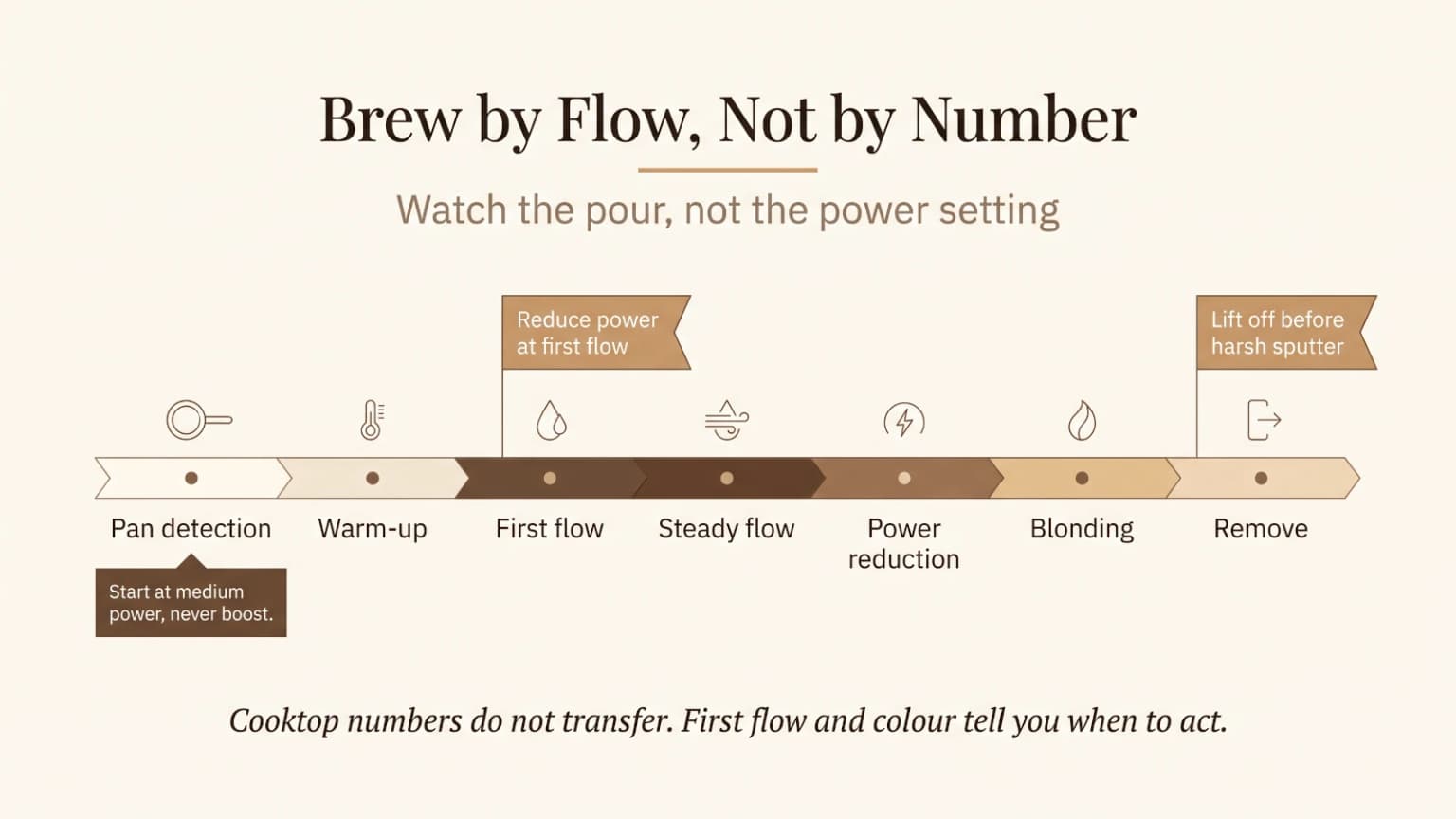
Brew by watching flow, not power
Induction settings are not recipes. Level five on one cooktop can deliver a different power pattern from level five on another.
Build the recipe around observable stages instead: detection, warm-up, first flow, steady flow, paling, and sputter.
Use medium-roast beans for the first baseline. Grind finer than typical drip coffee but clearly coarser than the powder used for unpressurized espresso baskets.
The correct grind lets water move without channeling or choking. Never tamp a moka basket, because the brewer is not designed for a compressed espresso puck.
Treat the cooktop number as a starting point. First flow and color change tell you when to reduce power and stop.
An induction moka workflow
1
Confirm the zone on paper
Read the cooktop minimum, select its smallest approved zone, and compare that requirement with the pot base before activating the hob.
Watch out Never activate an induction zone beneath an empty moka pot.
2
Use the model water mark
For a standard pot, fill as its manual directs without covering the safety valve. For the Brikka, use the graduated measure instead of the usual valve rule.
3
Fill and level the basket
Add moka-ground coffee until the basket is properly filled, then level it without tamping. Wipe every loose ground from the basket lip and boiler rim.
Tip A clean rim is part of the pressure seal, not cosmetic housekeeping.
4
Tighten by the metal bodies
Seat the basket and screw the chambers together evenly. Push against the metal body, never the handle, and stop when the gasket is firmly compressed.
5
Start at moderate power
Use a normal middle setting, not boost. Record the setting after a successful brew so the next batch begins from evidence rather than guesswork.
6
Reduce power at first flow
When coffee starts entering the collector, lower the setting enough to keep a calm stream. Stored heat in a heavy base will continue moving the brew.
Tip The clear <ProductLink id="sixaquae-glass-top-6-cup">glass-top model</ProductLink> makes this transition visible without lifting a lid.
7
Remove before harsh sputter
As the stream pales or turns bubbly, lift the pot to a dry heat-safe trivet and pour. Do not wait for a prolonged blast of steam and pale foam.
8
Judge the cup, then change one thing
If it tastes sharp and thin, try slightly finer coffee. If it is harsh and dry, reduce late heat or move slightly coarser before changing anything else.
The first batch establishes compatibility, not perfection. Note whether the hob maintained detection, when flow began, and whether the final phase accelerated.
If the zone cycles, let one full cycle play out before adding power. A momentary pause is less damaging than a large correction that arrives thirty seconds late.
Do not leave the brewer unattended. An induction timer can stop the coil, but it cannot judge a blocked basket, failed seal, or glass defect.
With the Brikka, follow its measured-water routine and expect a more abrupt release. Do not transfer a standard-pot endpoint rule blindly to the valve-controlled chimney.
If no coffee appears within the normal pattern you have established, switch off. A silent, heating pressure brewer is a reason to stop, not a request for boost.
For iced coffee, brew normally and pour over a measured amount of ice or chilled milk. Loading the boiler with ice-cold variables makes the induction baseline harder to repeat.
Fresh grinding helps more than exotic accessories. Our single-dose grinder guide explains how dose control and low retention support repeatable manual brewing.
Keep the seal path pressure-tight
Maintenance is not about polishing the outside. It is about preserving the route that forces heated water through coffee instead of around a dirty rim or failed gasket.
The correct routine depends on materials. Bialetti's aluminum interiors call for water-only hand cleaning, while some stainless models permit detergent or a dishwasher.
When instructions conflict, follow the manual packaged with the exact model. A broad brand rule can be wrong for a different metal or finish.
The seal-first maintenance routine
1
Cool before opening
Let the pot lose all pressure and become safe to touch. Unscrew it by the metal chambers, without twisting against the handle or lid hinge.
Watch out Never open, tighten, or inspect a moka pot while it is hot or pressurized.
2
Rinse the brew path after every use
Remove the basket, discard the puck, and rinse the collector, filter, gasket area, and boiler as the material instructions allow.
Tip Do not bang a thin basket against a hard bin. A bent rim can create a pressure leak.
3
Dry every chamber open
Wipe or air-dry the pieces separately. Store the upper and lower chambers loose so moisture does not remain trapped against steel, aluminum, or the gasket.
4
Inspect the seal monthly
Lift the gasket and filter plate when the manual permits. Look for flattening, cracks, coffee beneath the plate, a distorted screen, or damage on the basket lip.
5
Keep the safety valve clear
Check that the valve opening is free of scale and grounds. Manipulate an inspectable valve only as its manufacturer directs, and never enlarge the opening.
6
Retire damage, replace wear
Replace a hardened gasket with the exact model part. Retire a cracked collector, deformed boiler, damaged thread, or valve that no longer passes inspection.
Watch out Glue, sealant, and improvised valve parts do not belong on a pressure brewer.
Scale changes more than appearance. Deposits around the boiler, funnel, or valve can disturb sealing and water flow.
Use only the descaling method allowed by the manufacturer. Stainless and aluminum models may specify different acids, concentrations, and contact times.
The glass collector needs one extra rule: avoid abrupt temperature changes. Let it cool naturally on a dry trivet before rinsing.
A fresh gasket should restore even compression without extreme tightening. If leakage remains, inspect the filter plate, basket rim, and chamber faces instead of adding more force.
Seals are the wear item on every steel brewer. The same perished silicone that leaks here is what lets grounds slip past the plunger in an insulated French press.
That sequence protects the handles too. Many "broken handle" stories begin when an owner uses the handle as a lever against a gasket that has stuck the chambers together.
Which induction pot should you buy in 2026?
The right answer starts with a number hidden in the cooktop manual. Once the minimum bottom diameter is known, capacity and construction can make the final choice.
We would buy the six-cup hybrid first for a compatible 100 mm zone. We would choose the four-cup steel value pick for a smaller dose, subject to confirming its base.
The ten-cup steel pot is the group option and the strongest published detection bet. It is not a clever way for one person to solve a picky sensor.
The three we recommend first
Our pick
Moka Induction 6 Cup
$72.13
Best for
Most compatible households
Output
About 280 ml
Base evidence
About 100 mm published
Weak point
Some hobs need a wider pan
Diego 4 Cup
$39.99
Best for
Value and smaller doses
Capacity
200 ml advertised
Dose tool
Reducer included
Weak point
Flat base size not published
Venus 10 Cup
$76.69
Best for
Groups and broad-base hobs
Output
About 460 ml
Base evidence
About 128 to 130 mm
Weak point
Too large for most solo use
The three we recommend first
Specification
Our pick
Moka Induction 6 Cup
$72.13
Diego 4 Cup
$39.99
Venus 10 Cup
$76.69
Best for
Most compatible households
Value and smaller doses
Groups and broad-base hobs
Output
About 280 ml
-
About 460 ml
Base evidence
About 100 mm published
-
About 128 to 130 mm
Weak point
Some hobs need a wider pan
Flat base size not published
Too large for most solo use
Capacity
-
200 ml advertised
-
Dose tool
-
Reducer included
-
The Easyworkz Diego 4 Cup is our value alternative. Its reducer and 4.4-star score make it more than a cheaper imitation, though its flat base measurement needs confirmation.
Choose the Bialetti Venus 10 Cup only when its 460 ml output is an advantage. Its broad published base and deep owner record make it the large-household answer.
The other three are specialist choices. Handle clearance favors London Sip, valve-controlled foam favors Brikka, and visual feedback favors SIXAQUAE.
Browse the manual brewing collection for grinders and brewers that fit the same deliberate, low-waste routine.
Frequently asked questions
Do moka pots work on induction stoves?
Some do. The base must contain magnetic material, and its flat magnetic area must be large enough for your cooktop to detect.
An induction symbol on the box confirms the first condition, not always the second. Check the minimum cookware diameter in your cooktop manual before choosing a size.
All six pots in this guide have an induction-ready base, but compatibility still depends on the individual cooktop.
Why will an induction stove not detect a moka pot?
The usual cause is a base that is magnetic but smaller than the cooking zone's detection threshold. Poor centering, a warped contact surface, or weakly magnetic steel can also cause intermittent detection.
Try the smallest zone and center the flat base precisely. If the cooktop manual requires a wider pan than the pot provides, choose a larger pot or an approved adapter instead of trying to fool the sensor.
What size moka pot works best on induction?
The right size must satisfy both your coffee volume and your cooktop's minimum pan diameter. Larger 6-cup and 10-cup pots usually present a broader base than 2-cup models.
Do not oversize only for detection. A moka basket is designed to be filled properly, so a large pot can force one person to brew more coffee and use more grounds than needed.
Can a Bialetti Moka Express go on induction?
The standard aluminum Moka Express does not work directly on a conventional induction hob. Aluminum is not heated by the magnetic field used by ordinary induction zones.
It can sit on a manufacturer-approved induction adapter plate. The plate becomes the heated surface, so the system responds more slowly and retains heat after the power is reduced.
What heat setting should you use for a moka pot on induction?
Begin around the middle of the cooktop's normal power range, never on boost. Reduce the setting when coffee starts flowing, then remove the pot before the final harsh sputter.
Numbers do not transfer between cooktops. The correct setting is the lowest one that maintains a calm, continuous stream without repeated stopping, spraying, or violent bubbling.
Does a moka pot make real espresso?
No. A moka pot makes concentrated coffee through vapor pressure, but it operates at much lower pressure than an espresso machine.
The cup is stronger and heavier than drip coffee, which makes it useful for milk drinks and Americanos. Expect moka coffee, not espresso crema or the texture of a portafilter shot.