Pods on One Side, a Carafe on the Other: 6 Dual Coffee Makers for 2026
Pods on one side, a 12-cup carafe on the other. We read 127,000+ owner ratings to rank six dual coffee makers for 2026, from $74.95 to $249.95.
By the CoffeeGearGuides team · USA · Updated Sep 5, 2026 · 36 min read
On this page18
The best dual coffee maker settles a household argument rather than a coffee problem: one person wants a mug in ninety seconds, the other wants a pot that lasts the morning.
One machine, two brew paths, one plug.
Retailers also sell these as 2-way coffee makers, combo brewers, or single serve and carafe coffee makers. They are the same appliance: one brew path for a pod or a small basket, and a second for a 12-cup carafe.
The catch is that the two sides are rarely equal. Almost every combo brewer here is a competent 12-cup drip machine with a single-serve head attached to one side, and the compromise usually lands on whichever side you use more.
We read across twelve machines and more than 127,000 owner ratings, then checked every listing, reservoir capacity and brew size against the manufacturer's own published specification.
This 2026 guide covers the six we would spend our own money on, the two that competing guides still recommend despite being discontinued or barely reviewed, and the one number that decides whether a combo is the right purchase at all.
How we chose these dual coffee makers for 2026
We do not test machines in a lab, and we think saying so plainly is worth more than a staged photograph. You can read exactly how we work on our about page.
The short version: we start from what is actually purchasable, then read the owners who are least excited.
For this guide we compared manufacturer specification sheets, owner's manuals, independent lab reporting, troubleshooting forums, and the full spread of Amazon reviews across twelve candidate machines.
We weighted three-star reviews most heavily, because a three-star owner describes a real flaw without either rage or evangelism.
Three rules shaped the final six. Every machine had to be in stock on Amazon US with a live price on the day we published, verified through Amazon's own product API rather than assumed.
Every machine had to genuinely brew both a single cup and a carafe. Single-serve brewers with a large mug setting were cut, however good they are.
And every machine had to clear 4.0 stars on a review base large enough to mean something. Three of the twelve failed that outright, and three more were cut for reasons a star rating cannot show.
Which brew path will you use most?
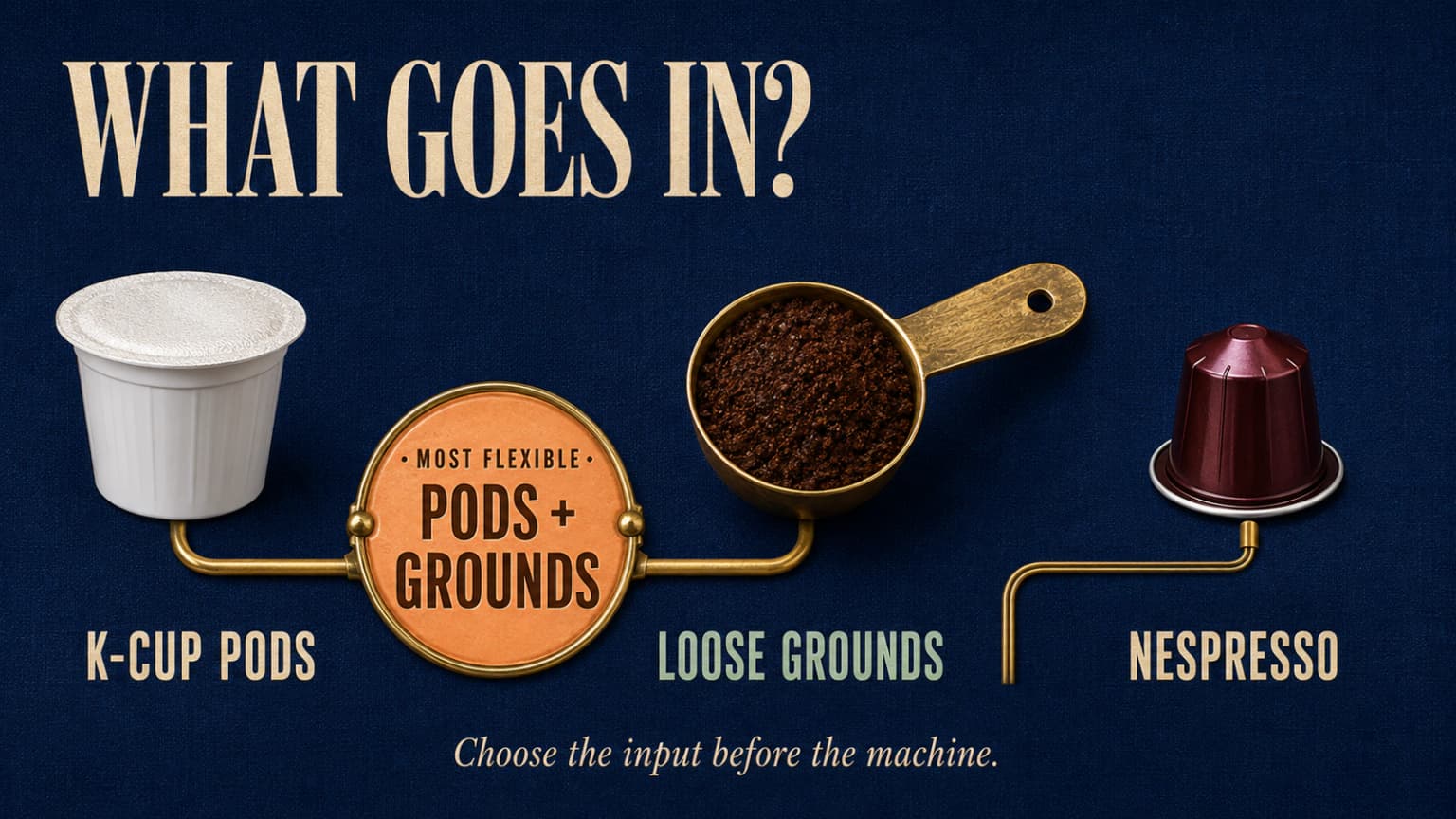
Every dual coffee maker brews both ways, so the real question is what the single-serve side will accept: sealed pods, loose grounds, or both. That one answer sets what every cup costs you afterward.
A pod-first machine puts a K-Cup receiver on the single-serve side. It is the fastest morning cup available, it needs no measuring, and the coffee arrives at a price set by whoever fills the pod.
The Keurig K-Duo Gen 2 is the clearest example, and its carafe side is a conventional grounds brewer.
A grounds-first machine puts a small basket on that side instead. It is slower by a minute, it asks you to measure, and it turns the same bag of beans into both your cup and your pot.
Three inputs, and only the machines in the overlap let you change your mind after you have bought.
The machines that take both pods and grounds on the small side are the ones worth paying for. Both Ninja DualBrew models brew loose grounds on that side as well as pods, so one appliance covers a guest with a box of pods and an owner with a bag of beans.
That flexibility is also the cheapest insurance in the category. Pod prices move, brands discontinue formats, and a machine locked to one input has no answer when they do.
What each side of the machine is for
What each side of the machine is for
What you want
The single-serve side
The carafe side
Time to a drink
About 60 to 90 seconds
Roughly 8 to 12 minutes
Measuring needed
None with a pod, a scoop with grounds
Always, and most people under-dose
Cost per cup
Set by the pod, or by your beans
Set by your beans, every time
Biggest pour
10 to 14 oz depending on machine
12 cups, about 60 oz
Cleaning burden
A needle and a small basket
A basket and a carafe
What goes wrong
Clogged needle, short cup
Weak brew, scale in the tank
Generalizations across the six machines here. Each review below covers where its own machine departs from this.
Read that table with a specific week in mind rather than an average one.
If both columns felt necessary, a combo is the right shape of appliance. If one column felt like a hypothetical, keep reading to the case against, because we make the argument for buying a single-purpose machine instead.
The 6 best dual coffee makers
Our ranking puts the Ninja DualBrew Pro CFP301 first, the Hamilton Beach FlexBrew Trio second on value, and the Hamilton Beach 2-Way Brewer third for anyone done with pods.
The lineup runs from there to the machine that answers the narrowest question. Every link was verified live and in stock through Amazon's own product API on the day we published.
Ratings and review counts recorded September 2026 on Amazon US. Prices move; use the buttons for the live number. Amazon.com prices as of 15/09/2026. Details
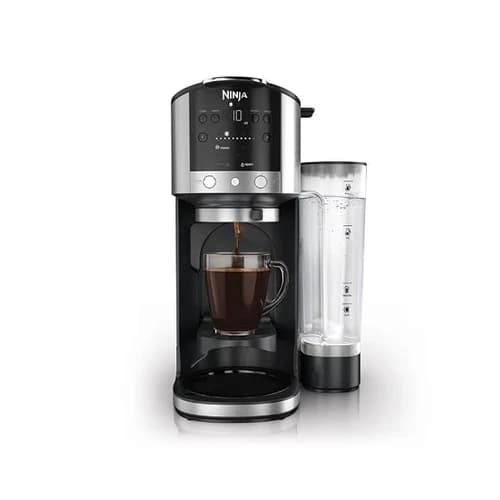
1. Ninja DualBrew Pro CFP301
If you buy one machine on this page without reading the rest, buy this one. It answers more of the category's questions than anything else here.
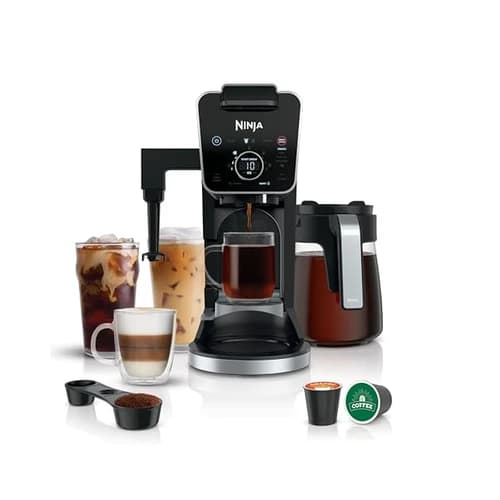
The DualBrew Pro (model CFP301) takes a K-Cup pod or a basket of grounds on its single-serve side, then brews anything from a small cup to a full 12-cup carafe on the other. Owners hold it at 4.4 stars across 8,088 ratings at the time of writing.
The size range is the part that keeps surprising people. Nine ground-coffee sizes run from a small cup through a travel mug to quarter, half, three-quarter and full carafe.
Four pod sizes cover 6, 8, 10 and 12 ounces, and four brew styles cover Classic, Rich, Over Ice and Specialty.
Ninja DualBrew Pro (CFP301)
Rated 4.4 from 8,088 ratings
The most capable combo brewer here: pods or grounds on the small side, thirteen brew sizes, a fold-away frother and a separate hot water system.
Key details
Brews K-Cup pods or loose grounds on the single-serve side
Thirteen sizes, from a small cup to a full 12-cup carafe
Four brew styles: Classic, Rich, Over Ice and Specialty
60 oz removable tank that mounts at the side or the rear
Fold-away frother for hot or cold milk
Independent hot water system with hot and boil settings
What we like
Takes pods and grounds, so nothing about your coffee is locked in
Carafe fraction settings brew a half pot without watering it down
Movable reservoir solves awkward corner and cabinet layouts
Largest owner evidence base of any machine at this price
Watch out for
Ships with a paper filter kit rather than a permanent filter
Water level and inlet faults are the most reported failure
Tall at 15.54 inches, which fights a standard cabinet gap
Owner reviews follow a consistent arc. The first month reads as delight at the number of things one appliance does, and the complaints that arrive later are almost all about water.
Overfilling, a cup that stops after a second, and a clean cycle that refuses to run are the three failures that recur, and troubleshooting guidance for the line points at the water level sensor and the inlet valve.
The honest weak point is that this machine punishes neglected descaling harder than a simple drip brewer does. Two water paths share one tank, and the narrow pod needle blocks first.
Owners who run the clean cycle on schedule rarely appear in the one-star reviews. Owners who wait for a symptom appear there often.
There is one buying trap worth naming. Ninja also sells the CFP307 at $249.99, and its listing differs from this one chiefly by including a permanent filter instead of a paper filter kit.
Buy the CFP301 and a reusable filter separately if you want one, because the fifty dollar gap buys a part that costs a fraction of that.
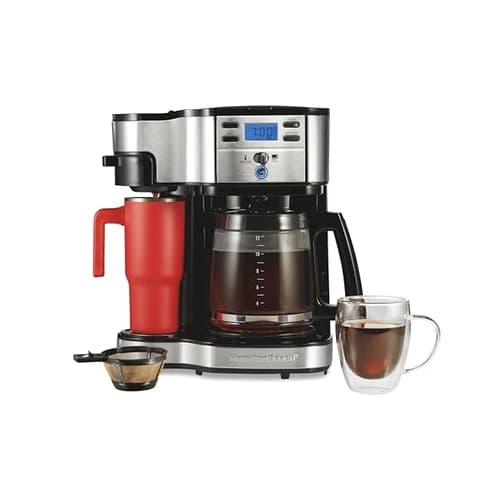
2. Hamilton Beach FlexBrew Trio
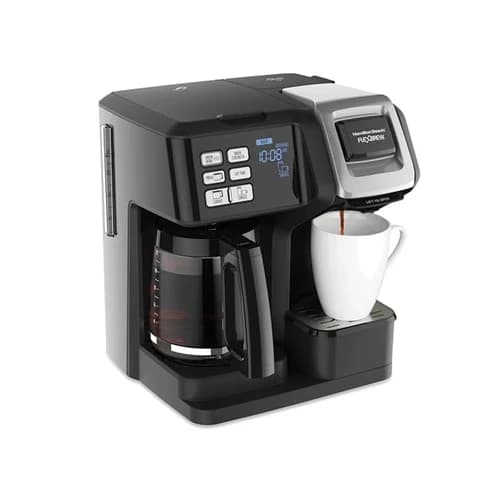
The FlexBrew Trio is the machine we recommend when the budget is a hundred dollars and the requirements have not changed. It holds 4.5 stars across 29,999 ratings, the second largest evidence base in this guide.
It does the same job as the Ninja for half the money, and it does one thing better than every other machine here.
That thing is water. The Trio gives each brewing side its own reservoir, so filling the carafe tank does not drain the cup you were about to brew, and neither side ever waits for the other.
Everything else is conventional and well judged: a 12-cup glass carafe, pods up to 10 ounces, grounds up to 14 ounces, and a stated 7.25 inch clearance for a travel mug.
Hamilton Beach FlexBrew Trio (49976)
Rated 4.5 from 29,999 ratings
The value pick, and the only pod-capable machine here that gives each brewing side its own water reservoir instead of sharing one tank.
Key details
Two separate water reservoirs, one per brewing side
Single cup from a K-Cup pod, another pod brand, or grounds
12-cup glass carafe with programmable Easy-Touch brewing
Pod brewing to 10 oz, grounds brewing to 14 oz
Clearance for a 7.25 inch travel mug on the small side
Select-a-Brew regular and bold strength settings
What we like
Separate tanks remove the single most annoying combo compromise
Nearly 30,000 owner ratings at 4.5 stars is unusual evidence
Includes a pod holder and a grounds basket, so both inputs work
Costs about $55 more than a plain Hamilton Beach drip brewer
Watch out for
The small side tank is filled per brew rather than held in reserve
Consumer Reports lab testing found it short of the 195F brewing guideline
Needle errors and single-serve clogging are the recurring fault
We should be precise about the two-reservoir claim, because owners are. Each side has its own tank, but the single-serve tank is a fill-per-brew design rather than a standing reserve, so you pour water in for each cup.
That is a real cost every morning, and also exactly why the small side never steals water from the pot.
The honest weak point is brew temperature. Consumer Reports lab testing of the 49976 found it fell short of the guideline of 195 degrees Fahrenheit or more held for five to six minutes, and thin, flat carafe coffee is what that shortfall tastes like.
The fix is dose rather than despair, and we cover it in the weak-brew section further down.
Buy the Trio if you want the category's core idea without the category's premium, and if the person refilling the tank cares more about never waiting than about never pouring.
At $99.99 it is the most machine per dollar on this page.
3. Hamilton Beach 2-Way Brewer
The 2-Way Brewer, sold as The Scoop and carrying model number 49980A, is the pick for anyone who wants the convenience of the format and none of the plastic that usually comes with it.
There is no pod receiver. The single-serve side takes a mesh filter that doubles as the measuring scoop, and 53,682 owners rate the result 4.5 stars.
Removing pods removes the running cost that defines this category. Your cup and your pot come from the same bag, at the same price per gram, with nothing to reorder.
It also removes a failure mode: there is no needle to block, which is the single most common complaint about every other machine here.
Hamilton Beach 2-Way Brewer, The Scoop (49980A)
Rated 4.5 from 53,682 ratings
The pod-free combo: a mesh scoop filter on the single-serve side, a 12-cup carafe on the other, and the largest owner base in this guide.
Key details
Single-serve side takes ground coffee only, no pods at all
Mesh filter doubles as the measuring scoop
Each side has its own water tank and its own brew basket
12-cup, 60 oz glass carafe on the full-pot side
Single-serve pours up to 14 oz into a mug or travel mug
Regular and bold brew strengths, two hour auto shutoff
What we like
Cheapest way into the format at $74.95, about $30 over a plain drip
No pod needle means the usual combo failure cannot happen
53,682 ratings at 4.5 stars is the strongest evidence on this page
Same coffee, same cost per gram, whichever side you use
Watch out for
Owners consistently report the coffee is not hot enough
Both sides share one heating element, so nothing brews at once
No pod option at all, which some households genuinely want
The owner reviews are unusually consistent for a machine with this many. People who bought it to escape pods describe exactly the appliance they wanted, and the recurring criticism is heat.
A meaningful number of owners report reheating the cup, and independent reviewers describe the water distribution as too simple to extract a balanced pot.
The honest framing is that this is a $74.95 appliance behaving like one. It gets coffee into two shapes of vessel reliably, and it does not chase the brew temperature that a certified brewer holds.
If temperature is the thing you care most about, the money is better spent on a single-purpose machine, and our guide to SCA certified coffee makers covers the ones that are independently tested for it.
Buy The Scoop if pods are the part of this category you dislike, or if the second side only needs to work rather than impress.
It is also the honest price floor for this format.
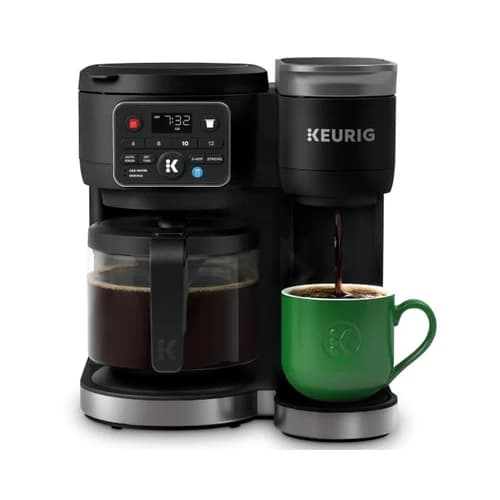
4. Keurig K-Duo Gen 2
The K-Duo Gen 2 is the machine to buy when the household already owns a rack of K-Cups and has no intention of changing. It sits at 4.1 stars across 6,668 ratings.
Keurig's version of the format is the most single-minded here: pods on the left, grounds and a 12-cup glass carafe on the right, and a 72 ounce reservoir shared between them.
That shared tank is the largest in this guide, and sharing is a deliberate trade rather than an oversight. One fill covers several pod cups and most of a pot, which is fewer trips to the sink than any two-tank design.
The cost is that a full carafe brew takes most of the water, so the tank is emptiest exactly when the second person wants a cup.
Keurig K-Duo Gen 2
Rated 4.1 from 6,668 ratings
The K-Cup household answer: pods on one side, a 12-cup grounds carafe on the other, and the largest shared reservoir in this guide.
Key details
Brews K-Cup pods on the single-serve side, grounds on the carafe side
72 oz removable reservoir shared by both brewing sides
Single cups at 6, 8, 10 or 12 oz; carafes at 6, 8, 10 or 12 cups
MultiStream Technology saturates the grounds through several streams
Strong Brew and Extra Hot settings on top of the standard cycle
Brew Over Ice mode and a 24 hour programmable carafe
What we like
Biggest reservoir here, so refills are least frequent
Strong Brew directly answers the old K-Duo weak-coffee complaint
Carafe is shaped to limit the drip that plagues cheap glass pots
Pause and pour holds the brew for 20 seconds mid-cycle
Watch out for
K-Cup pods only on the small side, with no grounds basket
Shared tank means a full pot leaves little for the next cup
Earlier K-Duo models built a reputation for thin carafe coffee
The 4.1 rating deserves an explanation rather than a shrug. The K-Duo line carries years of complaints about weak coffee on the carafe side, and the specific criticism was that the earlier machines offered no strength control there at all.
The Gen 2 adds Strong Brew and Extra Hot, which is Keurig answering the exact complaint, and the current reviews read better than the line's history suggests.
The honest weak point is the pod lock-in. This is the only machine here whose small side will not take loose coffee, so the cheapest cup it can make is still a pod.
For a household that buys pods anyway, that is not a flaw. For anyone hoping to drift away from them, it is the wrong machine.
Buy the K-Duo Gen 2 if the pod habit is settled and the pot is the part you wanted to add. It is the most refined execution of that specific idea.
5. Ninja DualBrew GP161
The DualBrew GP161 is the newest machine in this guide, and it earns its place on one feature the rest cannot match: it brews genuine cold brew rather than hot coffee poured over ice.
A single cup takes under ten minutes and a full carafe under twenty. Owners rate it 4.5 stars, the joint highest here.
We want to be straight about the evidence. That 4.5 comes from 173 ratings, a fraction of the 8,088 behind the CFP301, because the listing is new.
We kept it because the rating is strong, the specification is verifiable, and cold brew at this speed has no alternative here. Treat the number as promising rather than proven.
Ninja DualBrew (GP161)
Rated 4.5 from 173 ratings
The cold brew answer: pods or grounds on the small side, and real cold brew in under ten minutes rather than hot coffee over ice.
Key details
Rapid Cold Brew: a cup in under 10 minutes, a carafe in under 20
Four brew styles: Classic, Rich, Over Ice and Cold Brew
Brews K-Cup pods from 6 to 12 oz, or grounds in ten sizes
60 oz removable water reservoir feeding both sides
12-cup glass carafe with an adjustable warming plate
Ninja Smart Scoop and paper filter kit in the box
What we like
Only machine here that makes true cold brew, not iced hot coffee
Ten ground-coffee sizes from a single cup to a full carafe
Warming plate is adjustable and holds up to four hours
$20 less than the CFP301 while covering the same two inputs
Watch out for
Only 173 owner ratings, so the evidence base is still young
No frother and no separate hot water system, unlike the CFP301
The GP161 and the CFP301 are easy to confuse and are genuinely different purchases. The GP161 trades the frother and the hot water system for cold brew and twenty dollars.
That is a clean swap rather than a downgrade, decided by whether your household drinks milk drinks or iced coffee.
The honest weak point is the missing frother. Without it, a latte means a separate device, and the cappuccino crowd should pay the extra for the CFP301.
Anyone who already owns a frother loses nothing at all, and our roundup of milk frothers for oat milk covers what to pair it with if plant milk is the household default.
Buy the GP161 if iced coffee is a summer habit rather than an occasional novelty. Nothing else here turns a bag of beans into cold brew before you have finished getting dressed.
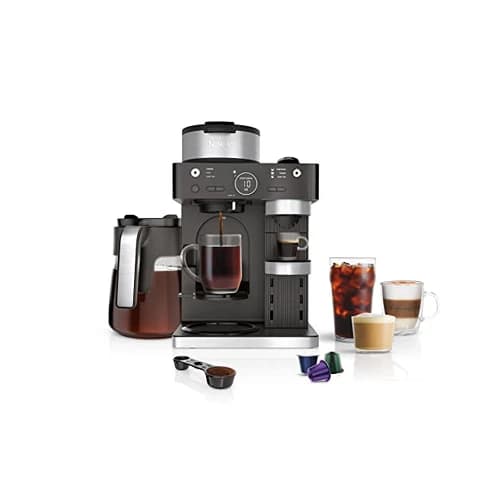
6. Ninja Espresso & Coffee Barista System
The Ninja Espresso & Coffee Barista System (model CFN601) is the outlier in this guide, and it exists for a household nothing else here serves.
One person wants espresso from a capsule. The other wants a 12-cup pot of drip coffee. This is the only machine on the page that does both, and 3,249 owners rate it 4.1 stars.
The capsule side runs Nespresso OriginalLine capsules at 19 bar, with three sizes: espresso at 1.35 ounces, lungo at 3.75, and a 1 ounce Over Ice pull built to survive dilution.
The coffee side is a conventional Ninja drip brewer with nine ground-coffee sizes from a cup to a full carafe and three brew styles.
Ninja Espresso & Coffee Barista System (CFN601)
Rated 4.1 from 3,249 ratings
The espresso answer: Nespresso OriginalLine capsules at 19 bar on one side, a 12-cup drip carafe on the other, and a fold-away frother between them.
Key details
19 bar pump for Nespresso OriginalLine capsules
Three espresso sizes: espresso, lungo and a 1 oz Over Ice pull
Nine ground-coffee sizes from a single cup to a 12-cup carafe
Classic, Rich and Over Ice brew styles on the coffee side
Built-in fold-away frother for cappuccinos and lattes
60 oz removable reservoir and a 20-capsule used bin
What we like
The only machine here that pours real capsule espresso and a pot
Frother is built in, so milk drinks need no second appliance
Shorter than either DualBrew model at 14.9 inches
Used capsule bin holds twenty, so the counter stays clear
Watch out for
Nespresso OriginalLine only, so K-Cups and Vertuo will not fit
Capsule espresso will not match a machine with a portafilter
The owner reviews split along a predictable line. People who wanted convenient espresso alongside a family pot describe the machine solving a problem no single appliance had solved for them.
People who arrived from a portafilter machine describe capsule espresso as capsule espresso, which was always going to be the verdict.
The honest weak point is format lock-in of a different flavor. Nespresso OriginalLine is an open format with many roasters filling it, but it is still one format, and the K-Cups in your cupboard will not fit.
Vertuo capsules will not fit either, and confusing the two is the most common buying error in this corner of the market.
Buy the CFN601 if the household's split is espresso against filter rather than cup against pot. If it is genuinely espresso you want and not a strong small coffee, our espresso machines with built-in grinders start where this machine's ceiling ends.
At $249.95 it is the most specialized machine here, and the most useful when it fits.
Two brew paths, one water system
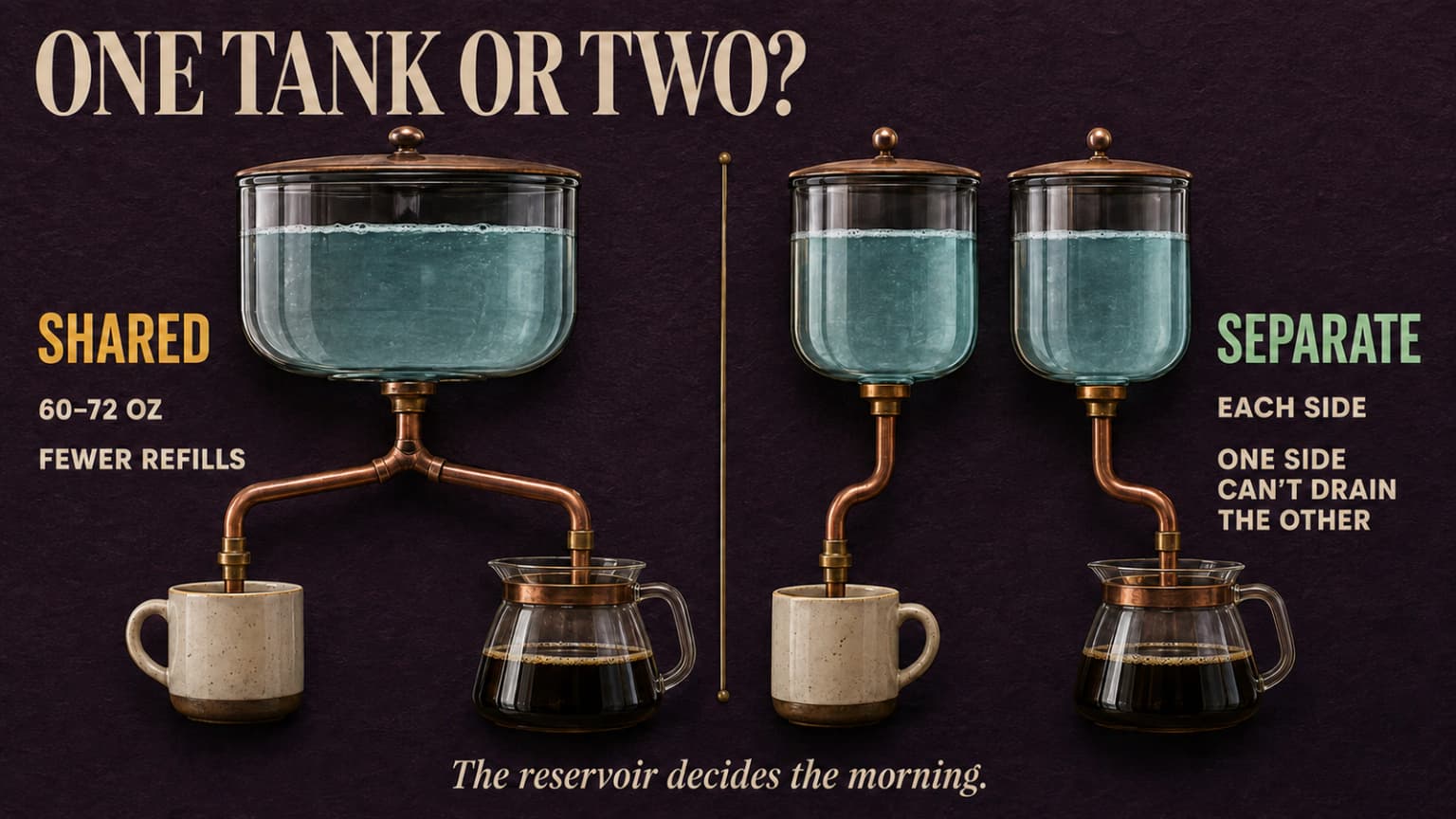
Dual coffee makers use one of two water systems: a single tank shared by both brew heads, or a dedicated tank for each side. No guide we read publishes this, and it is the difference you notice every morning.
The shared tank design runs one reservoir to both brew heads. The Keurig K-Duo Gen 2 holds 72 ounces this way, and all three Ninja machines hold 60.
Fewer refills is the reward. The penalty is that a full 12-cup carafe consumes most of the tank, so the person who wanted a quick cup afterward finds an empty reservoir.
The separate tank design gives each side its own supply. Both Hamilton Beach machines work this way, and on the FlexBrew Trio each tank has its own water window.
Neither side can drain the other. The cost is that the small tank on the Trio is filled per brew rather than held in reserve, so a single cup means pouring water in first.
One tank or two. It is the least advertised difference in this category and the one you notice daily.
Where each machine keeps its water
Where each machine keeps its water
Machine
Reservoir
Shared or separate
What that means daily
Keurig K-Duo Gen 2
72 oz, removable
Shared
Fewest refills, emptiest after a pot
Ninja DualBrew Pro CFP301
60 oz, removable
Shared
Mounts at the side or the rear
Ninja DualBrew GP161
60 oz, removable
Shared
Same tank feeds cold brew too
Ninja Espresso & Coffee
60 oz, removable
Shared
Capsule pulls barely touch it
Hamilton Beach FlexBrew Trio
Two tanks, one per side
Separate
Small side is filled per brew
Hamilton Beach 2-Way Brewer
Two tanks, one per side
Separate
One heating element, so no overlap
Capacities from each manufacturer's published specification. Verified September 2026.
One more detail hides inside the shared-tank camp. Ninja's 60 ounce reservoir on the DualBrew Pro is multi-position, mounting either at the side or the rear of the machine.
That sounds like marketing until you try to fit a 15 inch appliance into a corner.
Note also what the Hamilton Beach 2-Way shares even though its tanks are separate: one heating element. Two tanks do not buy you two simultaneous brews on any machine here.
If you pictured a pot and a mug brewing at once, no machine here delivers it, and better to know before the box arrives.
Pod formats are not interchangeable
Three pod formats reach American kitchens: K-Cup, Nespresso OriginalLine and Nespresso Vertuo. No machine in this guide takes more than one of them, and buying the wrong format is the costliest mistake here.
K-Cup pods are the American default. Keurig's own machines take them, both the CFP301 and the DualBrew GP161 take them, and the Hamilton Beach FlexBrew Trio takes them along with other pod brands.
Nespresso OriginalLine capsules are a different physical object entirely, pressed at 19 bar rather than dripped. Only the Ninja Espresso & Coffee Barista System accepts them here.
Nespresso Vertuo capsules are a third format, larger and barcoded, and nothing on this page takes them. If your household already owns a Vertuo machine, no combo brewer here will use its capsules.
Then there is the fourth input everyone forgets: loose grounds on the single-serve side. Five of the six machines accept it, and it is the only input whose price you control completely.
Which pods each machine will take
Which pods each machine will take
Machine
K-Cup pods
Nespresso Original
Grounds, small side
Ninja DualBrew Pro CFP301
Yes, 6 to 12 oz
No
Yes, nine sizes
Ninja DualBrew GP161
Yes, 6 to 12 oz
No
Yes, ten sizes
Hamilton Beach FlexBrew Trio
Yes, to 10 oz
No
Yes, to 14 oz
Keurig K-Duo Gen 2
Yes, 6 to 12 oz
No
No, carafe side only
Hamilton Beach 2-Way Brewer
No
No
Yes, mesh scoop, to 14 oz
Ninja Espresso & Coffee
No
Yes, 19 bar
Yes, cup to carafe
Compatibility from each manufacturer's published specification. No machine here accepts Nespresso Vertuo capsules.
The practical advice is simple and unpopular with pod manufacturers. Buy the machine that accepts grounds on both sides unless you have a settled reason not to, because that is the only configuration that survives a change of mind.
A household that buys pods today can still buy pods on a Ninja DualBrew. A household locked to pods cannot easily stop.
There is a second argument for the grounds basket that has nothing to do with money. A pod is sealed at the roastery months before you open it, and the small basket lets you put the same fresh coffee in your cup that you put in the pot.
If your coffee tastes flat from either side, the cause is more often the coffee than the machine, and our guide to why coffee tastes bitter works through the nine usual culprits in order.
The 18-inch cabinet problem
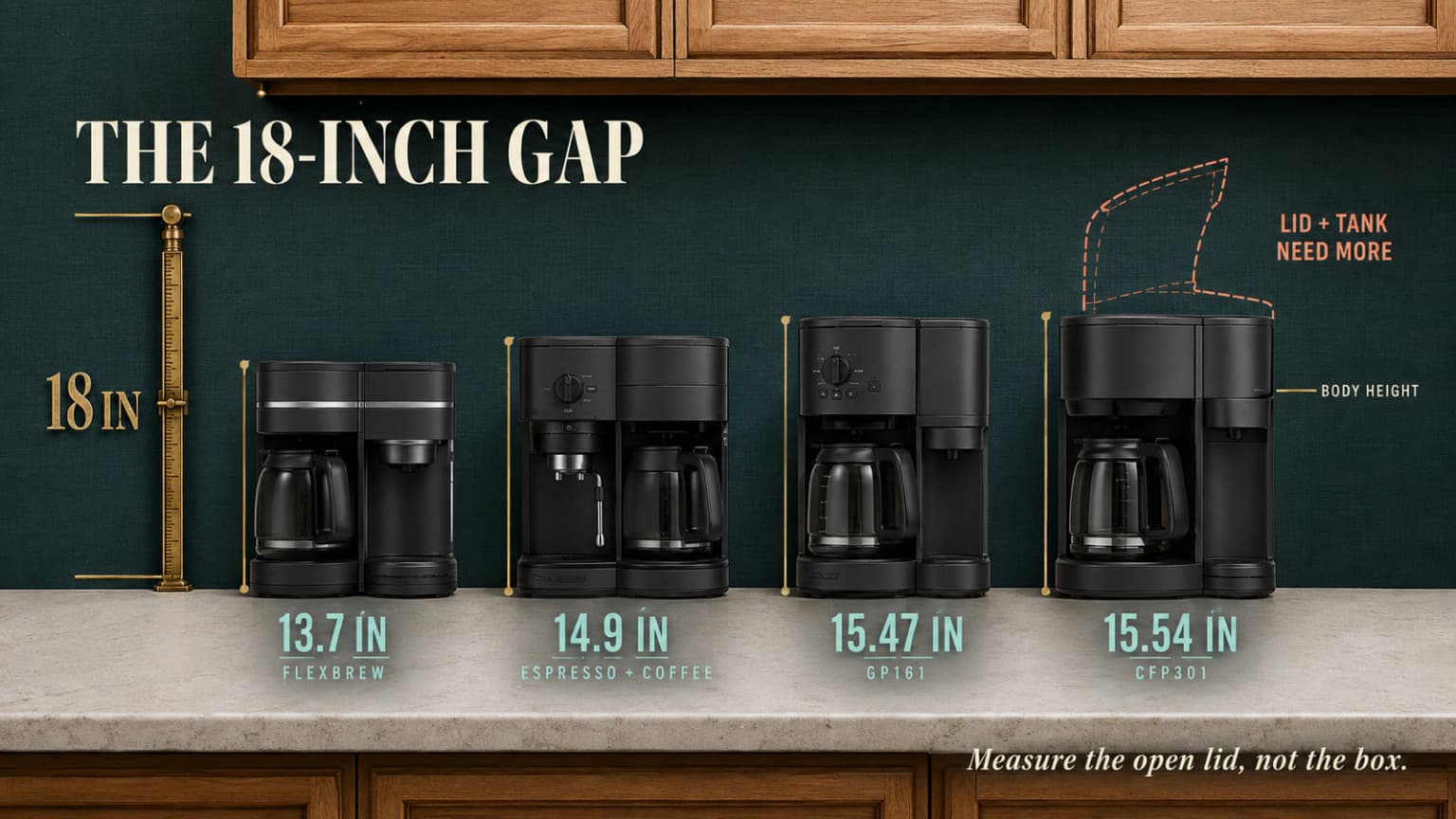
Dual coffee makers stand 13.7 to 15.5 inches tall, and American upper cabinets typically sit about 18 inches above the countertop. Stacking a pod head and a drip head into one body is what costs the height.
That margin is thinner than it looks, and it quietly disqualifies machines on this page for some kitchens.
The Ninja DualBrew Pro measures 15.54 inches high, the GP161 15.47, and the Ninja Espresso & Coffee 14.9. The Hamilton Beach FlexBrew Trio is the compact one at 13.7 inches.
Those are body heights, not clearance heights. What actually matters is where the lid opens and where the reservoir loads, because both need room above the machine.
Body height is the number on the box. Lid and reservoir clearance is the number that decides whether it lives there.
This is where Ninja's movable reservoir stops being a footnote. Mounting the tank at the rear rather than the side changes both the machine's width and where you need free space to refill it.
A tank you can only lift straight up needs the full cabinet gap. A tank that slides out sideways does not.
The other measurement worth taking is under the single-serve spout. The FlexBrew Trio publishes 7.25 inches of travel mug clearance, which is the only figure any of these manufacturers states plainly.
If you brew into a tall tumbler every morning, measure yours before ordering, because a machine that cannot take your mug is a machine you will resent daily.
Noise is the one fit question that barely matters here. None of these machines grinds, so the loudest thing any of them does is the pump, and no owner review in our reading treats it as a problem.
That is a real advantage over a bean-to-cup machine if your kitchen shares a wall with someone still asleep.
The case against a dual coffee maker
The strongest argument against a dual coffee maker is that it is two average machines sharing one body, and that a single good brewer would serve you better. That argument is right more often than this category admits.
It is right about the engineering. Every machine here puts its carafe side somewhere between adequate and good, and none is independently certified for brew temperature the way a dedicated brewer can be.
The single-serve sides are similarly honest: quick, convenient, and nobody's idea of the best cup available at the price.
So here is the threshold we would use, and it is the number the whole category avoids printing. Count how many times a week the second side would run.
Below about two, buy a single-purpose machine. The premium you pay for the combo buys a feature you are not using, and it buys it by compromising the feature you are.
Above about four, the combo is clearly correct. You are getting two appliances, one plug, one water tank to fill and one surface to wipe, for less than the two machines would cost together.
Between two and four, the deciding factor is not coffee at all. It is whether a second appliance would fit your counter and whether anyone would resent it.
What the second brew path costs you
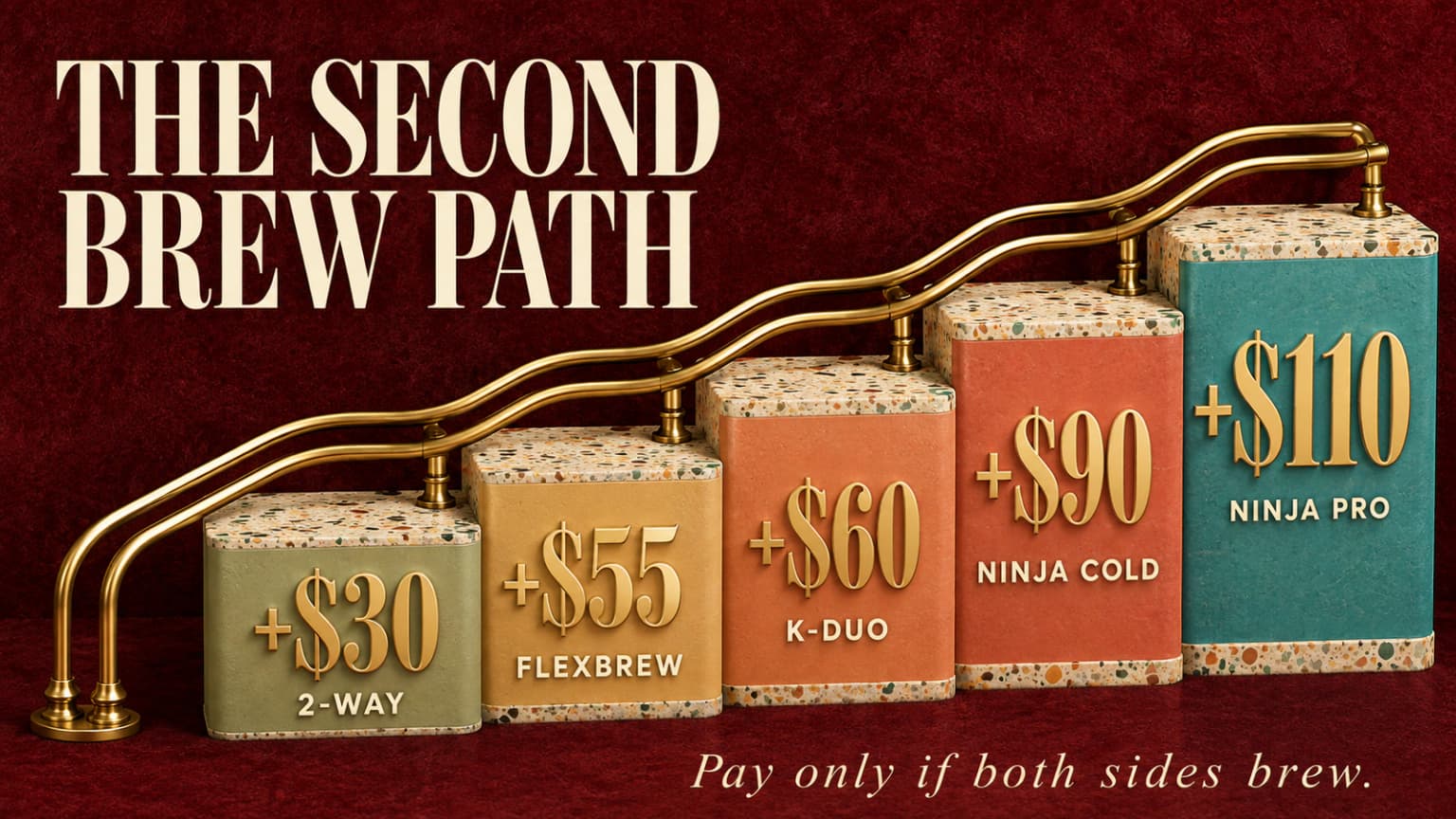
The second brew path costs $30 to $110 over the same brand's single-purpose brewer. That number is knowable because every brand here sells both machines side by side.
We priced both halves on Amazon US on the same day, through the same product API, so the gap is a real gap rather than a list-price story.
The second brew path costs $30 to $110 depending on the brand. That is the whole question, priced.
What the dual option adds to the price
What the dual option adds to the price
Same brand, two machines
Single-purpose brewer
The dual version
The premium
Hamilton Beach, into pod-free
12-cup programmable drip, about $45
2-Way Brewer, $74.95
About $30
Hamilton Beach, into pods
12-cup programmable drip, about $45
FlexBrew Trio, $99.99
About $55
Keurig
K-Supreme single-serve, $89.99
K-Duo Gen 2, $149.99
About $60
Ninja, into cold brew
CE251 12-cup drip, $89.99
DualBrew GP161, $179.99
About $90
Ninja, into everything
CE251 12-cup drip, $89.99
DualBrew Pro CFP301, $199.99
About $110
All prices verified live on Amazon US in September 2026. Use the buttons above for the current number.
Three things fall out of that table. The premium is small in absolute terms, between $30 and $110, and it is always less than buying the second machine outright.
It also scales with capability rather than brand. Hamilton Beach charges thirty dollars to add a scoop-fed second head, and Ninja charges a hundred and ten to add a head that takes pods, grounds, thirteen sizes, a frother and a hot water system.
And the cheapest entry into the format, at $74.95, costs about what a mid-range single-purpose drip brewer costs. If you were buying a $75 drip machine anyway, the second side is close to free.
Running costs are where the arithmetic turns personal. Paper filters, descaler and the occasional replacement carafe apply to every machine here in roughly equal measure.
Pods do not. A pod habit costs several times what the same coffee costs loose, which is why the grounds option on five of these machines is the most valuable feature nobody advertises.
We are deliberately not printing a cost-per-cup table, because your number depends on which side you use and what you put in it. The lever is yours, not the machine's.
When to buy
Combo brewers are gift-season merchandise, and their prices behave accordingly. Several picks here were already discounted when we checked, including the K-Duo Gen 2 at 32 percent off its list price.
Discounts open around Prime Day, Black Friday and the December gifting weeks, then close again in January.
Our practical advice: if the machine you want is already 20 percent or more below list, buy it. If it sits at full price in October, waiting a few weeks usually costs nothing.
The live prices on this page update daily, so the buttons always show the current number.
One caution about the older listings you will meet while comparing. The Cuisinart Coffee Center SS-15 still appears near the top of most competing guides, and Cuisinart itself now lists it as discontinued.
It reaches buyers through marketplace sellers at $284.95 and above, more than any current machine on this page. A discontinued appliance at a premium price is the worst trade here.
How to fix a weak carafe brew
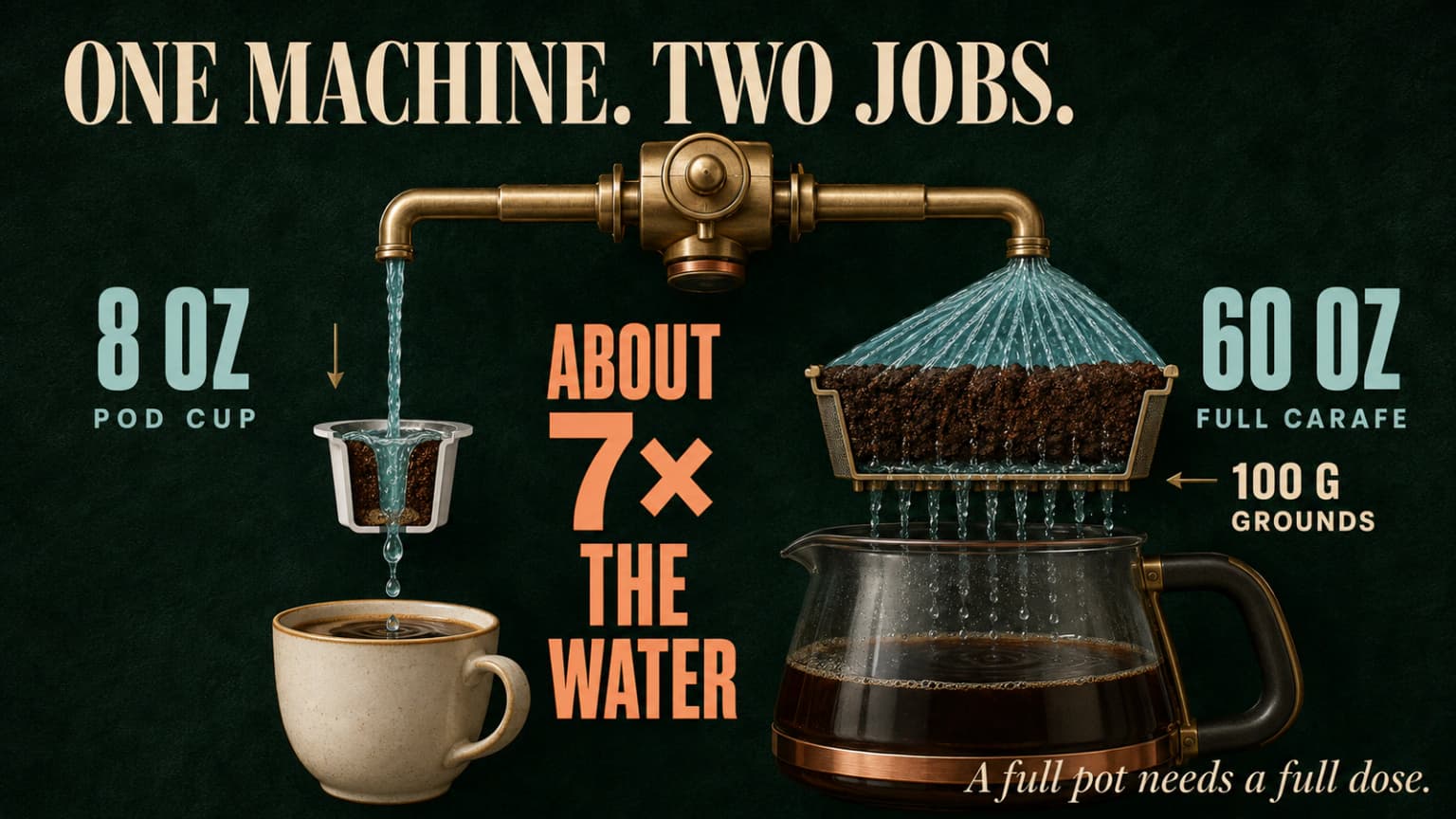
A weak pot is almost always dose rather than the machine. A full 12-cup carafe holds 60 ounces of water, roughly 1,775 milliliters, and a standard filter-coffee ratio puts about 100 grams of ground coffee against it.
That is around ten level two-tablespoon scoops. Most people load six or seven, then describe the result as the machine's fault.
Weak carafe coffee is the most common complaint in this category, across every brand, and it is also the most fixable.
The same pump, two very different jobs. The carafe side moves seven times the water through one bed of coffee.
Fixing a weak carafe brew
1
Match the size setting to what you are brewing
If you are making half a pot, use the half-carafe setting rather than under-filling the full-carafe cycle. The setting changes how much water goes through, and using the wrong one is the fastest way to dilute good coffee.
Tip The Ninja DualBrew models offer quarter, half, three-quarter and full carafe. The K-Duo Gen 2 offers 6, 8, 10 and 12 cups.
2
Weigh one pot, once
Put the basket on a kitchen scale and measure 100 grams of grounds for a full 60 ounce carafe. Note where that lands in your scoop, then go back to scooping with a number you trust.
Tip A $20 scale that reads to one gram removes this variable permanently.
3
Turn on the strength setting you already own
Bold on the Hamilton Beach machines, Rich on the Ninjas, and Strong Brew on the K-Duo Gen 2 all slow the water down over the bed. Every machine here has one and most owners never press it.
4
Grind a little finer, one step at a time
Drip coffee wants a medium grind, close to table salt. If the pot still tastes thin after fixing the dose, step the grind finer once and brew again before changing anything else.
Watch out Do not jump several steps. Too fine on a flat-bottom basket floods the filter and overflows the grounds into the carafe.
5
Rule out temperature before blaming the beans
A brewer that has not been descaled runs cooler and slower than it should. Run the clean cycle, then judge the coffee from the next pot rather than the current one.
Tip Independent lab testing has found combo brewers running below the 195F guideline, so this step is worth doing before you conclude anything.
6
Preheat if the first cup is the weak one
Run a short water-only cycle into the empty carafe before brewing. A cold machine and a cold glass pot both pull heat out of the first minutes of the brew, which is when most of the extraction happens.
Owners who work through those six steps rarely return the machine. The complaint that reads as "this brewer makes weak coffee" is usually three small errors stacked together.
The single-serve side has the mirror-image problem. A pod is a fixed dose, so choosing a 12 ounce cup from a pod built for 8 ounces dilutes it by half, and no setting on the machine can put that back.
If you drink large cups, brew the pod at its intended size and top it up with hot water rather than asking the machine to push more water through the same grounds. The taste difference is not subtle.
Cleaning two brew paths, not one
A combo brewer asks for the same cleaning as a drip machine plus one extra job, and the extra job is the one that ends machines early.
The pod needle is a narrow hole that sees coffee oil, mineral scale and fine grounds every day. It is also the part that produces the short cups, slow cups and error messages that fill the negative reviews of every machine on this page.
The two-path cleaning rhythm
1
Daily: empty and rinse both baskets
Knock the carafe grounds out and rinse the basket. Pull the pod holder or the small grounds basket, rinse it under the tap and leave it open to dry rather than clicking it back damp.
Tip A damp pod holder left closed overnight is where the smell in an old combo brewer comes from.
2
Weekly: wash the carafe and the cup rest properly
Warm water and detergent on the carafe, the lid and the removable cup rest. Coffee oil builds an invisible film on glass that makes every later pot taste stale.
3
Monthly: clear the needle
Follow your machine manual for the needle-cleaning tool or paper clip method, then run a water-only single-serve cycle to flush what you loosened. A blocked needle is the leading cause of the short-cup complaint.
Watch out Do the needle with the machine unplugged and cool. The exit needle sits directly under the pod and is genuinely sharp.
4
Every three to six months: descale both paths
Run the clean or descale cycle built into the machine, using descaling solution, then repeat with plain water. Three months on hard water, six on soft or filtered, and sooner if a single cup starts arriving short.
Tip Filtered water in the reservoir stretches every interval here and is the cheapest maintenance decision available.
The pattern across the negative reviews is consistent enough to be uncomfortable. Machines described as broken are very often machines that never had a clean cycle run through them.
Troubleshooting guidance for the DualBrew line points at mineral buildup in the water path for exactly the faults owners report as failures.
Budget five minutes a week and half an hour a year, and these become long-lived appliances. Skip it, and the pod side stops first, which on a shared-tank machine is the beginning of the end for both.
Which dual coffee maker to buy in 2026?
The Ninja DualBrew Pro CFP301 at $199.99 is the best dual coffee maker for most households, because it takes pods or loose grounds on both sides and pours thirteen sizes.
We ranked on input flexibility, water architecture, brew size range, owner evidence and price against the single-purpose equivalent. Then we asked the question that decides it: which side will your household actually use?
Three machines, three households
Our pick
Ninja DualBrew Pro CFP301
$199.99
You are
Two drinkers, two habits
Best at
Doing everything competently
Small side
Pods or grounds, 13 sizes
Weak spot
Tall, and paper filters only
Hamilton Beach FlexBrew Trio
$99.99
You are
Value first, no compromises
Best at
Two tanks at a fair price
Small side
Pods or grounds, to 14 oz
Weak spot
Brew temperature
Hamilton Beach 2-Way Brewer
$74.95
You are
Done with plastic pods
Best at
One bag of beans, two vessels
Small side
Mesh scoop, grounds only
Weak spot
Runs cooler than owners want
Three machines, three households
Specification
Our pick
Ninja DualBrew Pro CFP301
$199.99
Hamilton Beach FlexBrew Trio
$99.99
Hamilton Beach 2-Way Brewer
$74.95
You are
Two drinkers, two habits
Value first, no compromises
Done with plastic pods
Best at
Doing everything competently
Two tanks at a fair price
One bag of beans, two vessels
Small side
Pods or grounds, 13 sizes
Pods or grounds, to 14 oz
Mesh scoop, grounds only
Weak spot
Tall, and paper filters only
Brew temperature
Runs cooler than owners want
Whichever way you go, buy for the mornings that actually happen in your kitchen, not the ones in the product photography. A machine matched to the real split gets used twice a day for years.
If this exercise convinced you that only one side matters, take that seriously and spend the whole budget there. The rest of our coffee makers coverage is built for exactly that reader.
Frequently asked questions
What is a dual coffee maker?
A dual coffee maker brews a single cup on one side and a full carafe on the other, from one appliance and one power cord. The industry also calls them 2-way, combo, or pod-and-pot brewers.
Most take K-Cup pods on the single-serve side and loose grounds on the carafe side. A few take grounds on both sides and no pods at all.
The carafe side is almost always a conventional 12-cup drip brewer. The single-serve side is where the machines differ from each other.
Are dual coffee makers worth it?
They are worth it when your household genuinely uses both sides. Buying a combo costs roughly $30 to $110 more than the equivalent single-purpose brewer from the same brand, which is far less than buying two machines and giving up the counter space.
They are not worth it when one side does nearly all the work. If you brew a pot most mornings and a single cup once a fortnight, a dedicated drip brewer will pour a better pot for the same money.
The honest test is how many times a week the second side runs. Below about two, the second side is decoration.
Can you use ground coffee in the single-serve side?
On most of the machines here, yes. Both Ninja DualBrew models brew loose grounds on the single-serve side as well as pods, the Hamilton Beach FlexBrew Trio includes a single-serve brew basket alongside its pod holder, and the Hamilton Beach 2-Way uses a mesh scoop and takes no pods at all.
The Keurig K-Duo is the exception in this group: its single-serve side is built for K-Cup pods, and grounds go in the carafe side.
Using grounds on the small side is the cheapest cup a combo can make, and it is also the setting most owners forget they have.
Do dual coffee makers make weaker coffee?
Often, and the cause is usually dose rather than the machine. A full 60 ounce carafe needs roughly 100 grams of coffee, which is about ten level two-tablespoon scoops, and most people load six or seven.
Brew temperature is the second cause. Consumer Reports lab testing of the Hamilton Beach FlexBrew Trio found it fell short of the guideline of 195 degrees Fahrenheit or more, held for five to six minutes. That shows up in the cup as thin, flat coffee.
Match the carafe-size setting to the amount you are actually brewing, use the bold or rich setting, and descale on schedule before blaming the beans.
What is the best dual coffee maker?
The Ninja DualBrew Pro CFP301 at $199.99 is our pick for most households. It takes K-Cup pods or loose grounds on the single-serve side, brews thirteen sizes from a small cup to a full 12-cup carafe, and holds 4.4 stars across 8,088 owner ratings.
The Hamilton Beach FlexBrew Trio at $99.99 is the value answer, with 4.5 stars across nearly 30,000 ratings and a separate water tank for each brewing side.
If you want none of the plastic, the Hamilton Beach 2-Way Brewer at $74.95 takes no pods at all and carries the largest review base in the category.
How often should you descale a dual coffee maker?
Every three months on hard water, and every six on soft or filtered water. A combo brewer gives scale two places to collect rather than one, and the narrow pod needle blocks long before the carafe side shows any symptom.
Run the machine's own clean cycle rather than improvising, because the cycle is what pushes solution through both paths.
The earliest warning sign is a single-serve cup that arrives short or slow. Descale at that point rather than waiting for an error message.