The 9 Best Espresso Machines with a Built-In Grinder in 2026
We read 42,000+ owner reviews to find the best espresso machines with built-in grinders. Nine 2026 picks from $549 to $2,799, and who each one suits.
By the CoffeeGearGuides team · USA · Updated Jul 25, 2026 · 34 min read
On this page21
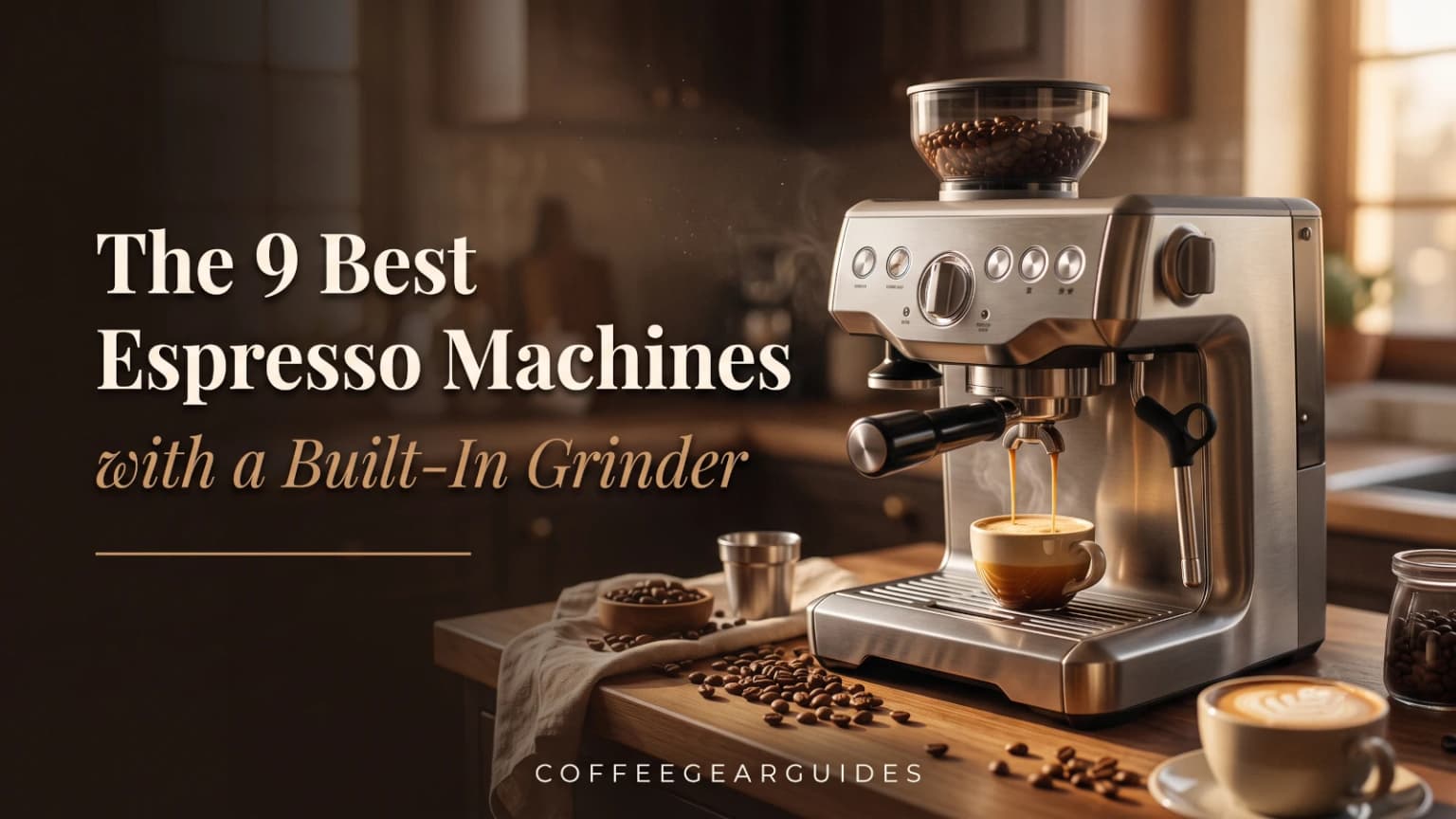
The best espresso machine with a built-in grinder solves the two problems that ruin most home espresso: stale pre-ground coffee and a crowded countertop.
One machine, whole beans in the top, espresso out the bottom.
The catch is that "espresso machine with grinder" covers two very different families. Semi-automatics like the Breville Barista Express make you the barista. Super-automatics like the Jura E8 replace the barista entirely.
We spent the past weeks comparing spec sheets, teardown videos, expert reviews, and more than 42,000 Amazon owner reviews across both families.
This 2026 guide covers the nine machines we would actually spend our own money on, what owners complain about after the honeymoon, and which machine fits which kitchen.
How we chose these espresso machines for 2026
We are a research-driven site, and we think that is a strength when it is done honestly. You can read exactly how we work on our about page.
The short version: we do not rely on a single glowing launch review, ours or anyone else's.
For this guide we compared manufacturer specifications, long-term owner reports on Reddit and coffee forums, teardown videos, and the full spread of Amazon reviews.
We paid the most attention to three-star reviews, because that is where owners describe real flaws without rage or hype.
Three rules shaped the final list. Every machine had to be in stock on Amazon US with a dense review base, not a fresh listing with twenty ratings.
Every machine had to earn strong owner sentiment. Where a rating dips below our usual 4.0 bar, we say so in plain language and explain why the machine is still here.
And every machine had to grind well enough that the built-in grinder is a genuine feature, not a marketing checkbox.
Prices were checked on the day of publication and move often, especially on Breville machines around holidays. The links let you check the current price yourself.
Semi-automatic or super-automatic?
Every machine in this guide grinds fresh beans for every cup. The split is in what happens next, and choosing the wrong side is the most common reason these machines get returned.
A semi-automatic espresso machine with a built-in grinder hands you a portafilter. It grinds into it, then you tamp, lock the handle in, start the shot, and steam the milk yourself.
The Breville Barista family and the Ninja Luxe Café work this way.
A super-automatic espresso machine, sometimes called a bean-to-cup machine, does everything internally. It grinds, doses, tamps, brews, and ejects the spent puck into a bin.
Milk drinks come from a carafe or tube system at the push of a button. De'Longhi, Philips, and Jura own this side of the market.
Two families, one promise: fresh ground espresso. The difference is how much of the work you want to own.
Here is the honest trade. The semi-automatic has a higher ceiling: with practice, a $550 Barista Express pulls shots and steams microfoam that no super-automatic under $2,000 can match, which is why every machine in our guide to espresso machines for latte art keeps a wand you control.
The super-automatic has a higher floor. It makes the same decent cup at 6 a.m. on a Tuesday with zero skill, zero mess, and about ninety seconds of patience.
The two families, side by side
The two families, side by side
What matters to you
Semi-automatic
Super-automatic
Effort per drink
3 to 5 minutes, hands on
About 90 seconds, hands off
Skill required
Real learning curve
None
Best possible cup
Cafe quality and beyond
Consistently good
Milk texture
True microfoam, latte art
Hot foamed milk, no art
Daily cleanup
Puck, wand, drip tray
Mostly self-rinsing
Typical spend
$549 to $1,430
$556 to $2,799
Generalizations hold across the nine machines in this guide. Individual quirks are covered in each review.
If you read that table and felt yourself defending the wand, you are a semi-automatic person. If you felt tired just reading it, go straight to the super-automatics.
Both are legitimate answers.
The 9 best espresso machines with grinders
The ranked lineup below runs from the crowd favorite to the endgame appliance. Every link was verified live and in stock through Amazon's own product API on the day we published.
At a glance
Best espresso machines with built-in grinders, compared
Ratings and review counts recorded July 2026 on Amazon US. Prices move; use the buttons for the live number. Amazon.com prices as of 15/09/2026. Details
1. Breville Barista Express
Ask any home barista community to name one espresso machine with a built-in grinder, and this is the answer you will hear.
The Barista Express (model BES870XL) has been the entry point into real espresso for over a decade. Its 27,685 Amazon reviews averaging 4.5 stars say the recipe still works.
The formula is simple and complete. A conical burr grinder with 16 settings grinds directly into a proper 54mm portafilter.
A thermocoil with digital PID control keeps the water where espresso needs it, and low-pressure pre-infusion wets the puck gently before the full 9 bars arrive.
Breville Barista Express (BES870XL)
Rated 4.5 from 27,685 ratings
The stainless semi-automatic that made home espresso mainstream, with a conical burr grinder, PID temperature control, and a real steam wand.
Key details
Integrated conical burr grinder, 16 settings
Dose-control grinding straight into the portafilter
54mm stainless portafilter with single and double baskets
Digital PID temperature control with pre-infusion
Manual steam wand for true microfoam
67 oz removable water tank, half-pound bean hopper
What we like
Unmatched shot quality per dollar, with real crema
Grind, dose, and tamp workflow teaches you actual barista skills
Enormous community means every problem has a documented fix
Frequently discounted well below its $699.95 list price
Watch out for
16 grind settings is the coarsest adjustment in the Breville family
Single-hole steam wand texture takes practice and patience
You clean a puck, a wand, and a tray every single day
The owner reviews tell a remarkably consistent story. The first week is humbling, the second week produces the best coffee the house has ever seen, and by month three the machine has paid for itself against a latte habit.
Complaints cluster around the learning curve and, in a minority of reports, grinder jams from oily beans.
The built-in grinder is the honest weak point. Sixteen settings covers most medium roasts, but the jumps between settings are bigger than on the Barista Pro or Impress models.
Very light roasts can leave you stuck between too fast and too slow. For a first machine, that limitation almost never bites in year one.
At $549.95 when we checked, a 20 percent cut from its usual Amazon price, it remains the benchmark everything else here has to justify itself against.
If you are unsure where to start and the wand does not scare you, start here.
2. Ninja Luxe Café Premier
The Ninja Luxe Café Premier is the machine that made the big review sites sit up in a way no budget espresso launch has in years.
CoffeeGeek gave it a Best in Class award, and 2,366 Amazon owners hold it at 4.3 stars.
Ninja's trick is measurement. The Luxe Café (model ES601) weighs your dose instead of timing it, the single biggest consistency upgrade available at this price.
Beans flow through a grinder differently as the hopper empties; a scale does not care. The machine then guides the grind setting for the next shot based on how the last one ran.
Ninja Luxe Café Premier (ES601)
Rated 4.3 from 2,366 ratings
A 3-in-1 espresso, drip, and cold brew machine whose built-in grinder weighs every dose. The most consistent espresso without learning anything.
Key details
Built-in conical burr grinder with weight-based dosing
Barista Assist feedback recommends the next grind adjustment
Assisted tamping lever for even, repeatable pucks
Hands-free milk frother with dairy and plant milk settings
Also brews drip coffee and rapid cold brew
Guided cleaning and descaling prompts on the display
What we like
Weighed dosing delivers consistency rivals twice the price cannot match
Three brew styles in one footprint suits mixed-coffee households
Gentle learning curve with genuinely useful on-screen guidance
Strong owner ratings for a first-generation espresso product
Watch out for
US version ships without a hot water button or single-shot basket
More plastic in the build than the all-metal Brevilles
Enthusiasts eventually bump against its guided guardrails
Owner sentiment is enthusiastic with two consistent grumbles. Americano drinkers miss a dedicated hot water spout on the US model.
And experienced users report the guided system occasionally fights them when they want to break the rules on purpose.
That second complaint is really the machine's identity. It is built to produce a reliable, tasty shot for someone who has never touched a portafilter, and the same guardrails a tinkerer will eventually outgrow are what guarantee it.
For a household where one person wants a cappuccino, another wants drip, and someone keeps cold brew going in summer, nothing else covers all three without a second appliance.
That versatility at $599 is why it sits directly behind the Barista Express in our ranking. Drop the espresso requirement and a dual coffee maker covers the same household for a third of that.
3. De'Longhi Magnifica Evo
The Magnifica Evo is where the super-automatic half of this guide starts. It is the machine we point to when someone wants push-button cappuccino without a four-figure spend.
This ECAM29084SB version includes De'Longhi's LatteCrema carafe, and 906 owners rate it 4.2 stars.
The routine could not be simpler. Fill the hopper, fill the tank, clip on the milk carafe, and press an icon.
The machine grinds with a 13-setting conical burr, tamps, brews, and froths in about the time it takes to find your keys.
De'Longhi Magnifica Evo with LatteCrema (ECAM29084SB)
Rated 4.2 from 906 ratings
The value benchmark in super-automatics: one-touch espresso, cappuccino, latte, and iced coffee with the LatteCrema auto-frothing carafe.
Key details
Fully automatic bean-to-cup brewing, tamping, and puck ejection
Conical burr grinder with 13 settings
LatteCrema carafe froths and dispenses milk automatically
One-touch espresso, coffee, cappuccino, latte, and iced coffee
Automatic rinse cycles at startup and shutdown
Milk carafe stores in the fridge between sessions
What we like
Espresso quality punches above its class among super-automatics
LatteCrema milk foam integrates into the cup instead of sitting on top
Compact for a super-automatic and quiet enough for open kitchens
Simple icon panel, nothing to configure or update
Watch out for
Shots are good, not great, next to a dialed-in semi-automatic
Milk carafe parts need disassembly and washing every few days
No user profiles or app, which the price arguably forgives
In head-to-head comparisons against the Philips 3200, reviewers consistently give De'Longhi the cup.
The shots run richer, and the LatteCrema foam is silkier, with smaller bubbles that fold into the espresso rather than floating on it. If flavor is the tiebreaker, this is the better machine.
The trade is maintenance. The LatteCrema carafe makes better foam than the Philips LatteGo but has more parts to rinse.
Owners who skip that chore for a few days write the machine's least happy reviews.
Watch one habit if you buy it: keep dry-surfaced medium roasts in the hopper and the rest of the bag in a sealed container. Like every super-automatic, the Evo dislikes oily beans.
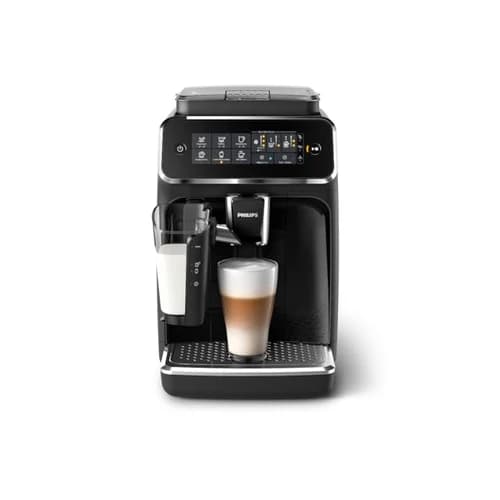
4. Philips 3200 LatteGo
The Philips 3200 LatteGo (EP3241/54) is one of Amazon's best-selling super-automatics for one specific reason, and it is not the espresso.
It is the milk system. The LatteGo carafe is two pieces of plastic with no tubes, and it rinses clean under the tap in seconds.
We want to be straight about the rating. At 4.0 stars across 6,188 reviews, it scores lowest among our super-automatic picks apart from the small-sample Jura.
The review base is huge and the machine has sold for years, so that number reflects real long-term ownership, not launch hype.
Philips 3200 LatteGo (EP3241/54)
Rated 4.0 from 6,188 ratings
The low-maintenance pick: a ceramic grinder, five one-touch drinks, and the tubeless LatteGo milk system that rinses clean in seconds.
Key details
100 percent ceramic burr grinder, 12 settings
Five one-touch drinks including cappuccino and latte macchiato
LatteGo two-piece milk carafe with no tubes to clog
AquaClean filter, rated by Philips for up to 5,000 cups before descaling
Adjustable strength and volume per drink
Automatic rinse at startup and shutdown
What we like
Easiest milk cleanup of any machine in this guide
Ceramic burrs run cooler and are rated for long service life
AquaClean system genuinely minimizes descaling chores
Consistent, repeatable results with zero learning curve
Watch out for
Espresso is milder than the Magnifica Evo in direct comparisons
LatteGo foam is stiff and sits on the drink rather than blending in
A 4.0 rating reflects a vocal minority of reliability complaints after year one
Reading the critical reviews, two threads dominate. Some owners report brew-unit or pump faults after the first year.
Espresso purists find the default shots watery until they shorten the volume and tighten the grind. The happy majority describe the same machine differently: it simply works, every day, with less attention than a houseplant.
The ceramic grinder deserves a mention. Ceramic burrs do not transfer heat into the beans the way steel can, and Philips rates the grinder for 20,000 cups.
Twelve settings is limited, but within the machine's automated recipe range it is enough.
Choose the 3200 if the person cleaning the machine is the person who hates cleaning machines. At $555.60 it is the cheapest one-touch latte on this list, and that convenience compounds daily.
5. Breville Barista Express Impress
The Barista Express Impress (model BES876) answers the one honest criticism of the original Express: the learning curve.
It keeps the manual workflow but adds the Impress Puck System, which doses intelligently, tamps with a 7 degree barista twist, and tells you how to correct the next dose.
That last part matters more than it sounds. The most common beginner failure is not bad tamping, it is inconsistent dosing.
The Impress quietly fixes both while still letting you feel like the barista. Owners agree at 4.3 stars across 1,083 reviews.
Breville Barista Express Impress (BES876)
Rated 4.3 from 1,083 ratings
The Barista Express with its learning curve sanded down: intelligent dosing, assisted tamping, and a finer 25-setting grinder.
Key details
Impress Puck System with intelligent dosing and assisted tamping
Auto-correcting dose learns from the previous grind
Conical burr grinder, 25 settings
54mm portafilter, PID temperature control, pre-infusion
Manual steam wand for real microfoam
Same footprint family as the original Express
What we like
Removes the two most common beginner mistakes on day one
25 grind settings dial in light roasts the Express cannot reach
Consistent pucks mean consistent shots, morning after morning
Keeps the manual steam wand skills worth learning
Watch out for
Around $250 more than the Express for the same brew hardware
Steam recovery after brewing is slower than the Barista Pro
The tamping lever adds moving parts to a machine you plan to keep for years
The grinder upgrade is the underrated half of this machine. Twenty-five settings versus the Express's sixteen means smaller jumps between adjustments.
That is exactly what you need when a shot runs three seconds too fast and you want to nudge it, not leap past it.
Owner complaints are mild by espresso standards. The most frequent is the pause between pulling a shot and full steam pressure, a thermocoil limit the Barista Pro solves with faster heating.
Buy the Impress over the Express if the $250 difference does not sting and early frustration would send the whole machine back in its box.
As a first espresso machine for a milk-drink household, it is the safest manual pick in this guide.
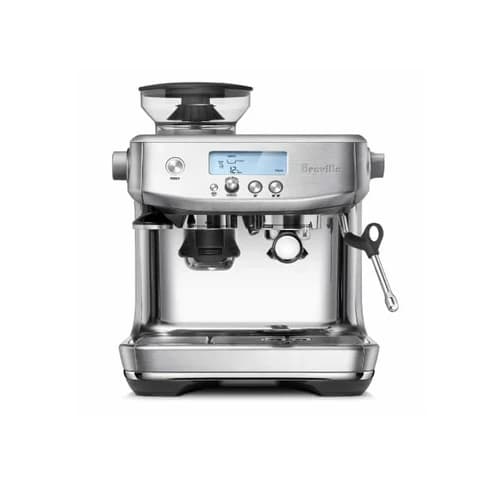
6. Breville Barista Pro
The Barista Pro (model BES878) is the enthusiast's pick of the Breville family.
It swaps the Express's thermocoil for Breville's ThermoJet system, which reaches brewing temperature in about three seconds and moves from shot to steam without the wait.
It also carries the finest adjustment of the sub-$1,000 Brevilles, with 30 grind settings feeding the same 54mm portafilter.
At 4.4 stars across 3,407 reviews, it is the second-best-rated machine in this entire guide.
Breville Barista Pro (BES878)
Rated 4.4 from 3,407 ratings
The fast one: ThermoJet heat in about three seconds, near-instant steam recovery, and a 30-setting grinder with room for light roasts.
Key details
ThermoJet heating system, ready in about 3 seconds
Conical burr grinder with 30 settings
LCD interface with grind and shot timing readouts
54mm portafilter with PID temperature control
Powerful manual steam wand with fast recovery
Slimmer profile than the Express on the counter
What we like
Back-to-back drinks with no thermal wait between shot and steam
30 grind settings handle light roasts gracefully
Best owner rating of any semi-automatic here after the Express
Quieter grinding than the original Express per owner reports
Watch out for
No pressure gauge, which traditionalists genuinely miss
Costs more than an Express plus a year of great beans
The speed changes how the machine fits a morning. On an Express, two lattes is a project.
On a Pro, the second drink starts before the first stops steaming. Owner reviews from two-coffee households read like they are describing a different hobby.
What you give up is the analog charm. There is no pressure gauge, so you learn to read the shot by timing and flow instead of a needle, and some owners never stop missing it.
The Pro makes sense for two groups: households pulling three or more milk drinks every morning, and light-roast drinkers who need those extra grind steps.
If neither describes you, the Express does 90 percent of this for $300 less.
7. Breville Barista Touch Impress
We need to be honest about this one, because the expert reviews and the owner ratings point in different directions.
Professional reviewers have called the Barista Touch Impress the easiest path to real espresso ever built. One major testing publication called it the best espresso machine it had tested.
Amazon owners hold it at 3.8 stars, the lowest score in this guide.
Both groups are describing the same machine truthfully. The Touch Impress (model BES881) combines the Impress puck system, a touchscreen that coaches every step, and automatic milk texturing with oat and almond modes.
When it works, it is the closest thing to a barista living in your kitchen.
Breville Barista Touch Impress (BES881)
Rated 3.8 from 796 ratings
Breville's most guided machine: touchscreen coaching, Impress dosing and tamping, and automatic milk texturing with plant-milk modes.
Key details
Color touchscreen with step-by-step guided workflow
Impress Puck System doses, tamps, and self-corrects
Automatic milk texturing with dairy, oat, and almond profiles
ThermoJet heating, ready in about 3 seconds
Conical burr grinder with 30 settings
Saveable drink profiles for multiple people
What we like
The shortest distance from unboxing to a genuinely good latte
Auto milk texturing rivals drinks from a trained hand
Guided corrections teach you espresso while making it
Profiles end the household argument over settings
Watch out for
A 3.8 owner rating driven by electronics and reliability complaints
The group head starts cold, so the first shot needs a warming flush the menu buries
At $1,429.99, a failure out of warranty stings badly
So why the 3.8? Reading the critical reviews, three themes repeat.
The touchscreen and sensors introduce failure modes a mechanical machine does not have. The ThermoJet heats water in seconds, but the metal group head starts cold, so early shots run cool unless you flush first, a step the interface buries.
And at this price, owners judge every flaw twice as hard.
None of that makes it a bad machine. It makes it a machine for a specific buyer: someone who values guidance and automatic milk enough to accept more electronics, and who will register the warranty.
We kept it because nothing else teaches espresso this well while making it. But the reliability-minded buyer should read the Barista Pro section again before spending the extra $580 here.
8. De'Longhi Eletta Explore
The Eletta Explore is what happens when De'Longhi points the Magnifica formula at a household that drinks everything.
Hot cappuccino, iced latte, cold brew style coffee, flat white. More than fifty preset recipes, from one machine with one grinder.
Its party trick is milk in both temperatures. The Explore ships with LatteCrema systems in hot and cool versions, so it froths cold milk for an iced latte as readily as hot foam for a cappuccino.
In the American market of year-round iced coffee, that is not a gimmick. And 512 owners rate the result at 4.2 stars.
De'Longhi Eletta Explore
Rated 4.2 from 512 ratings
The most versatile super-automatic here: 50+ hot and iced recipes, true cold foam, and Bean Adapt profiles that retune the grinder per bean.
Key details
Over 50 one-touch recipes, hot and iced
LatteCrema Hot and LatteCrema Cool milk systems included
Bean Adapt technology tunes grind and temperature per bean profile
Conical burr grinder with 13 settings
Color touchscreen with user profiles
App connectivity for recipes and maintenance guidance
What we like
Genuine cold foam and iced drinks no other machine here matches
Bean Adapt takes real guesswork out of switching coffees
Strong espresso base shared with well-proven De'Longhi internals
Handles a crowd: profiles, recipes, and fast back-to-back drinks
Watch out for
Two milk carafes means two sets of parts to wash
At $1,999.95 it costs as much as a machine and a vacation
Menu depth can overwhelm the one-button-cappuccino buyer
Owner reviews split along an obvious line. Households that actually use the cold functions love it, and the phrase "replaced our coffee shop runs" appears constantly.
Owners who only ever press the cappuccino button quietly admit a Magnifica Evo would have done their job for $1,250 less.
Bean Adapt deserves a specific mention for this guide's theme. Tell the machine what bean is in the hopper and it adjusts grind and extraction to suit.
That is the most intelligent use of a built-in grinder in the De'Longhi range.
Buy the Explore if iced drinks are a daily reality in your house. If not, the extra thousand dollars buys features you will demo once for guests and never touch again.
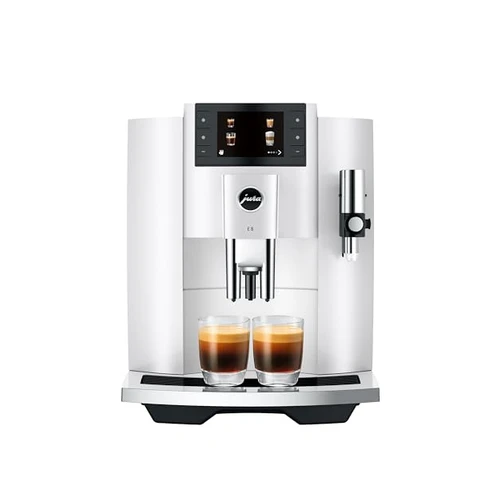
9. Jura E8
Every category has a product that owners describe in years, not features. The Jura E8 is that machine here.
The Swiss brand's best seller builds its case on grind quality, extraction engineering, and a service life that owner reports place at eight to twelve years.
Two pieces of technology justify the price. The Professional Aroma Grinder is engineered for consistency across the fineness range.
And Jura's Pulse Extraction Process pushes water through the puck in rapid pulses on short drinks, extracting flavor a standard stream misses. The result is the best straight espresso of any bean-to-cup machine we researched.
Jura E8 (Piano White)
Rated 4.1 from 41 ratings
The Swiss reference point: Professional Aroma Grinder, Pulse Extraction Process, and a filter system that nearly eliminates descaling.
Key details
Professional Aroma Grinder tuned for uniform grounds
Pulse Extraction Process for short specialty drinks
One-touch specialty menu spanning ristretto to latte macchiato
CLARIS Smart+ filter system minimizes descaling entirely
One-touch milk system with automatic rinse cycles
J.O.E. app control and maintenance tracking
What we like
The best espresso from any super-automatic in this guide
Owner-reported lifespans of 8 to 12 years with basic care
Maintenance is guided, automated, and genuinely easy
Quiet, fast, and composed in a way cheaper machines are not
Watch out for
Only 41 Amazon reviews, since most Jura volume sells through dealers
Milk pipe and filter consumables add real running costs
No portafilter romance: this is an appliance, a superb one
A transparency note first. The 41 reviews on the Piano White version we link is a tiny sample next to the Barista Express's 27,685, and we would not normally lean on it.
Jura sells mostly through its dealer network, so Amazon sees a fraction of its volume. The 4.1 figure matches the machine's reputation elsewhere, but weigh it accordingly.
The running costs are the honest asterisk. Jura's system replaces descaling with CLARIS filters, and the company recommends periodic milk pipe replacement.
Owners budget a meaningful sum per year in consumables. In exchange, the maintenance that remains is nearly effortless, and effortless maintenance is maintenance that actually happens.
The E8 is for exactly one buyer: the person done experimenting, who wants excellent coffee daily for a decade and considers $2,799 reasonable for that certainty.
For everyone else, it is a very pleasant thing to aspire to.
The built-in grinders, examined
Since the grinder is the reason this guide exists, the nine deserve a direct comparison on grinding alone.
This is where marketing copy gets vague, so we kept to what the spec sheets and owner reports support.
More settings means smaller jumps between adjustments, which matters most for light roasts.
Nine built-in grinders, side by side
Nine built-in grinders, side by side
Machine
Burr type
Settings
Dosing method
Barista Express
Steel conical
16
Timed, adjustable
Ninja Luxe Café
Steel conical
Fine-stepped dial
Weighed, automatic
Magnifica Evo
Steel conical
13
Automatic, internal
Philips 3200
Ceramic
12
Automatic, internal
Express Impress
Steel conical
25
Intelligent, self-correcting
Barista Pro
Steel conical
30
Timed, adjustable
Touch Impress
Steel conical
30
Intelligent, self-correcting
Eletta Explore
Steel conical
13
Automatic, Bean Adapt
Jura E8
Professional Aroma Grinder
Continuous dial
Automatic, per recipe
Settings counts from manufacturer specifications. Super-automatics manage dose internally, so their lower counts matter less in practice.
Three observations from that table earn a place in your decision.
First, on a manual machine, more settings genuinely matter. You are the one hunting for the setting where a shot runs 27 seconds instead of 22, which is why the Pro and Touch Impress suit light-roast drinkers better than the Express.
Second, on a super-automatic, the machine controls dose and pressure around its grinder, so 12 or 13 settings covers the recipe range fine.
Do not discount the Philips for its 12 steps. Discount it for its milder shots, if anything.
Third, the Ninja's weighed dosing is quietly the most advanced idea on the list. Every other machine measures grinding by time.
Grind-by-weight is the upgrade obsessive home baristas bolt on with a $150 scale and patience. Ninja built it in at $599.
Milk systems compared
Here is a secret the spec sheets bury: for most American buyers, the milk system matters more than the grinder.
Espresso is the base, but the drink most households actually make is a latte. The nine machines handle milk in four distinct ways.
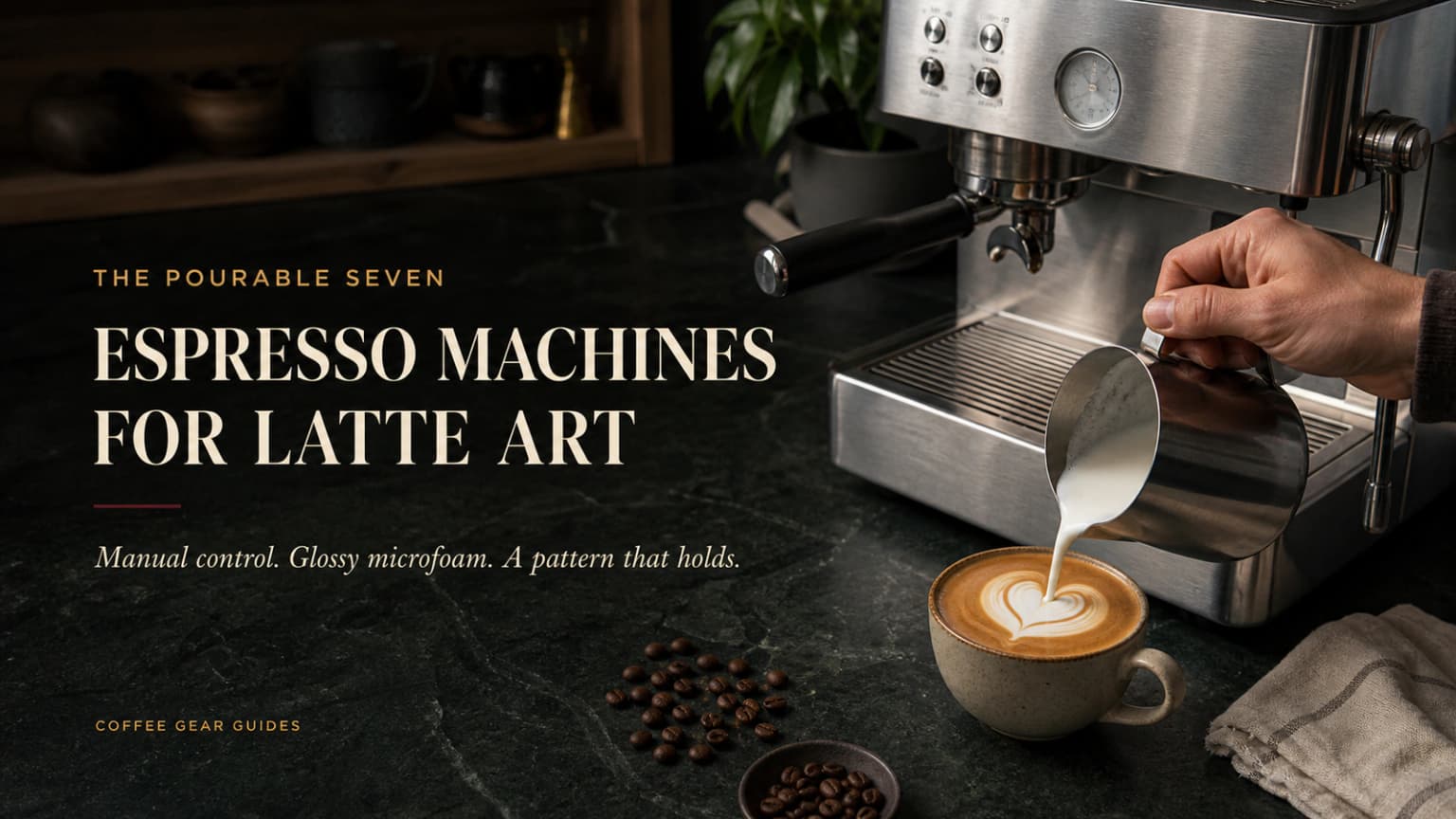
The manual steam wand on the Barista Express, Express Impress, and Pro is the craft option. It produces true microfoam, the glossy milk that makes latte art possible.
It also demands two weeks of practice and a purge-and-wipe after every use. Nothing automated matches its ceiling.
The automatic wand on the Ninja and the Barista Touch Impress splits the difference. You set texture and temperature, the machine steams the pitcher, and the result lands surprisingly close to hand-steamed.
The carafe systems from De'Longhi and Philips trade texture ceiling for convenience. The LatteCrema makes silkier foam and asks for more washing; the LatteGo makes stiffer foam and rinses in seconds.
The Eletta Explore's cold carafe is alone here in making genuine cold foam for iced drinks.
The Jura's tube system draws milk from any container and rinses itself. Its foam quality sits comfortably between the carafes and a practiced hand.
Counter space, noise, and fit
Owner reviews are full of a complaint no spec comparison predicts: the machine did not fit the kitchen.
Before choosing, measure three things, because returns in this category are heavy, boxed misery.
First, height. Bean hoppers load from the top, so you need clearance above the machine to refill without sliding it out.
Allow a few inches beyond the listed height, and remember most water tanks also lift out vertically.
Depth is the second surprise. Super-automatics run deep, and a machine that overhangs the counter edge will annoy you every day for a decade.
The Magnifica Evo is among the most compact super-automatics here, which is one reason it appears in so many apartment kitchens.
Noise is the third. Every built-in grinder is loud for the five to ten seconds it runs, roughly a blender's worth of sound.
Owner reports single out the ceramic Philips grinder as the gentlest and the Breville conicals as the most assertive. If your kitchen shares a wall with a sleeping baby, lean toward the Philips.
The case against a built-in grinder
We would be writing marketing, not a guide, if we skipped this section.
Spend ten minutes on any espresso forum and you will meet the standard advice: buy a cheaper machine and a separate grinder, because the grinder matters more than the machine.
That advice is correct, and it is also incomplete. A standalone burr grinder in the $200 range out-grinds every integrated grinder in this guide.
It adjusts finer, distributes better, and when it wears out you replace it without touching the machine. Serious hobbyists end up there eventually, and they are right to.
But the advice assumes the goal is the hobby. If the goal is good espresso with the least friction in the smallest footprint, the integrated grinder wins on the mornings that actually happen, the rushed ones.
One power cord, one warranty, one machine to clean, beans to cup in a single motion.
Our honest framing is this. The all-in-one machines here make coffee that beats any cafe chain and any pre-ground setup, full stop.
A separates setup beats the all-in-ones, at the cost of counter space, complexity, and a second purchase. Decide which sentence describes the problem you are actually solving.
What these machines really cost
The sticker price is the beginning of the story.
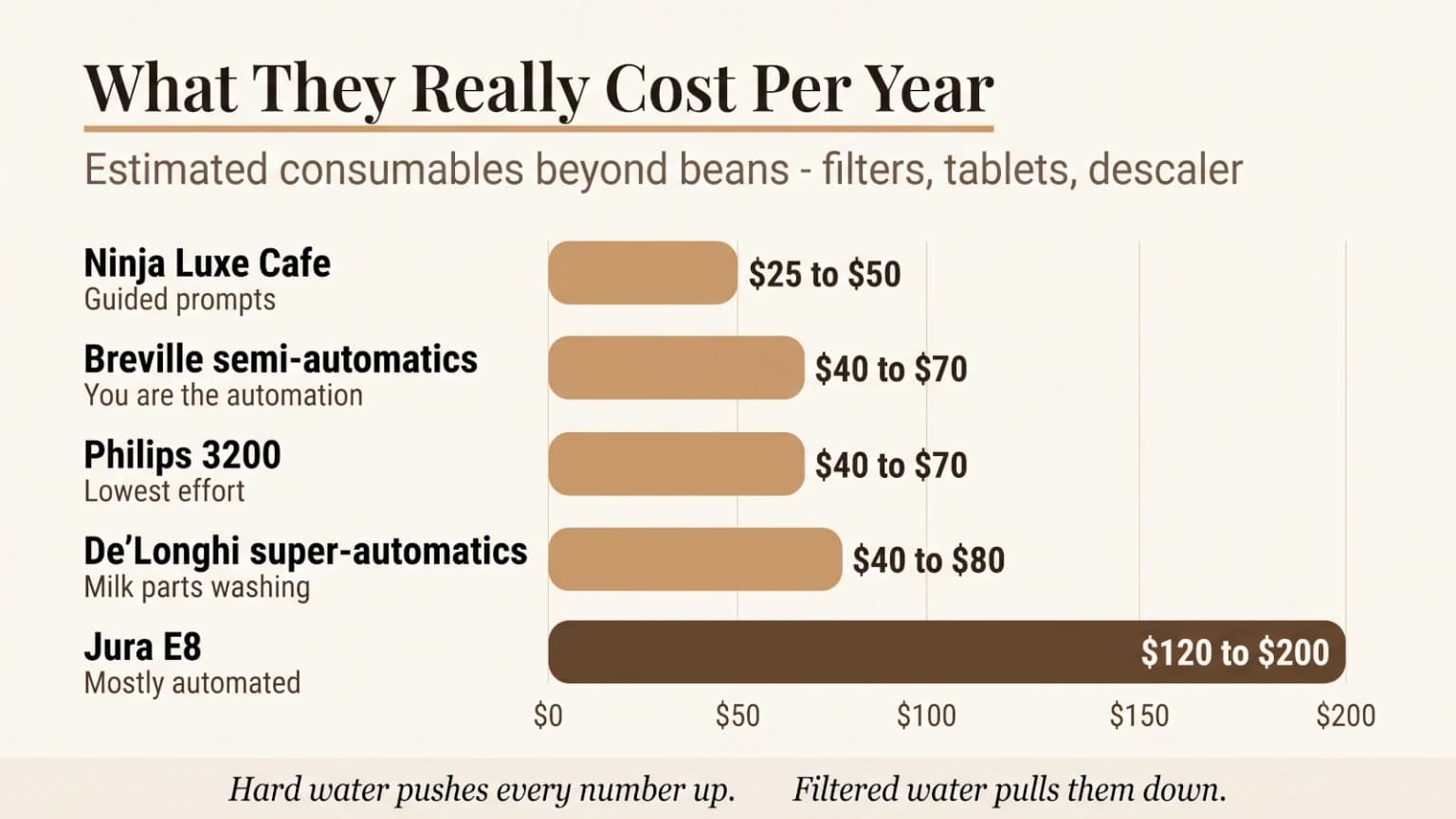
Espresso machines are the rare appliance you feed, filter, and clean on a schedule, and the nine machines here differ more in running cost than in electricity.
First-year estimates including typical consumables. Bean spending is the same whatever you buy, so we left it out.
Estimated yearly upkeep, beyond beans
Estimated yearly upkeep, beyond beans
Machine family
Typical consumables
Rough yearly cost
Hands-on time
Breville semi-automatics
Cleaning discs and tablets, descaler, water filters
$40 to $70
A few minutes daily, deep clean monthly
Ninja Luxe Café
Descaler, cleaning cycles
$25 to $50
Guided prompts, low effort
De'Longhi super-automatics
Descaler, water filters, milk system cleaner
$40 to $80
Milk parts washing, weekly tray duty
Philips 3200
AquaClean filters, occasional grease and cleaner
$40 to $70
Lowest of the group
Jura E8
CLARIS filters, cleaning tablets, milk pipes
$120 to $200
Minimal, mostly automated
Estimates from manufacturer schedules and owner reports as of July 2026. Hard water pushes every number up; filtered water pulls them down.
Two patterns are worth pulling out of the table. The Jura costs the most to run and the least to think about, which is consistent with everything else about the brand.
And the Breville machines cost little in parts but the most in minutes, because you are the automation.
Factor your water in before buying anything. Hard water is the quiet killer of espresso machines, and a $15 hardness test strip kit is the cheapest insurance in this hobby.
Machines fed filtered or bottled water skip most of the descaling drama entirely.
When to buy
Espresso machines are seasonal merchandise, and the Breville machines especially swing hard.
The Barista Express we priced at $549.95 lists at $699.95. That 20 percent gap opens and closes several times a year around Prime Day, Black Friday, and the gifting holidays.
Our practical advice: if the machine you want is already discounted 15 percent or more, buy it. If it sits at full list price and no holiday is near, waiting a few weeks rarely hurts.
The live prices on this page update daily, so the buttons always show the current number before you commit.
One caution on marketplace listings. Deep third-party discounts in this category are sometimes gray-market imports without a US warranty.
Espresso machines are exactly the product where warranty service matters. The links in this guide point to the standard Amazon listings we verified.
Dialing in a built-in grinder
If you buy one of the semi-automatics, the phrase you will live with for the first week is dialing in.
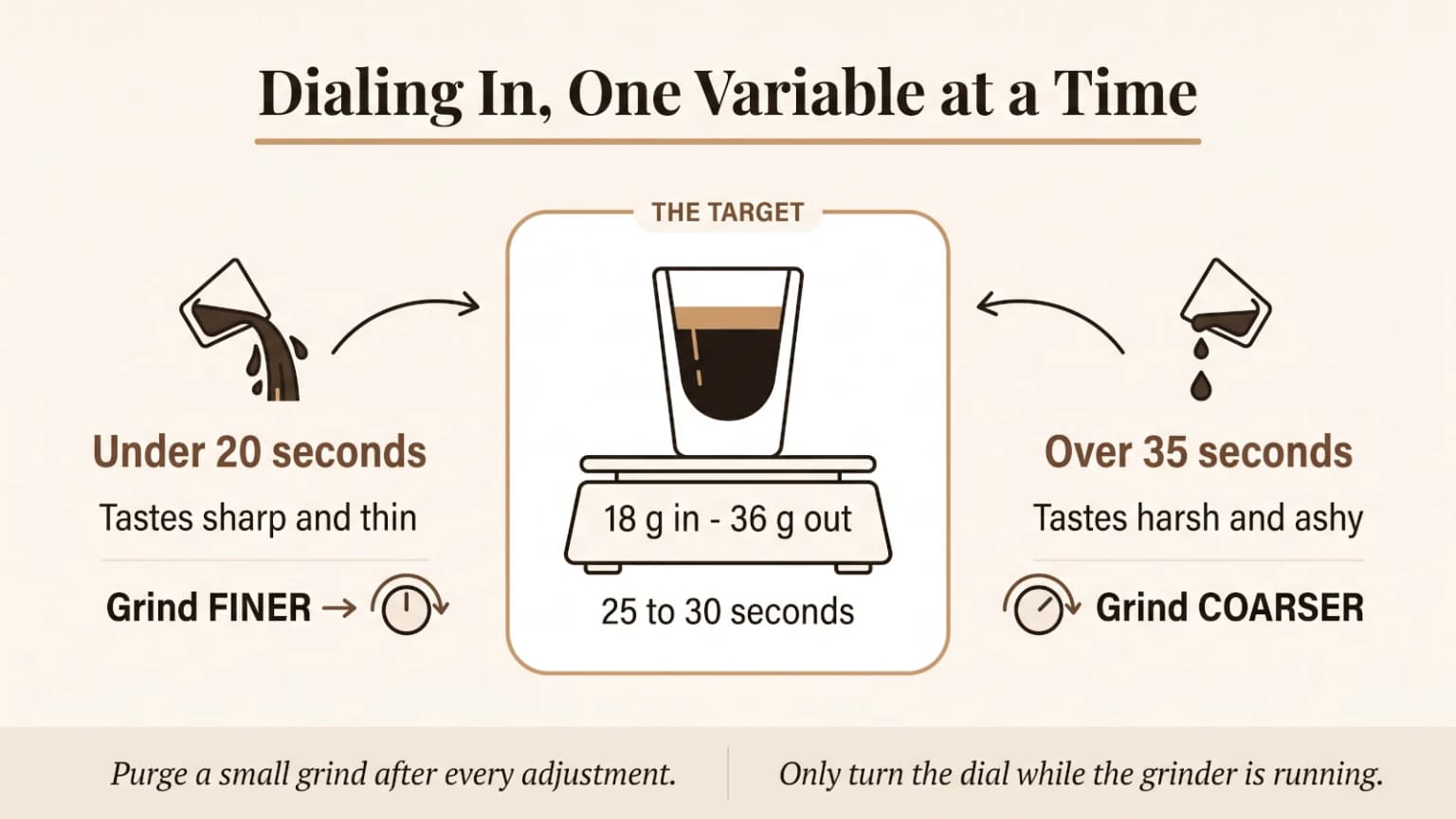
It means finding the grind setting where your beans, your dose, and your machine produce a balanced shot. Here is the process that removes the guesswork.
One variable at a time. The grind setting is your steering wheel; the dose stays fixed.
Dialing in, step by step
1
Start with fresh beans and a fixed dose
Use beans roasted within the past month and load the double basket with the dose your manual specifies, typically around 18 grams. Keep that number constant; changing two variables at once teaches you nothing.
Tip A $20 kitchen scale that reads 0.1 gram pays for itself in saved beans within a week.
2
Set the grinder to the middle of its range
On a 16-setting grinder start at 8, on 30 start around 15. The middle is a neutral opening bid that leaves room to move both directions.
3
Pull a shot and time it
Start the timer when the pump starts. Aim for roughly double the dose weight in liquid, about 36 grams out from 18 in, landing in 25 to 30 seconds.
4
Fast and sour means grind finer
A shot that gushes through in under 20 seconds and tastes sharp or thin is under-extracted. Move one or two settings finer and pull again.
Watch out Run a small purge grind after changing settings. The chute still holds grounds at the old size, and they will muddy your next data point.
5
Slow and bitter means grind coarser
A shot that drips out past 35 seconds and tastes harsh or ashy is over-extracted. Step one or two settings coarser and repeat.
6
Lock it in and stop fiddling
When a shot lands in the window and tastes sweet with body, write the setting down and leave it alone. Revisit it only when you change beans.
Tip New bag of the same beans? Expect to adjust one setting at most. New roaster or roast level? Start over.
Super-automatic owners get a shorter version of this ritual. Set the grinder one or two steps finer than factory, shorten the drink volume if shots taste weak, and adjust strength per recipe.
The Bean Adapt system on the Eletta Explore automates most of this, which is precisely what you are paying for.
One warning that applies to every machine here: only adjust the grind setting while the grinder is running.
Turning the collar on a bed of static beans can wedge grounds against the burrs. This single habit prevents the most common grinder jam reported in owner reviews.
Maintenance that keeps the grinder alive
Nobody buys an espresso machine for the cleaning. But the difference between a machine that lasts three years and one that lasts ten is almost entirely maintenance.
The routine is shorter than its reputation.
The maintenance rhythm
1
Daily: the sixty-second reset
Semi-automatics: knock out the puck, rinse the portafilter, purge and wipe the wand while warm. Super-automatics: empty the drip tray and dregs bin when asked, and rinse the milk system after the last milk drink.
Tip Milk residue gets dramatically worse overnight. Never leave the wand or carafe dirty after the last drink.
2
Weekly: the brew path
Wash removable parts with warm water. Philips and De'Longhi owners should pull the brew group and rinse it under the tap; it slides out in seconds and prevents most bitter-coffee complaints.
3
Monthly: the deep clean
Run the cleaning cycle with the tablet or disc your machine specifies, and vacuum out the hopper and grind chute. On Brevilles, brush the burrs; the top burr lifts out without tools.
Watch out Never run water or cleaning fluid through a grinder unless the manual explicitly allows it. Burrs are cleaned dry.
4
Per schedule: water care
Replace AquaClean or CLARIS filters when prompted, and descale on the schedule your water hardness demands. With filters maintained, Philips and Jura machines may never need a manual descale.
The pattern across thousands of negative reviews is depressingly consistent. Machines described as broken were very often machines that never saw a filter change or a brew group rinse.
Budget the ten weekly minutes as part of the purchase, and every machine in this guide becomes a long-term appliance.
Which espresso machine should you buy in 2026?
Nine machines is a lineup, not an answer, so here is the answer.
We scored the field on shot quality, milk performance, grinder capability, reliability sentiment, and cost of ownership. Then we asked one deciding question: how much of the process do you want to own?
The three we recommend first
Our pick
Barista Express
$549.95
You are
Willing to learn
Best at
Shot quality per dollar
Milk
Manual wand, real microfoam
Weak spot
16 grind settings
Magnifica Evo
$749.99
You are
Busy, milk-drink first
Best at
One-touch lattes for the money
Milk
LatteCrema auto carafe
Weak spot
Carafe parts to wash
Jura E8
$2,799.00
You are
Done compromising
Best at
Espresso quality, longevity
Milk
One-touch, self-rinsing
Weak spot
Consumable costs
The three we recommend first
Specification
Our pick
Barista Express
$549.95
Magnifica Evo
$749.99
Jura E8
$2,799.00
You are
Willing to learn
Busy, milk-drink first
Done compromising
Best at
Shot quality per dollar
One-touch lattes for the money
Espresso quality, longevity
Milk
Manual wand, real microfoam
LatteCrema auto carafe
One-touch, self-rinsing
Weak spot
16 grind settings
Carafe parts to wash
Consumable costs
Whichever side you land on, buy from the espresso machines tier that matches your actual mornings, not your aspirational ones.
A machine that fits your routine gets used every day for years. Daily use is where every machine on this list earns its price.
Frequently asked questions
Are espresso machines with built-in grinders worth it?
For most people, yes. Grinding beans seconds before extraction is the single biggest flavor upgrade over pre-ground coffee, and an integrated grinder guarantees that happens with zero extra counter space.
The trade-off is that a built-in grinder is rarely as good as a comparable standalone burr grinder. And if it fails, the whole machine goes in for service.
If you want maximum convenience per dollar and per square inch, a machine with a built-in grinder is the right call. If you are chasing competition-level espresso, budget for separates.
Is a built-in grinder as good as a separate grinder?
No, and it does not need to be. A $200 standalone burr grinder usually offers finer adjustment, better grind consistency, and easier servicing than the grinder inside any machine on this list.
What the built-in grinder wins on is workflow, freshness, and footprint. Every machine here grinds well enough to pull a shot with proper crema that beats anything made from pre-ground coffee.
Enthusiasts who fall in love with the hobby usually add a separate grinder later and keep the machine.
Can you use pre-ground coffee in these machines?
In most of them. The super-automatics from De'Longhi, Philips, and Jura all include a bypass chute for a scoop of pre-ground coffee, which is handy for decaf after dinner.
On the Breville semi-automatics you can simply fill the portafilter with pre-ground coffee and skip the grinder.
We would treat this as a backup feature, not a habit, because pre-ground coffee loses most of its aroma within days of opening.
What beans should you avoid in a built-in grinder?
Very oily, very dark roasts. The oil coats the burrs and the chute, clumps the grounds, and is the most common cause of clogged grinders in super-automatic machines.
Medium and medium-dark roasts with a dry surface feed cleanly and still make a rich, chocolatey shot.
If you love oily French roast, run a coarser setting, clean the grinder more often, and expect more maintenance.
How long do espresso machines with built-in grinders last?
Owner reports put the Breville semi-automatics at five to ten years with regular cleaning and descaling, and Jura machines at eight to twelve with the filter system maintained.
Water hardness is the biggest variable, so filtered water genuinely extends lifespan.
The main long-term risk on newer machines is electronics rather than pumps or boilers, which is worth remembering before paying extra for a touchscreen.
How much cleaning do these machines actually need?
Plan on a few minutes a day and a deeper session monthly. Semi-automatics need the portafilter rinsed, the steam wand purged and wiped after every use, and a cleaning-disc backflush roughly monthly.
Super-automatics rinse themselves at startup and shutdown, but the milk system needs cleaning after every session and the brew group or drip tray needs a weekly wash.
The Philips LatteGo is the least demanding milk system of the nine, which is a real reason it sells so well.