Portable Espresso Makers in 2026, from Hand Pump to Battery
We read 21,000+ owner ratings to rank the best portable espresso makers. Seven 2026 picks from $54 to $359, for travel, camping and work.
By the CoffeeGearGuides team · USA · Updated Oct 3, 2026 · 33 min read
On this page20
The best portable espresso maker is the one that matches where you will actually use it, because every device in this category depends on something you have to bring with you.
Some need boiling water. Some need a charged battery. Most need a grinder that goes fine enough.
That dependency is the whole buying decision, and it is the thing most guides skip. A pocket brewer that needs a kettle is useless in a tent, and a battery brewer that spends four minutes heating its own water is wasted in a kitchen that already has a stove.
For this 2026 guide we compared manufacturer specifications, expert assessments, community reports, and 21,000+ Amazon owner ratings that we read off the live listings ourselves.
We also checked stock on every candidate, which turned out to matter more than expected. Several devices the competing guides rank at the top cannot be bought on Amazon US at all.
How we chose these portable brewers for 2026
We narrowed nineteen candidates to seven on three rules: live stock on Amazon US, a 4.0 star rating over a review base deep enough to mean something, and a job no other pick on the list already did.
We research rather than test, and we are straightforward about what that means. You can read exactly how we work on our about page.
For this guide we compared published manufacturer specifications, long-form assessments from established coffee publications, community reports from travelers and campers, and the full Amazon rating base for every candidate.
Individual Amazon review bodies now sit behind a sign-in wall, so we do not claim to have read them. What we did read, device by device, is the star average and the size of the review base on the live listing.
Stock and price came from Amazon's own product API rather than from a shopping page, so every figure quoted here was live on the day we published.
Two candidates failed the ratings bar outright and were dropped rather than ranked low, and a third was cut for being a near-identical sibling of a cheaper pick.
That last rule is the one that keeps a list honest. A second Wacaco hand pump at a slightly lower price is not a seventh pick, it is padding.
Hand pump, lever, or battery power?
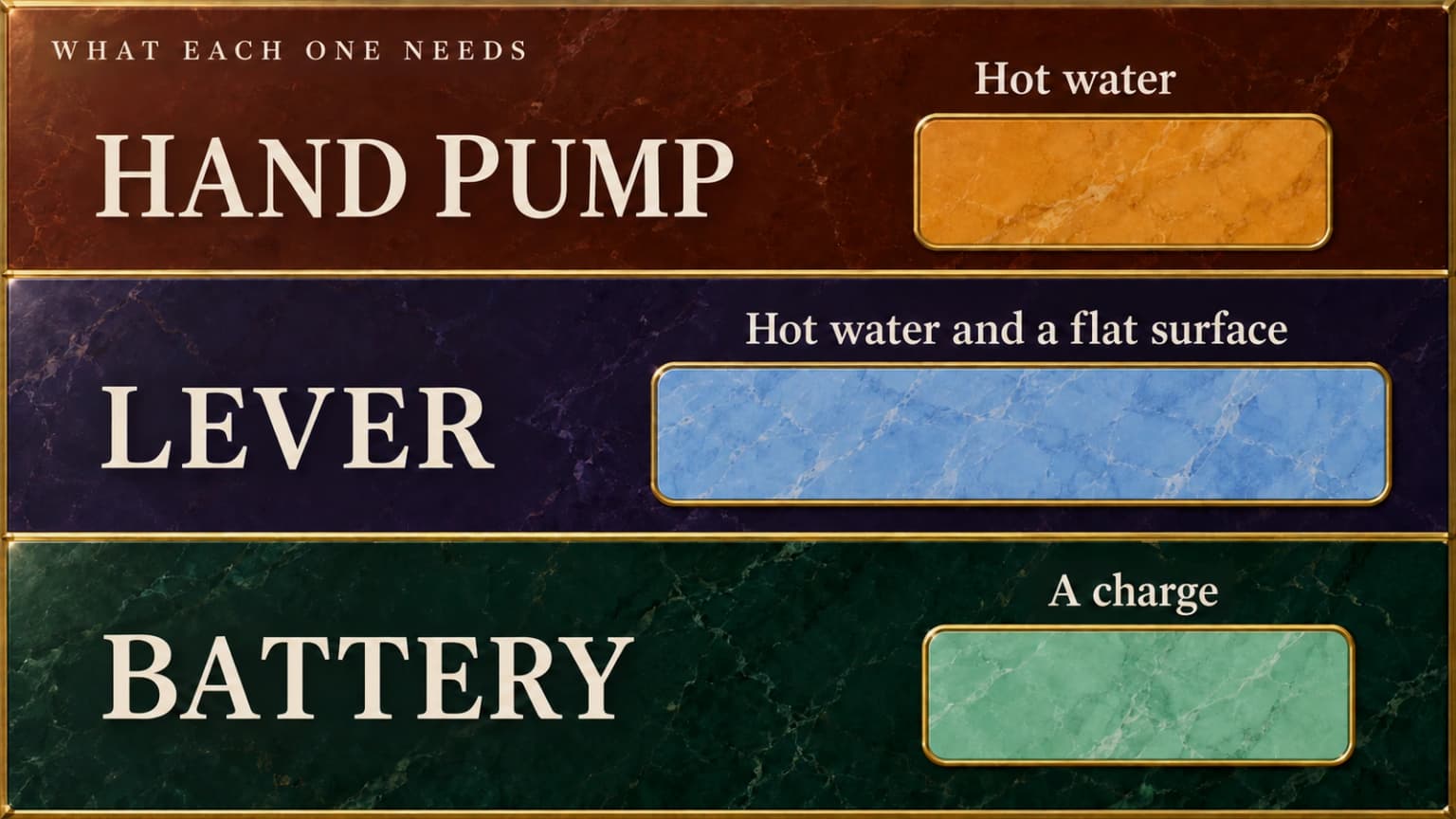
Three mechanisms cover this entire category, and they differ in one respect that matters more than price, weight or shot quality: what has to be true before you get a shot.
A hand pump generates pressure from repeated strokes of a piston you work with your thumb or palm. It needs water that is already hot. The Wacaco and Staresso devices work this way.
A lever multiplies the force of your arm through a long handle into one slow, continuous push. It also needs hot water, plus a flat surface to stand on. The Flair 49 PRO is the lever here.
A battery model is the only true portable espresso machine in the sense most people mean the phrase, with an electric pump and a heating element running from a rechargeable cell.
It is also the only family that takes cold water, and the only one that can run flat.
Pick the family by the thing you can guarantee. Everything else about these devices is negotiable.
The trade reads cleanly once you see it that way. Hand pumps and levers are lighter, cheaper, immune to flat batteries, and the better of them pull better shots.
Battery models buy you independence from a heat source, and they charge about $90 and another 330 grams for it. In a car, an office or a tent, that is money well spent.
Three mechanisms, three dependencies
Three mechanisms, three dependencies
What matters to you
Hand pump
Lever
Battery
You must supply
Hot water
Hot water, flat surface
A charge
Carry weight
178 to 400 g
Two-handed object
About 670 g
Typical dose
8 to 15 g
12 to 20 g
Ground or capsule
Time to a shot
Under a minute
Two to three minutes
Three to four minutes
Can it fail on you
Only the seals
Almost nothing
Flat battery
Typical spend
$55 to $70
$359
$150
Weights and doses are the figures each maker publishes. Individual quirks are covered in the reviews below.
If you already carry a stove, a kettle or a hotel room with a tap that runs genuinely hot, the hand pump answer is almost always right.
If hot water is the thing you cannot promise, stop reading the hand pump sections and go straight to the two battery models.
The 7 best portable espresso makers
The lineup below runs from the device we would recommend first to the specialists. Every link was verified live and in stock through Amazon's product API on the day we published.
Two of the seven run on a battery and five are driven entirely by hand. That split, rather than the price order, is the thing to read the table for.
Ratings and review counts read on Amazon US in October 2026. Prices move; use the buttons for the live number. Amazon.com prices as of 29/10/2026. Details
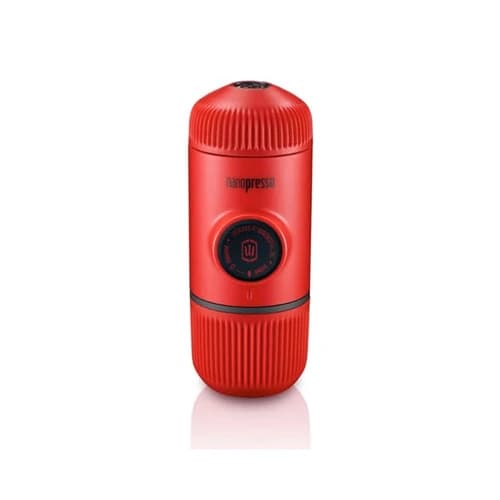
1. Wacaco Nanopresso
The Wacaco Nanopresso is the device that made this category credible, and nothing since has displaced it. It holds 4.4 stars across 4,655 owner ratings at the time of writing.
Wacaco publishes the numbers that matter. An 8.0 gram basket, an 80 ml water tank, a peak of 18 bar, and 336 grams on the scale.
Wacaco Nanopresso
Rated 4.4 from 4,655 ratings
The pocket hand pump that set the standard for portable espresso, with a patented pumping system, a pressurized basket and no power requirement at all.
Key details
Hand-pumped, no battery or electricity needed
8.0 g ground coffee basket, pressurized
80 ml water tank with a detachable cup
Peak pressure quoted at 18 bar
336 g and 15.6 cm long, genuinely pocketable
NS Adapter and Barista Kit sold separately
What we like
The deepest evidence base of any hand-pumped pick here
Pressurized basket forgives a grind that is slightly off
Strips into five parts and rinses clean in under a minute
Nothing on it can run flat, expire or need a cable
Watch out for
The 8 g dose is under half a cafe double
You still have to find boiling water from somewhere
The plain black version is only sold as a bundle on Amazon US
The reputation it has earned is for consistency rather than peak quality. Reviewers across a decade describe the same thing: a small, thick, properly crema-topped shot that behaves the same way in a hotel room as it does at home.
The pressurized basket is the reason. It builds back pressure on its own, so a grind that would choke or gush through a bare basket still produces a drinkable shot.
The honest weak point is dose. Eight grams is a single, and a short one, so a flat white built on it tastes thinner than the same drink from a countertop machine.
Note that the listing we link is the Red Patrol color edition at $64.90. It is the only plain Nanopresso on Amazon US that is not bundled with a case at a higher price, and it carries the deepest review base of the Nanopresso listings.
Buy it if you want the safest answer in the category and you can reach hot water. For most people reading this page, that is the honest recommendation.
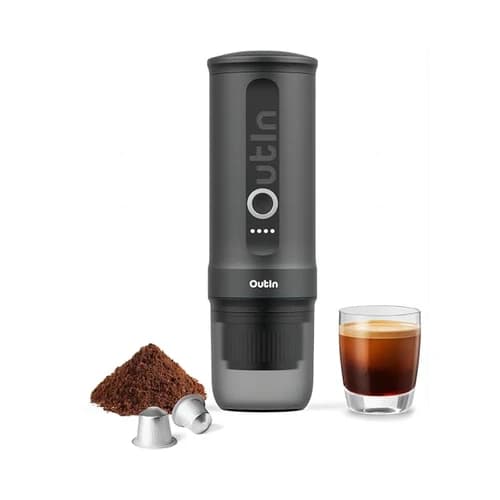
2. OutIn Nano
The OutIn Nano solves the one problem a hand pump cannot. It carries its own heating element, so it takes cold water and brings it to brewing temperature without a kettle anywhere in sight.
OutIn publishes 670 grams, a 2,500 mAh three-cell battery, a 90 watt heater, an 80 ml maximum fill, and a 198F brew target at 20 bar. It holds 4.2 stars across 5,763 ratings.
OutIn Nano
Rated 4.2 from 5,763 ratings
A battery-powered travel machine that heats its own water from cold, built in food-grade stainless steel and run from a single button.
Key details
Self-heating from a 2,500 mAh three-cell battery
Heats roughly 50 ml of cold water in about 200 seconds
Quoted at 20 bar and a 198F brew target
Takes ground coffee or Nespresso Original capsules
Food-grade stainless steel body, 670 g
One-button operation, leak-proof insulated design
What we like
The only sensible answer where no heat source exists
Far more owner evidence than any other battery model
Capsule and ground modes cover both habits
Insulated shell stays comfortable to hold while brewing
Watch out for
Heating is what drains it: about five brews from cold water
Twice the weight of a Nanopresso and more than twice the price
A full brew cycle runs three to four minutes, not thirty seconds
The number worth knowing before you buy is the one OutIn publishes but nobody quotes. From cold water the battery manages about five brews, and from water that is already hot it manages more than two hundred.
That gap tells you exactly where the energy goes. You are not paying for a pump, you are paying for a kettle that fits in a cup holder.
It also sets expectations correctly. Treat the Nano as a device that can heat water when it has to, not one that heats water all week, and the battery anxiety disappears.
The weak point is time. Three to four minutes with a 200 second heat-up is a long wait beside a hand pump that is finished the moment you stop pressing.
Buy it for the car, the office with no kitchen, the campsite, or any morning where finding boiling water is the hard part.
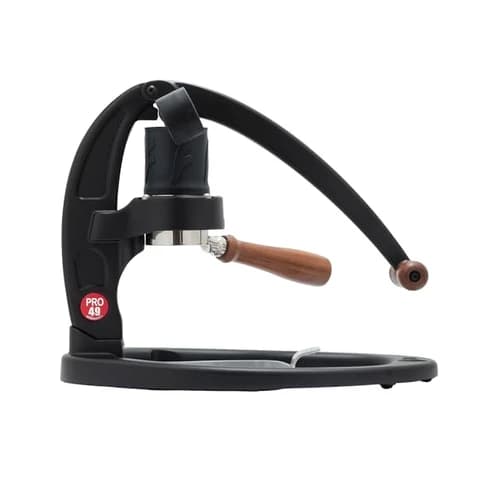
3. Flair 49 PRO
Among these seven, the Flair 49 PRO is the one that refuses to treat travel as an excuse. It is the only device here that brews at cafe scale, the only one that shows you the pressure you are applying, and it holds 4.2 stars across 426 ratings.
Flair publishes a dose range of twelve to twenty grams, a 90 ml water capacity and a yield of up to 55 ml. It ships with both a pressurized basket and a bottomless one.
Flair 49 PRO
Rated 4.2 from 426 ratings
An all-manual lever press with an integrated pressure gauge and a stainless brew path, built for people who want espresso rather than a shot-shaped compromise.
Key details
Direct lever action, no pump and no electronics
49 mm portafilter with a handle, deeper than a 58 mm basket
Published dose of 12 to 20 g, water capacity 90 ml
Integrated gauge with a marked espresso zone at 9 bar
No plastics in the brew path: steel cylinder, plunger and stem
Pressurized and bottomless baskets both in the box
What we like
The only cafe-sized dose in this guide, by a wide margin
The gauge turns pressure from a claim into something you steer
Steel brew path and a design built to be rebuilt, not replaced
Yields up to 55 ml, a genuine double rather than a taster
Watch out for
Heavy and bulky: a two-handed object, not a pocket one
Needs a flat stable surface, which a tent floor is not
At $359 it costs more than the two priciest other picks combined
The gauge is the feature that justifies the price, and it is worth understanding why. Every other device on this page quotes a peak pressure and gives you no way to know what the puck in the portafilter actually saw.
The 49 PRO puts a needle in front of you with the espresso zone marked. You hold nine bars because you can see nine bars, which is a completely different activity from pumping hard and hoping.
Calling it portable takes a generous definition. It packs down and travels, but it is luggage rather than pocket kit, and it wants a counter to stand on.
The 426 ratings are a thinner base than the Wacaco listings carry, which is normal for a product at four times the price with a narrower audience.
Buy it if the shot matters more than the gram count on your pack, and if "portable" for you means a holiday apartment rather than a mountain.
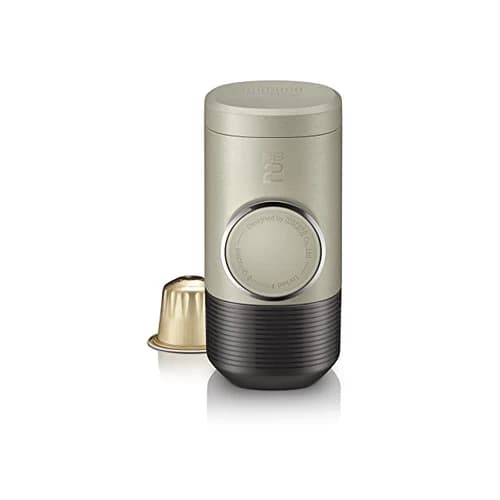
4. Wacaco Minipresso NS2
The Wacaco Minipresso NS2 removes the grinder from the equation entirely. It takes Nespresso Original capsules, which means no beans, no burrs and no dialing in.
Wacaco publishes 290 grams, an 80 ml tank, a peak of 18 bar and a yield of up to 60 ml. It reads 4.3 stars across 7,516 ratings, the deepest review base of any pick here.
Wacaco Minipresso NS2
Rated 4.3 from 7,516 ratings
A capsule-driven hand press that skips grinding completely, built around a piston you unlock and pump, with an integrated cup and a double-wall shell.
Key details
Takes Nespresso Original capsules and compatibles
Piston action, no battery or electricity
290 g and 129 mm tall, the lightest Wacaco here
80 ml water tank, yields up to 60 ml
Double-wall structure stays cool in the hand
Integrated cup, so nothing else is needed to drink from
What we like
The deepest owner evidence base in this entire guide
No grinder, no scale, no dialing in, no mess to clean up
Capsules are sold in supermarkets worldwide, which matters abroad
Lighter and shorter than the ground-coffee Wacaco devices
Watch out for
You are locked into capsule quality and capsule cost
The 7,516 figure is pooled across the NS and NS2 generations
One thing about that review count deserves a plain statement. Amazon pools the rating base across the Minipresso NS and the NS2, so both listings report the identical 4.3 and 7,516 figures.
It is still the largest body of owner evidence in this guide. It just is not 7,516 people reviewing the second generation specifically, and we would rather say so than let the number flatter the pick.
The capsule trade is the familiar one. You give up control over the coffee, and you get back a device that works identically for a complete beginner at six in the morning in a hotel room.
Nespresso Original is the open format here, which matters more than it sounds. Supermarket own-brands and specialty roasters both fill it, so you are not tied to one seller the way a closed format would tie you.
The weak point is cost per cup, which runs several times what loose coffee costs. Over a year of daily use that gap dwarfs the price of the device.
Buy it if you travel often, do not want to carry a grinder, and would rather have a reliable capsule shot than a variable one you have to work for.
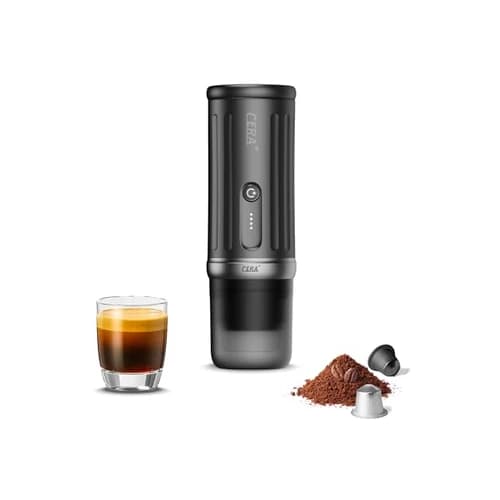
5. CERA+ PCM03S
Endurance is the weak point of every battery model, and the CERA+ PCM03S is the one pick that treats it as the main problem. It carries a 13,500 mAh pack built from three 4,500 mAh cells, and reads 4.4 stars across 384 ratings.
CERA+ publishes the figures that matter for a self-heating device. It takes 50 ml of water from 77F to 198F in 140 seconds, quotes 20 bar, and recharges at 30 watts in roughly an hour and a half.
CERA+ PCM03S
Rated 4.4 from 384 ratings
A self-heating travel machine built around the largest battery in this guide, aimed at people who need several brews between charges rather than one.
Key details
13,500 mAh pack, three 4,500 mAh cells
Heats 50 ml from 77F to 198F in about 140 seconds
20 bar pumping system quoted by the maker
30 W USB-C charging, full in roughly 1.5 hours
Dual brewing: ground coffee or capsules
One-button operation with no app required
What we like
Roughly five times the battery capacity of the OutIn Nano
The highest star rating of any electric pick we screened
Faster heat-up than its main rival, at 140 seconds
Fast charging means a lunch break refills it
Watch out for
384 ratings is a modest base beside the OutIn Nano
A bigger battery means more weight and more bulk
A newer brand with a shorter track record to judge
This is the pick for multi-day use away from power. If you are in a van, on a long road trip or camping for a week, battery capacity is the only specification that changes your experience.
The 140 second heat-up is also a real improvement rather than a marketing line. It is roughly a minute faster than the OutIn Nano on a comparable volume of water.
The evidence base is the honest limitation. At 384 ratings it is well above our floor, but it is a fraction of the 5,763 behind the OutIn Nano, and this is a newer company.
We would still take it over its rival for anyone who genuinely brews away from outlets. For an office desk with a charger in the drawer, the extra battery buys nothing.
Buy it when the gap between charges is measured in days rather than hours.
6. Cafflano Kompresso
Nothing else on this list builds pressure the way the Cafflano Kompresso does. It works hydraulically rather than pneumatically, so there are no strokes to repeat and no rhythm to learn.
Cafflano publishes 178 grams, a basket that takes up to 15 grams, an 80 ml water capacity, and a claim of sustained pressure above nine bars. It holds 4.1 stars across 249 ratings.
Cafflano Kompresso
Rated 4.1 from 249 ratings
The lightest device in this guide, using hydraulic compression rather than an air pump to hold pressure steady through the whole extraction.
Key details
Hydraulic water compression, not pneumatic
178 g, the lightest brewer on this list
Basket takes up to 15 g of fine espresso grind
80 ml maximum water capacity
Maker claims sustained pressure above 9 bar
Collapses flat and cleans with a rinse
What we like
Holds pressure through the shot instead of losing it per stroke
Lighter than every other pick by a clear margin
A 15 g basket is nearly double the Nanopresso dose
Nothing to charge, pump repeatedly or wear out quickly
Watch out for
Demands a genuinely fine espresso grind or it drains through
249 ratings is the thinnest review base in this guide
The flat packed shape is awkward to hold while it works
Hydraulic compression is a real engineering difference, not a brand word. A pneumatic pump loses pressure between strokes, while water under compression holds a steadier figure across the whole extraction.
The practical result is a shot that tastes more even from top to bottom. It is the reason this device keeps appearing in enthusiast round-ups despite a small review base.
The grind requirement is strict and Cafflano says so on the listing. Use a normal espresso grind and water drains straight through without building pressure at all.
That makes it the least forgiving pick here for anyone without a capable grinder, which is the opposite of the Nanopresso's pressurized basket.
Buy it if weight is the thing you optimize and you already own a grinder you trust. For backpacking, 178 grams is a serious argument.
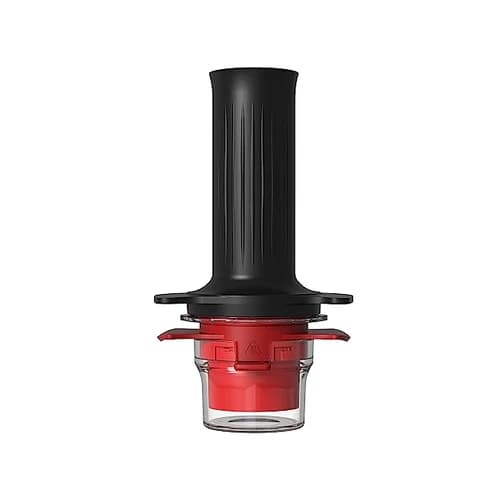
7. Staresso Classic
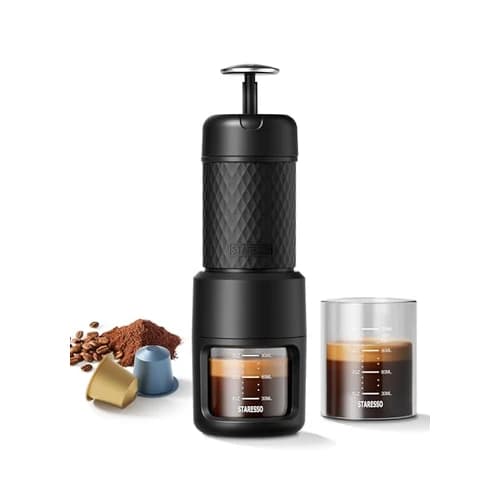
The Staresso Classic is the only pick that arrives with somewhere to drink from. The brewing chamber sits above a 120 ml glass, so the shot lands in a vessel instead of needing one.
Staresso publishes 400 grams, an 80 ml water capacity, a basket of eight to ten grams of ground coffee, and compatibility with Nespresso Original capsules as well. It reads 4.1 stars across 2,255 ratings.
Staresso Classic
Rated 4.1 from 2,255 ratings
A hand-pumped brewer that extracts straight into its own 120 ml glass, taking either ground coffee or capsules through the same chamber.
Key details
Brews directly into an integrated 120 ml glass
Takes both ground coffee and NS capsules
Basket holds 8 to 10 g of ground coffee
80 ml water capacity, 400 g all in
Manual pump, no battery or electricity
Stainless steel and aluminum construction
What we like
The only pick that needs no separate cup at all
Dual input covers both beans and capsules without an adapter
A 2,255 rating base, deep for a hand pump at this price
Graduated glass makes yield visible while you brew
Watch out for
Published pressure differs between the listing and the maker
Glass is the one part here that can break in a pack
The integrated glass sounds like a small thing and is not. Every other hand pump here needs a cup, and a hotel room cup is the wrong shape and the wrong temperature. The graduations also let you watch the crema build.
Watching the shot land against graduations also does something useful. You can see the yield instead of guessing it, which is the single easiest way to make shots repeatable.
The pressure claim is where this listing gets awkward, and it is worth flagging. Its Amazon page quotes 15 to 18 bar while Staresso's own site quotes 15 to 20, which is a reminder of how little these numbers mean.
The glass is also the obvious vulnerability. It is the one component on this page that a bad drop ends.
Buy it if you want one object that brews and serves, and if you want the option of capsules without buying a capsule-only device.
The bar number on the box is a peak
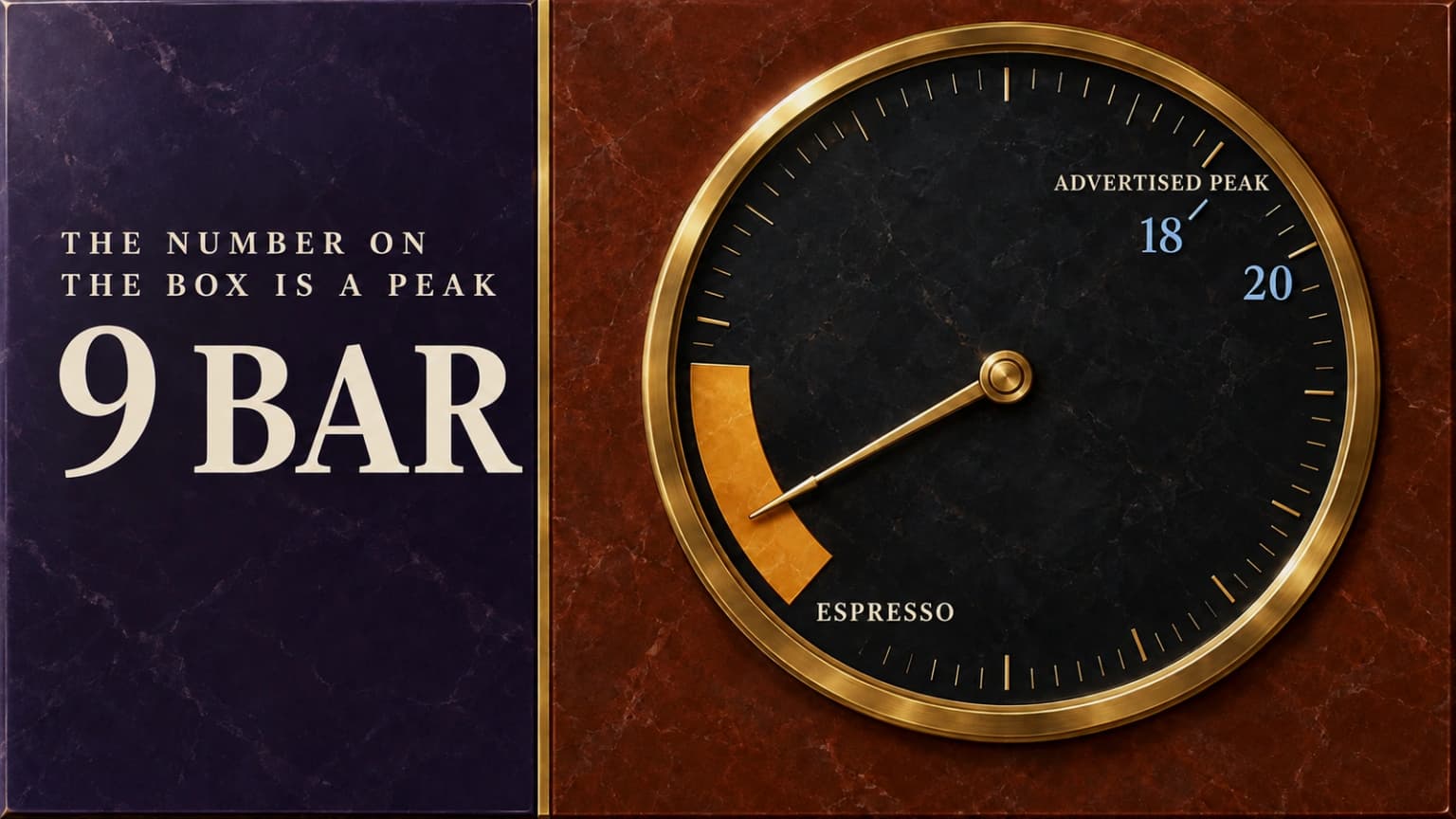
The pressure figure printed on a portable espresso maker is a peak, not a working pressure, and it is the most misleading number in this category.
Espresso is defined at around nine bars. That is the figure cafes pull at, and it is the figure the Flair 49 PRO marks on its gauge.
So when a pocket device advertises 18 or 20 bar, it is not promising better espresso than a cafe. It is quoting the maximum its pump can reach at the top of a stroke.
Nine bars is the target. The advertised peak tells you what the pump can touch, not what the coffee saw.
The gap between those two things is the whole problem with pneumatic pumps. Pressure spikes when you press and falls away between strokes, so the coffee bed experiences a sawtooth rather than a steady nine bars.
This is exactly the problem Cafflano designed around. Hydraulic compression holds a value instead of pulsing it, which is why the Cafflano Kompresso brews well despite modest advertised figures.
It is also what you are buying with the Flair 49 PRO gauge. A number you can see while you pull beats a number printed on a box.
What each maker actually claims
What each maker actually claims
Device
Published pressure
How it is generated
Wacaco Nanopresso
18 bar peak
Thumb-driven piston, per stroke
Wacaco Minipresso NS2
18 bar peak
Unlocked piston, per stroke
Cafflano Kompresso
Over 9 bar, sustained
Hydraulic compression
Flair 49 PRO
9 bar, shown on a gauge
Direct lever, you steer it
Staresso Classic
15 to 18, or 15 to 20
Hand pump, sources disagree
OutIn Nano
20 bar
Electric pump
CERA+ PCM03S
20 bar
Electric pump
Figures as each maker publishes them. We have no way to verify a pressure claim without hands-on measurement.
The practical reading is simple. Treat any advertised figure above nine bars as evidence that the device can reach espresso pressure, not as evidence that it is better.
Then judge the device on the things you can check: dose, basket type, and whether pressure is sustained or pulsed.
Where your hot water goes cold
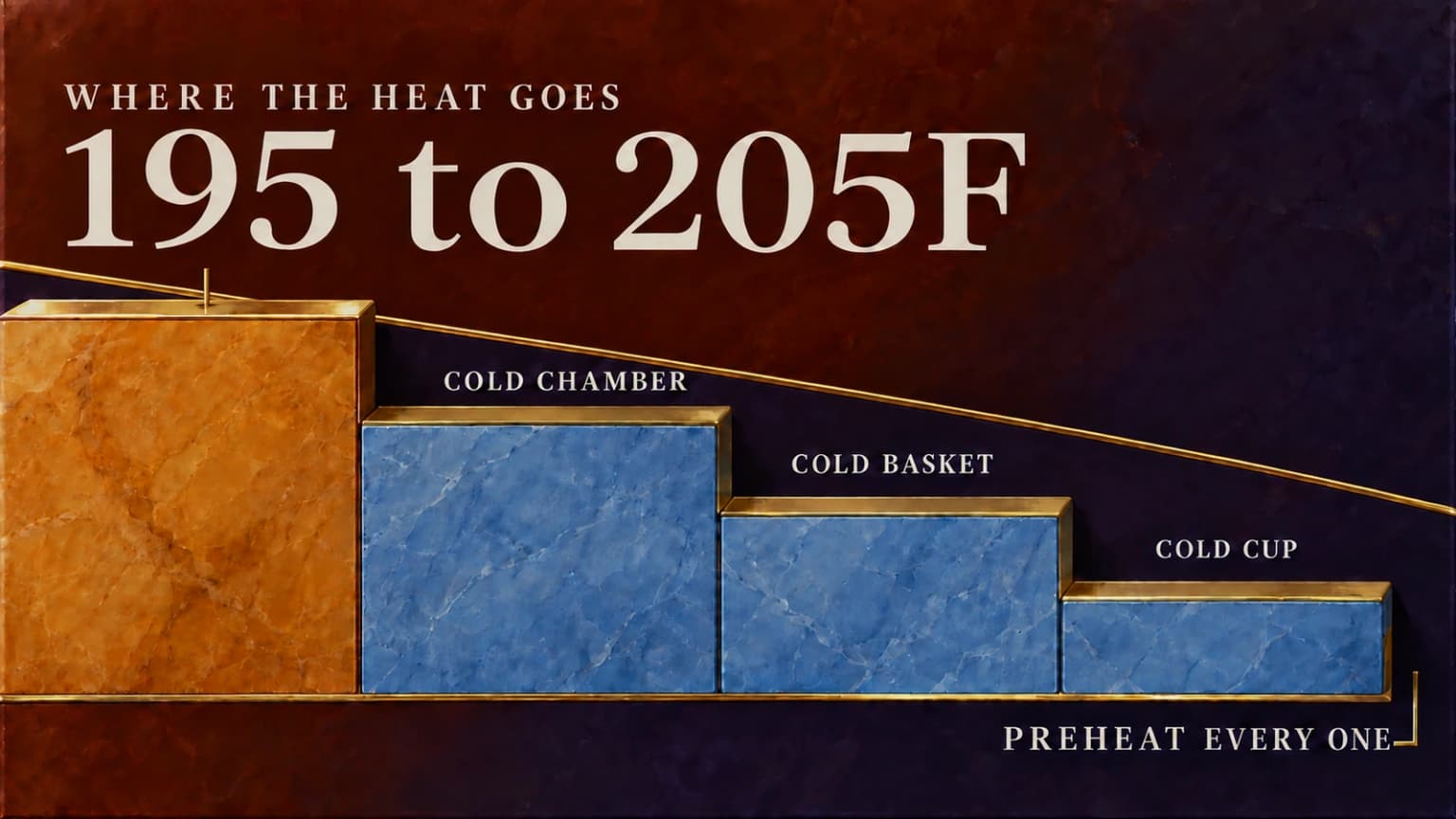
Five of the seven devices here have no heating element at all, which means the water arrives at the coffee cooler than it left your kettle.
Espresso wants water in the 195F to 205F band. Every unheated surface between the kettle and the puck takes a share of that, and nobody builds a warm-up cycle into these devices.
Each cold surface takes a share. Preheating the chamber and the cup is free and recovers most of it.
The losses stack in a predictable order. A room-temperature water chamber, a cold metal basket, a cold puck of coffee, and finally a cold cup waiting underneath.
That is why a shot from a portable maker so often tastes sour and thin when the grind looks right. Cool water pulls the acids out of the puck and leaves the sweetness behind, the same extraction curve our guide to bitter coffee reads from the other end.
The fix costs nothing and takes thirty seconds. Fill the chamber with hot water, let it sit, pour it away, then fill it again for the actual shot.
Preheat the cup the same way. Doing both is the single largest quality improvement available to anyone using one of these devices, and it is free.
Battery models remove this problem at the chamber but not at the cup. The OutIn Nano and CERA+ PCM03S both heat to roughly 198F internally, then push that water into a cup you have not warmed.
Basket size decides what you can brew
The dose a device holds is the specification that decides what drinks you can make, and it varies by more than two to one across this guide.
Most pocket devices brew from eight to ten grams. A cafe double uses about eighteen. That is not a small difference, it is the difference between a taster and a drink.
Eight grams makes a short, intense espresso shot, closer to a ristretto than a double, and it is genuinely good on its own or in a small cortado. Stretch it into a twelve ounce latte and it disappears.
The second half of the specification is basket type, and it matters just as much. A pressurized basket has a restricting plate that builds back pressure for you, so an imperfect grind still produces crema.
A bottomless or unpressurized basket has no such help. Grind slightly coarse and water races through; grind slightly fine and nothing moves at all.
Dose, basket and what the shot becomes
Dose, basket and what the shot becomes
Device
Published dose
Basket
What it makes
Wacaco Nanopresso
8 g
Pressurized
Single shot, small cortado
Staresso Classic
8 to 10 g
Pressurized
Single shot into its glass
Cafflano Kompresso
Up to 15 g
Unpressurized
Generous single, small flat white
Flair 49 PRO
12 to 20 g
Both supplied
A genuine cafe double
Wacaco Minipresso NS2
Capsule, fixed
Capsule
Whatever the capsule holds
OutIn Nano
Ground or capsule
Pressurized
Single shot, either input
Doses as each maker publishes them. The CERA+ PCM03S takes both inputs and does not publish a gram figure.
If you do not yet own a grinder that holds a fine espresso setting, buy a pressurized device such as the Wacaco Nanopresso. The basket will cover for the grinder while you learn.
If you already grind well, the unpressurized route gives you a better shot and a reason to bother. This is the same fork that separates the machines in our guide to espresso machines with built-in grinders, scaled down to something you can pack.
The case against portable espresso
The strongest argument against every device on this page is that most people buy one for a trip they take twice a year.
Used that way it is an expensive novelty. It sits in a drawer for eleven months, the seals dry out, and the one morning you reach for it you discover you have no grinder with you.
There is also a quality argument, and it is fair. A $65 hand pump does not beat a $550 countertop machine, and a $359 lever still asks more of you than a machine that holds temperature on its own.
The counter-argument is real too. For anyone who works away from a kitchen, or whose office coffee is genuinely undrinkable, these devices pay for themselves against bought coffee within weeks.
The question is not whether portable espresso is as good as a machine. It is whether the alternative at that moment is a worse cup or no cup at all.
The kit costs more than the maker
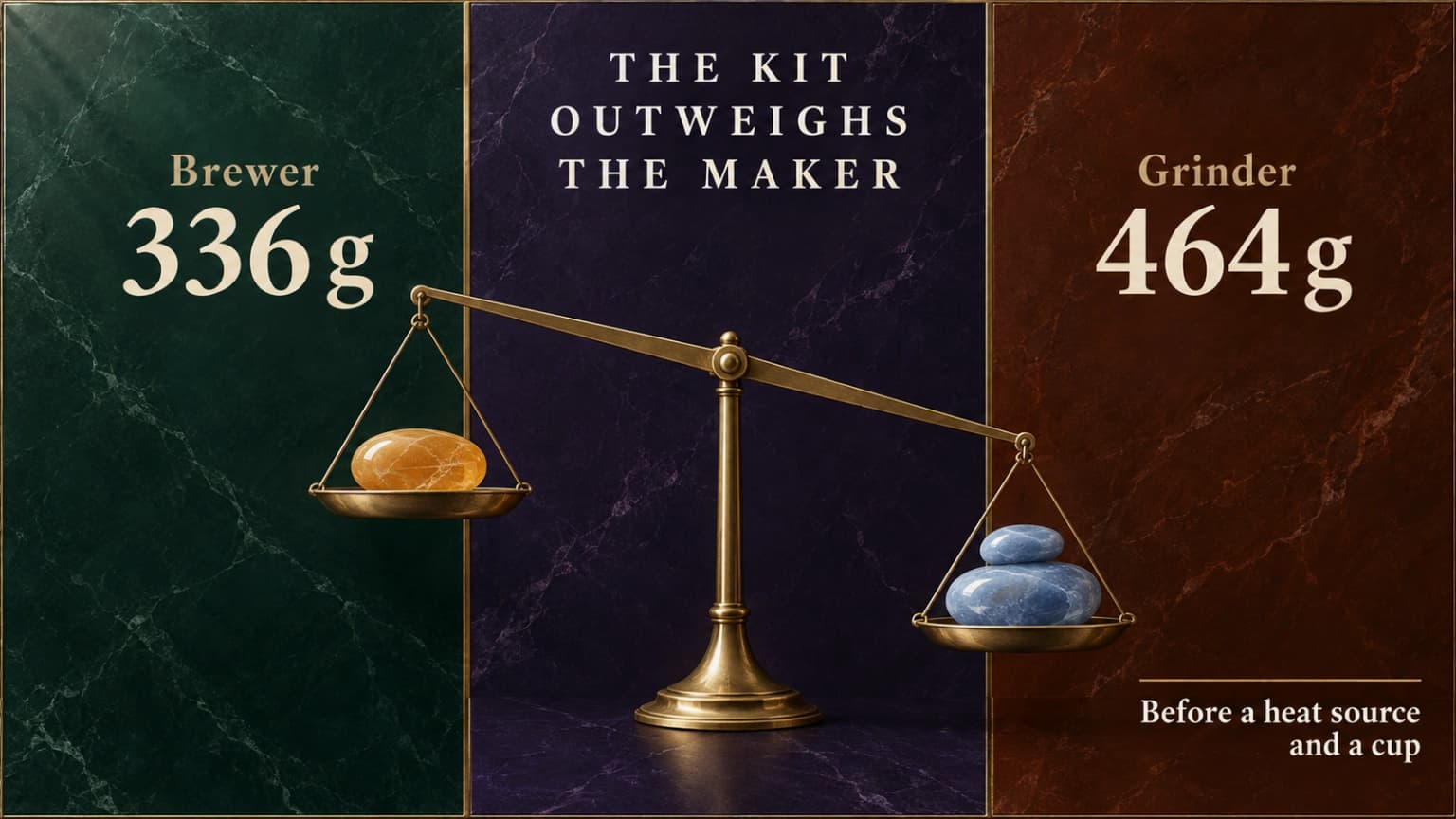
The brewer is rarely the expensive part. Everything one of these devices depends on has to be bought and carried as well, and that bill usually exceeds the device itself.
A hand pump needs a heat source and a grinder. A battery model removes the heat source and keeps the grinder.
The Wacaco Minipresso NS2 removes the grinder and keeps the heat source. Nothing on this page escapes both.
The brewer is the small end of the load. Plan the kit, not the device, before deciding what to buy.
Weight tells the same story as money. A Nanopresso is 336 grams and Wacaco's own Exagrind travel grinder is 464, so the grinder outweighs the brewer before any water-heating kit joins the pack.
What a working setup actually needs
What a working setup actually needs
What you need
Hand pump route
Capsule route
Battery route
The brewer
$59.99 to $69.99
$54.90
$149.99
Grinder
Required
Not needed
Required
Heat source
Required
Required
Not needed
A cup
Usually separate
Built in
Separate
Ongoing cost
Loose coffee
Capsules, per shot
Loose coffee
Charging
None
None
USB-C, per few brews
Brewer prices are the live Amazon figures for the picks above. Grinder and kettle costs depend on what you already own.
When to buy one
Buy when a specific recurring morning has no good coffee in it. A commute, a site office, a van, a camping season, a hotel you stay in monthly.
Buy before a long trip rather than during it, so the dialing in happens at home where a bad shot costs nothing.
And buy the cheapest device that fits the dependency you actually have. Paying $150 for a heater you will use beside a kettle is the most common mistake in this category.
Travel espresso is worth the money when it replaces a bad cup you would otherwise buy, and worth very little when it replaces a good cup you already make at home.
Flying with a portable espresso maker
All seven devices can fly, and the rules only get interesting for the two with batteries.
The hand-pumped and lever models carry no restriction worth the words. They are kitchenware, they go in either bag, and nothing about them triggers a second look.
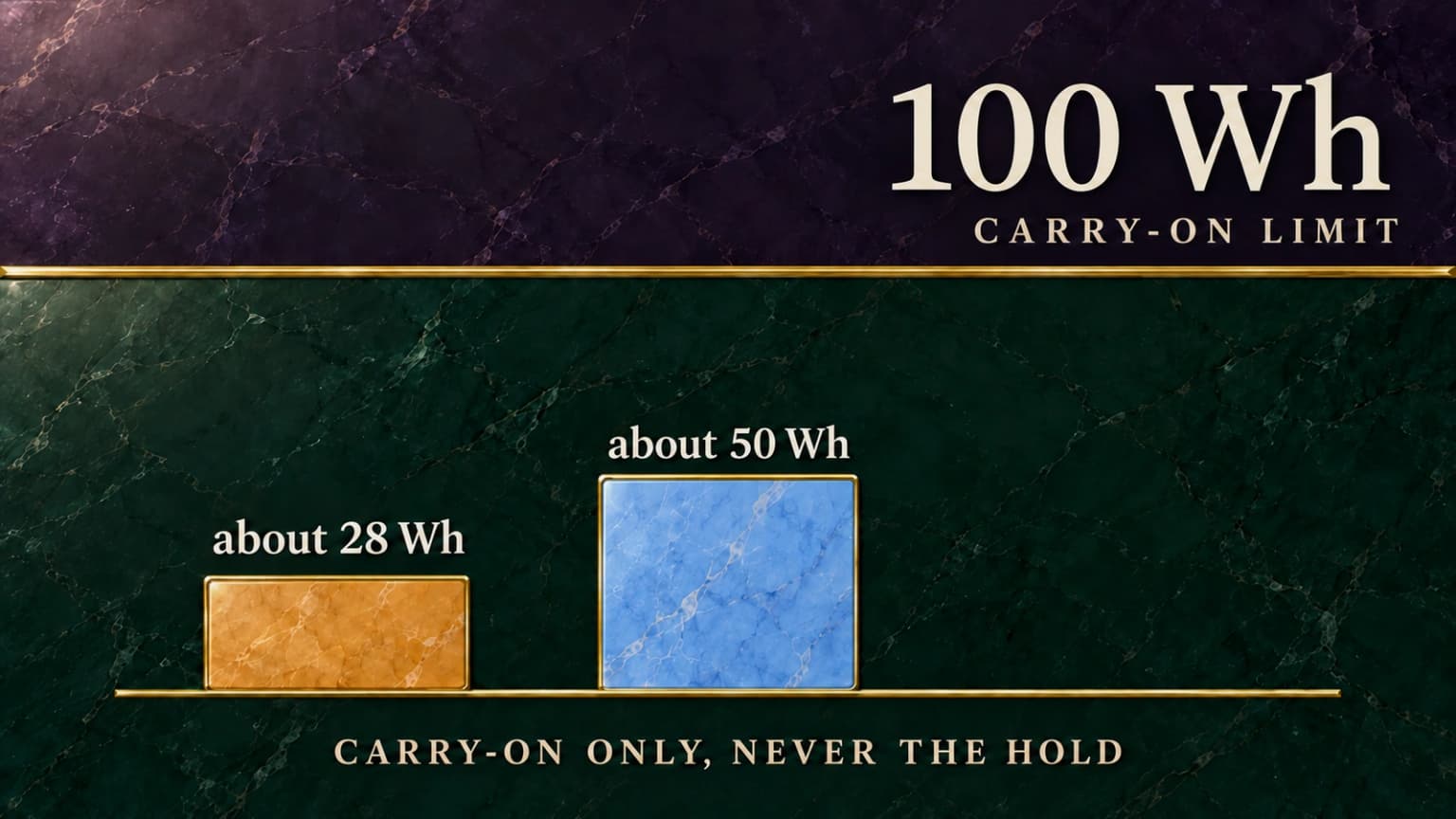
The battery models are lithium devices, and lithium rules are about watt hours rather than brand or size. The FAA permits batteries up to 100 watt hours freely, 101 to 160 watt hours with airline approval, and nothing above that.
Both battery picks sit far below the free-to-carry line. The rule that bites is which bag they travel in.
Run the arithmetic and neither pick comes close to the limit. The OutIn Nano pack works out near 28 watt hours, and the CERA+ PCM03S at 13,500 mAh lands around 50.
The rule that actually affects you is the bag, not the capacity. Devices with lithium batteries belong in carry-on baggage, and spare batteries are carry-on only with no exceptions.
Pack the coffee in the cabin as well. Ground coffee is permitted in both bags, and a sealed bag beside you is one less thing to lose with your luggage.
One practical note for the hand pumps. Empty the water chamber before you fly, because cabin pressure falls as you climb and a sealed chamber will push water past its seal.
How to pull a shot by hand
Pulling a good shot from a hand pump is a short routine, and almost every bad one comes from skipping the first step.
A hand-pumped shot, step by step
1
Preheat the chamber and the cup
Fill the water chamber with hot water, leave it for thirty seconds, then pour it out. Do the same with whatever you are drinking from.
Tip This is the single biggest improvement available. A cold chamber is the usual reason a portable shot tastes sour.
2
Grind finer than you think
Aim for table salt moving toward powdered sugar. A pressurized basket forgives a little coarseness; a bottomless basket does not.
3
Fill the basket level and tamp firmly
Use the scoop that came with the device, level it off, then tamp hard and evenly. An uneven bed sends water down one side and wastes the shot.
Watch out Do not overfill. A basket packed above its line can jam the piston and stress the seal.
4
Fill with water that is genuinely hot
Just off the boil is right. These devices have no boiler, so whatever you pour in is the hottest the coffee will ever see.
5
Pump slowly and steadily
Short fast strokes spike the pressure and drop it again. Long steady strokes hold a flatter curve, which is what the coffee wants.
Tip Watch the first drops. Dark and slow is right; a thin pale stream means the grind is too coarse.
6
Stop while it still looks dark
When the stream turns pale and watery, the good part is over. Stop there rather than chasing volume, or the last of it will taste harsh.
Battery models compress this routine into one button, with one exception that still applies. Preheat the cup, because the machine warms its own water and nothing else.
If shots run thin after all that, the grinder is the next suspect rather than the brewer. Fines and inconsistency show up faster in an eight gram basket than in an eighteen gram one.
Cleaning a seal you cannot see
These devices live or die on their rubber seals, and the seal is the one part a rinse under the tap never reaches properly.
The daily job is thirty seconds. Knock out the puck, rinse every part that touched coffee, and leave the device apart rather than screwed shut.
Keeping a portable maker alive
1
After every shot: strip and rinse
Separate the chamber, basket and cup, rinse each under hot water, and wipe the piston dry. Coffee oil sets hard once it cools.
Tip Rinse while the device is still warm. Everything comes away with water alone at that point.
2
Store it apart, not assembled
Leave the pieces loose or lightly together rather than screwed tight. A compressed seal sitting for weeks takes a set and stops sealing.
3
Monthly: clean the seal itself
Lift the seal out where the design allows, wash it in warm soapy water and dry it fully. This is where pressure loss starts on every one of these devices.
Watch out Never use abrasives or a dishwasher on a seal. A scratched seal cannot be repaired, only replaced.
4
Watch the signs of a tired seal
Pumping that suddenly feels easy, water escaping past the basket, or a shot that will not build pressure all point at the same part.
Tip Wacaco, Staresso and Flair all sell replacement seals. A worn seal is a two dollar problem, not a new device.
5
Battery models: charge before storing
Leave a lithium pack part charged rather than flat if it will sit unused. A battery stored empty for months can refuse to wake up.
The pattern across poor reviews of these devices is consistent. A large share of the complaints describe pressure loss, and pressure loss on a sealed hand pump is almost always a seal that was stored compressed and dirty.
Budget the thirty seconds and these devices last for years.
Which portable espresso maker to buy in 2026?
Seven devices is a shortlist, not an answer, so here is the answer.
We scored the field on shot quality, the dependency each device creates, weight, the depth of owner evidence, and what it costs to run. Then we asked the question that decides it: can you promise hot water?
The three we recommend first
Our pick
Wacaco Nanopresso
$64.90
You are
Near hot water, most days
Best at
Reliability per dollar
Dose
8 g, pressurized
Weak spot
Half a cafe double
OutIn Nano
$149.99
You are
Away from any kettle
Best at
Removing the heat problem
Dose
Ground or capsule
Weak spot
Five brews from cold
Flair 49 PRO
$359.00
You are
Unwilling to compromise
Best at
A real cafe-sized shot
Dose
12 to 20 g
Weak spot
Weight and bulk
The three we recommend first
Specification
Our pick
Wacaco Nanopresso
$64.90
OutIn Nano
$149.99
Flair 49 PRO
$359.00
You are
Near hot water, most days
Away from any kettle
Unwilling to compromise
Best at
Reliability per dollar
Removing the heat problem
A real cafe-sized shot
Dose
8 g, pressurized
Ground or capsule
12 to 20 g
Weak spot
Half a cafe double
Five brews from cold
Weight and bulk
Buy for your hardest morning rather than your easiest one, and the device will still be earning its place a year from now. Browse the rest of our espresso machines coverage if a countertop machine turns out to be the better fit.
Frequently asked questions
Do portable espresso makers make real espresso?
The good ones do. Espresso is defined by pressure, and several of these devices hold the nine bars that define the drink, which is why they produce genuine crema rather than strong filter coffee.
The honest limit is dose. Most pocket devices brew from seven to ten grams, where a cafe double uses eighteen, so you get a small, intense shot rather than a full double.
The Flair 49 PRO is the exception on this list. It takes a cafe-sized dose and a proper unpressurized basket, and it is the only pick that will not feel like a compromise to someone used to a countertop machine.
Do you need hot water for a portable espresso maker?
For every hand-pumped and lever device here, yes. They have no heating element at all, so you supply water that is already at brewing temperature from a kettle, a stove, a hotel tap, or a thermal flask.
Only the battery models heat their own water. The OutIn Nano and the CERA+ PCM03S both take cold water and bring it up to roughly 198F on their own, which is what you are paying the extra money for.
That difference drives everything else about living with one. A hand pump needs no charging and never runs flat, but it is useless without a heat source somewhere nearby.
Can you take a portable espresso maker on a plane?
Yes, and the hand-pumped ones have no battery rules to worry about at all. They are ordinary kitchenware as far as screening is concerned.
The battery models are lithium devices, so they belong in your carry-on rather than your checked bag. The FAA allows batteries up to 100 watt hours freely, and both electric picks here sit well under that line.
Pack the ground coffee in your carry-on too. Coffee is permitted in both bags, and keeping it with you means a delayed suitcase does not cost you your coffee as well.
What grind size does a portable espresso maker need?
Fine, and finer than most people expect. These devices need an espresso grind, the texture of table salt moving toward powdered sugar, not the medium grind a drip machine uses.
Pressurized baskets, which is what the Wacaco and Staresso devices use, are more forgiving than a bare basket. They build back pressure themselves, so a grind that is slightly too coarse still produces crema.
Unpressurized baskets punish a bad grind immediately. If you are buying the Flair 49 PRO or using the bottomless basket it ships with, budget for a grinder that holds a consistent espresso setting.
Are hand pump or battery portable espresso makers better?
It depends entirely on whether you can reach hot water. A hand pump is lighter, cheaper, has nothing to charge and nothing to fail, and the best of them pull a better shot than the electric models.
A battery model is the right answer in a car, an office with no kettle, or a tent at dawn. It removes the one dependency that makes a hand pump useless.
There is a cost nobody mentions. Heating water is what drains the battery, so the OutIn Nano manages about five brews from cold water against more than two hundred if you feed it water that is already hot.
How much coffee does a portable espresso maker hold?
Most of them hold a single shot. Wacaco publishes an eight gram basket on the Nanopresso and an 80 ml water tank, and the Staresso Classic and Cafflano Kompresso sit in the same range.
That is roughly half a cafe double. It makes a short, concentrated shot that works neat or stretched into a small milk drink, not a mug of coffee.
The Flair 49 PRO is the outlier, with a published dose range of twelve to twenty grams and up to 90 ml of water. It is the only device here that brews at cafe scale, and it is also by far the largest.