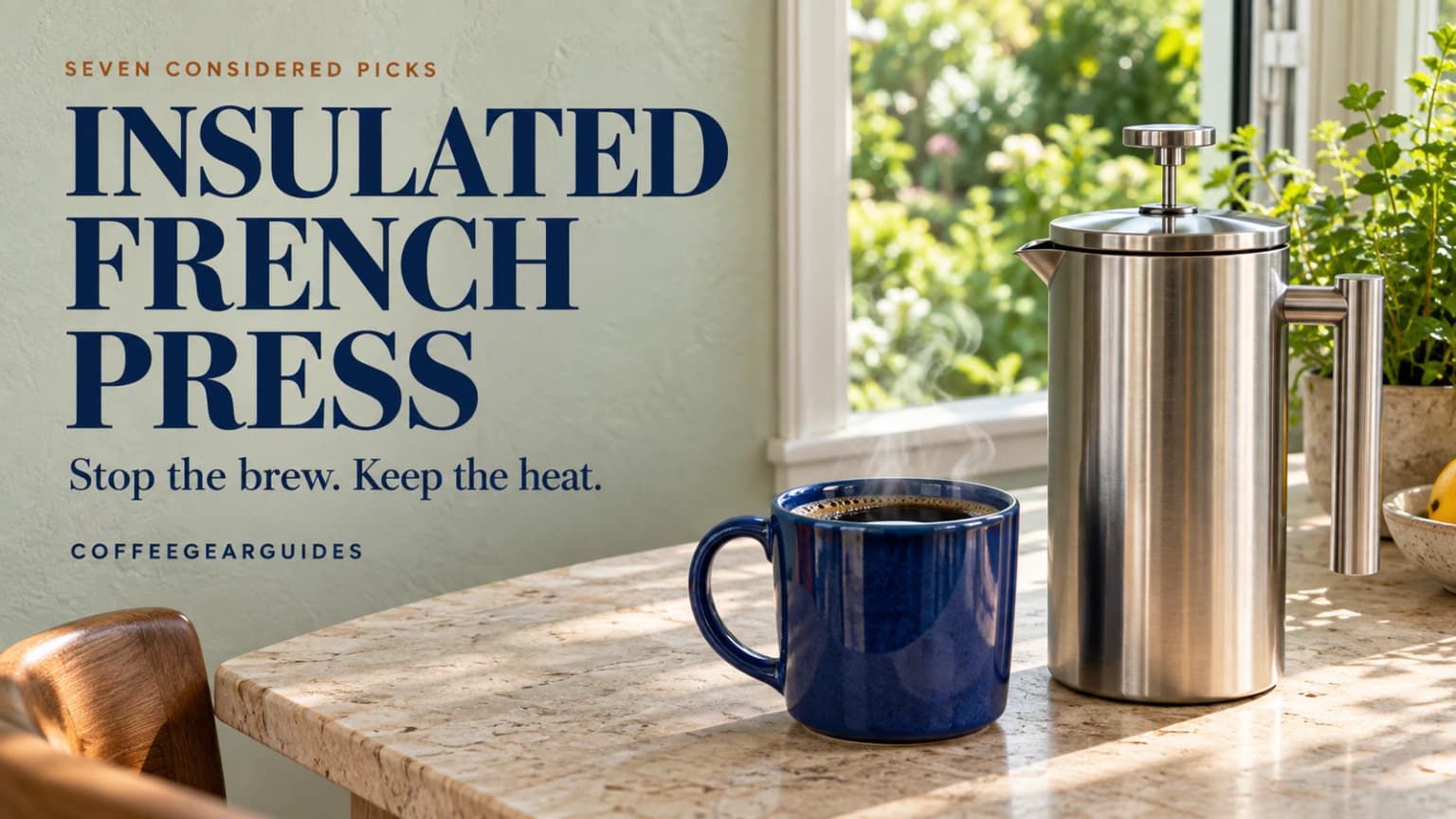
The Frieling Double-Walled Stainless Steel French Press is sold on a promise that very little kitchen equipment dares to make, which is that you will never need to buy another one. It asks around $139.95 for 36 ounces of coffee.
That is roughly five times what a competent glass press costs, so the difference has to come from somewhere real. Frieling's answer is a patented two-stage screen, a vacuum-insulated 18/10 steel body, and a spare part for everything that moves.
We have never brewed in one, and this 2026 Frieling French press review says so plainly. It is built from Frieling's own specifications, the listing we link, published testing, owner reports, and the full Amazon rating base.
What we found is a press that earns most of its price. It also hides its real cost in a place nobody in its search results has looked.
How we researched the Frieling for 2026
We build these verdicts from documents and evidence rather than from a week on our own counter, and it is worth saying exactly which documents. The starting point is the listing for the precise ASIN we link, B004XGBMB8, not a sibling size.
From there we read Frieling's own specifications and its direct parts catalogue, then testing from Consumer Reports and write-ups from independent coffee publications. Community threads fill in the long-term picture a first-week review cannot reach.
The rating and the review count are read straight off the live Amazon listing on the day of writing. We publish the figure we see, to one decimal, framed to the moment we saw it.
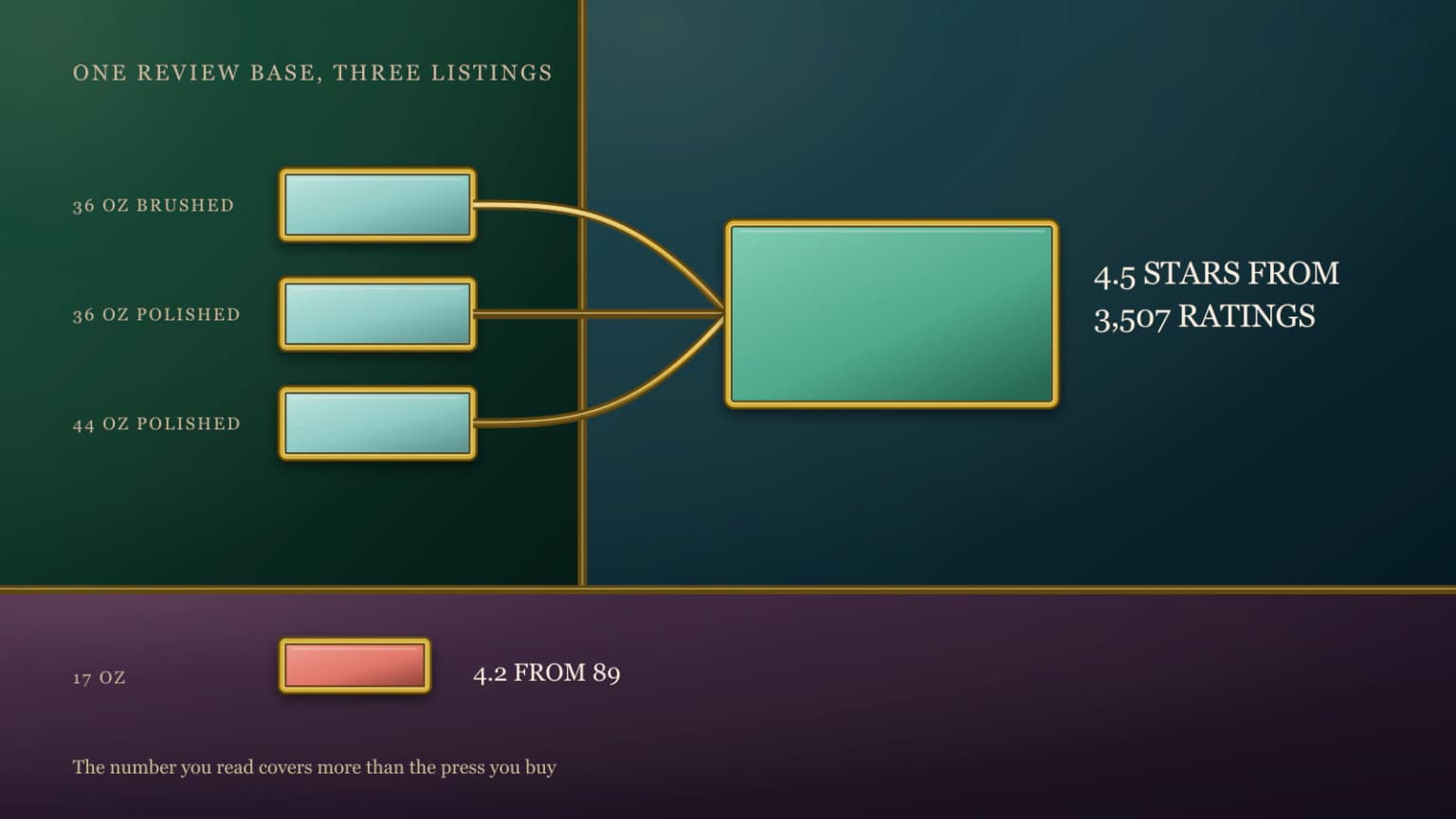
One thing about that figure needs saying out loud, because no other review of this press says it. The 36 oz brushed, the 36 oz polished and the 44 oz all report the same 4.5 stars from the same 3,507 ratings, so it covers two sizes and two finishes.
That is Amazon pooling variants, and it is not universal even within the range. The 17 oz listing sold in frustration-free packaging keeps a separate base of 89 ratings at 4.2, so the pooling is a choice made listing by listing.
Three listings report the same 4.5 stars from the same ratings. The 17 oz listing keeps its own much smaller base.
Read the 3,507 as evidence about the design rather than about one box. It is still the largest body of owner feedback available on this press, and it is what every competing review quotes without checking what it covers.
One thing we deliberately do not do is claim a three-star review synthesis. Individual Amazon review bodies now sit behind a sign-in wall, so any page claiming to have read and weighted them is describing work it cannot show.
Where a number has only one source, we name that source in the sentence. Where a number has none we can verify, it does not appear at all.
Who should own a Frieling French press
Buy this press if you plan to own one press for the rest of your life and you want the cleanest cup a mesh can give you. That is a narrow buyer, and the Frieling French press serves them better than anything else in its category.
It suits a household that brews a full pot most mornings and drinks it within half an hour. It suits anyone who has broken a glass beaker and refuses to buy a fifth.
It also suits people who will not have plastic in the brew path. Frieling specifies 18/10 stainless steel inside and out, and the coffee touches none of the silicone that seals rival presses.
Two buyers should not buy it. If you press the plunger and pour the whole pot within ten minutes, you are paying for insulation you do not use, and the insulated press guide has a $27.99 pick that brews nearly as well.
The second is anyone who wants the pot to sit for an hour while they work. The Frieling cannot stop a brew, and an hour under the screen turns a good pot heavy and harsh.
What the Frieling price actually buys
Around $139.95 buys a vacuum-insulated 18/10 steel carafe, a patented two-stage plunger, and a design that won the 2017 Housewares Design Award in the tableware and beverageware category. It does not buy accessories.
There is no scoop in the box, no spare screen, and no carry case. Frieling sells a coffee scoop and stirrer separately for around $11.99, which tells you how the range is priced.
What you do get is unusual mass. The press weighs about 2.8 pounds empty, and it stands roughly 8 inches tall without the lid, which is why it feels closer to a serving vessel than a brewer.
The finish is a real choice rather than a cosmetic one. Brushed and polished cost the same, and the mirror finish shows fingerprints in a way the brushed body does not.
The vacuum wall is the other thing the money buys, and it works. Home Grounds measured a fill of water at 200F still sitting above 120F after nearly four hours, which is thermal performance a glass beaker cannot approach.
What it does not do is seal. The lid closes but does not lock, so this is a press that holds heat while it serves rather than a thermal flask you carry.
Frieling 36 oz specifications
Frieling 36 oz specifications
Specification
What Frieling and the listing state
Capacity
36 fl oz, about 1 liter
Material
18/10 stainless steel, inside and out
Construction
Double wall, vacuum insulated
Filter
Patented two-stage screen with a pre-filter
Screen diameter
About 4 inches, part number 9104
Height
About 8 inches without the lid
Weight
About 2.8 pounds empty
Model
0144 brushed, 0104 polished
Sizes in the range
8, 17, 23, 36 and 44 fl oz
Country of manufacture
China, per Frieling retail listings
Warranty
Five years per Frieling, one year per the listing
Frieling's published figures and the listing's own detail table at the time of writing. The two disagree on the warranty, which we cover below.
The one line on that table nobody else prints is the last one. We will come back to it, because it changes what the press is worth.
Inside the two-stage dual screen
The filter is the entire reason this press costs what it does, and it is genuinely two filters rather than a marketing phrase. Coffee passes a coarse pre-filter first, then an Italian super-fine mesh, with a metal wire coil holding the assembly together.
A pre-filter stops the bulk of the grounds before they ever reach the fine screen. That leaves the fine mesh doing the job it is good at, which is catching the fines that a single mesh passes straight through.
Frieling's description of the assembly also puts a stainless steel ring inside the coil, to stop coffee slipping around the edge of the screen rather than through it. On an ordinary press, the gap at the wall is where most of the silt escapes.
Consumer Reports placed the Frieling at the top of its French press test and attributed that result to the mesh, which it found had the smallest openings of any model it reviewed. That is a rare thing to be able to cite on a press.
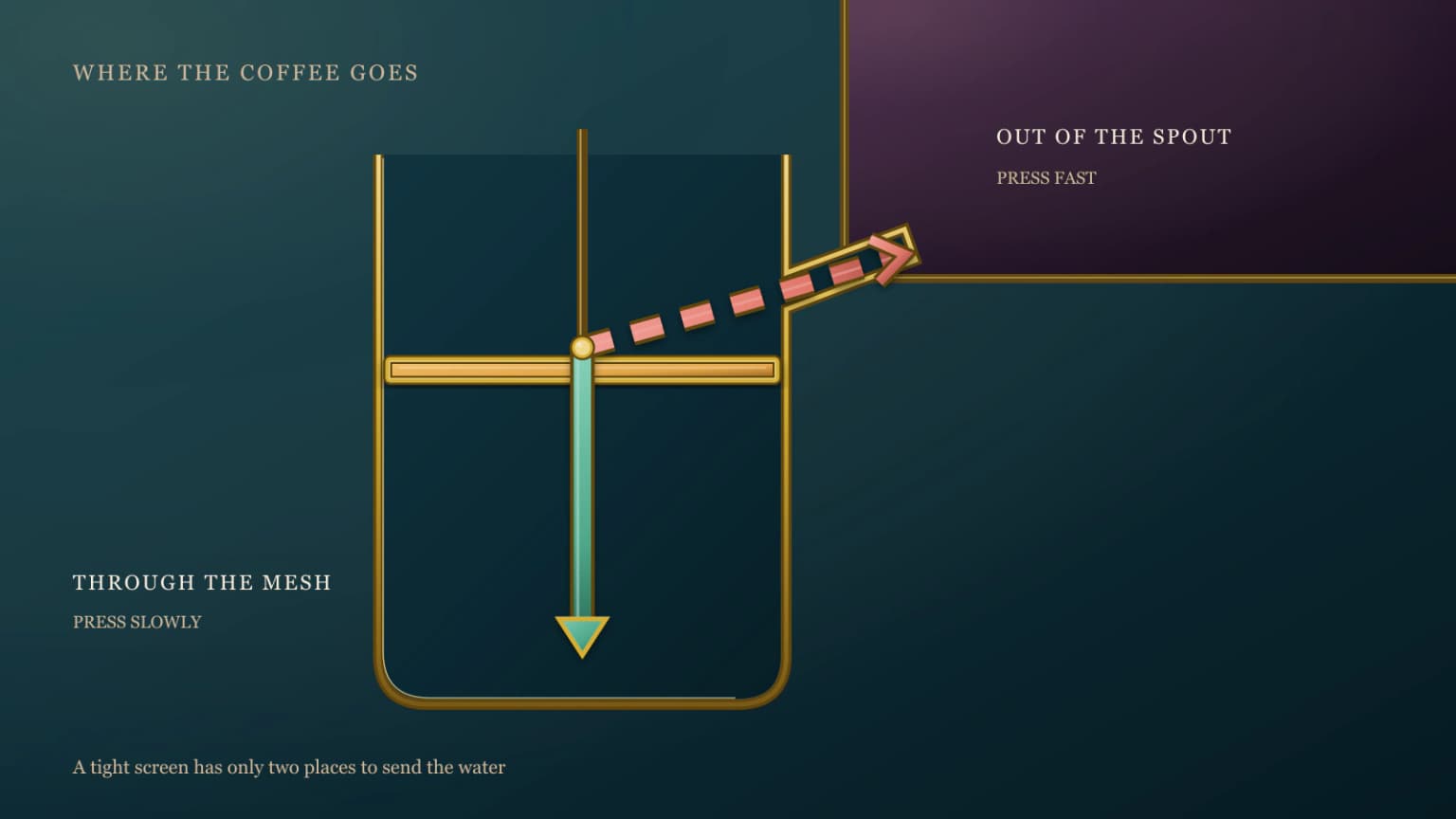
Push slowly and the coffee goes through the mesh. Push fast and the same tight fit sends it out of the spout instead.
We have not found an independent micron figure for either stage, and we are not going to invent one. Frieling does not publish an aperture size, and neither does the testing that praises it.
What can be said with confidence is comparative. The Frieling filters better than a single-mesh press, and it does not filter as absolutely as a basket that seals against the wall, because straining and sealing are different mechanisms.
How clean the Frieling cup really is
Cleaner than a Bodum, and not as clean as the listing claims. The Amazon detail table describes a "Zero Sediment Filter", and every careful reviewer who has tested a Frieling French press reports a small amount of sediment at the bottom of the cup.
That gap is worth naming rather than smoothing over. Zero is a marketing number, and the honest version is that the last cup poured from a Frieling has a fraction of the silt a single-mesh press leaves.
Owners moving from a glass press describe the difference immediately, which is the most consistent theme in the review base. The coffee reads cleaner without losing the weight that makes press coffee worth brewing.
The body stays. A press brews by immersion, so the grounds sit in the water for the whole four minutes, and a metal screen passes the coffee oils a paper filter would trap.
What changes is the finish. Less silt means the last third of the pot does not turn gritty, which is exactly where a cheap press falls apart.
If you want the cup cleaner still, the mechanism is a paper filter rather than a better mesh. Our guide to coffee filter types covers what each material actually stops.
Dose, grind, and a slow plunge
Frieling's own instruction is two tablespoons of ground coffee per cup, water just below boiling, a stir, then four minutes of steeping under the lid before you press. It is sound advice with one ambiguity worth resolving.
Two level tablespoons of coarse coffee weigh roughly 10 to 12 grams, which at a press ratio near 1:16 brews about 160 to 190 millilitres. Frieling's "cup" is therefore a six-ounce cup, not the four-ounce cup Bodum counts by.
Working in grams removes the guesswork entirely. The figures below use 1:16, which suits most medium roasts in a press.
Frieling 36 oz dose chart at 1:16
Frieling 36 oz dose chart at 1:16
What you are brewing
Water
Coarse coffee
One large mug
12 oz / 355 ml
About 22 g
Two mugs
24 oz / 710 ml
About 44 g
Comfortable full pot
32 oz / 946 ml
About 59 g
Filled to the brim
36 oz / 1,064 ml
About 66 g
Our own working figures at 1:16. Move to 1:15 for a heavier cup or 1:17 for a lighter one, then adjust by taste.
The brim row is there as a warning rather than a recommendation. A press filled to the top has nowhere to put the volume the plunger displaces, and on this press that volume leaves through the spout.
Brewing in the Frieling without a mess
1
Preheat the body with kettle water
Fill the press while the kettle finishes, swirl it, and tip it out. Nearly three pounds of cold steel takes real heat out of a brew.
Tip Preheating matters more here than on a glass press, because there is more metal to warm.
2
Weigh the coffee and grind coarse
Use the chart above and grind to coarse sea salt. A consistent coarse grind is what keeps the fine screen from clogging.
3
Stop filling about an inch below the rim
Pour to roughly 32 ounces rather than 36. The gap is where the plunger assembly goes when you press it down.
Watch out Filling to the brim is the single most common cause of coffee escaping past the spout.
4
Stir at one minute, then lid and wait
Break the crust with a stir, seat the lid with the spout closed, and leave it for four minutes total.
5
Press over fifteen to twenty seconds
Push the plunger down slowly and evenly. The screen fits tightly, so a fast press has to send the displaced liquid somewhere.
Tip If you feel real resistance, stop, lift slightly, and continue. Do not force it.
6
Decant what you will not drink now
Pour the rest into a carafe or a travel mug. The grounds stay in the pot and the coffee above them keeps extracting.
Watch out The insulation keeps the pot hot, which makes that continued extraction faster, not slower.
That last step is the habit that separates people who love this press from people who find it bitter for reasons they cannot place. The press holds heat superbly and has no way to end a brew, so the decanting has to be yours.
Why a fast plunge floods the spout
The complaint that recurs most in the Frieling review base is coffee escaping past the spout during the press, and it has one cause. The screen fits the body closely enough that liquid cannot flow back past it quickly.
Push the plunger at the speed you would use on a loose glass press and the water has two routes: through a fine mesh, or out of the opening at the top. It takes the opening.
This is the same property twice. The tight seat that gives the Frieling its clean cup is what makes a fast plunge overflow, so it is not possible to remove one without losing the other.
It is a technique problem rather than a defect, and it disappears entirely at a fifteen to twenty second press. That is good practice on any press and close to mandatory here.
A second contributor is the fill line. The plunger assembly displaces its own volume, so a pot filled to the rim has already committed to sending liquid somewhere before you touch it.
The three Frieling problems owners hit
Three Frieling problems recur once you read past the first week of ownership, and none is a failure of the brewing. They are the lid, the price, and the dishwasher.
The lid draws the most comment. Owners describe a gap between the knob and the lid top that lets the lid slide forward as you pour, which makes a full pot feel unbalanced in one hand.
The dishwasher complaint follows from the same part. Several owners report water trapped inside the lid after repeated cycles, which points to an assembly that is dishwasher safe without being watertight.
The third theme is value rather than function. Home Grounds runs its review under the question of whether the press is overpriced and concludes that it performs comparably to cheaper alternatives, which is a fair reading if you do not weigh longevity.
We should be clear about the limit of this section. Individual Amazon review bodies are no longer readable without a sign-in, so this synthesis comes from published reviews and community threads rather than from the star-filtered reviews themselves.
What the rating base does tell us is the shape of the sentiment. A 4.5-star average over 3,507 ratings, on a press that costs about five times a glass beaker, is not the profile of a product people regret.
Frieling vs ESPRO and Secura
The Frieling sits between two presses that each beat it at one thing. The ESPRO P7 filters more absolutely, and the Secura 34 oz brews respectably for a fifth of the money.
The ESPRO is the real cross-shop at this price. ESPRO states the inner mesh of its nested baskets is 12 times finer than a standard press filter, and because the basket seals to the wall it both strains and stops the brew.
The Secura is the value argument nobody at this end of the market wants to make. At around $27.99 it holds a comparable amount of heat, and it carries the deepest review base of any press we cover.
Where the Frieling wins and loses
Where the Frieling wins and loses
Press
What the filter does
Ends the brew?
Buy it for
Frieling 36 oz
Two-stage screen with a pre-filter
No, it strains
The cleanest strained cup, and spares for everything
ESPRO P7 32 oz
Nested baskets that seal to the wall
Yes
A pot that has to sit before you drink it
Secura 34 oz
Three-layer screen stack
No
Nearly the same coffee for a fraction of the price
YETI Rambler 34 oz
One solid GroundsControl disc
Yes, YETI states so
A press that travels and takes abuse
Straining and sealing are different mechanisms. The Frieling is the best strainer here, and it is not a sealer.
Choosing between them is really a question about your morning. If the pot is empty inside half an hour, the Frieling's filtration is the thing you will notice and the ESPRO's seal is the thing you will not.
If the pot sits, that reverses completely. The full field, with live prices and the seven presses we rank, is in the insulated French press guide.
The spare parts nobody mentions
Frieling sells a replacement for every part of this press that wears, by part number, and that is the strongest argument for paying its price. Not one of the competing reviews we read mentions it.
The replacement screen is part 9104, and it fits both 36 oz models, the polished 0104 and the brushed 0144. It costs about $7.08 direct from Frieling and from roughly $4.70 through specialist retailers at the time of writing.
Beyond the screen, the catalogue covers the whole plunger. Complete plunger assemblies run roughly $27.20 to $34.99, lids about $19.99 to $28.99, spiral plates about $8.70 to $14.10, cross plates about $7.40 to $10.60, and the plunger nut around $3.99.
How to clean a Frieling French press follows from that parts list. Frieling lists the press as dishwasher safe, so the body can go in the machine without argument, and the screen is the part worth protecting.
Unscrew the plunger stack, rinse the two stages under hot water, and wash them by hand with a little dish soap. Owners who put the whole assembly through repeated cycles are the ones who report water trapped inside the lid.
Compare the parts route with the rest of the category. When we researched grinders we found only one brand with a genuine parts route in the United States, and presses are worse served again, because most makers sell a screen at best.
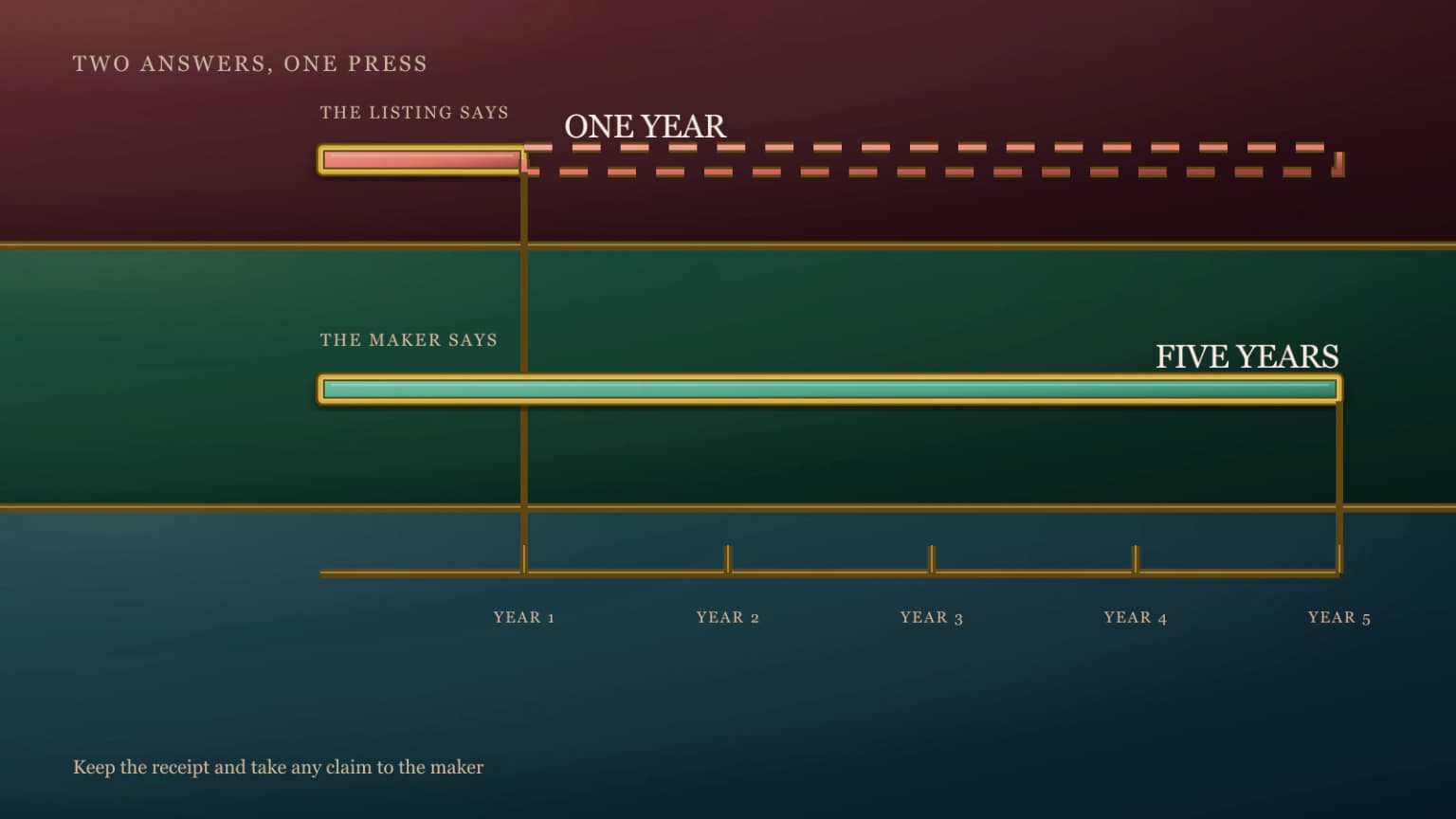
Then there is the Frieling warranty, which is a problem of the brand's own making. Frieling and its dealers state a five-year warranty, and the Amazon listing's own detail table reads one year.
The listing you buy from and the maker you would claim against do not state the same term. Keep the receipt.
We could not reconcile the two, so we quote both. Every other review of this press states five years without checking what the listing says, which is how a discrepancy survives for years.
One more detail decides where a claim actually goes. The buy box on this listing belongs to a marketplace seller, Zentra, LLC, rather than to Frieling or to Amazon, so the return route and the warranty route are two different routes.
None of that makes the press a bad buy. It makes it a press you register, keep the receipt for, and repair rather than replace.
Is the Frieling French press worth it in 2026?
The Frieling is worth its price only if you treat it as a twenty-year purchase, and it is excellent value on that basis. Judged as a press for this year, it is a $139.95 way to brew coffee that a $27.99 press brews nearly as well.
The filtration is real, and Consumer Reports' finding backs it rather than a manufacturer's claim. The build is real too, and the parts catalogue means normal wear is a five-dollar order rather than a new press.
What you are not buying is a brew that ends. Insulation without a sealing basket means the coffee keeps extracting under the screen, so the decanting habit is part of owning this press rather than an optional refinement.
Buy it with the plunge speed and the fill line understood. The complaints that fill its review base then never happen to you at all.
Frequently asked questions
Is the Frieling French press worth it?
It is worth it if you intend to keep one press for decades and you care about a clean cup. The two-stage screen filters better than any conventional mesh we have looked at, and every part that wears is sold separately.
It is poor value if you press and pour within ten minutes. A glass beaker or the Secura at around $27.99 gives you most of the same coffee for a fraction of the money.
The deciding question is not how good the coffee is. It is whether you will still own this press in fifteen years, because that is the only way the price resolves.
Does the Frieling French press keep coffee hot?
Yes. It is a double-wall vacuum body, and Home Grounds measured a fill of 200F water still sitting above 120F after nearly four hours.
Holding heat is not the same as ending the brew. The grounds stay in the pot under the screen and keep extracting, so hot coffee left for an hour tastes heavier and more bitter than the cup you poured first.
Treat the insulation as a way to serve a full pot across twenty minutes, not as a thermos. Decant anything you are not drinking soon.
Can you put a Frieling French press in the dishwasher?
Frieling lists the press as dishwasher safe, and the body handles it without complaint. The plunger assembly is the part to think twice about.
Owners report water trapped inside the lid after repeated cycles, and dishwasher heat and pressure are harder on a fine mesh than a sink of warm water. The screen is the component you actually pay for.
Our advice is the body in the machine, the plunger by hand. It costs a minute and it protects the one part that decides how clean the cup is.
What is the Frieling French press warranty?
There are two answers, which is the problem. Frieling and its dealers state a five-year warranty, and the Amazon listing's own detail table states one year.
We have not found a version of the terms that reconciles the two, so we quote both rather than picking the flattering one. Keep your receipt and take any claim to Frieling directly.
This matters more than usual here because the buy box is a marketplace seller rather than Frieling or Amazon, so the return route and the warranty route are not the same route.
Is the Frieling better than the ESPRO P7?
They solve different halves of the same problem. The Frieling strains better than any ordinary mesh, and the ESPRO P7 seals to the wall so the brew actually stops when you press.
If you drink the pot straight down, the Frieling gives you a cleaner cup for about $5 less and a body that is easier to take apart. If the pot sits while you work, the ESPRO is the one built for that.
Neither is a mistake. Buy the Frieling for filtration and repairability, the ESPRO for a brew that ends on schedule.
Can you buy replacement filters for a Frieling French press?
Yes, and that is one of the strongest arguments for the press. Frieling sells screens by part number, and part 9104 fits both 36 oz models, the polished 0104 and the brushed 0144.
Screens run from roughly $4.70 through specialist retailers to about $7.08 direct from Frieling at the time of writing. Plunger assemblies, lids, spiral plates, cross plates and even the plunger nut are all sold separately.
Very few press makers publish a parts list at all. It is what turns a $139.95 purchase into a repair rather than a replacement when something eventually wears.