Pour Real Latte Art in 2026: 7 Espresso Machines Ranked
Automatic frothers make foam you cannot pour. We read 38,000+ owner reviews to rank 7 espresso machines for latte art in 2026, $299 to $800.
By the CoffeeGearGuides team · USA · Updated Sep 1, 2026 · 35 min read
On this page19
The best espresso machine for latte art is rarely the one with the cleverest milk system. It is the one that hands you the steam wand and gets out of the way.
Four of the seven machines below steam only by hand. The other three run a preset first, and every one of them will still hand the wand back.
A machine with an automatic frother aerates milk to a preset texture and stops. It makes very good foam. It cannot make the wet, glossy microfoam that a poured pattern needs, because it has no idea whether you are making a rosetta or a cappuccino.
A machine with a manual steam wand gives you nothing but a metal tube and a valve. That is exactly what latte art requires: the ability to change what the milk is doing while it is doing it.
We spent weeks on manufacturer documentation, wand teardowns, barista training material, and more than 38,000 Amazon owner reviews to sort the machines that can pour from the machines that only froth.
This 2026 guide covers seven machines from $299.95 to $799.95, what their wands actually do to milk, and the one that will teach you fastest.
How we chose these latte art machines for 2026
We are a research-driven site and we never claim to have steamed milk on these machines ourselves. You can read exactly how we work on our about page.
What we do instead is read the evidence carefully and refuse to repeat a spec we cannot stand behind.
For this guide that meant manufacturer manuals, support documentation, wand tip part numbers, barista training sources, and the full spread of Amazon owner reviews.
We paid the most attention to three-star reviews, because that is where owners describe a wand honestly without either rage or evangelism.
Three rules shaped the list. Every machine had to be in stock on Amazon US with a live price on the day we published, checked through Amazon's own product API.
Every machine had to let a human control the milk, whether through a manual wand or a manual mode hidden inside an automatic one.
And where a rating sits below our usual 4.0 bar, or the review base is thin, we say so in plain numbers rather than quietly rounding up.
One listing correction is worth stating up front. Amazon's page for the Breville Bambino describes an automatic steam wand, but that text belongs to its more expensive sibling. The Bambino's wand is manual, which is the whole reason it costs less.
Automatic frother or manual steam wand?
For latte art, choose the manual steam wand. An automatic frother makes good foam with less effort, but only a wand you control can build milk you can pour a pattern with.
Every machine here makes a cappuccino. Only some make one with a pattern on it, and the difference is not price.
An automatic milk system runs a preset. It injects air for a fixed period, heats to a chosen temperature, and shuts off when a probe says it is done.
The foam is consistent and pleasant, and for a morning drink it is genuinely enough. It is also a little too aerated to pour with, and it starts separating in the pitcher within about half a minute.
A manual steam wand has no opinion. You control how long the tip sits at the surface pulling air in, how deep you then submerge it, and when to stop.
That control is the entire skill, and it is why every cafe on earth uses a bare wand.
The preset is never the ceiling on any of these machines. What differs is how easy each one makes it to switch back to your own hands.
Only one machine hides that route, and it is the Ninja. The other two print the manual setting on the panel, where you would expect to find it.
Where the milk control actually sits
Where the milk control actually sits
Machine
Wand type
Automatic presets
Manual mode
Gaggia Classic E24
Commercial, bare
None
Always, the only mode
Breville Bambino
One hole, bare
None
Always, the only mode
Dedica Arte
My LatteArt, bare
None
Always, the only mode
Barista Express
Bare, swivel
None
Always, the only mode
Bambino Plus
Auto texturing
Temperature and texture
Yes, on the panel
Luxe Café Mini Plus
Multi-jet AutoFroth
Hands free frothing
Yes, but hidden
La Specialista Touch
Auto, guided
Froth and temperature
Yes, a listed setting
Compiled from manufacturer documentation and support material. A machine with no preset is not a lesser machine here, it is the point.
If that table made you want the bare wand, you are a manual person and the top three picks are yours. If it made you want the preset with an escape hatch, the Bambino Plus and the La Specialista Touch were built for you.
Both are legitimate. What is not legitimate is a machine that offers only the preset, and we left those out.
The 7 best espresso machines for latte art
The Gaggia Classic E24 is our top pick for latte art, with the Breville Bambino the best value and the Bambino Plus the pick for a shared kitchen.
The lineup below is ordered by how well each machine teaches and holds a pour, not by price alone. Every link was verified live and in stock through Amazon's product API on the day we published.
Ratings and review counts read on Amazon US at the time of writing. Prices move; use the buttons for the live number. Amazon.com prices as of 15/09/2026. Details
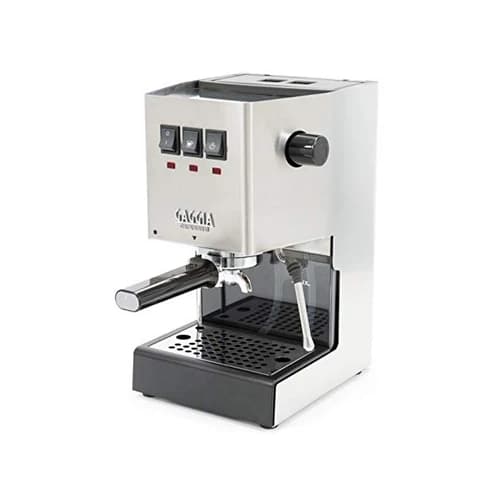
1. Gaggia Classic E24
The Gaggia Classic E24 is the machine we would put a beginner on, because it gives you commercial fittings and no automation to hide behind.
Ask a working barista which home machine they recommend and this is the shape they describe: a steel box, a real portafilter, and a bare wand.
The Gaggia Classic in its current E24 form (model RI9380/46) has been that answer for decades, and 3,168 Amazon owners hold it at 4.4 stars.
Its advantage for latte art is specific. The 58mm commercial portafilter and commercial steam wand are the same fittings a cafe uses, so every technique you read about or watch applies directly to your machine.
Gaggia Classic E24 (RI9380/46)
Rated 4.4 from 3,168 ratings
A solid steel Italian machine with commercial fittings throughout, built around a bare steam wand and a 58mm portafilter rather than any automation.
Key details
Commercial stainless steel 58mm portafilter
Commercial steam wand, manual control only
9 bar espresso extraction
Commercial three way solenoid valve
Solid steel housing, made in Italy
Accepts standard 58mm baskets and tampers
What we like
Commercial fittings mean every barista tutorial applies directly
Strong owner evidence at 4.4 stars across 3,168 ratings
Solenoid valve drops pressure cleanly and leaves a dry puck
Repairable and heavily documented, with a large parts ecosystem
Watch out for
Single boiler, so you wait between pulling a shot and steaming
No grinder, and it needs a good one to be worth owning
Steepest learning curve here, with nothing guiding you
The owner reviews tell a consistent story about the first two weeks. People describe a frustrating week, then a moment where the milk suddenly goes glossy instead of bubbly, then rapid progress.
The recurring complaint is the wait. A single boiler heats water for espresso at one temperature and steam at another, so there is a pause between the two.
That pause is the honest weak point, and it is worse than it sounds when you are making two drinks. You pull, wait, steam, pour, then wait again for the boiler to settle before the next shot.
The other cost is real. This is a bare machine, so a burr grinder is not optional, and on a $449 machine the grinder becomes a serious second purchase rather than an accessory.
Buy the Classic if you want to learn the actual craft and keep the machine for a decade. Nothing else here teaches faster, because nothing else here does anything for you.
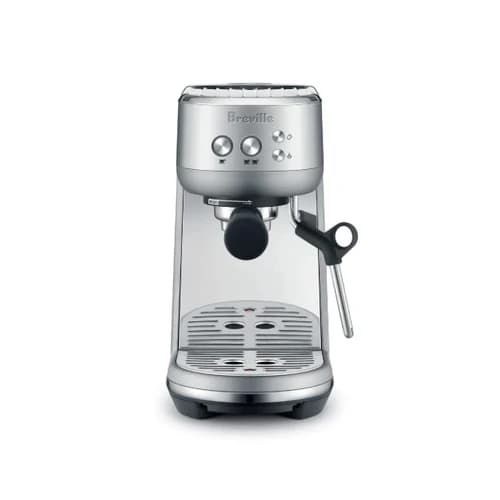
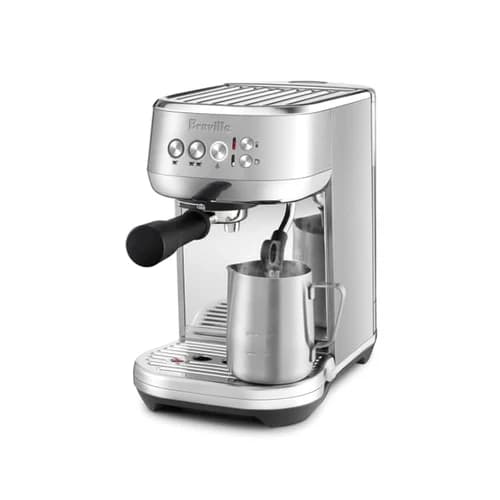
2. Breville Bambino
The Bambino (model BES450) is the cheapest genuinely good route into pourable milk, and it wins that on one underrated detail: its wand is gentle.
At $299.95 with 2,601 owners at 4.0 stars, it is also the smallest financial risk here if latte art turns out not to be your hobby.
Breville's ThermoJet system heats the machine in seconds rather than minutes, and there is no meaningful wait between the shot and the steam.
Breville Bambino (BES450)
Rated 4.0 from 2,601 ratings
A compact stainless machine with a manual one hole steam wand and near instant heat up, built to make a good shot without doing any of the milk work for you.
Key details
Manual one hole steam wand, no automation
ThermoJet heating system, ready in seconds
Digital PID temperature control
Low pressure pre-infusion at the start of the shot
54mm portafilter with single and dual wall baskets
Narrow footprint for a machine with a real wand
What we like
One hole wand aerates slowly, which is easier to learn on
Almost no wait between brewing and steaming
Costs less than many standalone espresso grinders
Small enough for a genuinely cramped kitchen
Watch out for
Steam power is modest, so larger pitchers take a while
No grinder, and it needs one to make crema worth pouring on
4.0 stars is the lowest average of the manual machines here
Owners consistently praise the speed and the size, and the three-star reviews cluster around two honest limits.
The first is steam power. A single hole and a compact heater texture a small pitcher beautifully and a large one slowly, so this is a machine for one or two drinks rather than a dinner party.
The second is that 4.0 average, which is real and worth naming. Reading the lower ratings, most describe the machine as underpowered rather than faulty, which is a fair description of what $299.95 buys.
The slow wand is genuinely an advantage while learning. A fast wand punishes hesitation, and a beginner hesitates constantly.
Buy the Bambino if you want to find out whether you enjoy steaming milk before committing serious money to the question.
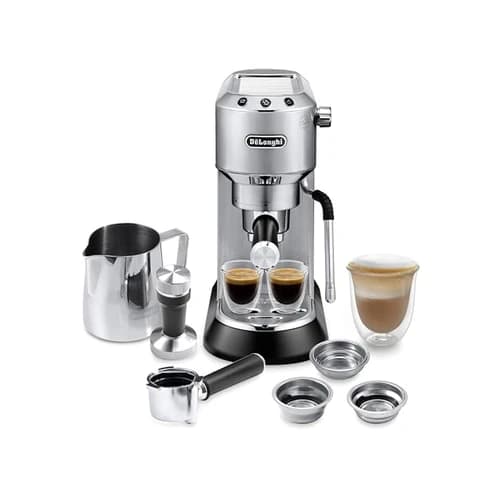
3. De'Longhi Dedica Arte EC885
The Dedica Arte exists because of a constraint most guides ignore. Some kitchens simply do not have room for an espresso machine.
At roughly six inches wide it is the narrowest machine here by a wide margin, and De'Longhi named its wand the My LatteArt specifically for the job this article is about.
We have to be straight about its numbers. It holds 3.9 stars, below our usual 4.0 bar, but across a substantial 2,139 ratings, which makes it one of the better-evidenced machines in the guide.
De'Longhi Dedica Arte (EC885)
Rated 3.9 from 2,139 ratings
A six inch wide stainless machine built around the My LatteArt manual steam wand, aimed at people who want microfoam without surrendering half a counter.
Key details
My LatteArt manual steam wand for microfoam
Around six inches wide, the narrowest machine here
15 bar pump with adjustable controls
Three level temperature control
Filter basket takes up to 18 grams of coffee
Automatic flow stop and a professional tamper included
What we like
Fits kitchens where nothing else in this guide will
A real manual wand rather than a frothing sleeve
18 gram basket matches standard espresso recipes
Dense owner evidence across more than 2,000 ratings
Watch out for
A 3.9 star average, the lowest in this guide
Narrow body means a small tank and frequent refills
No grinder, and the compact build limits future upgrades
The three-star reviews are unusually informative on this machine. Owners who love it describe the footprint and the wand, and owners who do not describe longevity, with several reporting trouble after a couple of years.
That split is why the average sits where it does, and we would rather you knew it than discovered it. A 3.9 across 2,139 ratings is not a bad machine, but it is not the Gaggia either.
The narrow body carries a second cost that no listing mentions. A slim machine has a slim water tank, so you will refill it noticeably more often than with anything else here.
What it does better than any machine in this guide is fit. If your counter has six inches of clear space, this is the only real manual wand on the list that will occupy it.
Buy the Dedica Arte for the footprint, with clear eyes about the rating. If you have the room, the Bambino costs the same and rates higher.
4. Breville Bambino Plus
The Bambino Plus (model BES500) resolves the argument this whole guide is built on, because it refuses to pick a side.
Its wand runs an automatic cycle with temperature and texture settings, steams the milk hands free, and shuts itself off. It also keeps a manual mode on the same panel.
That combination is worth more than it sounds. On a Tuesday you press a button, and on a Sunday you practice.
Breville Bambino Plus (BES500)
Rated 4.1 from 2,411 ratings
The Bambino with automatic milk texturing added: choose a temperature and a texture and walk away, or switch to manual and steam the milk yourself.
Key details
Automatic steam wand with temperature and texture settings
Manual steaming mode on the same control panel
ThermoJet heating system, ready in seconds
Low pressure pre-infusion at the start of the shot
54mm portafilter with single and dual wall baskets
Stops automatically when the milk reaches temperature
What we like
Genuinely good automatic foam for everyday milk drinks
Manual mode means the machine does not cap your skill
Same near instant heat up as the standard Bambino
Strong owner base at 4.1 stars across 2,411 ratings
Watch out for
The automatic setting alone will not produce pourable microfoam
Costs $200 more than the Bambino for the milk automation only
No grinder, so the real spend is higher than the sticker
Owner sentiment is warm and the pattern is clear. People buy it for the automatic wand, and a good number end up using the manual mode within a few months.
The complaint that matters for this guide is that the automatic cycle aerates a little too enthusiastically for art. It makes a lovely cappuccino and a difficult flat white.
That is not a fault, it is a design decision. An automatic system has to guess, and guessing slightly foamy is safer than guessing slightly flat.
The honest question is whether the automation is worth $200 over the plain Bambino, given both share a heater and a basket size.
If you will use the preset on weekday mornings, yes. If you bought this to learn, buy the cheaper one and put the difference toward a grinder.
Buy the Bambino Plus for a household where one person wants a button and another wants a wand.
5. Ninja Luxe Café Mini Plus
The Luxe Café Mini Plus (model ES351) is the only machine here that grinds, weighs, brews espresso and makes drip coffee, and it does all of it at $499.99.
Ninja's headline feature is AutoFroth, a fast multi-jet wand with a temperature probe that textures milk hands free. On its own that would rule the machine out of a latte art guide.
It survives because of something Ninja does not advertise. Select No Froth on the dial and hold the froth button for a few seconds, and the machine gives you continuous manual steam.
Ninja Luxe Café Mini Plus (ES351)
Rated 4.3 from 28 ratings
A compact espresso and drip machine with a built in burr grinder, a weighing scale, hands free AutoFroth, and a manual steam mode most owners never find.
Key details
Integrated conical burr grinder
Weight based dosing from a built in precision scale
AutoFroth steam wand with a temperature probe
Manual continuous steam through the No Froth setting
Brews espresso plus hot and iced drip coffee
Barista Assist guidance for grind, dose and temperature
What we like
Grinder, scale and machine in one box at this price
Weighed dosing is more consistent than timed grinding
Covers espresso and filter drinkers in one appliance
The manual steam mode makes real latte art possible
Watch out for
Only 28 owner ratings, a very thin evidence base
Fast aerating wand is unforgiving in a small pitcher
Manual steam mode is undocumented on the machine itself
We have to be direct about the evidence. This machine holds 4.3 stars from 28 ratings, which is a promising signal and nothing more.
Twenty-eight people is not a verdict. We kept it because the feature set at this price is genuinely unusual and the weighed dosing solves a real problem, but you would be buying earlier in a product's life than with anything else on this list.
The wand is the other caveat. It aerates quickly, which is what a cafe wants and what punishes a beginner working with 5 oz of milk.
Weighed dosing deserves the praise it gets. Beans flow differently through a grinder as the hopper empties, and a timed grinder never notices while a scale always does.
Buy the Mini Plus for a household split between espresso drinkers and filter drinkers, and go in knowing you are an early owner.
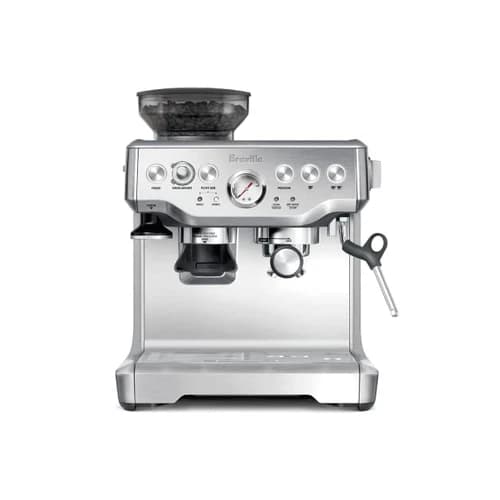
6. Breville Barista Express
The Barista Express (model BES870XL) is the most reviewed machine in this guide by an enormous margin, at 27,685 ratings and 4.5 stars.
It earns its place for a simple reason. It is the cheapest way to get a proper manual steam wand and a capable burr grinder in one box.
For latte art that matters more than it first appears, because the grinder is the part beginners skip and the part crema depends on.
Breville Barista Express (BES870XL)
Rated 4.5 from 27,685 ratings
The stainless machine that made home espresso mainstream, pairing a 16 setting conical burr grinder with a bare manual steam wand in a single footprint.
Key details
Integrated conical burr grinder with 16 settings
Manual steam wand on a swivel, no automation
54mm stainless portafilter with single and dual wall baskets
Adjustable grind amount and manual dose control
Half pound bean hopper and a 67 ounce water tank
Razor dose trimming tool included
What we like
By far the strongest owner evidence here, 4.5 stars from 27,685 ratings
Grinder and wand together remove the second purchase
Enormous community, so every problem has a documented fix
Discounts appear regularly around major sale events
Watch out for
Single boiler, so steaming waits for the machine to switch over
16 grind settings is the coarsest adjustment in the Breville range
With nearly 28,000 ratings the owner picture is unusually reliable, and it is consistently positive about the wand once people stop expecting it to be effortless.
The recurring criticism relevant here is the one the Gaggia attracts too. A single boiler means a switch-over pause between espresso and steam, and making four drinks in a row is a slow business.
The grinder is the honest limitation rather than the wand. Sixteen settings covers medium roasts comfortably, but the steps are large enough that very light roasts can leave you between too fast and too slow.
If you already own a burr grinder, this machine loses most of its argument. The Gaggia Classic costs less and gives you commercial fittings instead.
Buy the Barista Express if you are starting from nothing and want one purchase to cover the whole setup.
The La Specialista Touch is the premium end of this guide at $799.95, and it is built around guidance rather than raw capability.
An Italian conical burr grinder feeds it, a touchscreen walks you through dialing in, and Bean Adapt technology helps reset the grind when you change beans.
Its milk system runs automatically through a range of froth and temperature settings, and it also carries a listed manual setting for hand steaming.
De'Longhi La Specialista Touch
Rated 4.3 from 220 ratings
A guided semi-automatic with an Italian burr grinder and a touchscreen, offering automatic milk frothing with a manual mode kept alongside it.
Key details
Italian made conical burr grinder
Automatic milk frother with a manual setting alongside
Touchscreen display with 10 preset drink recipes
Bean Adapt guidance for dialing in a new bag
Grinds, doses and brews in one guided sequence
Cold brew and iced drink recipes included
What we like
The gentlest introduction to espresso of any machine here
Grinder and machine tuned to work together out of the box
Manual milk mode is documented rather than hidden
Broad recipe range covers hot, iced and cold brew drinks
Watch out for
Most expensive machine here, and much of that is the screen
220 ratings is a modest base for an $800 purchase
Guided systems can get in the way once you know what you want
At 4.3 stars from 220 owners the evidence is respectable rather than deep, which is normal for a machine this recent at this price.
Owners describe the guided setup warmly, particularly people who had never pulled a shot before. The criticism that recurs is the one every guided machine attracts, that the guardrails helping in month one can irritate by year two.
For latte art the manual setting is the feature that matters, and De'Longhi lists it openly rather than burying it the way Ninja does.
The honest question is what the extra $300 over the Bambino Plus buys. The answer is the grinder and the guidance, not better milk, because a bare wand is a bare wand at every price.
Buy the La Specialista Touch if you want the machine to teach you espresso while you teach yourself milk, and you would rather spend money than time.
What a steam wand tip does to milk
The steam wand tip is the single most important part for latte art, and it is the one specification almost no listing publishes.
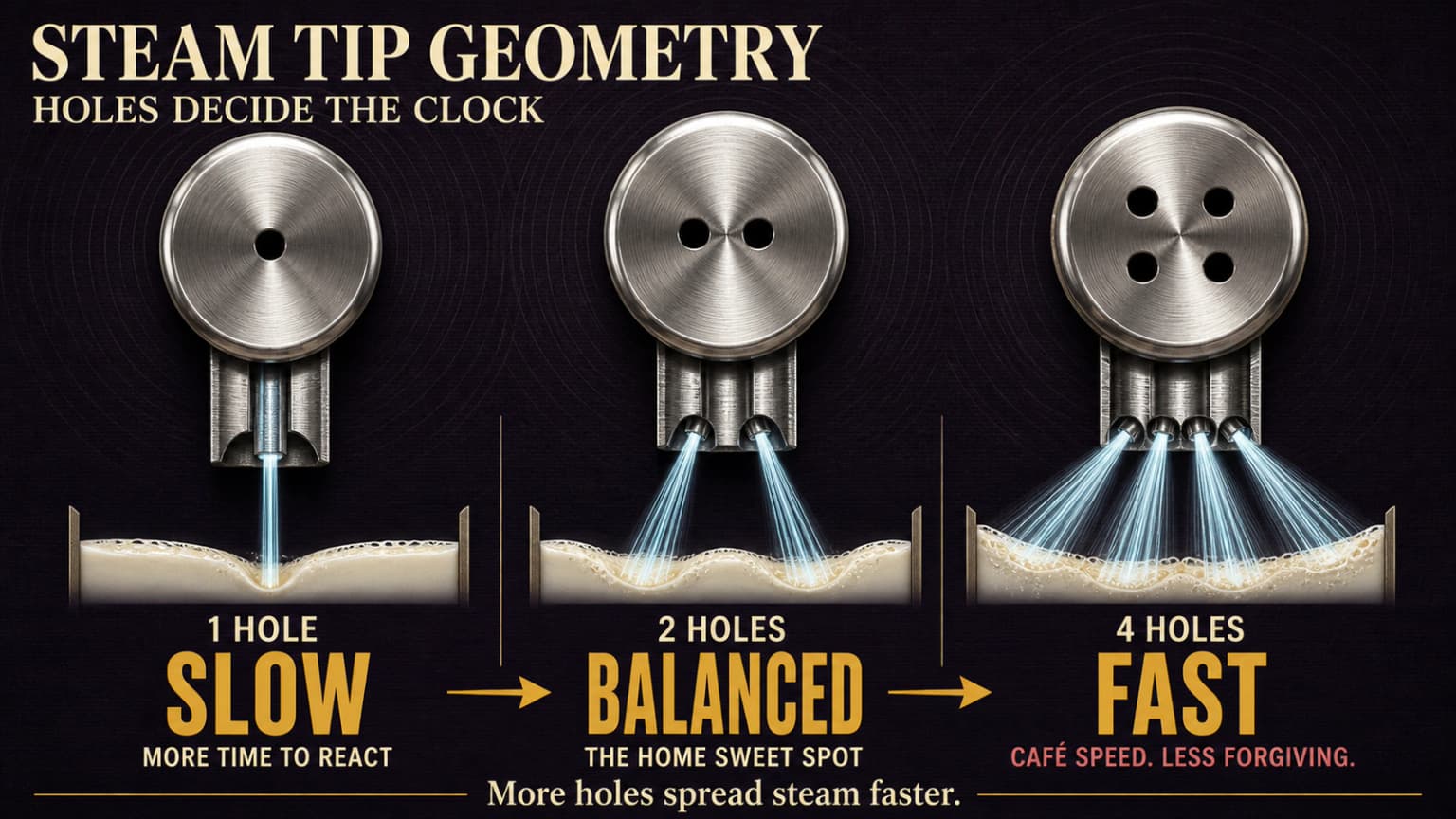
A tip is a small metal cap with holes drilled through it at an angle. The number of holes decides how fast air enters the milk, and the angle decides how hard the milk spins.
Fewer holes means slower aeration and more thinking time. More holes means cafe speed and far less room to correct a mistake.
A one hole tip, like the one on the Breville Bambino, pushes all its steam through a single jet. Air enters slowly, the milk takes longer to reach temperature, and you get several extra seconds to hear what is happening and react.
That sounds like a weakness and it is the best beginner feature in this guide.
A four hole tip spreads the same steam across four jets. It textures a full 32 oz pitcher in the time a single hole handles a small one, which is exactly why cafes use them.
In 5 oz of milk those same four jets will over-aerate before a beginner has registered the sound changing. The Ninja's wand sits at this fast end of the range.
Tip holes and what they do to your milk
Tip holes and what they do to your milk
Tip holes
Aeration speed
Room for error
Suits
One
Slow and steady
Generous
Learning, small pitchers, one drink
Two
Moderate
Fair
The usual home compromise
Three
Quick
Limited
Confident hands, medium pitchers
Four
Very quick
Very little
Large pitchers, back to back drinks
Hole counts come from manufacturer part listings and support documentation. Steam pressure and pitcher shape both shift these tendencies.
There is a practical consequence worth acting on. Tips unscrew, and replacement tips for the common Breville and Gaggia fittings are inexpensive and widely sold.
If you buy a machine and find its wand too aggressive for the pitcher you own, changing the tip is a far cheaper correction than changing the machine.
Why automatic foam will not pour
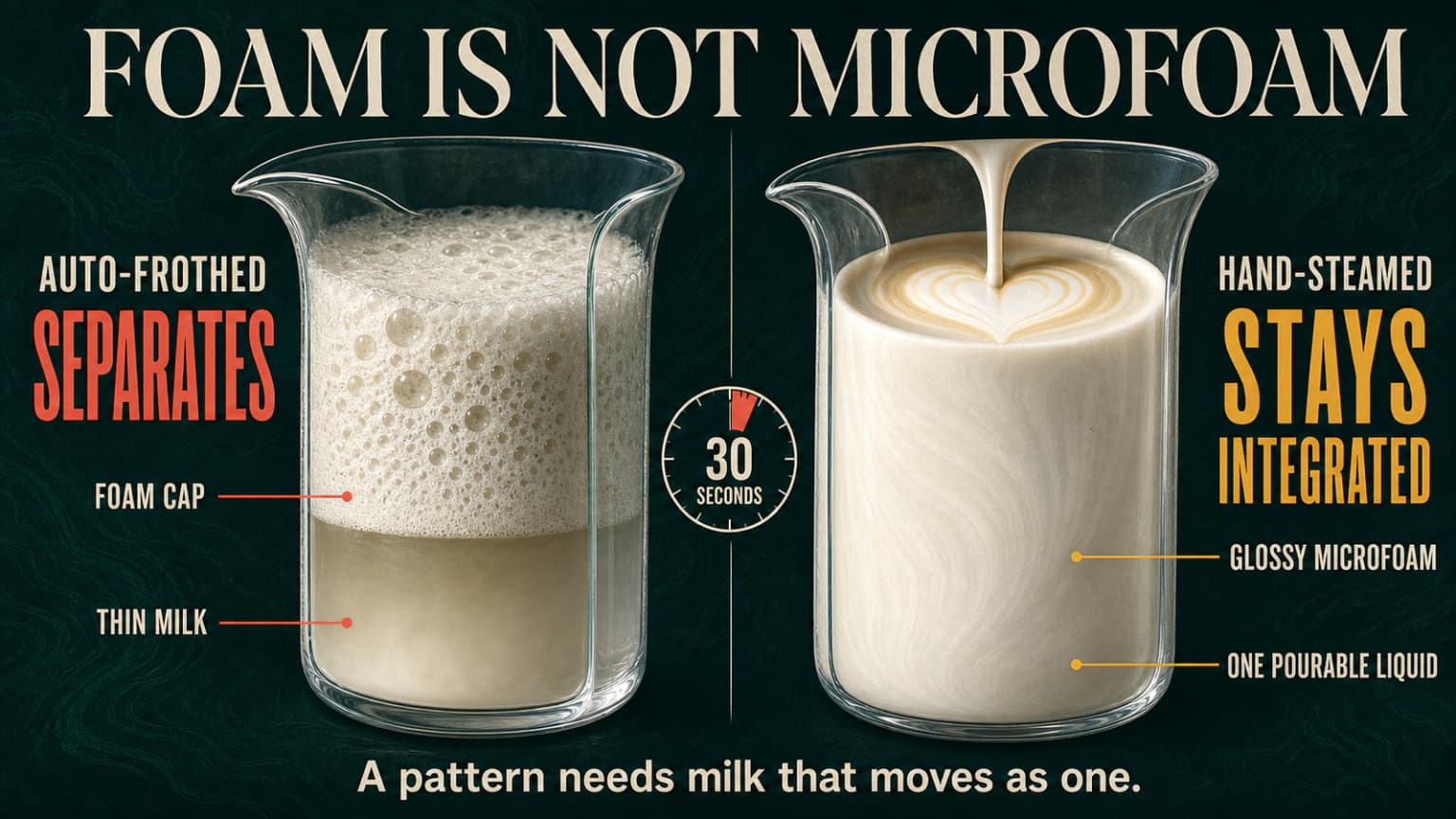
Automatic foam will not pour because it is over-aerated, and over-aerated milk separates. Within about thirty seconds it splits into a foam cap and thin liquid, and a split pitcher cannot carry a pattern.
Latte art works because two liquids of similar density meet and one floats a pattern on the other. That requires microfoam: milk with bubbles so small the foam behaves like wet paint rather than like a head on a beer.
This is what baristas call free pouring, where the pattern comes from the milk itself rather than from a tool dragged through the surface afterwards.
An automatic system cannot aim for that, because it does not know what drink you are making.
Automatic milk separates into liquid and a foam cap within about thirty seconds. Hand-steamed microfoam stays one glossy liquid.
Watch a pitcher of automatically frothed milk sit for half a minute and you will see it split. A layer of foam rises, thin milk settles beneath it, and the two stop behaving as one liquid.
Pour that and the foam arrives in a lump at the end. Nothing you do with the pitcher will fix it, because the damage was done during aeration.
Hand-steamed milk that has been rolled properly stays integrated. The whole pitcher pours as a single glossy stream, which is what lets a pattern form on the surface instead of sinking or clumping.
This is also why the three automatic machines in this guide are still here. Each one keeps a manual route, so the ceiling belongs to you rather than to the preset.
Pitcher size decides your microfoam
Use a 12 oz pitcher for one drink and a 20 oz pitcher for two. Pitcher size decides whether the wand can spin the milk at all.
Owner reviews are full of a complaint that has nothing to do with the machine. People blame the wand for milk that was doomed by the pitcher.
A milk pitcher works by holding milk deep enough for a whirlpool to form. Too much milk and the wand cannot move it, and too little and the tip breaks the surface and sprays.
The useful rule is to fill to the base of the spout, and to pick a pitcher sized for the drink rather than a large one for everything.
A 12 oz pitcher suits one drink and a 20 oz pitcher suits two, and using the large one for a single latte is the most common self-inflicted failure in home steaming.
Match the pitcher to the tip as well. The fast wand on the Ninja Luxe Café Mini Plus is genuinely difficult in a 12 oz pitcher and behaves beautifully in a 20 oz one.
Heat and wait times, machine by machine
Heat and wait times, machine by machine
Machine
Cold start
Shot to steam
Gaggia Classic E24
Several minutes
A short boiler wait
Breville Bambino
Seconds, ThermoJet
Effectively none
Dedica Arte
Under a minute
A brief wait
Bambino Plus
Seconds, ThermoJet
Effectively none
Luxe Café Mini Plus
Under a minute
Short, guided
Barista Express
About a minute
A short boiler wait
La Specialista Touch
Under a minute
Short, guided
Compiled from manufacturer documentation and owner reports. Treat these as the shape of each machine's rhythm rather than stopwatch figures.
Noise is worth a sentence too. Steam is loud on every machine here for the ten to twenty seconds it runs, and the machines with built-in grinders add a short burst before that.
If your kitchen shares a wall with someone asleep, the grinderless machines are the quieter morning.
The case against learning latte art
The honest case against is that latte art is a skill with a real learning curve, and plenty of people find they wanted good coffee rather than a hobby.
There is a hardware argument too, and we would be writing marketing rather than a guide if we skipped it.
Spend an evening on any espresso forum and you will be told these machines are all too cheap, and that a serious person buys a Rancilio Silvia, a Profitec, or an Ascaso and learns on that.
The advice is not wrong about the hardware. Those machines have more steam power, better temperature stability, and they will outlive everything in this guide.
It runs into a practical wall, though, and it is worth being blunt about it. When we checked Amazon US for this guide, Rancilio Silvia and Silvia Pro X were both out of stock, and Profitec and Ascaso do not sell there at all.
Those machines are specialist dealer purchases, at specialist dealer prices, with specialist dealer waiting times. That is a fine thing to want and a poor thing to be told casually.
That brings us back to the skill objection, which is the one that actually stops people.
If what you want is a reliable cappuccino at 7am with no practice, an automatic machine is the correct purchase.
Nobody should make you feel otherwise about that. Buy the Bambino Plus and use the preset forever.
What a latte habit really costs
A daily latte made at home costs roughly $250 to $500 a year in milk, beans and cleaner, before the machine itself. The same habit bought at a cafe runs $1,800 to $2,200.
The machine is the smallest recurring number in this hobby, and the one everybody focuses on.
A latte a day is about 8 oz of milk and roughly 18 grams of coffee, every day, for a year. Those two lines dwarf everything else you will spend.
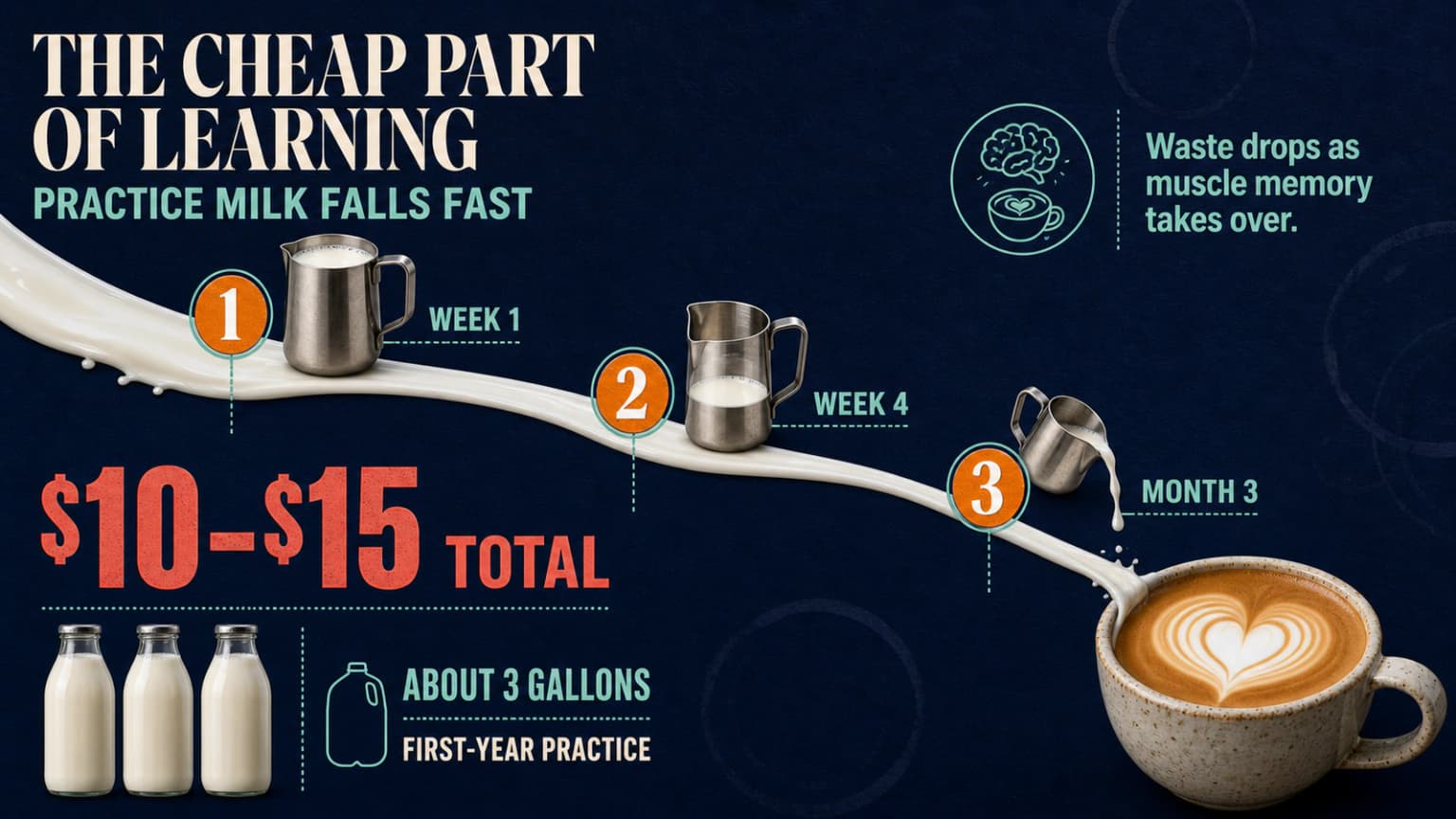
The practice milk everyone warns about is real, and it costs less than a single month of beans. The waste falls off quickly.
A year of one latte a day, beyond the machine
A year of one latte a day, beyond the machine
What you buy
Roughly per year
Estimated cost
Whole milk, 8 oz a day
About 24 gallons
$90 to $110
Coffee beans, 18g a day
About 14 lbs
$120 to $350
Descaler and wand cleaner
A few treatments
$20 to $40
Practice milk, first year only
About 3 gallons
$10 to $15
Burr grinder, if not built in
One purchase
$150 to $400
Estimates from US grocery and specialty coffee prices at the time of writing. Bean spend swings hardest, depending entirely on what you drink.
Two things fall out of that table. The practice milk everyone is warned about is trivial, well under the cost of a month of beans, so it should never be the reason you hesitate.
The grinder is the line that actually decides your budget. Four of these seven machines have no grinder, and a capable one costs as much as the cheaper machines do.
Now the number that makes the case. A cafe latte in the US runs about $5 to $6, which is where that $1,800 to $2,200 comes from.
Against that, the Breville Barista Express plus a year of milk, good beans and cleaner lands around $950 to $1,175. That is roughly half the cafe bill in year one.
Year two is where it stops being close. With the machine already paid for, the same habit costs $250 to $500 against another $2,000 of takeaway lattes.
When to buy
Espresso machines are seasonal stock and the Breville models swing hardest. The Barista Express we priced at $694.99 moves several times a year around Prime Day, Black Friday and the gifting season.
Our practical rule: if the machine you want is already down 15 percent or more, buy it. If it sits at full list with no holiday near, waiting a few weeks costs you nothing.
The live prices on this page refresh daily, so the buttons always show today's number before you commit.
One caution on marketplace listings. Deep third-party discounts on espresso machines are sometimes grey imports without a US warranty, and this is exactly the product category where warranty service matters.
How to steam milk you can pour
Every machine here can produce pourable microfoam, and the sequence is the same on all of them. It splits into two phases that beginners tend to merge.
Phase one puts air in. Phase two mixes that air through the milk until the bubbles are too small to see.
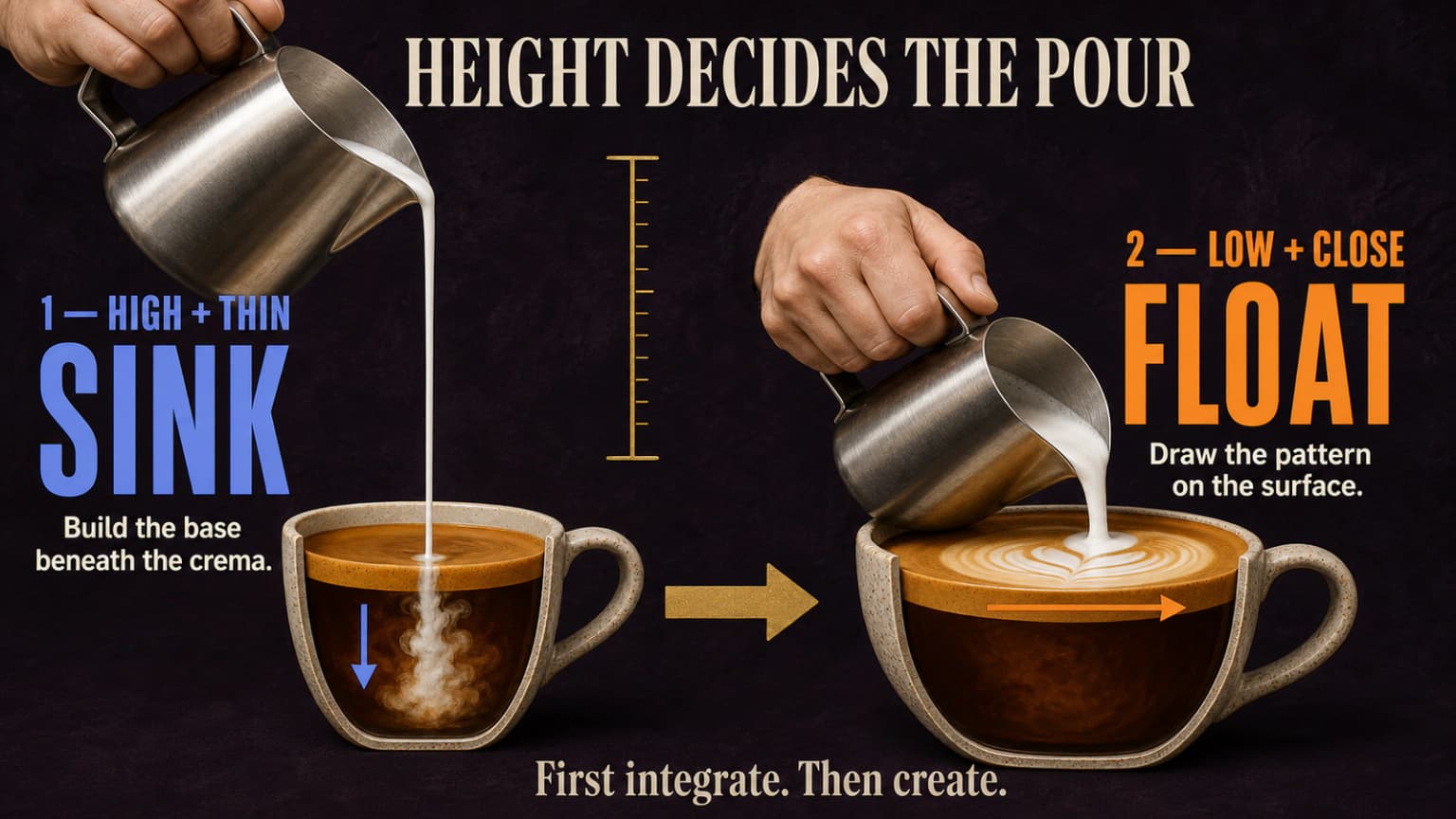
Height is the whole trick. Pour high to sink milk under the crema, then drop the spout to the surface to float the pattern.
From cold milk to a poured pattern
1
Start with cold milk and the right pitcher
Fill a pitcher to the base of its spout with fridge-cold whole milk. Cold milk buys you more seconds of working time before it reaches temperature.
Tip A 12 oz pitcher for one drink and a 20 oz pitcher for two. Using the big one for a single latte is the most common mistake.
2
Purge the wand first
Run the steam for a second into the drip tray to clear condensed water. Skipping this puts a splash of plain water into your milk.
3
Stretch: hold the tip just under the surface
Position the tip barely below the milk and listen for a steady soft tearing sound. Each second of that sound is air going in, and a few seconds is usually enough.
Watch out A loud screech means the tip is too high and you are making large bubbles. Lower it immediately rather than pushing through.
4
Roll: submerge and spin the milk
Sink the tip deeper and angle it off center so the milk turns in a steady whirlpool. This is the phase that breaks big bubbles into microfoam.
5
Stop at about 140°F, before it feels hot
Cut the steam when the pitcher is uncomfortable to hold but not painful, around 140°F (60°C). Milk scalded past about 150°F tastes flat and will not hold a pattern.
Tip A cheap stick-on pitcher thermometer removes the guesswork for the first few weeks.
6
Groove the milk, then free pour
Tap the pitcher once and swirl until the surface looks like wet paint. Start the pour high and thin to sink the milk, then drop the spout close to the surface to float the pattern.
Tip If the pattern sinks, you poured from too high for too long. If it never appears, the milk was too foamy.
The order matters more than any single step. Milk texture comes first and pouring second, because no amount of pouring skill rescues foam that is already stiff.
One caveat on the shot underneath. If the espresso tastes harsh through the milk, that is usually over-extraction rather than your steaming, and our guide to why coffee tastes bitter walks through the fixes.
Plant milk changes the timings rather than the method. Oat and almond need slightly less air and collapse faster, and the barista editions exist to behave more like dairy.
Milk protein cooks onto hot metal within seconds and turns to a hard varnish within hours. A neglected wand blocks its own holes, which quietly ruins the foam long before anyone suspects the machine.
The routine takes about fifteen seconds and it is the highest return habit in this guide.
The wand routine
1
Purge immediately after steaming
Run the steam for a second the moment the pitcher comes away. This clears milk out of the tip before it can bake onto the inside.
Watch out Never leave milk sitting in the wand while you drink your coffee. That is how holes block.
2
Wipe while it is still warm
Wrap a damp cloth around the wand and wipe from the base down to the tip. Warm residue comes off with almost no effort, and cold residue does not.
3
Weekly, soak the tip
Unscrew the tip if your machine allows it and soak it in hot water with a little milk system cleaner. Clear any blocked hole with a pin rather than a knife.
Tip A blocked hole shows up as steam firing sideways. Check the spray pattern if the foam suddenly gets worse.
4
Descale on the schedule your water needs
Hard water furs up the steam path and weakens pressure long before the machine complains. Filtered water pushes the interval out considerably.
The pattern across negative reviews in this category is consistent. Machines described as having weak steam are very often machines whose wand tips have never been taken off and soaked.
Fifteen seconds after each drink, and a few minutes a week, keeps every machine here steaming the way it did new.
Which latte art machine to buy in 2026?
Buy the Gaggia Classic E24 if you want to learn latte art properly, the Breville Bambino if you want the cheapest honest route in, and the Bambino Plus if the machine has to suit two people.
We ranked on wand control, evidence quality, how quickly the machine gets out of your way, and what you still have to buy afterwards. Then we asked the deciding question: do you want to learn this, or do you want it done for you?
The three we recommend first
Our pick
Gaggia Classic E24
$449.00
You are
Here to learn properly
Best at
Commercial fittings, real control
Milk
Bare commercial wand
Weak spot
Boiler wait, no grinder
Breville Bambino
$299.95
You are
Testing whether you enjoy it
Best at
Cheapest route to microfoam
Milk
Gentle one hole wand
Weak spot
Modest steam power
Breville Bambino Plus
$499.95
You are
Sharing a kitchen
Best at
A preset with a way out
Milk
Automatic, manual on request
Weak spot
Preset foam will not pour
The three we recommend first
Specification
Our pick
Gaggia Classic E24
$449.00
Breville Bambino
$299.95
Breville Bambino Plus
$499.95
You are
Here to learn properly
Testing whether you enjoy it
Sharing a kitchen
Best at
Commercial fittings, real control
Cheapest route to microfoam
A preset with a way out
Milk
Bare commercial wand
Gentle one hole wand
Automatic, manual on request
Weak spot
Boiler wait, no grinder
Modest steam power
Preset foam will not pour
Whichever way you lean, buy from the espresso machines shelf that matches the mornings you actually have, not the ones you imagine.
A machine that suits your routine gets used daily for years, and daily use is where every machine on this list earns its price.
Frequently asked questions
Can you make latte art with any espresso machine?
No. You need two things the machine has to provide: espresso with real crema for the foam to sit on, and a steam wand you can position yourself.
Machines that only offer a sealed automatic frother, or a pressurized panarello sleeve, produce foam that is too stiff and too dry to pour a pattern with.
Every machine in this guide can be steered by hand, though on one of them you have to know the button sequence that unlocks it.
Do automatic milk frothers make latte art?
They make excellent foam, but foam is not latte art. An automatic system aerates to a preset texture and stops, and it has no way to know whether you want a flat wet milk for a rosetta or a stiffer cappuccino foam.
The result is usually a little too aerated to pour with, and it separates in the pitcher within about thirty seconds.
The good news is that most automatic machines keep a manual mode. The Bambino Plus, the La Specialista Touch and the Ninja Luxe Café Mini Plus all let you take the wand back.
What steam wand is best for latte art?
For learning, a one or two hole wand. Fewer holes means slower aeration, which gives you several extra seconds to hear what the milk is doing and correct it.
Four hole tips are what cafes use because they texture a full 32 oz pitcher quickly. In a small home pitcher they can wreck the milk before you have reacted.
Tip geometry matters more than boiler size at this price. A machine with a gentle wand and a modest boiler teaches faster than a powerful one you cannot control.
Do you need a separate grinder for latte art?
For four of the seven machines here, yes, and it is not optional. Latte art needs crema to pour onto, and crema needs freshly ground coffee at an espresso grind you can adjust.
Pre-ground supermarket espresso will give you a thin, pale shot that the milk sinks straight through, however well you steamed it.
Budget a real burr grinder alongside the machine. On a $300 machine the grinder is often the larger half of the purchase.
What milk pours the best latte art?
Whole dairy milk, cold, straight from the fridge. Its fat and protein balance builds the glossy wet microfoam that holds a pattern longest, and it is the most forgiving while you learn.
Skim milk foams up faster and higher, but the foam is dry and stiff and tends to sit on the surface rather than fold into the espresso.
Barista editions of oat milk are the best plant option, because the added protein and oil are there specifically to mimic what dairy does under steam.
How long does it take to learn latte art?
Most owners describe steaming milk correctly within two or three weeks of daily practice, and a recognizable heart somewhere between one and three months. A tulip or rosetta usually takes longer.
The order matters. Milk texture comes first and pouring second, because no amount of pouring skill rescues foam that is already stiff and bubbly.
Expect to pour away a fair amount of milk in month one. That waste is the real cost of learning, and it is worth planning for.