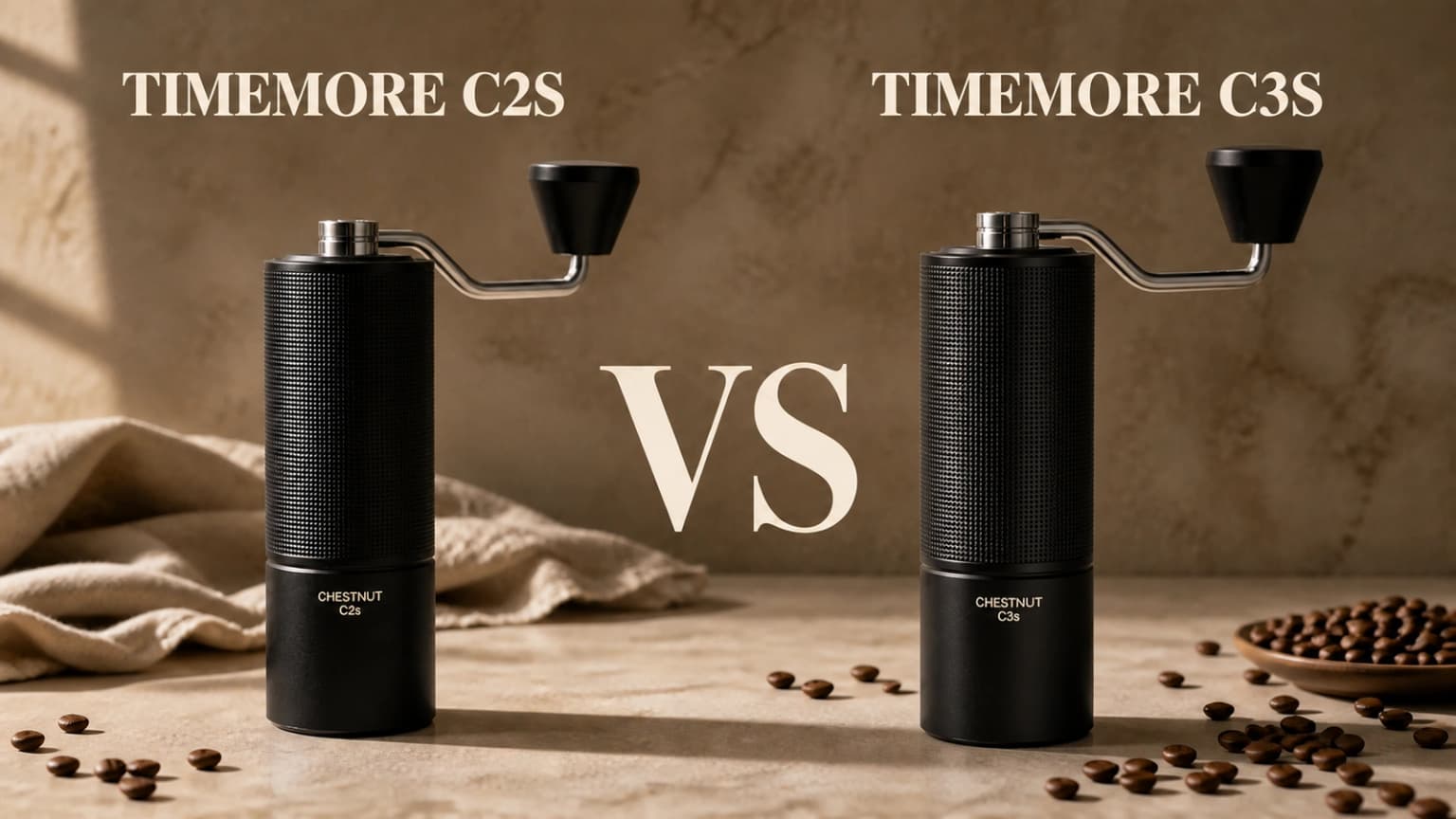
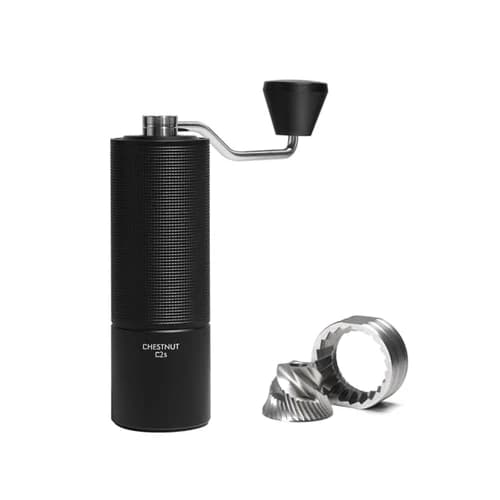
Timemore C2S vs C3S comes down to one part inside two nearly identical bodies. The Timemore Chestnut C2S keeps the standard 38 mm burr, while the Timemore Chestnut C3S spends its ₹1,351 premium on the S2C burr.
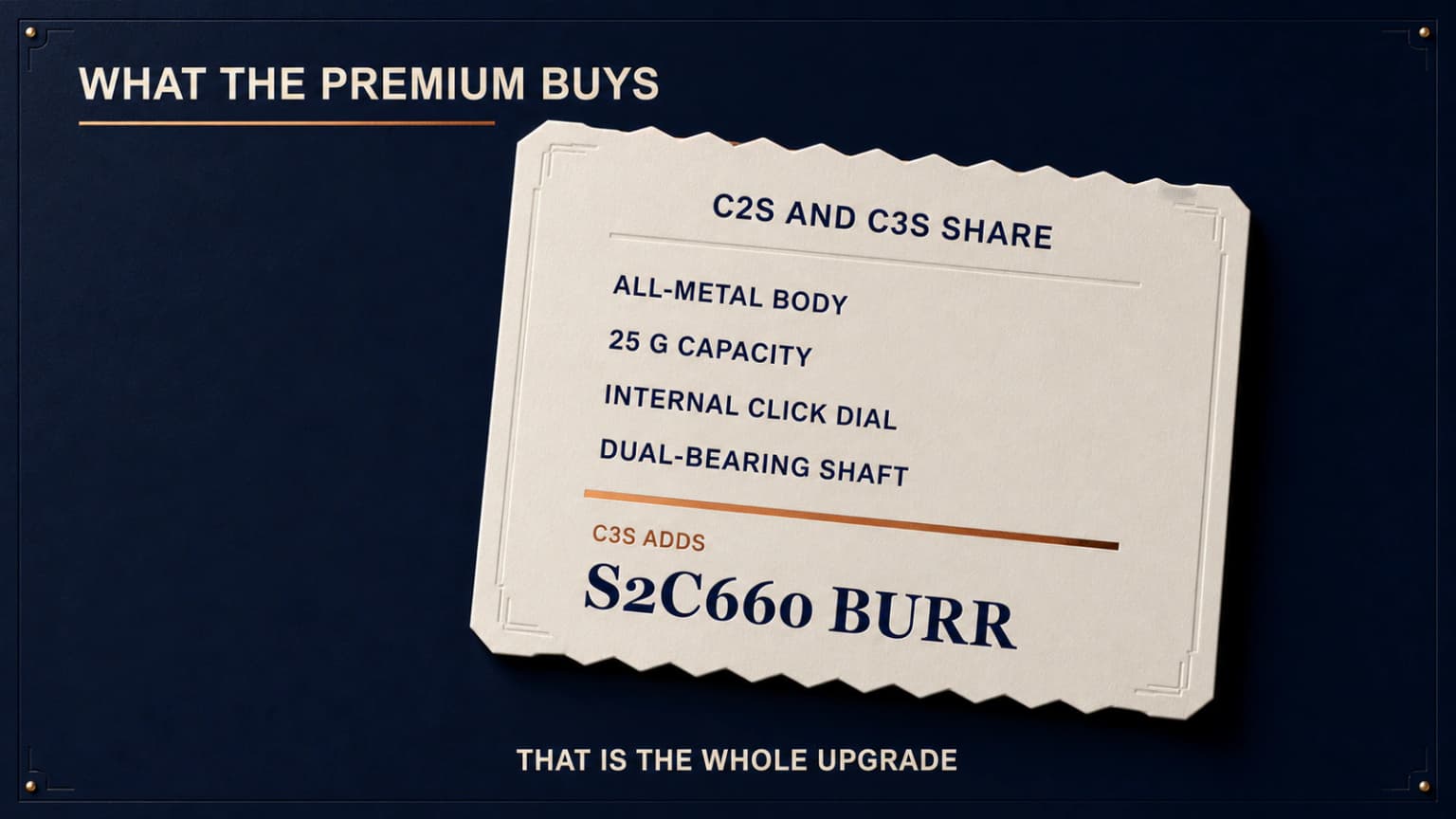
Everything around that burr is unusually similar. Both grinders have an all-metal body, a fixed handle, an internal click dial and enough listed capacity for a 25 g batch.
So the decision is cleaner than the names suggest. Choose the Timemore C3S for lighter-roast pour-over, and the Timemore C2S when value and faster grinding matter more.
For 2026, our verdict comes from the exact Amazon listings, Timemore's published specifications, independent grinder coverage and owner discussions. We have not brewed with either grinder ourselves.
Our coffee grinder guide for India ranks both products in the same field. The C3S is the overall pick there, while the C2S is the cheaper first step away from pre-ground coffee or a mixie.
Timemore C2S vs C3S at a glance
Same shell, different burr
TIMEMORE Chestnut C2S
₹4,999.00
Burr
38 mm standard stainless steel
Burr profile
Direct cutting profile
Adjustment
Internal stepped dial
Capacity
25 g on this listing
Body
All-metal unibody
Diameter
52 mm
Owner evidence
4.7 stars, 91 reviews
Our pick
TIMEMORE Chestnut C3S
₹6,350.00
Burr
38 mm S2C660 stainless steel
Burr profile
Spike-to-cut entry pattern
Adjustment
Internal stepped dial
Capacity
25 g on this listing
Body
All-metal unibody
Diameter
52 mm
Owner evidence
4.7 stars, 326 reviews
Same shell, different burr
Specification
TIMEMORE Chestnut C2S
₹4,999.00
Our pick
TIMEMORE Chestnut C3S
₹6,350.00
Burr
38 mm standard stainless steel
38 mm S2C660 stainless steel
Burr profile
Direct cutting profile
Spike-to-cut entry pattern
Adjustment
Internal stepped dial
Internal stepped dial
Capacity
25 g on this listing
25 g on this listing
Body
All-metal unibody
All-metal unibody
Diameter
52 mm
52 mm
Owner evidence
4.7 stars, 91 reviews
4.7 stars, 326 reviews
The highlighted side is our better default, not a claim that the Timemore C3S wins every brew against the Timemore C2S. The burr is the purchase, because the bodies and daily routine are close enough to cancel each other out.
The equal 4.7-star rating matters too. The C3S has more than three times the review count, so its score carries stronger evidence, yet the C2S shows no owner-rating penalty for costing less.
Do not read “stepless” in the C3S Amazon copy as a hidden advantage. The standard C3S uses a stepped internal dial, and Timemore publishes a separate ESP dial for finer espresso control.
Why buyers compare these Timemore grinders
These two are cross-shopped because they do the same job at adjacent India prices. A buyer leaving pre-ground coffee can reach the C2S at ₹4,999 or stretch to the C3S at ₹6,350 without changing size, brand or workflow.
Timemore's model letters confuse buyers more than the hardware does. The “S” versions are the later all-metal updates, so older C2 versus C3 comparisons mislead when they discuss plastic supports that these exact products do not share.
That leaves one clean question: is S2C burr geometry worth ₹1,351? Recent India buyer threads ask exactly that for moka, French press, cold brew and pour-over, rather than comparing two unrelated price tiers.
The answer depends on what the next rupee would buy. If the rest of the setup is settled, the C3S is the better grinder. If you still need a scale, a brewer or fresher beans, the C2S creates more total improvement.
How we compared these hand grinders for 2026
We did not grind beans with the C2S or C3S, so this is a research verdict rather than a bench test. Our editorial method starts with what the exact products promise and looks for independent evidence that supports or challenges it.
We verified both Amazon India ASINs together on 30 August 2026. Both were in stock, both showed a live price, and both were sold by Kaapi Solutions at the time of writing.
The C2S listing displayed 4.7 stars from 91 reviews, while the C3S displayed 4.7 stars from 326 reviews. Those figures were read on the same day and are not mixed with the older counts in our roundup.
For specifications, we used each exact listing, Timemore's current product pages and its C-series guidance. For performance, we looked for agreement across expert coverage and owners using the same standard and S2C burr families.
We rejected several tempting numbers. Published C2S weights conflict sharply, C3S capacity differs between Timemore pages, and no India warranty duration was verified for these two offers.
That is why the matched table uses the 25 g claim on both exact listings and omits weight. A neat comparison is not worth an invented specification.
What changes inside the two burrs
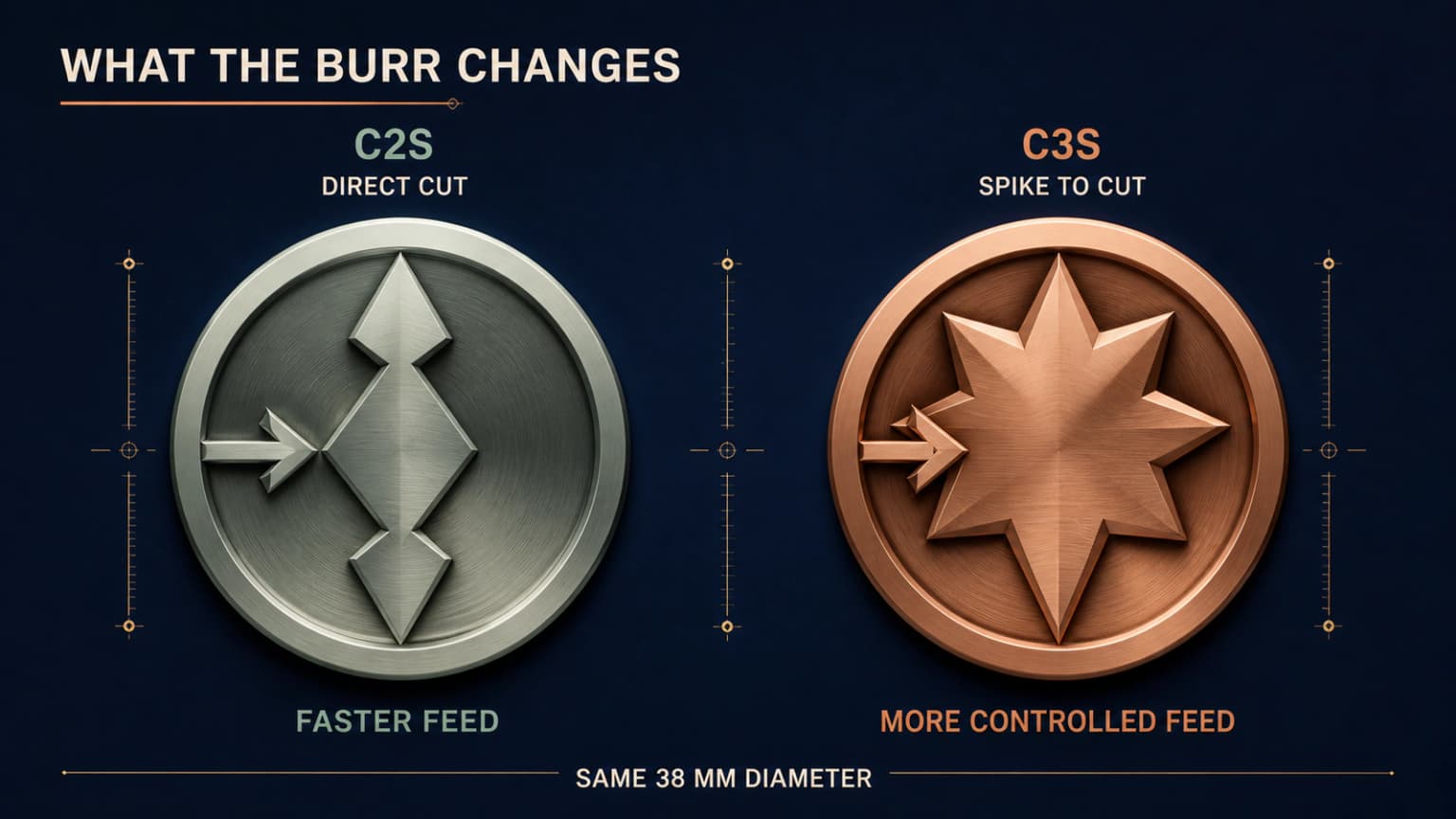
Both burrs are 38 mm; the way beans enter the cutting zone is the change that matters.
Both grinders use a 38 mm stainless steel conical burr, but identical diameter does not mean identical work. The tooth pattern controls how a bean enters, fractures and leaves the cutting zone.
The C2S uses Timemore's standard burr. Its simpler entry geometry takes a direct route from whole bean to smaller fragments, which is why reviewers of this burr family often note brisk filter-speed grinding.
The C3S uses the S2C660, short for Spike to Cut. Raised entry features break the bean before the main cutting surfaces finish it, giving the burr a more controlled feed at the cost of some throughput.
That control changes the particle-size distribution, not the nominal grind setting. The useful aim is fewer oversized pieces and fewer very fine particles around the target size, because both extremes extract at different rates.
In a pour-over, excess fines can slow the drawdown and add muddiness. Large fragments can under-extract at the same time, leaving sourness inside a cup that also tastes dry.
The C3S does not remove those particles, and the C2S does not produce a chaotic grind. S2C is a refinement between two capable steel burrs, not a rescue from a bad one.
Timemore's C2S listing publishes a burr hardness of 55 to 58 HRC. Timemore does not publish an equivalent HRC figure on the current C3S page we found, so we will not pretend the S2C steel is harder.
Both use dual-bearing shaft support and an all-metal structure around the burr. Those shared parts protect burr alignment, so the profile gets to be the real variable rather than body flex.
Timemore C2S vs C3S: S2C or savings?
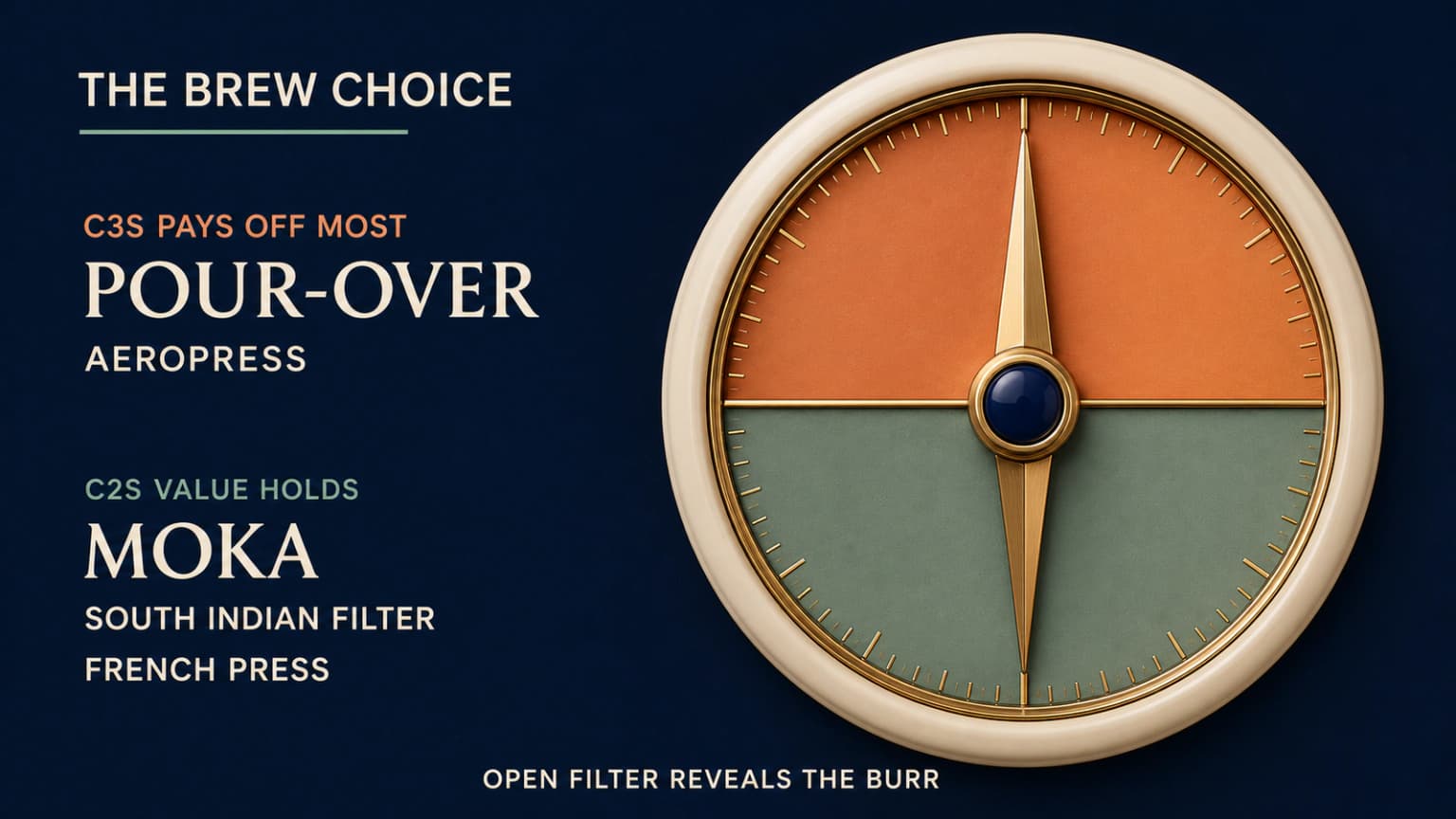
Pay for the Timemore C3S when filter clarity is the goal, and keep the saving when the brew method masks small distribution gains. That sentence is the whole comparison.
Pour-over exposes grind differences because water passes once through an open bed. A narrower particle spread can make acidity easier to separate from sweetness, especially with a lightly roasted coffee brewed without milk.
Moka and South Indian filter coffee behave differently. Finer grounds, longer contact and the weight of milk or chicory shrink the value of a subtle clarity gain, so the pot you brew in and your heat control matter more than the burr.
French press is forgiving for another reason. Immersion lets all particles sit in the same water, so the standard C2S burr can make a satisfying cup without asking you to pay for the S2C entry pattern.
None of this makes the C3S wasted on those brewers. It makes the premium harder to taste, which is a more useful distinction than declaring one grinder universally better.
The price gap is also small in daily terms and large at checkout. ₹1,351 spread across five years is about ₹0.74 a day, but today it can buy a scale or a good bag of specialty coffee.
Open filter brews reveal the S2C gain most clearly; immersion and milk drinks narrow it.
There is no contradiction between calling the C3S our overall pick and the C2S our value pick. The C3S wins the narrow performance question, while the C2S can improve the whole setup more.
Light-roast filter: C3S wins outright
The Timemore C3S wins this section, although the margin is smaller than the model names imply. Its S2C burr is designed to control the bean before the main cut, and that is most useful in a clean, lightly roasted pour-over.
Independent coverage of the C3 burr family reports a more controlled grind but also warns that taste differences from the standard C2 burr can be hard to spot. That is the right level of confidence for the C3S too.
In cup terms, look for a little more separation between acidity, sweetness and finish. Do not expect more strength, because strength comes mainly from coffee-to-water ratio rather than burr branding.
The benefit also depends on technique. Stale beans or a guessed dose can swamp the difference, so the C3S pays off most once a controlled pour and a repeatable recipe are already in place.
For AeroPress, the gain becomes recipe-dependent. A paper-filtered, short-steep recipe can show clarity, while a longer immersion with agitation pulls the two grinders closer together.
For South Indian filter coffee, the C3S can still deliver a clean decoction. A coffee-chicory blend and milk simply make consistency across mornings more valuable than a delicate separation between tasting notes.
The C3S has the stronger evidence base as well. At the time of writing, 326 Amazon India reviewers held it at the same 4.7 stars that the C2S reached with 91 reviews.
TIMEMORE Chestnut C3S
Rated 4.7 from 326 ratings
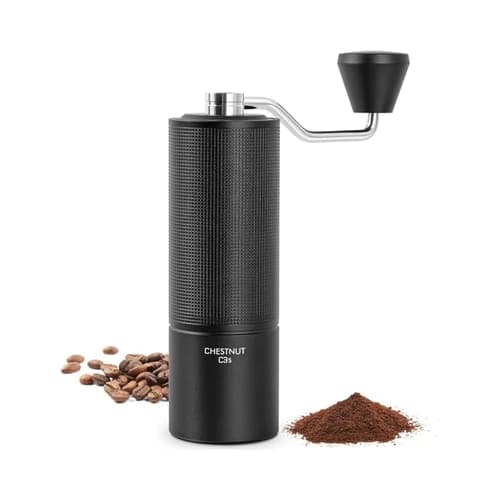
The filter-first side of this comparison. It keeps the same compact all-metal format and spends the premium on Timemore's S2C660 burr.
Key details
38 mm S2C660 stainless steel conical burr
Spike-to-cut entry pattern before the main cutting zone
The C3S is therefore the one to buy when the grinder is the last weak link in a filter setup. It is not ₹1,351 better in every cup, but it puts the money into the part that can change one.
Speed and value: C2S wins outright
The Timemore C2S wins on both checkout cost and grind speed. Its standard burr usually clears a filter dose faster, and the verified India price leaves ₹1,351 in the buyer's pocket.
The speed result can sound backwards because the C3S is the dearer grinder. Burr design decides the feed rate, and S2C's more controlled first stage can take longer than the C2S's direct cutting path.
No single seconds figure is honest across roast and grind size. Dense light-roast beans resist the crank more than brittle dark-roast beans, and a moka setting takes longer than a French press setting.
What stays consistent is the direction. Expert coverage of the same burr families and direct owner comparisons repeatedly describe the C2 pattern as faster, while C3 owners accept more turns for its grind profile.
That matters more in a household than in a tasting note. A 25 g morning batch repeated every day makes small workflow differences visible long after the excitement of a new grinder disappears.
The C2S is also the better first grinder. Someone moving from pre-ground coffee will gain freshness, dose control and a steel burr at once, which is a far larger change than moving from C2S to C3S later.
Use the saving deliberately. A small scale makes recipes repeatable, and fresher beans make every brewer better, so ₹1,351 can produce more flavour outside the grinder than inside it.
TIMEMORE Chestnut C2S
Rated 4.7 from 91 ratings
The value side of this comparison. It keeps the all-metal 25 g format, uses Timemore's faster standard burr and leaves ₹1,351 for the rest of the setup.
Key details
38 mm standard stainless steel conical burr
Five-axis CNC machining, listed at 55 to 58 HRC
All-metal unibody with double-bearing shaft support
The C2S is not a consolation prize for someone who cannot reach the C3S. It is the rational purchase when coffee is brewed with milk, chicory, immersion or a tighter total budget.
Your first week with either Timemore
Start with one repeatable recipe, not a tour of every marking on the dial. Both grinders reward the same habit: find a reference setting, brew, change one click and write down what happened.
The dial sits beneath the burr, so the catch cup comes off before every adjustment. Clockwise moves finer and anti-clockwise moves coarser on both models.
1
Find zero gently
Turn the empty dial clockwise until the burr reaches light contact, then stop. Zero is a reference point, not a setting for grinding beans.
Watch out Do not tighten the burr faces together. Force at zero can damage the cutting edges and makes later click counts unreliable.
2
Choose one brewer for the week
Use the maker's suggested band for your first pour-over, moka pot or filter. Ignore settings copied from the other Timemore because matching click counts need not produce matching particles.
3
Weigh one normal dose
Use the same coffee and water each time so the grinder is the only variable. Our coffee-to-water guide gives a starting ratio for each Indian brewing method.
Tip Stay within the listed 25 g capacity for a clean first run. Larger household batches should be split rather than heaped above the rim.
4
Read flow before flavour
A pour-over that drains too quickly usually needs a finer setting, while a stalled bed usually needs a coarser one. For a steel filter, use drip time and decoction flow in the same way.
5
Move one click only
Change one step, keep the dose and water fixed, then brew again. Two changes at once erase the lesson and make both grinders seem less consistent than they are.
6
Record the grinder and setting
Write C2S or C3S beside the click count, bean and brewer. Return to zero and recount after a full clean because reassembly can shift the reference slightly.
This routine matters more than a universal click chart. Roast, bean density, seasoning and zero point all move the useful setting, so a number copied from another grinder is only an opening bid.
The same rule protects against the most common C3S misunderstanding. Its standard dial clicks into fixed positions, despite one listing line calling it stepless.
For a practical ratio, use our coffee-to-water ratio chart before changing the grinder. Ratio sets strength; grind size controls how that strength tastes.
Hand effort through a full 25 g dose
The Timemore C2S is usually quicker, but neither grinder is effortless at every setting. A full 25 g load of dense, lightly roasted coffee makes the difference clearer than a 12 g dark-roast dose.
Both bodies are listed at 52 mm across, a diameter that suits average and smaller hands. The textured metal gives a secure grip, while the dual-bearing shaft keeps the crank turning smoothly through each rotation.
The C2S standard burr feeds beans faster at common filter settings. That speed can make its handle feel busier, but the dose tends to clear in fewer turns.
The C3S S2C burr stages the break before the final cut. Reviewers of this burr family commonly report a slower grind, which is the price of its more controlled feed rather than evidence of a weak bearing.
Dark roasts change the experience because brittle beans fracture easily. Light roasts ask for more torque, and grinding near the fine end raises both time and resistance on either model.
Grip strength matters more than model choice if there is wrist pain. An electric grinder is the honest answer for someone who already avoids hand-cranked tools, even if either Timemore looks compact on a counter.
Technique can reduce effort without changing the result. Hold the grinder close to the body, keep the crank level and use a steady circle instead of trying to overpower each hard bean.
A full family batch may also exceed the comfortable hopper level. Split anything above 25 g into two loads, because forcing beans under the lid saves a few seconds and costs you a secure grip.
Cleaning two nearly identical grinders
Cleaning is a tie because the layouts are nearly identical. Both send grounds down through a conical burr into a threaded metal cup, with no chute or motor cavity to trap a large dose.
After each grind, tip out the catch cup and tap the body lightly. A soft brush around the lower burr and adjustment dial clears the thin ring of powder that builds around the exit.
Timemore tells owners to clean both grinders dry and avoid water. Do not rinse the burr or the adjustment assembly, because moisture left in threads and steel surfaces can invite corrosion.
That warning matters in an Indian monsoon. Store the grinder in a closed cupboard away from the stove, and let the body reach room conditions before sealing it after travel.
The Ross Droplet Technique uses a tiny amount of water on beans to tame static. We would skip it when humidity is already high, because these grinders retain little and Timemore's care guidance favours dry cleaning.
Chicory needs extra attention. It breaks into finer dust and can leave more residue around the burr, so a grinder used for a coffee-chicory blend deserves a weekly brush rather than a monthly one.
Full disassembly is straightforward but demands one habit. Lay the dial, spring and washers down in removal order, then return them in the same order before finding zero again.
Do not judge retention by grounds clinging to the cup wall alone. Static can hold a light dusting without changing dose meaningfully, and no matched laboratory figure exists for these two exact ASINs.
All-metal bodies and long-term wear
Build quality is another tie, which is easy to miss if you judge these two by an old C2-versus-C3 article. The Timemore C2S and C3S are both the all-metal revisions, so neither carries the earlier model's plastic internal support.
Each grinder uses an aluminium alloy body, a metal crank and dual bearings around the central shaft. That shared architecture keeps the burr centred and removes most of the mechanical reasons to pay more for the C3S.
The threaded catch cup is simple and secure once it starts cleanly. Independent hands-on coverage of the C2S found that its threads can need a small jiggle to align, so never force the cup if it starts crooked.
The same caution is sensible for the C3S because its cup follows the same basic form. Cross-threading an aluminium cup is avoidable wear, not a defect that better burr geometry can solve.
Burr longevity is hard to turn into a useful year count. Roast, volume, foreign objects and cleaning all matter, while neither exact India listing publishes a rated lifetime in kilograms.
The C2S listing does publish 55 to 58 HRC for its CNC burr. The C3S page names stainless steel but omits a directly comparable hardness, so we score the surrounding build as equal rather than awarding hardness by assumption.
Neither grinder has a motor, gearbox, display or power board. That removes four common failure points and makes long service plausible, but it does not prove that replacement burrs will always be stocked in India.
Check the box contents and the seller invoice on arrival. If the model printed on the body does not match the order, resolve it inside the return window before seasoning the burr with coffee.
What the C3S premium really buys
The Timemore C3S premium buys the S2C burr and stronger owner evidence, not a different daily machine. At the verified prices, the C2S costs ₹4,999.00 and the C3S costs ₹6,350.00, a gap of ₹1,351.
The real India purchase, line by line
The real India purchase, line by line
What you pay for
TIMEMORE C2S
TIMEMORE C3S
Verified grinder price
₹4,999.00
₹6,350.00
Burr system
38 mm standard steel
38 mm S2C660 steel
Accessory needed for filter
None
None
Regular consumables
None
None
Electricity and voltage
Not applicable
Not applicable
Seller at verification
Kaapi Solutions
Kaapi Solutions
Verified India warranty term
Confirm before ordering
Confirm before ordering
The ₹1,351 premium changes the burr and the depth of owner evidence; the body, capacity and running cost stay level.
No upgrade accessory is required for ordinary filter brewing on either side. Brushes wear slowly, hand grinders use no electricity, and there is no 110 V grey-import risk because neither product plugs in.
Strip away the shared body and routine, and the C3S premium lands almost entirely on S2C.
At the time of verification, both offers named Kaapi Solutions as the merchant. That symmetry is useful in India because it removes seller route as a reason to favour one product.
It does not guarantee identical support. The listing information did not give us a verified warranty duration for either exact offer, so confirm the invoice, return window and local service route before payment.
Festive-sale discounts can change the decision. If the C3S falls close to the C2S, buy the better burr; if the gap grows enough to fund a scale and fresh beans, the C2S becomes more persuasive.
The five-year daily-cost calculation is perspective, not a promise about lifespan. ₹1,351 divided across five years is about ₹0.74 a day, but repairs and future prices remain unknown.
What C2S and C3S owners complain about
The useful complaints are small and repetitive, which fits two products rated 4.7 stars. We gave more weight to middling owner reports and independent hands-on coverage than to praise written on the first day.
For the C2S, the first theme is the catch cup. Its metal threads can need careful alignment, and forcing them when they start crooked risks turning a minor daily annoyance into permanent wear.
The second C2S theme is grind uniformity at the edges of its range. Independent sieve work found the grinder less uniform than dearer reference models, which is fair at ₹4,999 and relevant to light-roast filter buyers.
The third is expectation at the fine end. The C2S can make fine grounds, but the classic click spacing is not enough for careful dialling in with a non-pressurised espresso basket.
For the C3S, owners most often notice speed. The S2C burr can take more turns than the standard burr, so an upgrade chosen for cup refinement can feel like a workflow downgrade on the first morning.
The second C3S theme is also espresso adjustment. The grinder reaches fine settings, but a standard C3S is not a C3 ESP, and the listing's broad wording does not create the smaller steps a standard basket needs.
The third is the handle knob. Owners sometimes say it feels cheaper than the all-metal body, although this is a tactile complaint rather than a recurring breakage report.
One India-specific complaint applies to both: closely named listings can lead to the wrong variant arriving. Recent buyers have reported C2S and C3S mix-ups, so check the model mark before using the grinder.
None of those themes shows one body failing while the other survives. The complaints follow the same divide as the verdict: C2S owners accept a simpler grind, while C3S owners accept slower throughput.
The Timemore C2S vs C3S scorecard
The scorecard gives the C3S three row wins, the C2S two and two ties. That tally matches our verdict because the C3S wins burr performance, light-roast filter and owner evidence.
The C2S wins the two rows a value buyer feels every day: speed and price. Those are not consolation categories, which is why the lower overall score does not make the C2S a poor purchase.
Build is tied because both S models use the same all-metal idea and dual-bearing support. Cleaning is tied because both use the same internal dial area, threaded cup and dry-brush routine.
The 4.7-star averages are inputs, not the scorecard's overall scores. Our 4.4 and 4.5 figures weigh the comparison criteria above, while Amazon's figure records owner sentiment on each listing.
Owner evidence goes to the C3S because 326 reviews make the same average more stable than 91. Same rating does not mean same evidence depth, although both counts are substantial enough to take seriously.
Limits both Timemore grinders share
Neither grinder is the right standard-basket espresso purchase. Both can reach fine coffee, but the classic internal dial leaves too much distance between clicks for reliable shot timing.
Both also hide the internal adjustment dial under the catch cup. Changing brew methods means removing the cup, finding the click count and remembering which direction you moved.
The 25 g listed capacity suits one or two filter cups. A family batch of South Indian filter coffee can need a second load, especially when the upper chamber is filled for a stronger decoction.
Manual grinding remains manual work. If the grinder will be skipped on busy mornings, an electric burr grinder makes better coffee by being used, and a machine that grinds for you removes the step entirely.
Neither product should be washed under the tap. The all-metal build feels washable, but Timemore's own care instructions call for dry brushing around the steel burr and adjustment parts.
India support depends on the actual offer and invoice. Both listings showed Kaapi Solutions when verified, yet the warranty duration was not clear enough to publish as a fact.
These are compact grinders, not invisible ones. The fixed crank needs drawer length, and the threaded cup deserves care when removed before every grind change.
Finally, neither burr can repair stale beans or an unstable recipe. Better single dosing, a consistent water ratio and beans ground immediately before brewing remain the larger gains.
Which Timemore hand grinder wins in 2026?
The Timemore C3S wins overall, and the Timemore C2S wins on value. The deciding question is whether a small light-roast filter gain is worth ₹1,351 and a little more time at the crank.
If the budget is fixed, count the whole coffee setup rather than the grinder alone. A C2S, a scale and fresh beans beat a C3S paired with guessed doses and old coffee.
If both fit comfortably, buy the C3S once and stop revisiting the question. The premium reaches the burr rather than decoration, which is exactly where extra grinder money should go.
If neither Timemore is right for you
Move beyond this pair if espresso, electricity or a smaller travel body is the real requirement. The full India grinder ranking places those alternatives beside these two with current prices and owner evidence.
For non-pressurised espresso, the KINGrinder K6 offers much finer adjustment than either classic Timemore dial. It costs more, but it solves the problem instead of asking a filter grinder to imitate an espresso one.
For a motor, the Baratza Encore ESP removes hand effort and covers both filter and espresso. Its larger price buys a different workflow, so it is a more honest comparison than pretending the C3S turns electric through better burr teeth.
For a smaller travel grinder, the 1Zpresso Q Air gives up the all-metal body and some capacity. It makes sense when packed size matters more than the solid feel that defines both Timemores.
And if pre-ground coffee already tastes good and convenience matters most, buy neither, or look at a capsule machine instead. Fresh grinding is valuable only when the grinder becomes part of the morning rather than an object left in a drawer.
Frequently asked questions
What is the difference between the Timemore C2S and C3S?
The only meaningful difference between the Timemore C2S and the Timemore C3S is the 38 mm burr inside each body. The C2S uses Timemore's standard stainless steel burr, while the C3S uses the S2C660 burr with a spike-to-cut entry pattern.
Everything else matches on the exact Amazon India listings compared here: an all-metal body, a 52 mm diameter, an internal click dial and a 25 g capacity. The C2S clears beans faster, while the C3S suits a cleaner, more controlled light-roast filter cup.
Is the Timemore C3S worth the extra money over the C2S?
The Timemore C3S is worth the extra ₹1,351 for light-roast pour-over drinkers who will notice a small burr-quality gain over years of daily brewing. The premium is harder to justify for moka, French press and traditional South Indian filter coffee.
Buy the Timemore C2S if ₹1,351 buys better beans, a scale or a brewer you still need. Both grinders hold the same 4.7-star Amazon India rating at the time of writing, although the C3S has 326 reviews against the C2S's 91.
Which is faster, the Timemore C2S or C3S?
The Timemore C2S is generally the faster grinder because its standard burr feeds beans through more aggressively. Independent coverage of the same C2 and C3 burr families consistently reports that the S2C design trades some speed for a more controlled particle distribution.
Roast density and grind size can change the gap, so no honest time applies to every dose. Expect both grinders to slow at fine settings and on dense light-roast beans.
Which Timemore grinder is better for pour-over?
The Timemore C3S is our pour-over pick, especially for lighter roasts where separation and clarity matter. Its S2C660 burr is the only meaningful performance upgrade over the C2S, but the difference is a refinement rather than a new class of cup.
The Timemore C2S remains a good pour-over grinder and may be the smarter first purchase on a fixed budget. Fresh beans, a repeatable ratio and sound pouring technique will move the cup more than this burr change alone.
Can the Timemore C3S grind for espresso?
The Timemore C3S can reach espresso-fine grounds, but its classic internal dial has steps that are too broad for reliable non-pressurised espresso dialling. One click can leave a shot too fast while the next leaves it too slow.
A pressurised basket is more forgiving, so the C3S can serve an entry-level machine in that context. Buy the C3 ESP, C3 ESP Pro or another espresso-focused grinder if you use a standard non-pressurised basket.
Do the Timemore C2S and C3S use the same click settings?
No, a remembered C2S setting should not be copied blindly to a C3S. Both use internal stepped dials, but burr geometry, zero point and small assembly tolerances change the result at a matching click count.
Return each grinder gently to zero, move to the maker's suggested band and adjust one click at a time from taste and flow. Record the grinder name beside the setting so two similar black cylinders never turn into one confusing recipe.