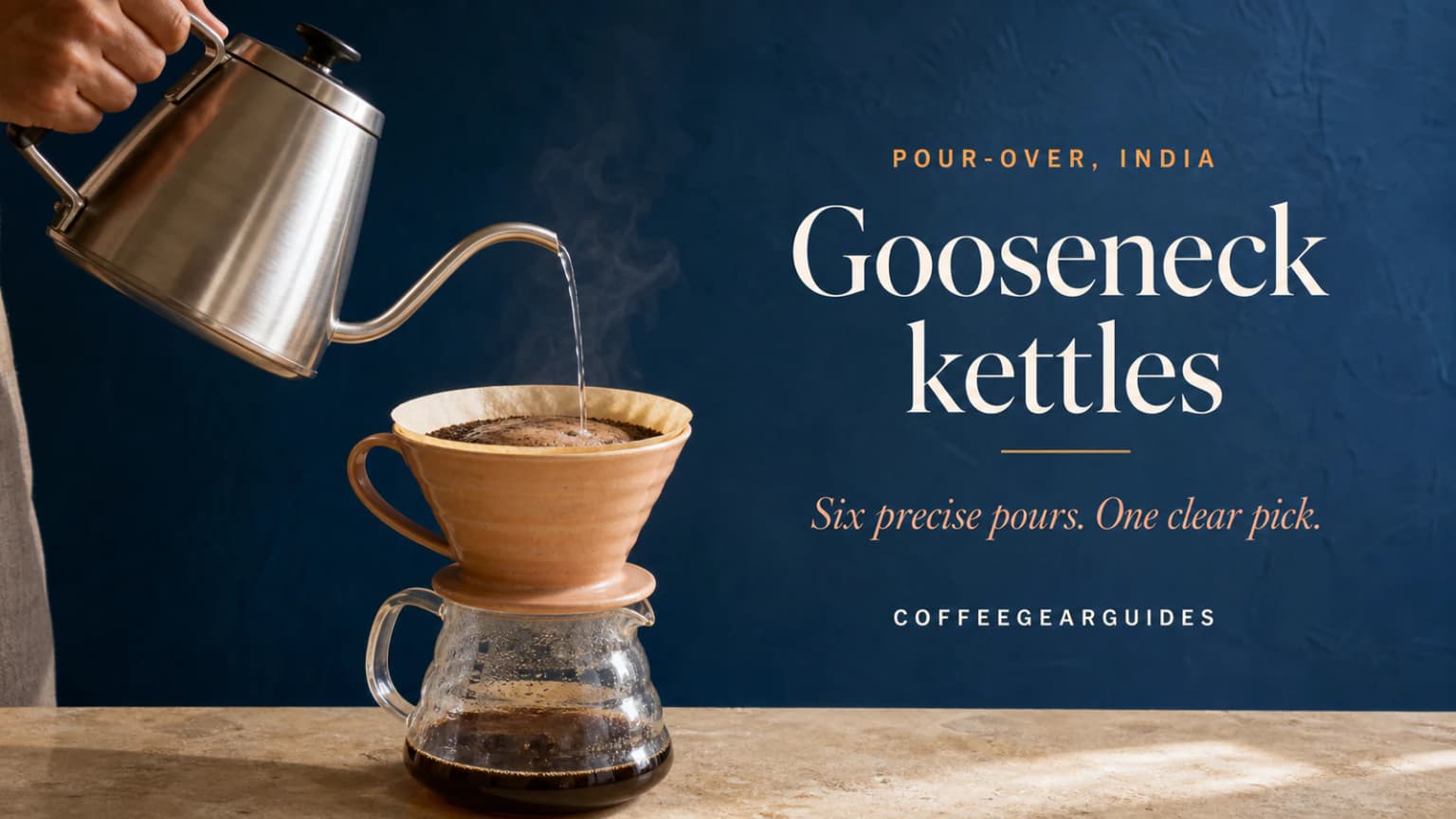
Gooseneck Kettles in India: 6 Picks and Who Really Needs One in 2026
We checked 14 gooseneck kettles on Amazon India and kept six for 2026, ₹1,596 to ₹6,861, with the altitude rule that decides if you need a thermostat.
By the CoffeeGearGuides team · India · Updated Aug 17, 2026 · 36 min read
On this page18
The best gooseneck kettle in India for most people is the HARIO V60 Buono, at ₹4,249 with 4.5 stars from 10,600 owner ratings.
That answer comes more easily than it should. Two names carry almost all the owner evidence on this shelf, and the rest of it is noise.
A gooseneck kettle is a kettle with a long, curved, narrow spout that pours a thin, steerable stream. Indian listings also sell it as a drip kettle, a goose neck kettle or a swan neck kettle.
Pour-over brewing needs that control. Almost nothing else in an Indian kitchen does.
The category splits in two. Stovetop kettles pour beautifully and leave the temperature to you, while electric ones add a thermostat and a powered base.
We checked every gooseneck listing we could find in stock on Amazon India through Amazon's own product API, then read the rating and review base behind each one.
Fourteen candidates went in and six came out. Three of the eight we cut sat below 4.0 stars, three carried no owner ratings at all, and one held a perfect 5.0 built on two reviews.
This 2026 guide covers the six that survived, what each one is genuinely for, and why the kettle matters far less than the shop selling it wants you to think.
How we chose these six kettles for 2026
We research rather than test, and we would rather say that plainly than pretend otherwise. You can read exactly how we work on our about page.
For this guide that meant three passes. First, every gooseneck kettle listed on Amazon India, filtered to what was actually in stock with a live price.
Second, the rating and review count behind each listing, read on the day we published rather than copied from another article.
Third, the reputation trail: expert reviews of the models sold worldwide, long-term owner reports, and the complaints that only show up after a year of use.
We paid the most attention to three-star reviews, because that is where owners describe a real flaw without either rage or excitement.
Four rules decided the final list. Nothing under 4.0 stars stayed, whatever the brand.
Nothing with a token review base stayed either, and we give each pick's exact number in its own section so you can weigh it yourself.
Nothing entered the list because it filled a price gap, and one kettle we liked was cut for being beaten by a near-twin.
And nothing here is ranked on specifications alone, because a specification is a claim and a review base is a record.
Ratings and review counts were read at the time of writing. Prices move constantly here, so the buttons on this page show the current figure.
Electric or stovetop gooseneck kettle?
Every kettle in this guide pours the same shape of stream. The split is whether the kettle knows how hot the water is, and at the entry level that decision costs about ₹2,100.
A stovetop gooseneck kettle is a pouring tool. It sits on your gas ring or induction hob, boils, and leaves the temperature judgement to you or to a thermometer.
An electric gooseneck kettle is a pouring tool with a thermostat. You set a number, it reaches it, and the better ones hold it while you brew.
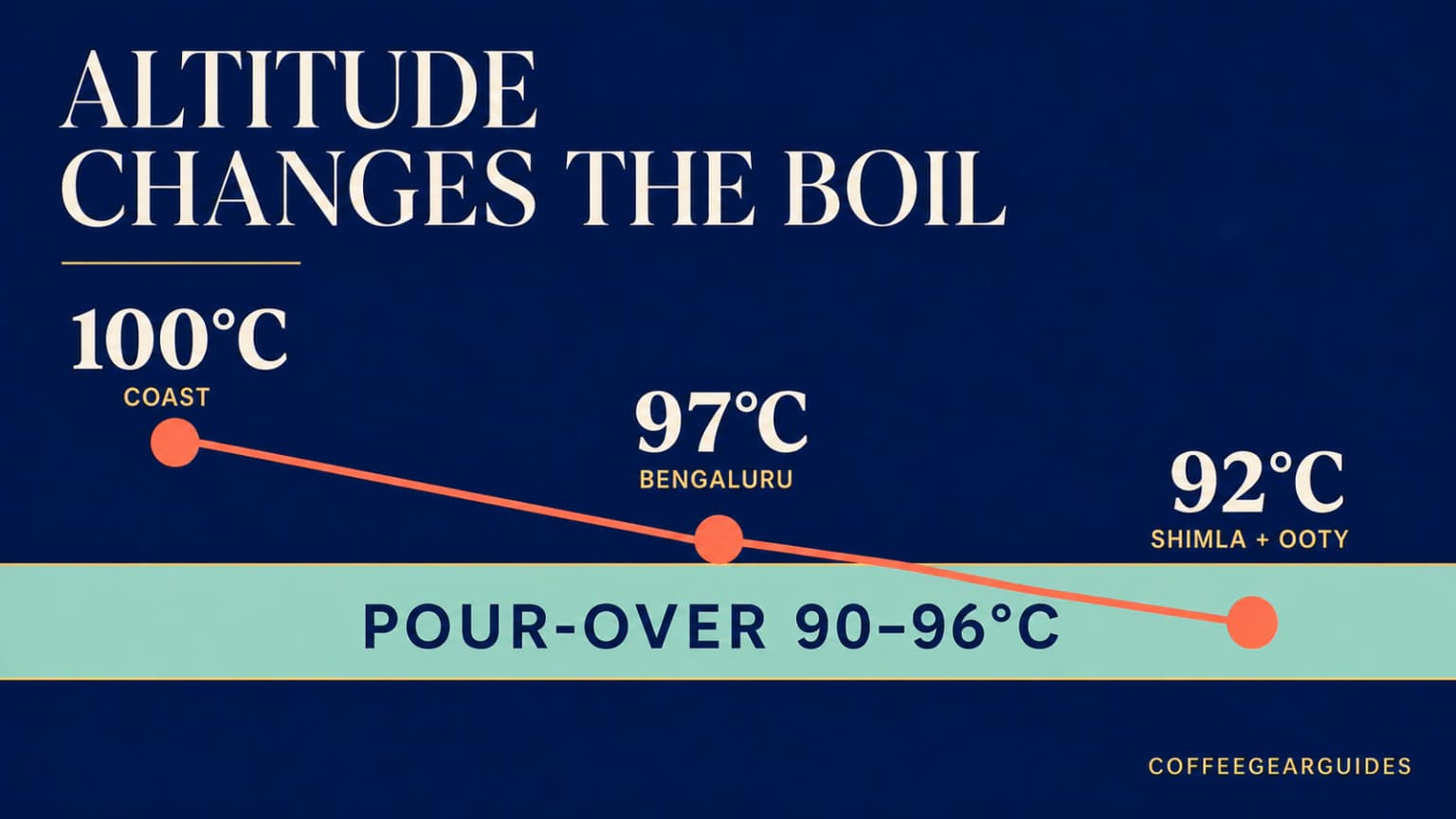
Here is the part nobody selling these kettles mentions. Water does not boil at 100°C in most of India, and pour-over coffee wants roughly 90°C to 96°C.
Boiling point falls by about 1°C for every 300 metres of altitude, so where you live decides how much work a thermostat has to do.
Altitude sets your starting temperature. The brewing band is the same everywhere; the distance to it is not.
In Chennai, Mumbai or Kolkata, water leaves the kettle at about 100°C, comfortably above the band. You wait a minute, or you measure.
In Bengaluru, at roughly 920 metres, water boils at about 97°C. Pour after half a minute of standing and you are inside the window without owning a thermometer at all.
Above 2,200 metres in Shimla or Ooty, water boils at about 92°C, which is the bottom of the band or under it. No kettle can heat water past its own boiling point, so a hill kitchen brews straight off the boil and adjusts the grind instead.
Two kettles, two different jobs
Two kettles, two different jobs
What you are weighing
Stovetop
Electric with control
What it controls
The stream, and a gauge at best
The stream and the temperature
Price on Amazon India
₹1,596 to ₹5,212
₹3,699 to ₹6,861
You also need
A thermometer, or patience
A free socket and counter space
Delicate tea
Guesswork
Set 80°C and forget it
What can fail
Almost nothing
Board, sensor, base contacts
Suits you if
Coffee is the only reason
The household drinks tea too
Price bands cover the six kettles in this guide, at their Amazon India prices when we published.
If you read that table and thought a thermometer sounds fine, buy stovetop and spend the difference on beans.
If your house drinks green or oolong tea as well as coffee, the electric kettle earns its price on the tea alone.
Either way, the kettle only matters if the grind underneath it is even. Our burr grinder guide for India covers that half of the setup.
The 6 best gooseneck kettles in India
The lineup runs from the kettle with the most owner evidence in the category to the cheapest way to get a temperature you can set. Every link was checked live and in stock on the day we published.
Ratings and review counts read on Amazon India at the time of writing. Prices move; the buttons show today's. Amazon.in prices as of 15/09/2026. Details
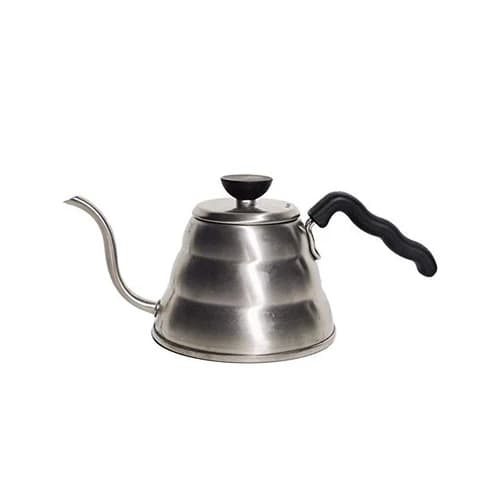
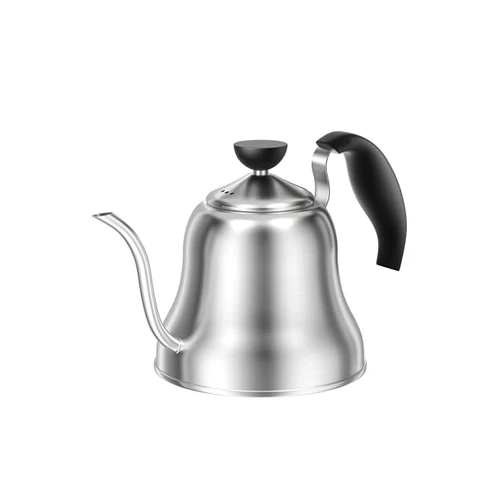
1. HARIO V60 Buono Drip Kettle 1L
Ask anyone brewing pour-over in India what they pour with, and this is the kettle they name.
The V60 Buono is the reference point for the whole category, and its 10,600 ratings at 4.5 stars are not a marketing claim.
They are the largest owner sample behind any gooseneck kettle sold here, nearly three times the next-biggest and a hundred times everything below it.
The design has barely changed in years because it did not need to. Its spout leaves the body low, which keeps the stream steady as the kettle empties, and the stepped body is stable on a ring.
The listing states it is designed and manufactured in Japan, and that it suits any cooking surface including induction.
HARIO V60 Buono Drip Kettle 1L
Rated 4.5 from 10,600 ratings
The kettle the pour-over world settled on: a slender gooseneck spout, a stable stepped body, and stainless steel that works on gas and induction.
Key details
Slender gooseneck spout for a slow, controlled stream
Stainless steel body with an ergonomic handle
1 litre stated capacity
Suits any cooking surface including induction, per Hario
Designed and manufactured in Japan, per the listing
Made to pair with the Hario V60 ceramic dripper
What we like
10,600 ratings at 4.5 stars, by far the deepest evidence here
Stream stays predictable through most of the pour
Nothing electrical, so nothing electrical can fail
The spare parts and community knowledge exist worldwide
Watch out for
No temperature reading of any kind, so you judge or measure
No whistle and no auto shut-off, so it is easy to forget
Owners report the usable fill is short of the stated litre
Read the critical reviews and the same two notes recur. The kettle has no whistle and no shut-off, so it will happily boil dry if you walk away.
And the stream turns less predictable once the kettle is nearly empty, which is a physics problem rather than a fault: less water above the spout means less pressure behind it.
The honest weak point is that it tells you nothing about temperature. On a coastal hob you will overshoot the brewing band every single time unless you wait or measure.
That is a ₹200 thermometer away from being solved, and if you live in Bengaluru it barely matters at all.
Buy the Buono if you brew V60 or a flat-bottom dripper and want the pouring problem finished permanently.
It is the only kettle here whose rating rests on a sample large enough to be boring, and boring is exactly what you want from evidence.
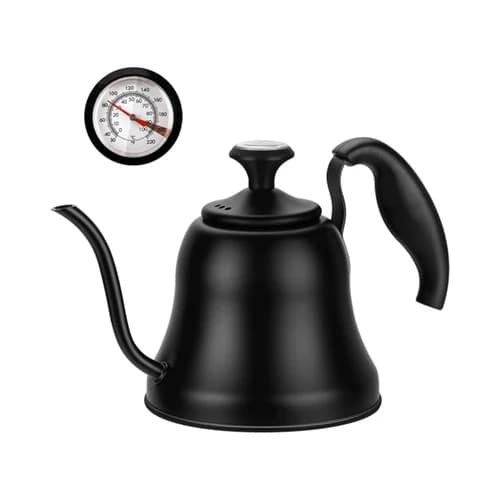
2. Chefbar Gooseneck with Thermometer
The Chefbar thermometer kettle answers the one complaint every stovetop gooseneck owner eventually has: the kettle pours beautifully and tells you nothing.
A dial thermometer sits in the lid, reading the water while it heats, and 3,824 owners rate this listing at 4.4 stars. That is the second-largest review base in this category by a wide margin.
The rest is a conventional matte black gooseneck, and the listing says its base suits gas, induction and electric hobs alike.
Chefbar's own bullets call it a 0.8 litre, 28 oz, four-tea-cup kettle, and they recommend filling it to about 80 percent to avoid overflow. That works out to a comfortable two cups per boil.
Chefbar Gooseneck Kettle with Thermometer (28oz)
Rated 4.4 from 3,824 ratings
A matte black stovetop gooseneck with a dial thermometer in the lid, so the kettle answers the temperature question without a probe or a wait.
Key details
Integrated dial thermometer built into the lid
Precise gooseneck spout for controlled pouring
0.8 litre stated, 28 oz, about four tea cups
Heat-resistant Bakelite handle that lifts clear of steam
Suits induction, electric and gas hobs per the listing
Matte black finish over stainless steel
What we like
4.4 stars from 3,824 ratings, second only to the Hario here
The gauge removes the guesswork a stovetop kettle normally leaves you
Costs ₹1,649 less than the electric kettle we recommend
Nothing electrical, so nothing electrical can fail
Watch out for
Shares one pooled review base with its sibling listing
A lid gauge reads the water, not the exact brewing temperature at the spout
The lid should not be soaked or put through a dishwasher
One disclosure before you weigh that rating. Both Chefbar listings on Amazon India report the identical 4.4 stars from 3,824 ratings, which means the two share a single pooled review base.
Amazon India does this across variants of the same product family, so treat the number as evidence about Chefbar's gooseneck kettles in general rather than about this exact version.
The honest limitation is the gauge itself. A dial in the lid reads the body of the water, which is not quite the temperature arriving at the coffee, and it responds slowly as the kettle cools.
Treat it as a guide that gets you inside the brewing band, not as a laboratory instrument. That is still an enormous improvement on guessing.
Buy this one if you want a stovetop kettle and you live where boiling water overshoots the band, which is most of coastal India.
It is the kettle we would hand to anyone who wants the pour solved and the temperature answered without needing a socket.
3. Chefbar Pour Over Gooseneck
The plain Chefbar is the same idea in brushed steel, without the thermometer, for ₹807 less.
It carries the same 4.4 stars from the same 3,824 ratings, because it is the sibling listing sharing that pooled base.
Its feature bullets are word for word the ones on the thermometer version, and that matters when you read the page.
The listing title says 40 oz and 1.2 litres, while the listing's own bullets describe a 0.8 litre, 28 oz kettle.
We have gone with the bullets, because they are the more specific claim and they match the sibling exactly. Expect the smaller kettle, and treat the title as optimistic.
Chefbar Pour Over Gooseneck Kettle (brushed steel)
Rated 4.4 from 3,824 ratings
The thermometer kettle without the thermometer, in brushed stainless steel, for ₹807 less. The right pick if you already own a probe.
Key details
Precise gooseneck spout for controlled pouring
0.8 litre per the listing bullets, about four tea cups
Brushed stainless steel body
Heat-resistant Bakelite handle that lifts clear of steam
Suits induction, electric and gas hobs per the listing
Recommended fill is about 80 percent to avoid overflow
What we like
The cheapest well-reviewed stovetop gooseneck after the HASTHIP
Same pouring hardware as the thermometer version
Sensible choice if you already own a thermometer
Brushed steel hides marks better than matte black
Watch out for
The listing contradicts itself on capacity, 40 oz against 0.8 litre
No temperature reading at all
Its review base is pooled with the sibling, not independent
The decision between the two Chefbars is the one this whole guide keeps circling.
For ₹807 you buy the answer to the temperature question.
If you already own a probe thermometer, or you live high enough that boiling water is already at the bottom of the band, save the money and take this one.
If you do not, spend the ₹807. It is the cheapest temperature reading on this page, and the whole kettle still lands ₹1,649 below the Sipologie Precision.
One caution applies to both Chefbars. They ship through the same marketplace merchant rather than a brand storefront, so treat after-sales as a returns window.
Buy the plain version only if you prefer its shape or its steel finish. At ₹4,405 it costs ₹156 more than the Buono, which has nearly three times the owner evidence behind it.
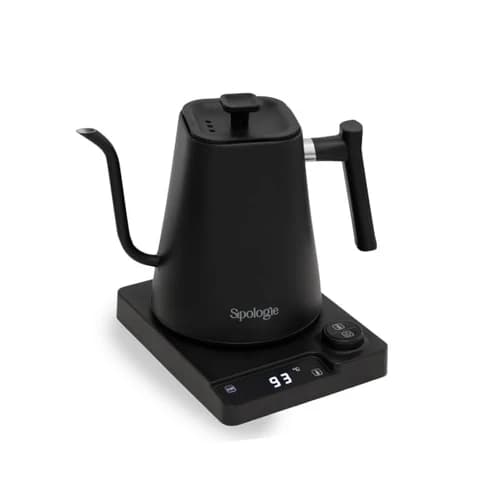
4. Sipologie Precision Gooseneck 1000ml
The Sipologie Precision is the kettle for a household where coffee is not the only thing being brewed.
This temperature control kettle sets any figure between 40°C and 100°C in single-degree steps, holds it, and shows target and actual temperature on one display.
At the time of writing it holds 4.3 stars from 51 ratings.
Sipologie is one of the few Indian specialty coffee brands selling its own hardware here.
Its listing also does something unusual: it publishes a flow rate, roughly 2 to 6 ml per second depending on how far you tilt.
Nobody else in this category publishes that number, and it is the number that describes what a gooseneck actually does.
Sipologie Precision Electric Gooseneck Kettle 1000ml
Rated 4.3 from 51 ratings
Single-degree temperature control from 40°C to 100°C, a dual display showing target and actual, and a water path with no plastic in it anywhere.
Key details
Any temperature from 40°C to 100°C in 1°C steps
Dual display shows target and actual temperature together
Keep warm holds the temperature after the boil
Body, lid and spout all 304 stainless, no plastic contact
1200W element, stated flow of roughly 2 to 6 ml per second
Auto shut-off, boil-dry protection, one year warranty
What we like
Single-degree control suits green tea as well as coffee
Seeing target and actual at once removes the guesswork
No plastic touching water, which few kettles here can claim
Sold and warranted in India rather than parallel imported
Watch out for
Only 51 ratings behind it, a small sample to lean on
The most expensive kettle in this guide by some margin
Needs a socket and permanent counter space for its base
We want to be straight about the evidence. Fifty-one ratings is a thin base next to the Buono's 10,600, and we would normally want more before recommending a ₹6,861 purchase.
It stays because the 4.3 average is consistent, the specification is unusually specific rather than vague, and the brand is reachable in India if something goes wrong.
The stainless water path deserves its own mention. Most electric kettles in Indian kitchens have a plastic lid, a plastic window or a plastic filter sitting in the water, and this one does not.
Whether that matters to you is a personal call, but it is a real construction difference rather than a marketing line.
Buy the Precision if the household drinks delicate teas too, or if you want one number set and held every morning without a probe or a wait.
If coffee is the only reason you are here, the extra ₹2,600 over the Buono buys convenience rather than a better cup.
5. HASTHIP Gooseneck Kettle 1200ml
The HASTHIP 1200ml is the answer to a specific question: what if the budget is ₹2,000 and the pour still has to be good?
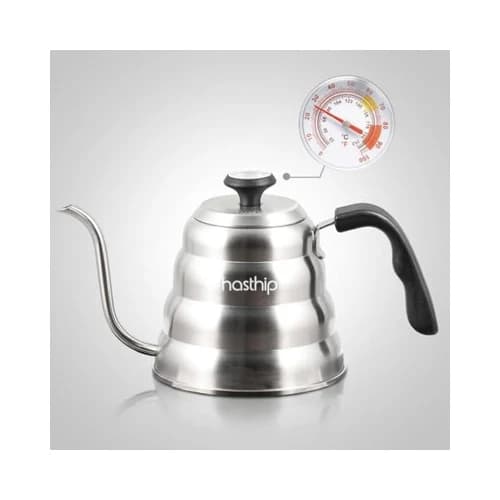
It is a plain stovetop gooseneck with a thermometer set into the lid, and 103 owners hold it at 4.3 stars, which is a real review base rather than a token one.
That thermometer is what makes it interesting at the price. It converts the cheapest kettle here into one that answers the temperature question without a separate probe.
It is also the largest stovetop on the list at 1.2 litres, which suits brewing two or three cups in one go rather than one at a time.
HASTHIP Gooseneck Kettle 1200ml with Thermometer
Rated 4.3 from 103 ratings
The budget entry that still answers the temperature question: a 1.2 litre stovetop gooseneck with a thermometer built into the lid.
Key details
Stovetop gooseneck kettle, 1200ml capacity
Thermometer set into the lid
Long narrow spout for a controlled pour
Largest stovetop capacity in this guide
The lowest price in this guide by a wide margin
Nothing electrical to fail or to plug in
What we like
103 ratings at 4.3 stars, solid evidence at this price
The thermometer removes the main weakness of a cheap kettle
1.2 litres brews for two or three people in one fill
Costs less than half the cheapest electric kettle here
Watch out for
A marketplace listing rather than an established brand
The listing publishes very little detail beyond the basics
A full 1.2 litres is heavy to pour steadily with one hand
Be clear-eyed about what this is. HASTHIP is a marketplace label rather than a coffee brand, and the listing publishes almost nothing beyond capacity, material and the thermometer.
We have not repeated any specification the seller does not state, which is why this section is shorter on numbers than the others.
The practical weakness is weight. A 1.2 litre kettle filled to the top is heavy, and a slow controlled pour is harder when your wrist is working.
Fill it to two-thirds for pour-over and use the extra capacity when you are brewing for the house.
Buy the HASTHIP if you want to find out whether pour-over is your thing before spending real money on it.
At ₹1,596 the experiment is cheap, and the thermometer means you learn the temperature lesson at the same time.
6. Supvox Electric Gooseneck 1L
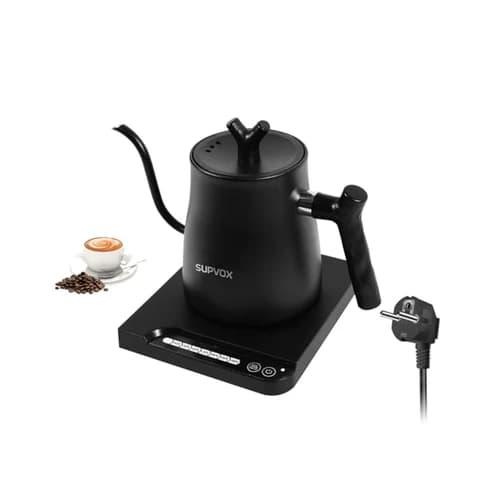
The Supvox electric exists to answer one question: what is the cheapest way to set a temperature and have the kettle hold it?
At ₹3,699 it undercuts the Sipologie Precision by more than ₹3,000, and 56 owners rate it at 4.0 stars.
It works from seven preset buttons rather than a dial, so you pick from a fixed set of temperatures instead of naming any number you like.
For coffee that is no real loss, because you only ever want two or three settings. For tea it means living with whatever presets the maker chose.
Supvox Gooseneck Electric Kettle 1L
Rated 4.0 from 56 ratings
The cheapest way onto the electric side of this category: seven preset temperatures, a long keep-warm, and a 1 litre stainless body.
Key details
Electric gooseneck kettle with its own powered base
Seven temperature preset buttons
Keep warm function rated up to 24 hours
1 litre capacity, 1000W element
304 stainless steel construction
Gooseneck spout for controlled pour-over flow
What we like
Temperature control for roughly half the Sipologie price
Long keep-warm suits a household that brews through the day
1 litre covers two or three brews per fill
No hob needed, so it can live anywhere with a socket
Watch out for
4.0 stars from 56 ratings is the weakest evidence here
Presets only, so no single-degree control
An unbranded marketplace import with a thin support trail
This is the pick we argued about most, so here is the reasoning in the open. A 4.0 average is the lowest rating on this page, and it sits right on our cut-off rather than comfortably above it.
It stays because it is the only kettle that makes temperature control affordable, and cutting it would have left a ₹3,000 hole with nothing honest to fill it.
The other caution is support. Supvox is a marketplace label shipping through a third-party seller, and the listing states no warranty term at all.
Electric kettles fail at the control board and the base contacts, which are exactly the parts an unbranded import gives you no route to repair.
Buy the Supvox if temperature control is the feature you want and ₹6,861 is not a number you are willing to reach. Go in knowing the evidence is thin and the support is thinner, and keep the invoice.
What a gooseneck spout actually does
A gooseneck is not a style choice, and the difference it makes is mechanical rather than mystical.
Two things separate it from the kettle already in your kitchen, and only one of them is the shape.
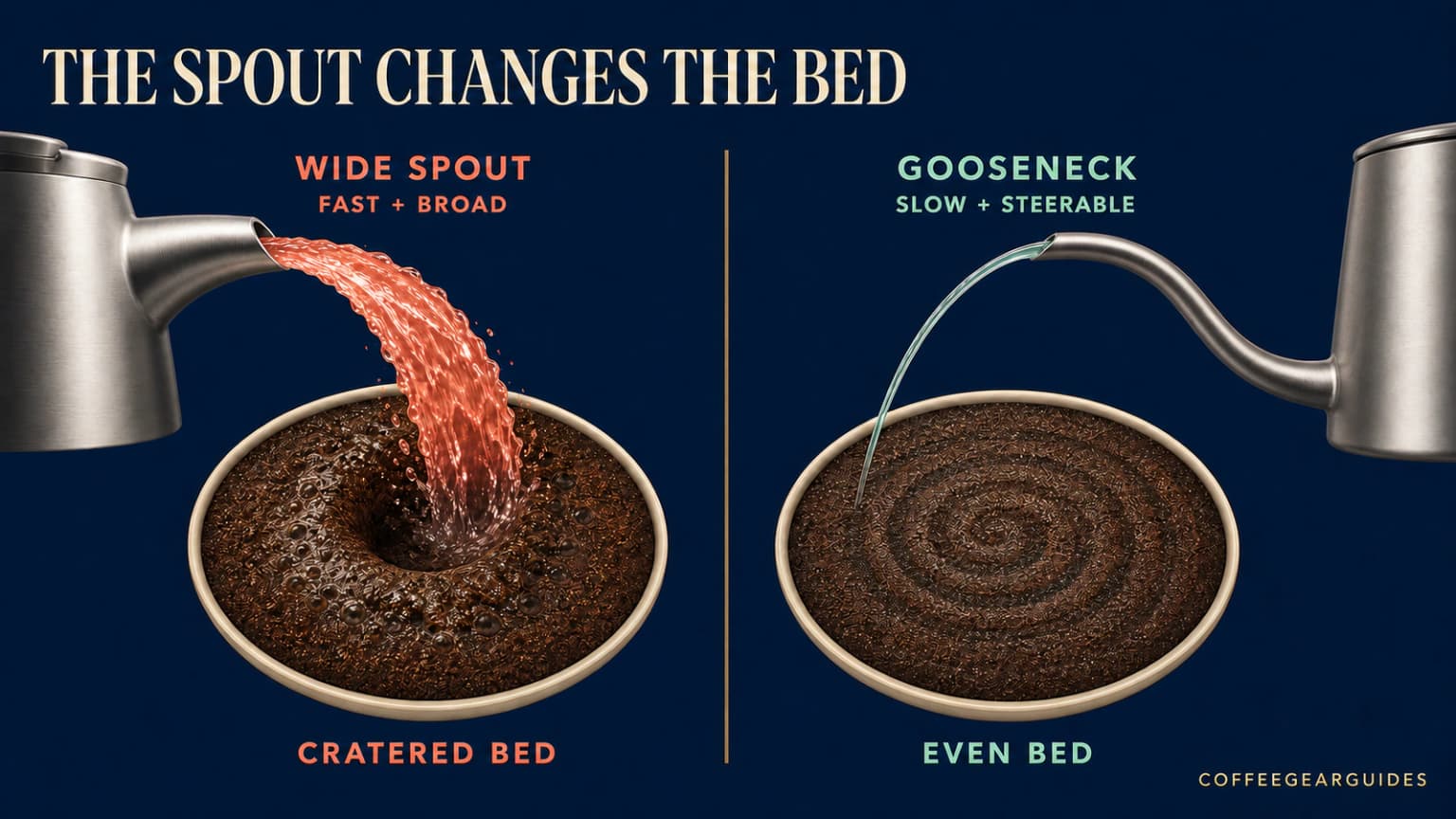
Same water, same height, two different results on the bed. The bore and the exit height do the work.
The first is the bore, the internal diameter of the spout.
A narrow bore turns a given tilt into a thin stream you can steer onto one part of the coffee bed, rather than a broad one that lands wherever it lands.
The second is where the spout leaves the body. On a gooseneck it exits low, so the water above it keeps pushing at a fairly even pressure as the kettle empties.
On a household kettle the spout leaves high and wide, which is why the first pour gushes and the last one dribbles.
What that means in the cup is straightforward.
A fast, wide stream digs a crater in the bed, throws grounds up the paper where water never reaches them again, and drains through the channel it dug.
A slow, steerable stream wets the whole bed evenly, and an even extraction is what gives you sweetness before bitterness.
That is why a Chemex, a Hario V60 and a Kalita Wave all ask the same thing of a kettle, and why a French press asks nothing at all.
The number that describes all of this is flow rate, and almost nobody publishes it. Sipologie is the exception at roughly 2 to 6 ml per second.
You can measure your own in half a minute. Put a jug on a kitchen scale, tare it, pour at your normal brewing angle for ten seconds, and divide the grams by ten.
Under about 5 g per second is controllable. Above 10 and you are emptying a kettle rather than steering a stream.
Two things you are unlikely to read on a listing change that number as you brew. The first is how full the kettle is.
Water sitting above the spout is what pushes the stream out, so filling to about two-thirds gives you the steadiest stretch of the pour.
The second is where the handle sits. A handle set well behind the body lets you tip with your wrist rather than your whole arm, and a wrist makes far smaller corrections than an arm does.
That is why a 600ml kettle often pours better than a 1.2 litre one in the same hands. It is not the capacity, it is the weight hanging off your wrist at the moment you need to slow down.
What each brewer asks of the pour
What each brewer asks of the pour
Brewer
Pour control needed
Why
V60 or cone dripper
High
A cone drains fast and punishes an uneven bed
Flat-bottom dripper
Moderate
More forgiving, but still wants a level bed
French press
None
Everything steeps together regardless of the pour
Moka pot
None
Water arrives from below, under pressure
South Indian filter
None
You fill the upper chamber and walk away
Drip machine
None
The machine owns the pour, not you
If your brewer is in the bottom four rows, a gooseneck kettle changes nothing about your coffee.
Read that table before you spend anything. Three of India's most common brewing methods gain nothing at all from a gooseneck, and a shop is never going to be the one to tell you.
If a stovetop pot is what you actually brew on, the money belongs there instead. Our moka pot guide for India ranks those by the hob you own rather than the pour.
What the review counts really say
The numbers we collected turned out to be more useful than any specification on this page. If you read nothing else here, read this part.
We checked fourteen gooseneck kettles that Amazon India had in stock.
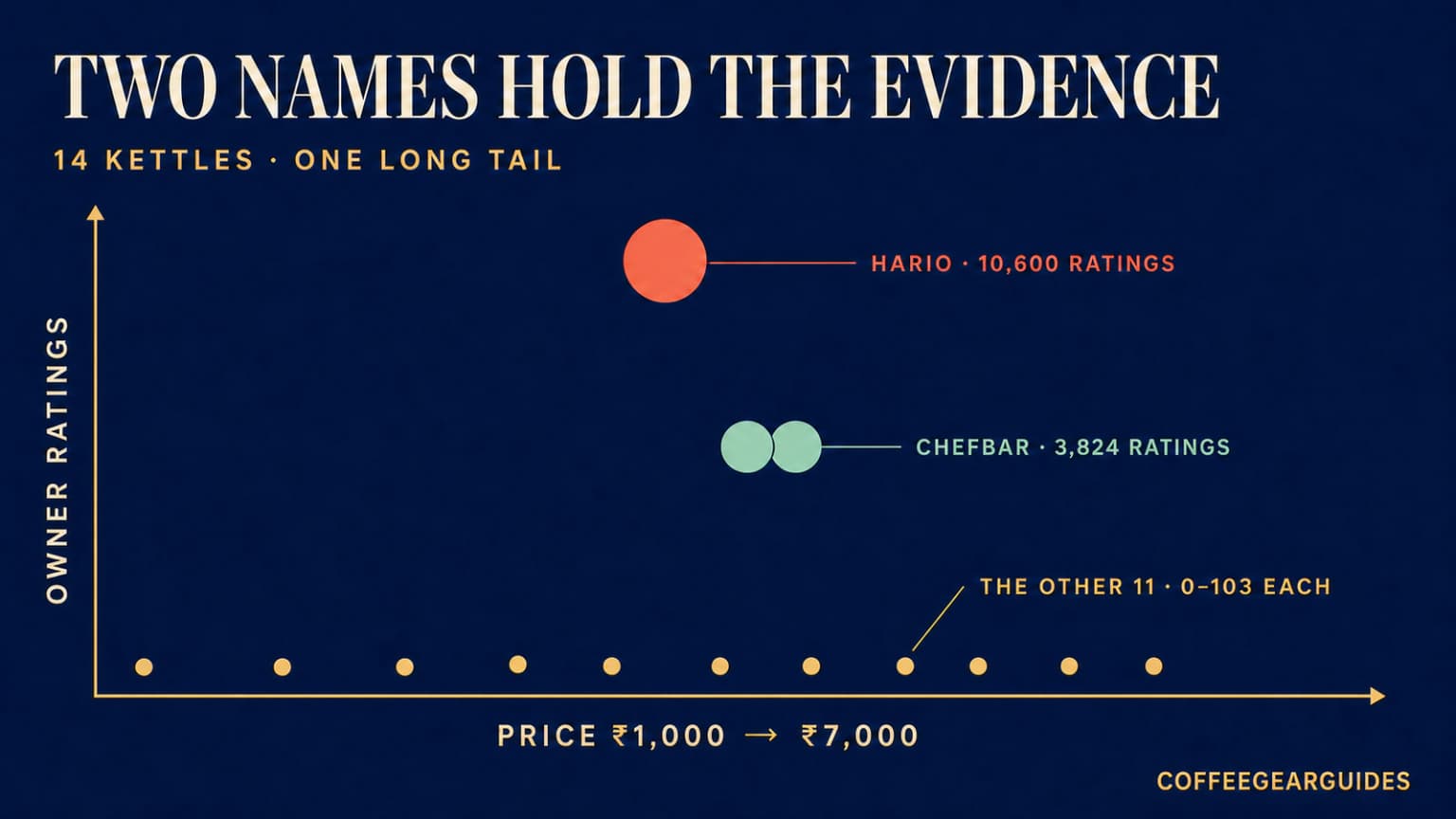
Every in-stock gooseneck kettle we checked, plotted by price and by how many owners rated it. Almost all the evidence sits on two names.
The Buono carries 10,600 ratings, and the two Chefbar listings share 3,824 between them. After those two names, the category falls off a cliff.
The next best is the HASTHIP at 103. Then 56, then 51, and then nothing at all.
Eight candidates did not make it. Three came in under 4.0 stars: a 1.5 litre stovetop at 3.8 from 26 ratings, an electric at 3.8 from 4, and a well-specified kettle from a brand we like at 3.6 from 6.
Three had no ratings whatsoever, including a ₹4,999 model with a genuinely clever preset system.
One held a flawless 5.0 average built on two ratings, which is the most misleading number on the whole shelf.
Two reviews cannot tell you anything. A single unhappy owner would drop that 5.0 to 3.7, so it is noise wearing the costume of a perfect score.
A 4.3 from 103 owners is worth more than a 5.0 from two, every time, and it is worth more than a 4.8 from nine.
The eighth was a good kettle beaten on the numbers: a 600ml stovetop with a lid thermometer, 4.2 stars from 64 ratings, priced ₹1,055 above a Chefbar with sixty times the owner evidence.
Nothing was wrong with it. It simply had a better-documented near-twin that costs less, and we would rather say so than pad this list to seven.
Pooling is the last thing to understand, and this shelf happens to show both behaviours at once.
The two Chefbar listings report identical figures, 4.4 stars from 3,824 ratings, so Amazon India is pooling one review base across both.
That is useful evidence, but it is one verdict rather than two.
The two Hario listings do the opposite.
The 1 litre version carries 10,600 ratings and the 1.2 litre version carries two, so those are separate records and only one of them is worth buying.
Assuming either behaviour would have misled us. The only way to know is to open both listings and compare the numbers.
Finally, the guide that currently ranks at the top of this search recommends a Fellow Stagg and a Bonavita. Neither is sold on Amazon India at all.
The one Brewista listing we found was priced at ₹48,562 and out of stock. Advice you cannot act on is not advice, which is why this guide only lists what was in stock the day we published it.
You can run the same check yourself before any accessory purchase here.
Look at the number of ratings before the average, and treat anything under about fifty as a hint rather than a verdict.
Then open the three-star reviews first, because that is where flaws get described without drama.
Last, look at the dates. A cluster of glowing reviews inside one week, followed by silence, usually says more about how a listing was promoted than about how the kettle pours.
Counter fit, cleaning and the water path
Four practical things decide whether a kettle stays on the counter or moves to a cupboard, and none of them appears in a specification table.
Start with the base. An electric gooseneck needs its powered base, a socket within reach, and permanent counter space, so measure the base rather than the kettle.
A stovetop kettle can live on a shelf and come out when you brew, which in a small Indian kitchen is often the deciding factor.
Then the water path. The Sipologie Precision states an all-304-stainless body, lid and spout, while most electric kettles here put a plastic lid, window or filter in hot water daily.
Plastic is also where scale announces itself first. A clouded sight window is visible in a way a filmed steel wall never is, so check the lid and the filter rather than the body alone.
Last, and least considered, is the part you cannot reach. No brush fits inside a gooseneck spout, so it is the one section of the kettle you will never scrub.
In much of India that is exactly where scale appears first, as a chalky narrowing you notice only when the pour goes strange. The descaling routine near the end of this guide deals with it.
Capacity deserves more thought than it usually gets, because the number on the listing is not the number you will use.
A single cup takes about 290 g of brew water, and rinsing the paper first takes another splash on top of that. Two cups need roughly 600 g, and a jug for four wants a full litre.
Size the kettle for the biggest brew you actually make, then fill it to two-thirds each time. The pour stays steady that way, and you are not boiling a litre for one cup every morning.
The case against a gooseneck kettle
We would be writing a sales page rather than a guide if we skipped this, so here is the argument against everything above.
Almost every Indian kitchen already owns an electric kettle costing ₹500 to ₹1,000. A probe or clip-on thermometer costs a couple of hundred rupees more.
That combination solves the temperature problem completely. It does not solve the pouring problem, but it is worth understanding exactly how much of the result the pouring problem owns.
Grind consistency and coffee freshness account for most of what is wrong with a bad home cup. Water temperature comes next. Pour technique comes after both of them.
So the honest order of spending is a burr grinder first, then better beans, then a kettle. We rank eight burr grinders sold in India by what you brew, which is the page to read first if you are still choosing one.
There is also the decanting trick, which costs nothing. Boil in the kettle you own, pour into a small stainless jug with a narrow lip, and pour from that.
It is slower, it drops the temperature by a few degrees, and it genuinely improves an uneven pour. Try it for a week before spending ₹4,000 to find out whether pour-over is a habit or a phase.
Our position is this. If you brew V60 or a flat-bottom dripper daily, a gooseneck is the cheapest remaining upgrade and it fixes a variable nothing else can.
If you brew anything else, or you brew pour-over twice a month, the kettle is jewellery. Excellent jewellery, and still jewellery.
And if the ritual was never the appeal, a capsule machine removes the grind, the pour and the kettle in one purchase, at a cost per cup you should read before you commit.
Where your brewing money should go
Kettles cost almost nothing to run. Heating a litre of water from room temperature to boiling takes roughly 0.09 kWh of heat energy.
After real-world losses that is well under a rupee of electricity, and doing it on a gas ring works out at about the same.
There is no filter to replace, no cartridge, no cleaning tablet. Citric acid for descaling costs a few rupees a month.
So the entire cost of a kettle is the purchase, which turns the question into a better one: out of the money you are spending on brewing, how much of it should be the kettle?
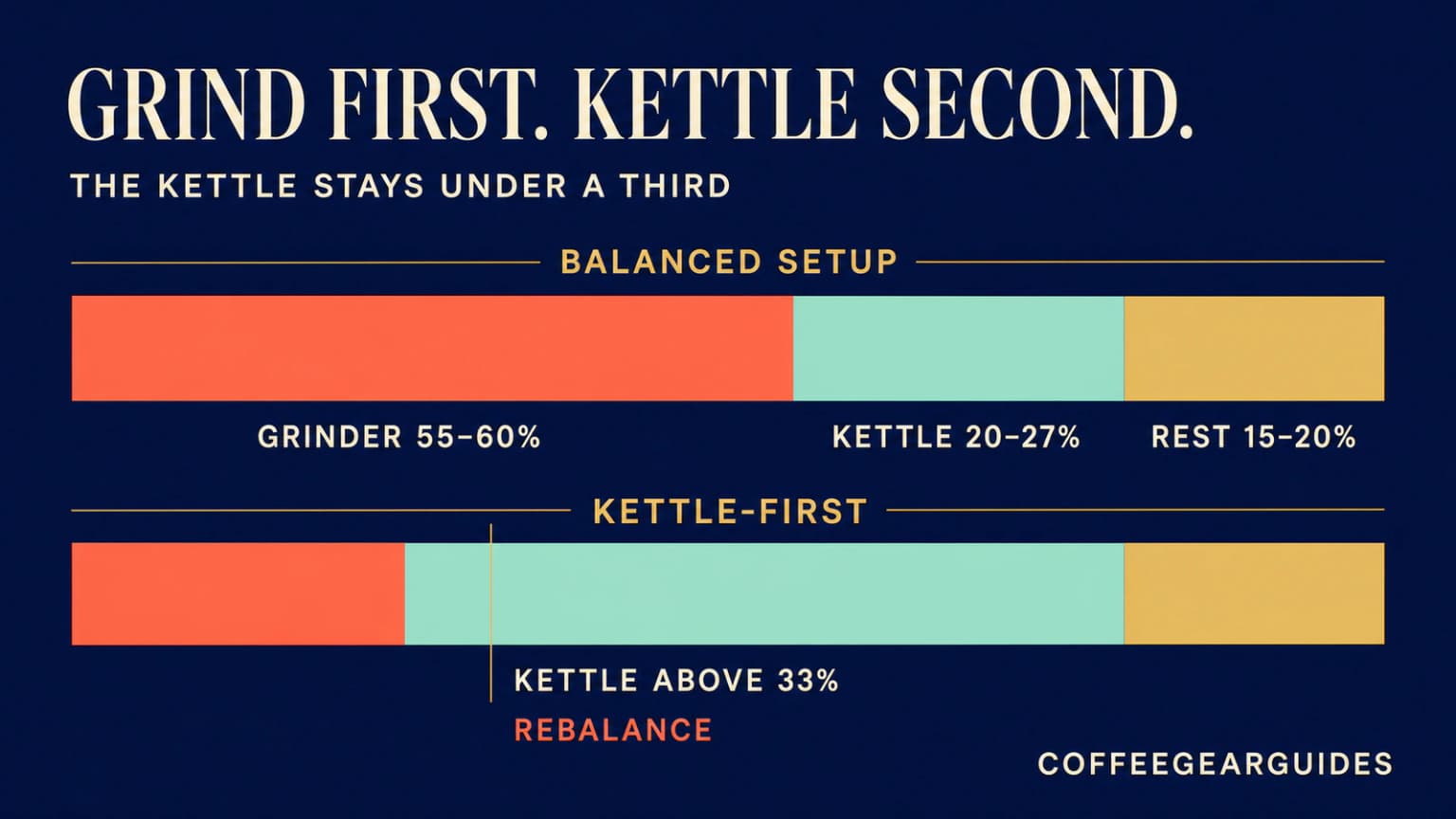
The kettle should be about a quarter of the hardware spend. Past a third, the money is in the wrong object.
Building a pour-over setup here, two ways
Building a pour-over setup here, two ways
What you buy
Around ₹8,000
Around ₹16,000
Why it matters
Burr grinder
₹4,990
₹8,963
Decides most of the cup, so it goes first
Gooseneck kettle
₹1,596
₹4,249
Decides the evenness of the pour
Dripper
₹399
₹499
Cone or flat-bottom, both are cheap
Filter papers
₹399
₹399
A hundred sheets lasts months
Scale with timer
₹799
₹1,899
Repeatability, and it measures flow rate too
Kettle as a share
About 20%
About 27%
Past a third, rebalance towards the grinder
Component prices are live Amazon India figures at the time of writing, taken from the categories we have researched.
The pattern in that table is the whole argument. In both builds the grinder costs two to three times the kettle, and that ratio separates a setup that tastes good from one that photographs well.
If you are looking at a kettle that costs more than your grinder, close the tab and buy the grinder twice as good instead.
That is also the argument for starting on the HASTHIP rather than the Chefbar with a thermometer. The ₹3,616 between them buys a great deal more grinder than it buys kettle.
Water is the one input worth spending on beyond the hardware. Coffee is about 98 percent water, so what comes out of your tap is most of what you taste.
In a hard-water city, a filter jug or the filtered tap you already have does more for the cup than moving up a kettle tier.
Very soft or heavily softened water is its own problem, because coffee needs some mineral content to taste like anything.
The practical version is simple. Brew with the same water you would happily drink cold, avoid RO water with nothing added back, and change filter cartridges on schedule rather than when you remember.
When to buy
Gooseneck kettles are discounted heavily and often, which makes the sticker price nearly meaningless here.
On the day we checked, the Buono was listed with 27 percent off, the HASTHIP with 40 percent off, the Supvox with 22 percent off, and even the Sipologie carried 14 percent.
Those cuts deepen around the Great Indian Festival and Prime Day, and again in the Republic Day sales.
If the kettle you want is not discounted and no sale is close, waiting a few weeks costs you nothing.
One caution about very cheap listings. Below about ₹1,000 the goosenecks on Amazon India are 350ml miniatures, several of them carrying no ratings at all, and 350ml is not enough water to brew a cup.
How to pour with a gooseneck kettle
Owning the kettle is the easy part. Below is the routine that turns it into better coffee, written for one cup.
It is the same sequence a cafe barista follows, minus the theatre.
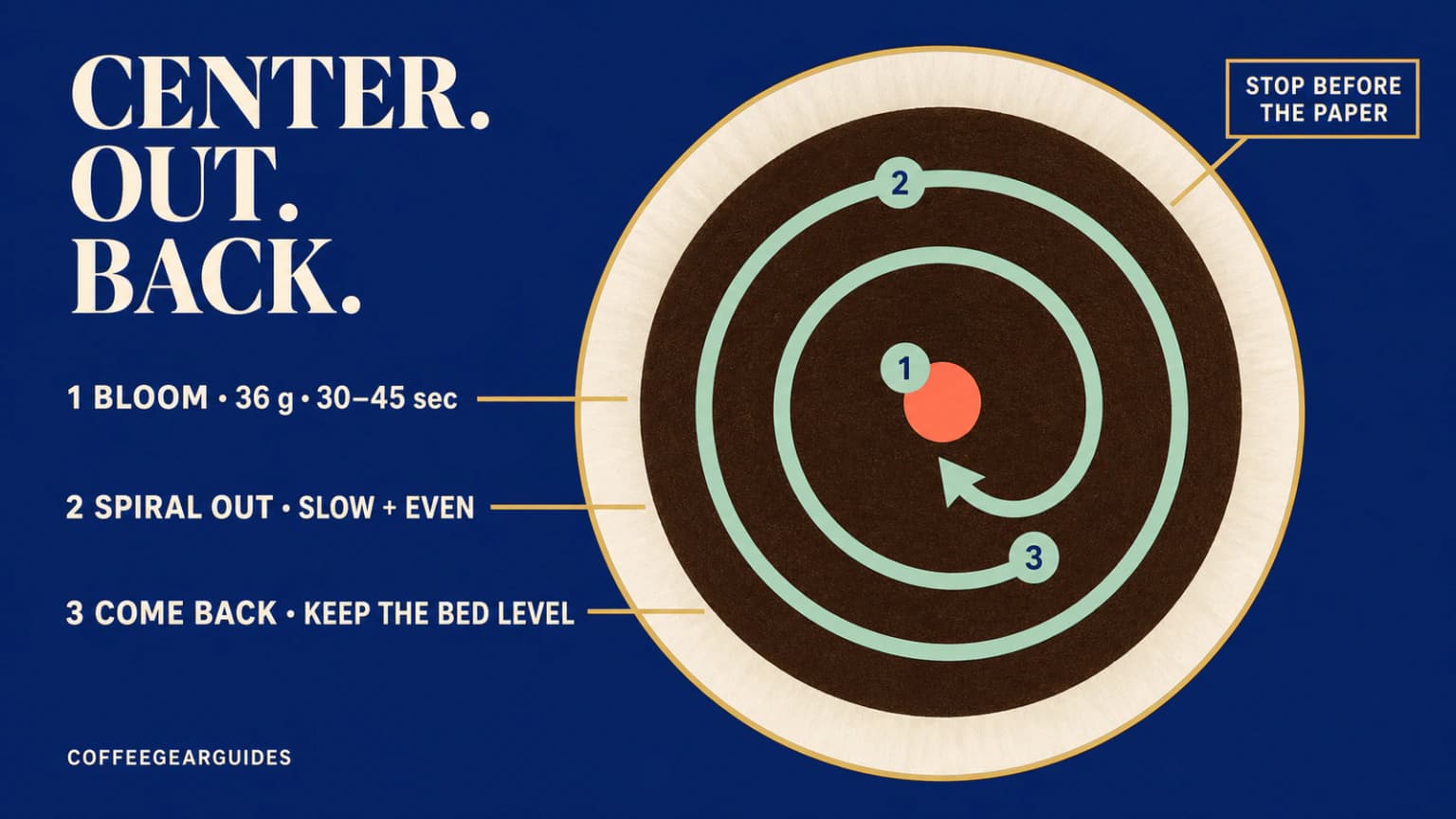
Start in the middle, spiral out, come back. The paper rim never needs water; coffee sitting on it is coffee you have wasted.
A pour-over routine for a gooseneck kettle
1
Weigh the coffee and decide the water
Use 18 g of coffee to about 290 g of water, a 1:16 brew ratio that lands roughly 250 ml in the cup. Keep it fixed while you learn the pour, because changing two things at once teaches you nothing.
Tip A scale with a timer costs from about ₹799 here and pays for itself in beans you stop wasting.
2
Set the temperature for where you live
Aim for 92°C to 96°C. On the coast, boil and wait about a minute. In Bengaluru, wait about thirty seconds. Above 2,000 metres, brew straight off the boil.
3
Rinse the paper and warm everything
Pour hot water through the empty filter into your cup, then throw that water away. It removes the papery taste and stops a cold dripper stealing heat from the brew.
4
Bloom with twice the coffee weight
Add the grounds, level them, then pour about 36 g of water in slow circles until every ground is wet. Wait 30 to 45 seconds while the bed puffs up and settles.
Watch out If nothing puffs up, the beans are stale. No kettle can fix coffee roasted four months ago.
5
Pour in slow spirals, not in one go
Add the rest in two or three pours, spiralling out from the centre and back again. Keep the stream thin and the water level in the cone roughly steady.
Tip Pour lower rather than higher. A short drop is easier to steer and disturbs the bed less.
6
Read the bed when it has drained
A flat, even bed means the pour worked. A deep crater means you poured too fast, and grounds stranded high on the paper mean you poured too wide.
7
Change the grind, not the pour
If the brew runs through in under two minutes it is too coarse, and past three and a half it is too fine. Adjust the grinder and leave your pouring technique alone.
Two habits separate people who love pour-over from people who abandon it. The first is fixing the ratio and changing only one variable at a time, and our coffee to water ratio chart gives the number to fix it at.
The second is pouring lower and slower than instinct suggests. Almost every beginner pours from too high, which agitates the bed and makes the coffee taste rough.
Descaling a spout you cannot reach
Every kettle in this guide will scale up in most Indian cities, and the spout is where it does the damage you notice last.
The routine below takes about five minutes a week and one longer session a month.
Keeping a gooseneck kettle clear
1
Empty it after every brew
Pour out what you did not use and leave the lid off so the inside dries. Water left standing overnight is where scale and that flat, mineral taste both begin.
2
Wipe the outside while it is warm
A warm stainless body wipes clean with a damp cloth. Left to cool, the same splashes bake on and need scrubbing that scratches the finish.
Watch out Never use steel wool or a scouring pad inside the body. Scratches give scale more surface to grip.
3
Descale monthly, and pour it through the spout
Fill with warm water plus a spoon of citric acid or a cup of white vinegar, leave it thirty minutes, then pour half of it out through the spout rather than tipping it away.
Tip That last instruction is the whole point. The spout is the narrowest passage in the kettle and the only part no brush reaches.
4
Rinse twice, then boil once and discard
Two cold rinses take the acid out, and one full kettle of boiled water thrown away removes the taste. Skipping this makes the next brew taste sharp.
5
Keep water away from the electrical parts
On an electric kettle, never put the powered base in water and dry the contacts before it goes back on. Corroded contacts are the most common failure on cheap electric kettles.
6
Treat a lid thermometer gently
Kettles with a thermometer in the lid should not go in a dishwasher, and the gauge should not be submerged for long soaks. Wash that lid by hand.
The reward for five minutes a week is a kettle that pours the same way in year three as it did in week one.
The alternative is a spout that narrows so slowly you never notice, until the pour is a trickle and you blame the kettle for being old.
Which gooseneck kettle should you buy in 2026?
Six kettles is a shortlist, not an answer, so here is the answer.
We weighed owner evidence first, then what each kettle controls, then what it costs to live with. One question settles it: do you want to judge the temperature, or have it decided for you?
The three we recommend first
Our pick
HARIO V60 Buono 1L
₹4,249
You are
Brewing pour-over daily
Best at
A steady, steerable stream
Evidence
4.5 stars, 10,600 ratings
Weak spot
Tells you nothing about heat
Chefbar with Thermometer
₹5,212
You are
Brewing where water overshoots
Best at
A gauge, without a socket
Evidence
4.4 stars, 3,824 pooled
Weak spot
The dial reads slowly
Sipologie Precision 1000ml
₹6,861
You are
Brewing coffee and fine tea
Best at
Holding an exact temperature
Evidence
4.3 stars, 51 ratings
Weak spot
Small sample, high price
The three we recommend first
Specification
Our pick
HARIO V60 Buono 1L
₹4,249
Chefbar with Thermometer
₹5,212
Sipologie Precision 1000ml
₹6,861
You are
Brewing pour-over daily
Brewing where water overshoots
Brewing coffee and fine tea
Best at
A steady, steerable stream
A gauge, without a socket
Holding an exact temperature
Evidence
4.5 stars, 10,600 ratings
4.4 stars, 3,824 pooled
4.3 stars, 51 ratings
Weak spot
Tells you nothing about heat
The dial reads slowly
Small sample, high price
Whichever you choose, buy it after the grinder rather than before it. The rest of our coffee gear sits on the accessories and tools shelf.
A kettle that suits your actual brewing gets used every morning for a decade. That is the only thing on this page that makes any of it worth the money.
Frequently asked questions
Is a gooseneck kettle worth it in India?
It is worth it if you brew pour-over coffee in a V60 or a flat-bottom dripper. The thin, steerable stream is the one variable you cannot fake with a normal kettle, and it changes the cup immediately.
It is not worth it for a French press, a moka pot, a South Indian filter or a drip machine. Those brewers do not care how the water arrives.
Buy the grinder first. A ₹6,861 kettle in front of a blade grinder puts the money in the wrong place.
Can I use a normal kettle for pour over coffee?
You can, and plenty of people do. A wide spout dumps water fast, which digs into the coffee bed, throws grounds up the paper and drains unevenly, so the cup comes out thinner and less sweet than it should.
A cheap workaround is to decant boiling water into a small jug with a narrow lip and pour from there. It is slower and messier, and it does help.
The gooseneck buys you control, not temperature. If temperature is your only problem, a ₹200 probe thermometer solves it.
What temperature should water be for pour over coffee?
Between about 90°C and 96°C for most coffee, and towards the top of that range for lighter roasts.
Where you live changes what that means. Water boils at about 100°C in Chennai and Mumbai, about 97°C in Bengaluru, and about 92°C in Shimla or Ooty, because boiling point falls roughly 1°C for every 300 metres of altitude.
So a coastal kitchen waits or measures, a Bengaluru kitchen is nearly there off the boil, and a hill kitchen brews straight off the boil because no kettle heats water past its own boiling point.
Do gooseneck kettles work on induction?
Some do. The Hario V60 Buono listing states it suits any cooking surface including induction, and stainless steel stovetop kettles generally work if the base is flat and magnetic.
Electric gooseneck kettles sidestep the question entirely, because they heat on their own powered base and never touch your hob.
If your kitchen runs on induction, check the base of a stovetop kettle with a fridge magnet before you order.
Electric or stovetop gooseneck kettle: which is better?
Stovetop kettles cost less, have nothing electrical to fail, and pour just as well. You supply the temperature judgement yourself, or clip on a thermometer.
Electric kettles with temperature control set a number and hold it, which matters more for green tea than for coffee, and they save you standing over a hob.
In India the electric versions cost roughly ₹3,700 to ₹6,900 against ₹1,600 to ₹5,200 for stovetop. Pay the difference if you also drink delicate teas.
How do I remove scale from a gooseneck kettle spout?
Fill the kettle with a warm citric acid or white vinegar solution, leave it for thirty minutes, then pour half of it out through the spout rather than tipping it down the sink.
That last step is the one people miss. The spout is the narrowest part of the kettle and the part no brush reaches, so it only gets descaled if the solution actually flows through it.
Rinse twice, then boil and discard one full kettle of clean water before you brew again.