8 Coffee Grinders in India for 2026, Ranked by What You Brew
We read 1,800+ owner reviews to rank 8 burr coffee grinders in India for 2026, ₹4,999 to ₹20,299, for South Indian filter coffee, pour-over and espresso.
By the CoffeeGearGuides team · India · Updated Aug 30, 2026 · 37 min read
On this page20
The best coffee grinder in India is almost certainly one you turn by hand, and that is not romance. It is what the shelf on Amazon India actually offers.
Across the whole range below the ₹20,299 Baratza Encore ESP, we found exactly one electric burr grinder with a real brand behind it and a review base worth reading.
The hand-grinder shelf in that same gap is crowded with serious equipment from Timemore, KINGrinder and 1Zpresso.
For this 2026 guide we compared live Amazon India listings, expert reviews and more than 1,800 owner ratings, checking every claim against the listing's own specification.
We also did something no other Indian grinder guide bothers with: we treated the steel filter in your kitchen as a real brewing method with its own demands.
How we chose these grinders for India in 2026
We research rather than test, which we think is a strength when done in the open. You can read exactly how we work on our about page.
The short version is that we do not trust any single review, including a glowing one.
We read manufacturer specifications, independent reviews from CoffeeGeek and other specialists, Home-Barista forum threads, and the full spread of Amazon India ratings.
We pay closest attention to three-star reviews, because that is where owners describe real faults without rage or excitement.
Four rules shaped the list. Every grinder had to be in stock on Amazon India with a live price on publication day, checked through Amazon's own product API.
Every grinder had to hold at least 4.0 stars. Where a review base is thin, we say so in that product's section rather than burying it.
Every grinder had to use burrs. A burr grinder crushes beans between two shaped steel surfaces held a set distance apart, so the particles come out close to one size.
A blade grinder chops at random and hands you dust and gravel in the same batch. Not one appears here, because grind consistency is the entire reason to own a grinder.
And every grinder had to earn a different job.
We cut four that could not: two with review bases of eight and twenty-seven, one rated 3.6, and one that was a weaker version of a grinder already listed.
Filter coffee or a Western brewer?
Almost every grinder guide written for India assumes you are making pour-over. Most Indian kitchens are not.
The single biggest fork is the brewer you are grinding for: a steel filter, the two-part drip set that makes decoction, or one of the Western brewers that arrived with third-wave coffee.
The two jobs pull a grinder in opposite directions.
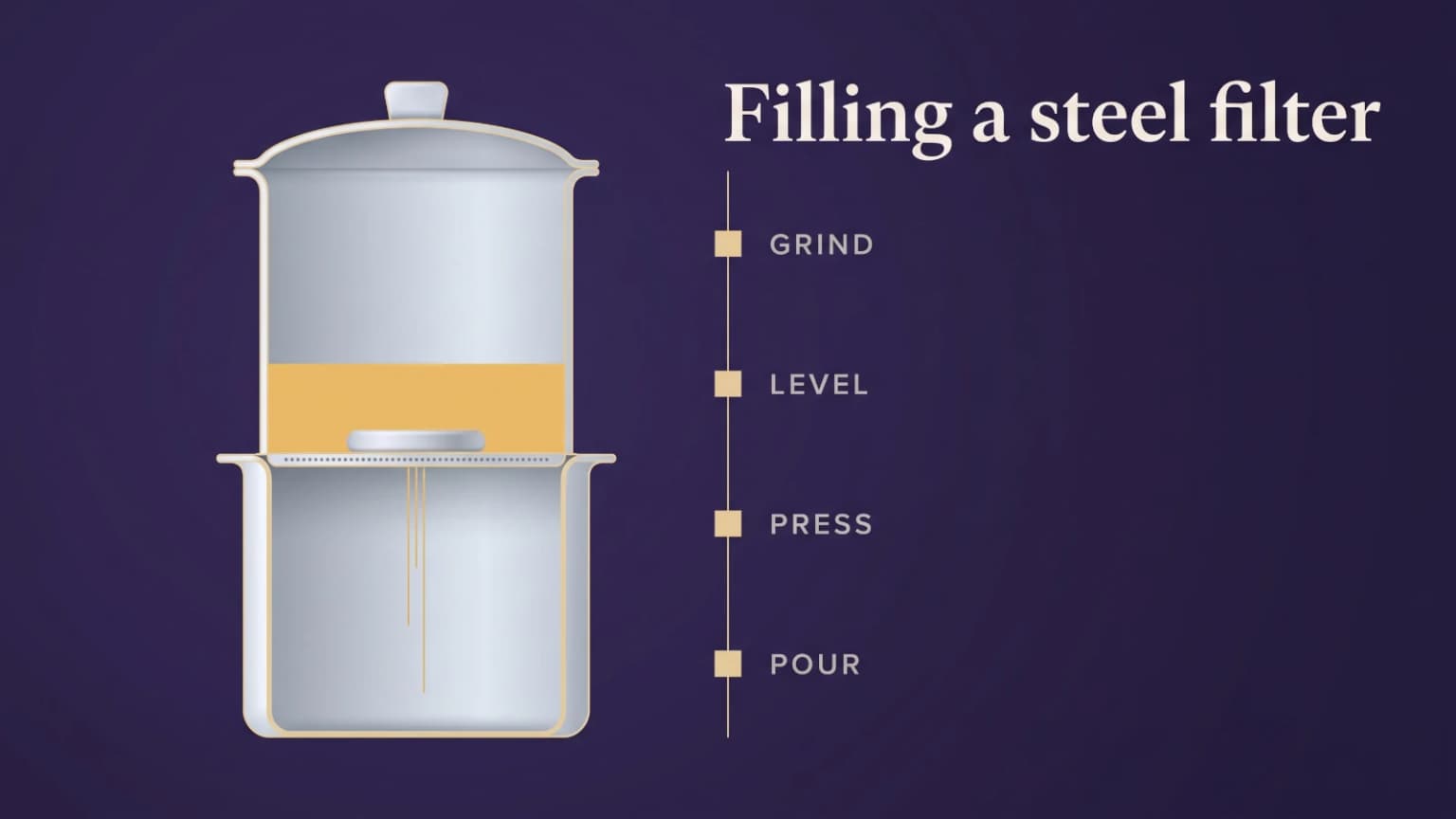
A steel filter is unusual because the metal plate itself holds the coffee bed.
There is no paper, so the grind size has to be fine enough to stay put and open enough to let water pass over fifteen to twenty minutes.
Push past that and the drip stalls completely. Fall short and the decoction runs through in three minutes tasting thin and woody.
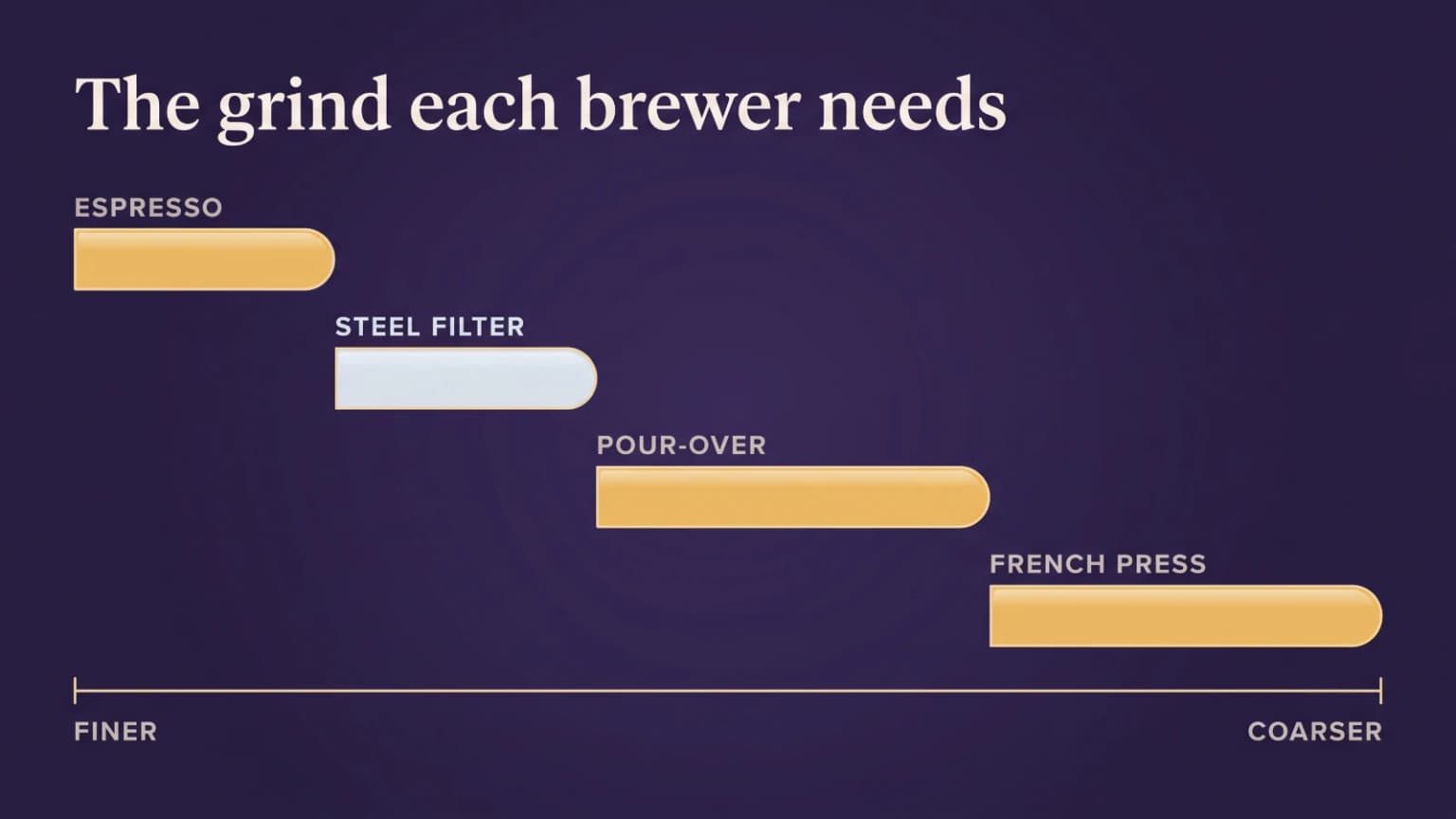
Western brewers spread across a far wider range, from a coarse French press bed through a moka pot down to espresso, and each one wants a different setting from the same grinder.
The steel filter sits in the fussiest part of the range, and its window is narrower than any guide admits.
Published targets for filter decoction disagree with each other, and we will not pretend otherwise.
Some Indian roasters call for a medium grind. Others describe the traditional powder as close to espresso fine.
Both camps are describing real filters. Plate perforations differ between a ₹300 steel set and a heavier brass one, so the same powder behaves differently in each.
The honest instruction is to treat the drip time as your instrument. Aim for a decoction that finishes in roughly fifteen to twenty minutes, and adjust the grinder rather than the coffee.
Two grinding jobs, side by side
Two grinding jobs, side by side
What changes
South Indian steel filter
Western brewers
Batch size
25 to 40 g at once, for the family
15 to 20 g, one or two cups
Grind range used
One narrow window, found once
Wide, changes with the brewer
Adjustment you need
Small, precise steps near fine
Reach at both ends of the dial
What goes in
Usually a coffee and chicory blend
Straight single-origin beans
How failure shows up
Drip stalls, or runs through fast
Sour and thin, or harsh and heavy
Effort per session
One larger grind, once a day
A smaller grind, per cup
Most households do both. The grinder that suits you is the one that handles whichever of these you do every morning.
If you read that and thought about decoction, weight fine-end adjustment. If you thought about a V60 and a moka pot, weight range and speed instead.
The 8 best coffee grinders in India
This lineup of the best coffee grinders in India runs from the one most people should buy to the specialists at either end.
Every link was verified live and in stock through Amazon's own product API on the day we published.
Ratings and review counts recorded on Amazon India at the time of writing. Prices move often; use the buttons for the live number. Amazon.in prices as of 15/09/2026. Details
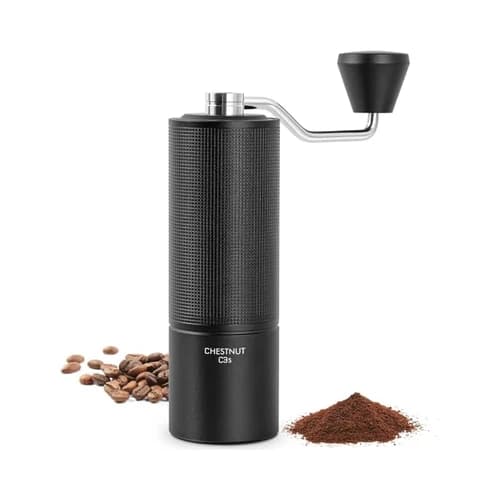
1. TIMEMORE Chestnut C3S
If someone asks us for one grinder and does not want a conversation about it, this is the answer.
The Chestnut C3S carries Timemore's patented S2C steel burr in a body machined from one piece of aluminium alloy, with no plastic in the grinding path.
At the time of writing, 326 owners hold it at 4.7 stars.
What that buys you is boring reliability, which is the highest praise a manual coffee grinder can earn.
The burr holds its grind consistency from decoction through French press, and the metal body means nothing flexes while you turn the handle.
At 530 grams and 52 millimetres across, it sits in a hand comfortably for the two minutes a batch takes.
TIMEMORE Chestnut C3S
Rated 4.7 from 326 ratings
The all-metal hand grinder we would put in most Indian kitchens: a patented S2C steel burr, no plastic in the grind path, and range from decoction to French press.
Key details
Patented S2C stainless steel conical burr
All-metal aluminium alloy body, no plastic parts
Internal adjustment collar for grind size
25 g bean capacity, enough for one filter batch
About 530 g and 52 mm across, easy to hold
Brush cleaning, no water needed on the burrs
What we like
The most capable burr you can buy in India near ₹6,000
Second largest review base of any grinder in this guide
All-metal build with nothing to flex or crack over time
Frequently discounted well below its listed price
Watch out for
The plastic handle knob is the one cheap-feeling part
Reviewers report the espresso end is coarsely stepped
No external scale, so you count clicks and remember them
Owner reviews on Amazon India follow one pattern. The first surprise is how much better the coffee tastes, the second is how much quieter it is than a mixie.
The third is that the handle knob feels cheaper than the rest of the grinder. That complaint is real and it is also cosmetic, because nobody reports the knob failing.
The honest weak point is espresso. Independent reviewers note that the C3S jumps too far between clicks at the fine end, so a shot runs either too fast or too slow with nothing in between.
Timemore sells a separate ESP version with finer steps for that reason. If you own an espresso machine, read the KINGrinder K6 section first.
Buy the C3S if you make decoction, pour-over, French press, moka or cold brew. That covers almost everybody, and it makes the rest of this list look like specialists.
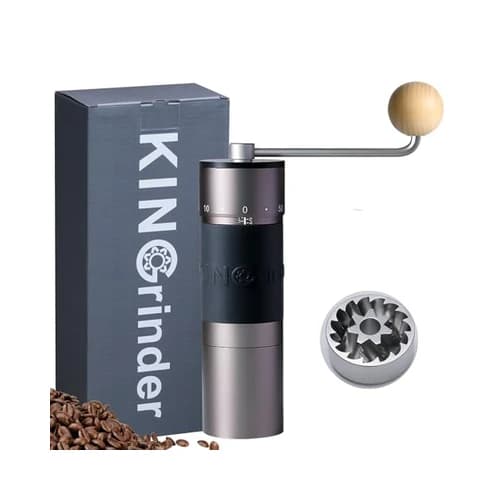
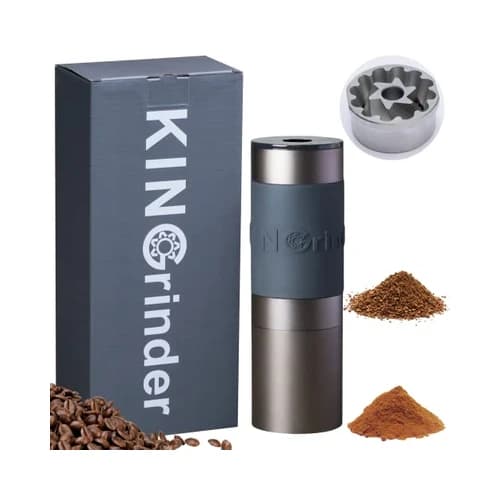
2. KINGrinder K6
The KINGrinder K6 has something no other grinder here can claim: 857 Amazon India owners, at 4.7 stars.
In a category where most listings scrape together a few dozen ratings, that is by a wide margin the best-evidenced grinder on this page.
What it is actually built for is precision. The K6 adjusts internally in steps of about 16 microns, which is a much finer instrument than the click-and-hope collars on cheaper grinders.
For a steel filter, where the window between a stalled drip and a thin decoction is narrow, that resolution is the difference between guessing and knowing.
KINGrinder K6
Rated 4.7 from 857 ratings
The precision instrument here: roughly 16 microns per click of internal adjustment, a full metal body, and the largest owner review base of the eight.
Key details
Internal adjustment of about 16 microns per click
Stainless steel conical burr set
Full metal body in aluminium alloy
Straight handle for steady, high-torque turning
Tool-free disassembly for cleaning
Silicone grip sleeve around the body
What we like
By far the largest review base in this guide, at 857 ratings
Fine enough steps to actually dial in a steel filter
Grinds noticeably faster than the entry-level hand grinders
KINGrinder replaces parts for initial defects
Watch out for
Owners report the factory zero point is often not true zero
The silicone sleeve can turn slippery with use
Light roasts at espresso fineness are hard work by hand
The calibration complaint deserves a straight answer, because it surfaces in forum threads rather than in the marketing.
On many K6 units the marked zero does not match the point where the burrs actually touch, and there is no user calibration.
In practice this matters less than it sounds. You find your own number for your own coffee, and the printed scale becomes a reference rather than a truth.
The silicone sleeve is the other recurring gripe. Some owners report it turning slick over months, which makes a two-minute grind less pleasant than it should be.
Where the K6 is genuinely brilliant is repeatability. Set it, grind a week of decoction at the same number, and every batch drips at the same rate.
Buy the K6 if the steel filter is your main brewer, or if you care about hitting the same cup twice. It costs twice the C2S and gives you control the cheaper grinders cannot.
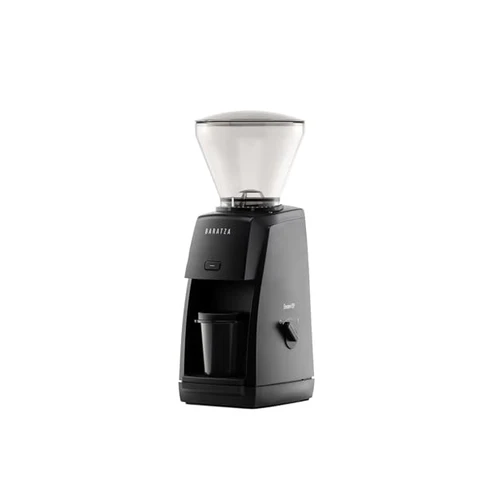
3. Baratza Encore ESP
Every other grinder on this list is powered by your arm. The Baratza Encore ESP is the one machine here we can recommend without qualifying it, and at ₹20,299 it is also the most expensive.
Baratza is an American brand with a long reputation for grinders you repair rather than replace, and 128 owners on Amazon India rate this one at 4.4 stars.
Its clever part is the split adjustment: Baratza publishes forty grind settings in two ranges.
The first twenty act as fine micro-steps for espresso, and the upper twenty open out for filter brewing.
That is the layout you want if you own an espresso machine, because the fine end has resolution instead of a cliff.
Baratza Encore ESP
Rated 4.4 from 128 ratings
The only electric burr grinder in India we would recommend without a caveat: forty settings split into an espresso range and a filter range, from a brand built on repairability.
Key details
Conical burr set driven by a geared motor
Forty grind settings across two adjustment ranges
Micro-steps at the fine end for espresso dialling
Hopper fed, so it grinds a batch hands-free
Portafilter holder and grounds bin both included
Baratza supplies replacement burrs and spare parts
What we like
The only plug-in grinder here with a real brand behind it
Genuine espresso capability, which nothing else here matches
Grinds a family batch while you do something else
Designed to be opened and serviced rather than binned
Watch out for
At ₹20,299 it costs three times our top pick
Reviewers note it will not reach a true Turkish fineness
Spare parts in India depend on the importer, not Baratza
Reviewers who have used it alongside better grinders describe the same two limits. It does not reach a true Turkish fineness, and consistency at the very fine end is good rather than exceptional.
Neither affects the person buying a first electric grinder, which is who this is for.
The Indian asterisk is service. Baratza's design philosophy is that you replace burrs and parts instead of the grinder, and that needs a parts supply behind it.
This listing sells through a specialist Indian retailer rather than a marketplace importer, which is the better of the two situations. Budget for a part taking weeks to arrive anyway.
Buy the Encore ESP if you pull espresso, or if you know yourself well enough to admit you will not turn a handle every morning. Both are good reasons, and the price is what they cost.
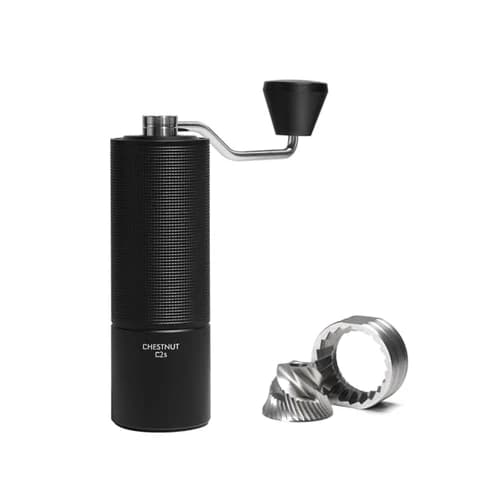
4. TIMEMORE Chestnut C2S
The Chestnut C2S is what we point at when someone wants to stop using the mixie and does not want to spend much doing it.
At ₹4,999 it is the cheapest grinder on this page, and at 4.7 stars across 91 owners it is also tied for the highest rated.
Timemore builds it as a full metal unibody with a CNC-machined stainless burr rated at 55 to 58 HRC, which is proper hardness for a burr rather than a soft steel that rounds off in a year.
Coarseness adjusts internally across roughly 36 levels, and double bearings keep the shaft from wandering while you turn.
TIMEMORE Chestnut C2S
Rated 4.7 from 91 ratings
The cheapest grinder here that is honestly a burr grinder: a full metal unibody, a hardened CNC stainless burr, about 36 levels of adjustment.
Key details
CNC stainless steel conical burr, 55 to 58 HRC
Full metal unibody, upgraded from the older C2
Roughly 36 levels of internal coarseness adjustment
Double bearing positioning for a steady shaft
25 g bean capacity
About 700 g in the hand
What we like
Real burr quality at a price where most listings are blades
Tied for the highest owner rating in this guide
Metal body throughout, nothing to crack or flex
A sensible first grinder that will not need replacing soon
Watch out for
Fewer adjustment levels than the C3S or either KINGrinder
Heavier than the C3S despite being the cheaper grinder
Owners describe it in near-identical terms across listings and forums: heavier than expected, slow to grind, and better than whatever they used before.
Nobody reports the burr going dull, which is the failure that matters at this price.
The real limitation is resolution rather than quality. Thirty-six levels covers filter, French press and moka comfortably.
It then runs out of usable steps as you approach espresso, which is the trade you would expect at ₹4,999.
Buy the C2S if this is your first burr grinder and you would rather spend the difference on better beans.
The gap between this and the C3S is real but small. The gap between this and a mixie is enormous.
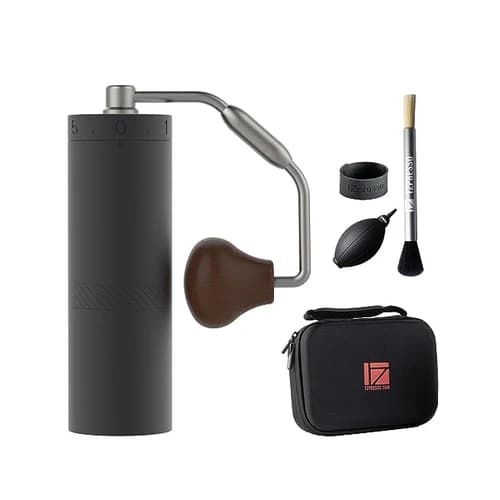
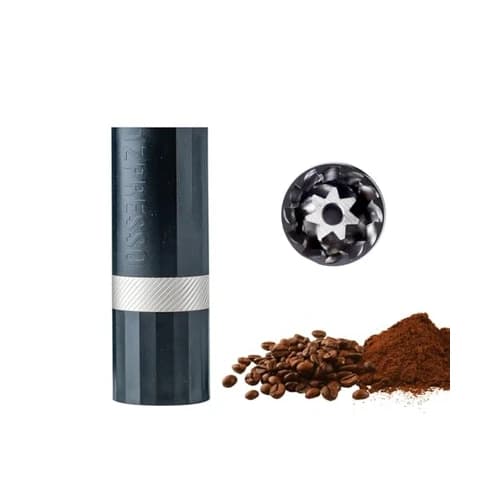
5. 1Zpresso X-Ultra
1Zpresso is the brand that hand-grinder enthusiasts argue about, and the X-Ultra is its all-rounder. At ₹18,989 it is the most expensive grinder here that does not plug in.
189 owners on Amazon India rate it 4.5 stars, which is a solid base for a premium hand grinder in this market.
Two things justify the money. The burr is a heptagonal design that 1Zpresso tunes toward a sweet, clean pour-over profile.
It also cuts fast enough that a batch takes noticeably less effort than the cheaper grinders here.
The other is the external adjustment ring, marked and numbered, offering sixty steps per rotation. You change grind by reading a number instead of counting clicks in your head.
1Zpresso X-Ultra
Rated 4.5 from 189 ratings
The premium hand grinder here: a heptagonal burr tuned toward sweet pour-over, an external numbered dial with sixty steps per turn, and the fastest grinding of the eight.
Key details
Heptagonal stainless steel burr, tuned for filter clarity
External numbered adjustment, 60 steps per rotation
Magnetic catch cup holding 25 to 30 g
Foldable crank handle for storage and travel
Tool-free disassembly for cleaning
Burr factory calibrated and fixed before shipping
What we like
Noticeably faster and easier to turn than cheaper hand grinders
External dial means you never have to remember a click count
Larger catch cup suits a full filter batch in one go
The clearest, sweetest pour-over of any grinder here
Watch out for
Three times the price of the C2S for a better version of it
Tuned toward filter, so it is not the espresso specialist
Sold by a marketplace importer, so check the warranty terms
In 1Zpresso's own range the X-Ultra sits between the espresso-focused J-Ultra and the filter-leaning K-Ultra, and reviewers describe it as the versatile middle child.
Neither sibling is currently listed in stock on Amazon India, which makes the X-Ultra the practical choice here anyway.
Owner reports centre on speed and feel. A 25 gram batch takes well under a minute, the mechanism runs smoothly, and the magnetic cup sends grounds where you point them.
The honest question is whether it is worth three C2S grinders. In cup quality alone, no. In the daily experience of using it, many owners say yes without hesitation.
Buy the X-Ultra if you grind every day, switch between brewers often, or count good equipment as part of the pleasure.
6. KINGrinder K2
The KINGrinder K2 exists for one kind of person: someone who wants serious adjustment resolution and does not want to spend ₹12,000 to get it.
It offers 140 levels of internal adjustment, forty per rotation of the collar, at ₹8,963. Ninety-one owners rate it 4.6 stars.
That is the same adjustment concept as the K6 in a smaller, cheaper body. The burr set is smaller and the grind is slower, but the control you have over grind size is close.
The build is aluminium alloy with a silicone anti-slip band, and it comes apart for cleaning without tools.
KINGrinder K2
Rated 4.6 from 91 ratings
KINGrinder's adjustment system in a cheaper body: 140 internal levels at forty per rotation, an aluminium alloy build, and tool-free cleaning.
Key details
140 levels of internal adjustment, 40 per rotation
Stainless steel conical burr set
Aluminium alloy body with a silicone grip band
20 to 25 g capacity per batch
Disassembles for cleaning without tools
KINGrinder covers initial defects with parts or repair
What we like
The finest adjustment available here under ₹10,000
Suits both a steel filter and espresso experiments
Simple to strip and clean after a chicory blend
Solid 4.6 rating from owners in this market
Watch out for
Slower through a batch than the K6 or the X-Ultra
Internal adjustment means counting clicks, with no scale to read
Understand the trade against the K6 before you save the money. The K2 grinds the same coffee to the same size, and takes longer and more wrist to do it.
For one or two cups a day that difference is trivial. For a 40 gram family batch every morning it is the whole argument.
Owner sentiment is quietly positive rather than enthusiastic, which is what we expect from a grinder that is competent everywhere and remarkable nowhere.
Its one real edge over the bigger sibling is that a smaller chamber clears faster, which matters if you alternate between straight coffee and a chicory blend.
Buy the K2 if you want fine control on a budget and you are grinding for yourself. Grinding for a household, spend the extra on the K6.
7. 1Zpresso Q Air
The 1Zpresso Q Air answers a question Indian apartment kitchens ask constantly: where exactly is this thing supposed to live?
It is the smallest grinder here, slim enough to fit inside an AeroPress plunger, and 113 owners rate it 4.6 stars.
1Zpresso positions it as an entry-level grinder, and the burr is a genuine stainless conical set factory calibrated before it ships. Adjustment is numerical, so you set a figure rather than counting.
Everything about it is designed around going somewhere: a hostel room, an office drawer, a hotel with a kettle and no ambitions.
1Zpresso Q Air
Rated 4.6 from 113 ratings
The smallest real grinder on this page: slim enough to travel inside an AeroPress plunger, with a factory-calibrated stainless burr and numbered settings.
Key details
Stainless steel conical burr, calibrated at the factory
Slim body that fits inside an AeroPress plunger
Numerical adjustable setting instead of blind clicks
Patented structure that comes apart quickly for cleaning
Light enough to carry daily without noticing
1Zpresso build quality at the entry level of the range
What we like
Genuinely portable without giving up a real burr set
Numbered settings make it easy to return to a recipe
Strong 4.6 owner rating in this market
Takes up almost no counter space in a small kitchen
Watch out for
The short handle gives less leverage, so fine grinding is slow
Reviewers say it lacks the finesse for good espresso
Small capacity means two rounds for a family filter batch
The short handle is the compromise that makes everything else possible, and reviewers agree on what it costs.
Less leverage means fine grinds take real effort, and the finer you go the more you feel it.
For pour-over and AeroPress, which is what this grinder is for, it barely registers.
Capacity is the other thing to check against your morning. A family filter batch means grinding twice, and grinding twice at 6 a.m. gets old faster than you expect.
Buy the Q Air if your kitchen has no spare space, if you travel with coffee, or if you want a second grinder that does not need a home.
As a household's only grinder, the C3S is the better ₹6,350 to spend.
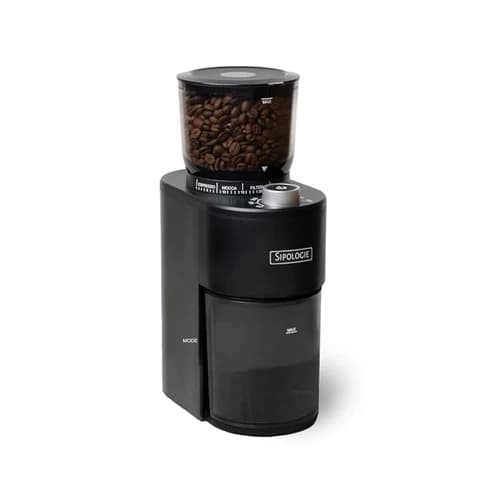
8. Sipologie Precision Grinder
We want to be straight about this one before anything else. At 4.2 stars across 58 owners, the Sipologie Precision Grinder carries both the lowest rating and the thinnest review base of the eight.
We kept it for a reason. It is the only plug-in grinder we found under ₹10,000 in India from a real brand with its own storefront rather than an anonymous marketplace listing.
Sipologie is an Indian coffee equipment brand selling across its own site, Amazon and Flipkart. The grinder is hopper fed, with a stainless burr and a dial the brand lists at 38 settings.
For a household that wants fresh grounds without turning a handle, and cannot justify ₹20,299, this is the coffee grinder machine the Indian market currently offers.
Sipologie Precision Grinder
Rated 4.2 from 58 ratings
The only credible plug-in grinder in India under ₹10,000: a stainless burr, a 200 g hopper, and an Indian brand with a real storefront behind it.
Key details
Stainless steel burr rather than a chopping blade
200 g hopper, enough for several days of coffee
Dial adjustment, listed by the brand at 38 settings
Grinds a batch hands-free while you do something else
Compact enough for an Indian kitchen counter
Sold and supported by the brand directly on Amazon
What we like
Hands-free grinding at a third of the Baratza price
Hopper capacity suits a household rather than one cup
A brand you can actually contact if something fails
Clears the 4.0 bar where cheaper plug-ins do not
Watch out for
The lowest rating and smallest review base in this guide
No independent expert review exists that we could find
The reviews that exist describe a decent, reliable grinder that has been someone's daily machine for months without incident.
That is a fair summary of what 58 ratings can support, and we will not stretch it further.
What we could not find is any independent expert review, which is why it sits eighth rather than higher.
The practical limitation is adjustment. A dial with 38 marked positions across the whole range is coarser than 140 internal levels, so you get close to a target rather than land on it.
For French press, drip and everyday decoction that is fine. For espresso it is not, and the listing does not claim otherwise.
Buy the Sipologie if a hand grinder is genuinely not going to happen in your house and ₹20,299 is out of reach. Go in knowing the evidence base is thinner than we normally accept, and that we said so.
The blend is the problem, not the burr
Here is the thing every grinder guide written for India leaves out. Most of the coffee ground in this country is not coffee.
Traditional South Indian filter blends run somewhere between 85:15 and 53:47 coffee to chicory, and the ratio is printed on the pack. Bru Green Label is 53 percent coffee. Cothas Darshini is 80.
That second ingredient changes how the grinder behaves, and nobody warns you.
Roasted chicory root is more brittle and more porous than a roasted coffee bean.
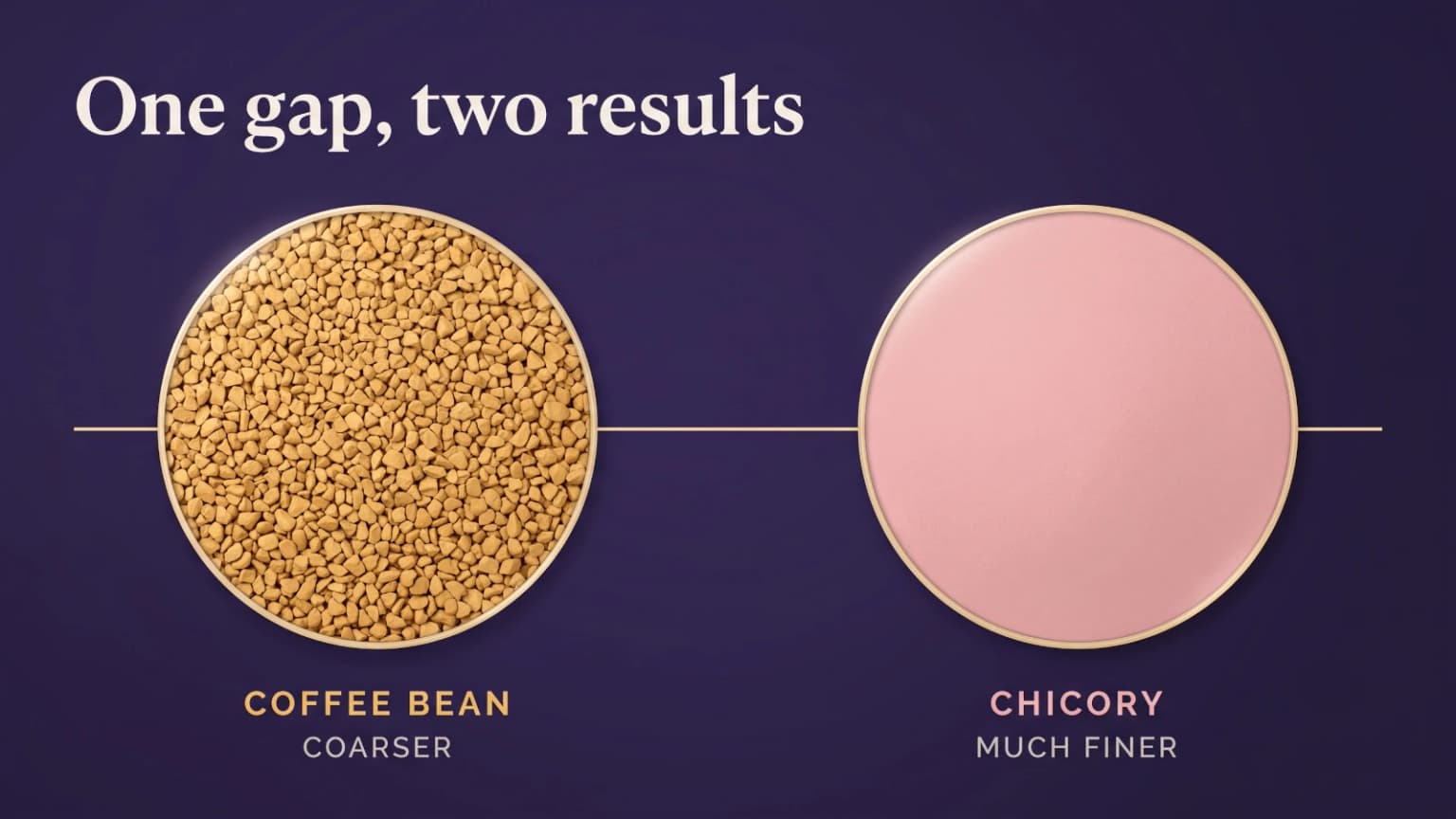
Put both through the same burr gap and the chicory shatters into a much finer powder, while the coffee holds a larger particle size.
You are not grinding one thing. You are grinding two materials that break differently, into one bed.
One setting, two results. The chicory in a traditional blend always ends up finer than the coffee beside it.
This is not a defect to fix. The fine chicory fraction packs the bed and slows the drip, which is exactly why a blend gives such a heavy, dark decoction.
That is the cup South India has liked for a century.
Practically, a blend and straight coffee are two different recipes on the same grinder. A setting that drips beautifully with 80:20 will run fast and thin with single-origin arabica.
It also means more retention, the ground coffee that stays inside the grinder instead of reaching your filter. A blend leaves noticeably more behind than straight beans.
What a chicory blend does differently
What a chicory blend does differently
What you notice
Why it happens
What to do about it
The drip slows at your usual setting
Fine chicory packs the bed tighter
Go one or two steps coarser for blends
More powder clings inside the burrs
Chicory breaks down into finer dust
Brush out the chamber more often
Decoction tastes heavier and darker
The chicory fraction extracts fast
Nothing, this is the traditional cup
Straight beans run through too fast
Coffee alone leaves a more open bed
Keep a separate setting for single origin
Grounds clump in humid weather
Chicory is more hygroscopic than coffee
Grind immediately before brewing
Ratios are printed on Indian filter coffee packs and vary widely. Treat each pack you buy as its own starting point.
Coffee and masala from one grinder
Almost any grinder listing on Amazon India makes the same promise: coffee, spices, masala, herbs, dry ingredients. It sells well, and it is a trap for a burr grinder.
The mixie in your kitchen genuinely is multi-purpose, because a blade does not care what it hits. A burr set is a precision gap, and everything you put through it either fits or damages it.
Hard spices such as clove and dried turmeric root can chip a burr edge that coffee never would, and oily spices leave a film that grounds then stick to.
Aromatic spices are the hardest to remove. Cardamom in particular will show up in your coffee for weeks afterwards, faintly and constantly.
What a coffee burr can and cannot take
What a coffee burr can and cannot take
What you put in
What it does to the burrs
Our verdict
Coffee beans, any roast
Normal wear over years of use
What the grinder is for
Roasted chicory or a blend
More fine residue in the chamber
Fine, clean more often
Black pepper, coriander seed
Aromatic oils coat the burr faces
Only in a dedicated grinder
Cardamom, cinnamon bark
Aroma persists through many cleanings
Never in a coffee grinder
Clove, dried turmeric root
Hard enough to chip a burr edge
Never, use the mixie
Rice, dal, sugar
Jams the gap or scores the burr faces
Never, this ruins grinders
Compiled from manufacturer guidance and owner reports. Every manual we read restricts its grinder to coffee alone.
Our position is simple. Buy a cheap blade grinder for spices and keep the burr grinder for coffee. Together they cost less than repairing a burr set.
Grinding for a household, not a cup
Nearly every hand grinder review you will read was written by someone grinding 15 grams for one pour-over. Filter kaapi is not made that way.
Decoction is brewed as a batch for the house, which means 25 to 40 grams in one go, once a day, at an hour when nobody is feeling athletic.
That difference changes which grinder makes sense, and no spec sheet shows it.
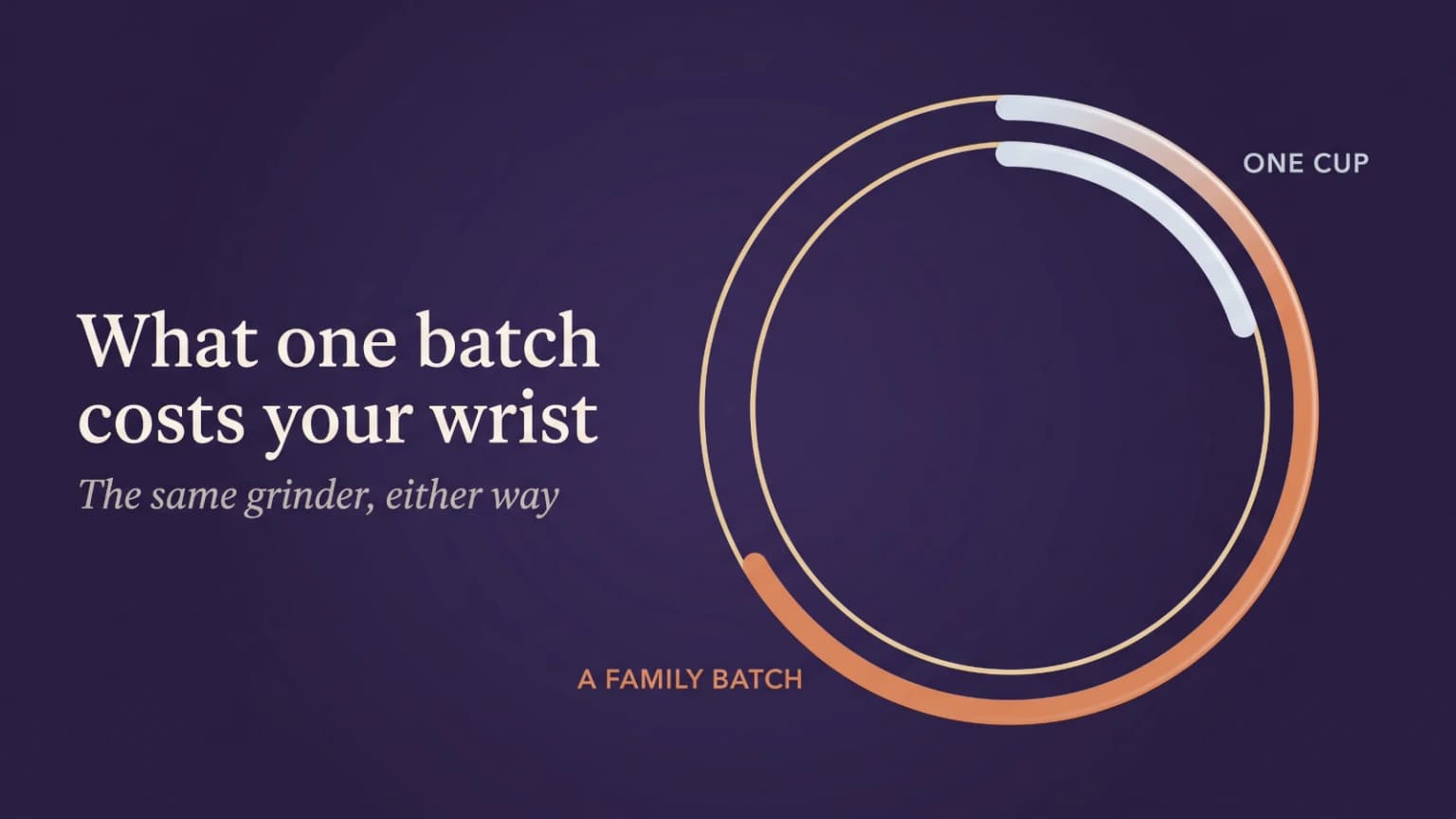
At one cup the grinders feel similar. At a family batch, burr size and handle leverage decide your morning.
Owner reports agree that a small dose takes under a minute on almost anything, so at 15 grams the cheap grinders feel fine.
Scale up to a 40 gram batch and the differences compound. Larger burrs and better leverage on the X-Ultra and the K6 pull ahead.
Capacity matters as much as speed. Most hand grinders here hold 20 to 25 grams, so a 40 gram batch means two loads and two grinds.
The X-Ultra catch cup holds 25 to 30 grams, the closest any hand grinder here comes to a family batch in one pass.
Noise is the advantage nobody mentions. A hand grinder crunches softly for a minute, where a mixie is a wake-the-house event.
In a flat with thin walls and someone still asleep, that is not a small thing.
The case against grinding at home
Here is the strongest argument against everything on this page, and it is a good one.
In India, a grinder does not save you money. It costs you money, it costs you time, and it is easy to build a case that you should not buy one at all.
Start with the arithmetic. At the time of writing, half a kilo of Cothas Darshini filter powder sells for around ₹430 and Bru Green Label for about ₹414.
That puts ready-ground filter coffee at roughly ₹850 a kilo.
Specialty whole beans from an Indian roaster such as Blue Tokai run about ₹650 for 250 grams, or roughly ₹2,600 a kilo. That is three times the price.
Worse for the grinder's case, those roasters price whole beans and pre-ground bags within a few tens of rupees of each other.
You are not being charged for grinding, so there is nothing for a grinder to earn back.
Then there is the roaster down the road. In most Indian towns you can hand over beans and have them ground to your filter's setting at no charge, freshly, on the day.
Traditional blends are also sold ground because that is how the market works. Finding your favourite 80:20 as whole beans is harder than it should be.
So the honest framing is this. A grinder buys you freshness, control of a variable the packet currently decides for you, and the ability to change grind between brewers.
It buys you nothing on price, ever.
If those three things do not describe a problem you actually have, keep buying your powder and spend the money on better coffee.
That is a respectable answer, and a bean-to-cup machine from our India machine guide solves the same problem a different way.
What fresh grinding costs in India
Assuming that did not convince you, the next question is what a burr coffee grinder costs to run here.
For a hand grinder, almost nothing. No consumables, no filters, no descaling, no electricity worth counting.
The gap is the finding. On the plug-in side of the Indian market, the useful middle is missing.
That figure is the most useful thing we can tell an Indian buyer, so we will state it plainly.
Every hand grinder here sits between ₹4,999 and ₹18,989, and each is a real product with a brand, an expert review trail and owners.
Across that same band, the electric coffee grinder listings we checked were overwhelmingly unbranded, thinly reviewed, or blade grinders described as burr grinders.
Only the ₹7,299 Sipologie cleared our bar, and only just.
The next credible electric option is ₹20,299. In the United States that stretch is the busiest part of the category, which is exactly why guides written for that market mislead here.
What a grinder costs to own here
What a grinder costs to own here
Where the money goes
Hand grinder
Electric grinder
Buying it
₹4,999 to ₹18,989
₹7,299 or ₹20,299, little between
Running it
Nothing at all
A few rupees of electricity a year
Whole beans instead of powder
Roughly ₹2,600 a kg for specialty
The same, this is bean cost
Your time each morning
1 to 3 minutes of turning
Seconds, hands free
Burr replacement
Years away, if ever
Baratza sells parts, via the importer
What can fail
Almost nothing, no motor
Motor, gearbox, electronics
Bean and powder prices were checked on Amazon India at the time of writing and move with the season. Everything else is an estimate from owner reports.
Two patterns fall out of that table. A hand grinder is close to a lifetime purchase, because nothing in it wears out on a human timescale.
An electric grinder buys back minutes every morning, at the cost of components that can fail in a market where spares are slow.
When to buy
Grinder prices on Amazon India swing hard, and two of our picks sat around 50 percent below list price when we checked.
Those discounts are not random. They cluster around the Great Indian Festival, Prime Day and Republic Day sales, and specialist coffee sellers follow the platform rather than lead it.
Our advice is the same one we give for machines. If the grinder you want is already 30 percent or more below its listed price, buy it, because that is close to the floor.
At full price with no sale near, waiting a few weeks usually costs you nothing. The live prices on this page refresh daily.
One caution specific to this category. Stock moves fast, and we watched three strong candidates sell out while researching this guide.
In stock at a good price is a rarer combination here than it looks.
Grinding for a South Indian filter
If you bought a grinder mainly to make better decoction, this is the section that matters. The steel filter rewards a careful routine and punishes guesswork.
You adjust to a target drip time, not to a number someone published. Our coffee to water ratio guide for India gives the starting dose, and your filter, blend and water decide where you finish.
Grind, level, press, pour. Every step exists to make the water pass evenly through the whole bed.
Finding your decoction setting
1
Weigh the blend, do not scoop it
Use the same weight every morning, typically 25 to 40 g for a household. A ₹500 kitchen scale removes the largest variable in the whole process.
Tip Write the weight on a slip of paper and keep it with the filter until it becomes habit.
2
Grind immediately before brewing
Ground coffee loses aroma within minutes, and a chicory blend picks up moisture from humid air faster than straight coffee does.
Watch out Never grind the night before. In a Mumbai or Chennai monsoon the powder will have clumped by morning.
3
Start at a medium setting
On a 36-level grinder start near the middle, and on a 140-level grinder start around a third of the way from fine. This is an opening bid, not a target.
4
Level the bed before the disc goes in
Tap the upper chamber gently on the counter so the powder settles flat, then seat the pressing disc without forcing it down hard.
Tip An uneven bed sends the water down one side, which is the most common cause of a weak decoction.
5
Time the drip and read it
A good decoction finishes in roughly fifteen to twenty minutes. Much faster and the grind is too coarse, much slower and it is too fine.
6
Change one step and repeat
Move the grinder a single step in the direction the timing tells you, then brew the same weight again tomorrow with everything else unchanged.
Watch out Changing grind and dose at the same time teaches you nothing. One variable, one morning.
7
Record the number and leave it alone
When the drip lands in the window and the coffee tastes sweet rather than thin or harsh, write the setting down and stop adjusting.
Tip A new pack of the same blend may need one step. A different brand of blend usually needs a fresh start.
One habit protects every grinder here: only turn the adjustment while the burrs are empty or turning. Forcing a collar against a chamber packed with beans is how people bend adjustment mechanisms.
If you also brew pour-over or moka, keep a written note of the setting for each. On the grinders with internal adjustment there is no scale to read, so your notebook is the scale.
Pour-over asks one more thing of you than a good grind, and that is a controlled stream of water. We cover what that needs in our guide to gooseneck kettles sold in India.
Keeping burrs alive in monsoon air
Maintenance guides written elsewhere assume a dry kitchen. Large parts of India spend months at humidity that turns coffee dust into paste.
Add the chicory in a traditional blend, which absorbs moisture faster than coffee, and residue behaves very differently here than in a European kitchen.
The routine is short. Skipping it entirely for a year is what causes the problems owners write reviews about.
A grinder routine for Indian kitchens
1
After every session: tip and tap
Empty the catch cup completely and tap the grinder gently to shake loose powder off the burr faces. Ten seconds, every time.
Tip Grounds left sitting in a catch cup overnight in humid weather go stale and stick.
2
Weekly: brush the chamber dry
Take the grinder apart as far as it comes without tools and brush the burrs and chamber with the brush supplied. Every grinder here disassembles by hand.
Watch out Never wash burrs or the grinding chamber with water. Burrs are cleaned dry, and water is how rust starts.
3
Monthly: a full strip after blends
If you grind a chicory blend daily, strip the grinder fully once a month and clear the fine powder that packs into the threads and the shaft.
4
Through the monsoon: store it sealed
Keep the grinder in a closed cupboard rather than on an open counter, and keep beans in an airtight container away from the stove.
Tip A silica sachet in the bean container costs almost nothing and does more for your coffee than most accessories.
5
Yearly: check the burr for play
Turn the handle slowly with the grinder empty and feel for wobble or grinding noises. A hand grinder burr should last many years of daily use.
Read enough one-star grinder reviews and you notice how many describe a grinder that was never once opened. Ten minutes a month is the whole price of avoiding that.
Which coffee grinder should you buy in 2026?
You did not come here for eight options, so here is the one.
We scored the field on burr quality, adjustment resolution, owner evidence, build, and how well each one handles a family-sized batch.
Then we asked the question that actually decides it: what are you brewing, and how much of the work do you want to do yourself?
The three we recommend first
Our pick
Chestnut C3S
₹6,350.00
You are
Buying one grinder, once
Best at
Everything except espresso
Evidence
4.7 stars, 326 owners
Weak spot
Coarse steps at the fine end
KINGrinder K6
₹12,440
You are
Serious about decoction
Best at
Hitting the same cup twice
Evidence
4.7 stars, 857 owners
Weak spot
Factory zero is not true zero
Baratza Encore ESP
₹20,299
You are
Not turning a handle
Best at
Espresso, and doing it for you
Evidence
4.4 stars, 128 owners
Weak spot
Spares depend on the importer
The three we recommend first
Specification
Our pick
Chestnut C3S
₹6,350.00
KINGrinder K6
₹12,440
Baratza Encore ESP
₹20,299
You are
Buying one grinder, once
Serious about decoction
Not turning a handle
Best at
Everything except espresso
Hitting the same cup twice
Espresso, and doing it for you
Evidence
4.7 stars, 326 owners
4.7 stars, 857 owners
4.4 stars, 128 owners
Weak spot
Coarse steps at the fine end
Factory zero is not true zero
Spares depend on the importer
Whichever way you go, buy from the coffee grinders tier that matches the coffee you actually drink, not the coffee you imagine drinking on a Sunday.
Fresh grounds every morning is a small change made daily, which is the kind that survives.
Frequently asked questions
Which coffee grinder is best for South Indian filter coffee?
The KINGrinder K6 is our pick, because its 16-micron steps let you land on the narrow grind window a steel filter needs. Any burr grinder that reaches a fine setting without stalling will make good decoction.
The steel filter is unusually fussy about grind because the perforated plate, not a paper filter, is holding the bed. Too fine and the drip stalls, too coarse and the decoction runs thin in minutes.
Expect to spend a week finding your setting, because plates vary between filters. Once you have it, write it down and stop moving it.
Can I grind coffee beans in a mixer grinder?
You can, and the result will be uneven. A mixie chops with a spinning blade, so the same batch holds dust and gravel at the same time, and the dust over-extracts while the gravel barely gives anything up.
For a strong filter decoction with milk and sugar, many households genuinely do not mind. For pour-over, moka or espresso, the difference is not subtle.
A mixie is also very hard on the aroma, because the blade heats the grounds while it works.
Is a manual coffee grinder better than an electric one in India?
Below about ₹20,000 in India, yes, and that answer is specific to this market rather than a universal truth.
The hand-grinder shelf here carries Timemore, KINGrinder and 1Zpresso, all with serious burrs and fine adjustment. The plug-in shelf under ₹20,000 is mostly unbranded machines with vague specifications and thin review bases.
Above ₹20,000 the argument flips, which is where the Baratza Encore ESP earns its place.
How much should I spend on a coffee grinder in India?
About ₹5,000 is where a real burr grinder starts. Below that, the listings you see are either blade choppers or ceramic burrs with six coarse settings, and neither will hold a grind for espresso or a steel filter.
Between ₹6,000 and ₹13,000 you are buying finer adjustment and faster grinding rather than a fundamentally better cup.
Past ₹18,000 you are paying for speed, ergonomics and the option of a motor.
Can I grind chicory and coffee together?
Yes, and grinding them together is how the traditional blend is meant to be made. Roasted chicory is more brittle and porous than a coffee bean, so it breaks down finer in the same burr gap.
That is not a fault. It is part of why a chicory blend gives such a heavy, dark decoction from a steel filter.
What it does mean is that a blend behaves differently from straight coffee at the same setting, so treat the two as separate recipes.
Do imported coffee grinders have a warranty in India?
It depends entirely on who sold it to you, and the listing page rarely says so plainly. Check the Sold by line before you buy.
Some of these grinders sell through established specialist retailers such as Kaapi Solutions and Something's Brewing. Others ship from marketplace importers, who usually offer a return window and little beyond it.
A hand grinder is the lower risk of the two, because it has no motor, no electronics and very little to fail.