Espresso Coffee Beans in India: 6 Bags for Your Basket and Cup in 2026
Roast level matters less than your basket. Six 2026 picks for the best coffee beans for espresso in India, ₹665 to ₹2,124, black shots or milk.
By the CoffeeGearGuides team · India · Updated Aug 21, 2026 · 39 min read
On this page19
The best coffee beans for espresso in India are rarely the darkest bag on the shelf, and almost never the one promising the most crema.
Espresso beans are not a separate species of coffee. They are ordinary beans, usually taken a little further in the roast and blended so the flavour stays legible when hot water is forced through a compact bed of grounds in about thirty seconds.
So the useful question is not which roast is best. It is which bag your equipment can actually reveal, and whether the shot ends up black or under milk.
Your portafilter basket answers the first half. A pressurised basket makes forgiving foam across a broad grind range, while a single-wall basket exposes the bean, the grinder, the dose, and your preparation with far less mercy.
Milk answers the second half. A delicate Arabica can be vivid as a 36g shot and turn anonymous in a 180ml cappuccino, while a structured blend can taste blunt alone and complete once milk goes in.
We compared verified Amazon India listings, roaster information, current owner discussions, and 3,620 owner ratings across six finalists. Every pick holds 4.0 stars or better, with at least 147 ratings behind it.
Four candidates did not make it, failing either on rating or on the thinness of their evidence. We would rather hand you a short list we can defend than a long one padded to look thorough.
This 2026 guide ranks the beans by the drink and the equipment they genuinely suit. It also counts something the rest of this shelf ignores: how much of a new bag disappears before the grinder is properly set.
How we chose these espresso beans for 2026
We research rather than taste-test, and we would rather say that plainly. A few shots pulled in one kitchen cannot stand in for every roast batch, grinder, machine, and Indian delivery route.
You can read exactly how we work on our about page, which covers how we weigh specifications, expert work, owner evidence, and availability.
For this guide, Amazon's own product API confirmed the exact whole-bean variant, live price, seller, image, and stock status behind every finalist.
That API does not return dependable ratings in this market, so we read the star average and review count off each Amazon India page ourselves and recorded them without rounding.
We weighted the middle of the feedback far more heavily than either extreme. Three-star reviews are where an owner names a real limitation while still telling you what the coffee does well.
Roaster claims were treated as claims, not as tasting notes from our desk. We checked roast level, bean species, bag weight, processing, and stated flavour notes against official or verified listings.
Owner discussions told us where the recurring risks sit: inconsistent roast colour, old marketplace stock, muted aroma, harshness, and profiles that work in milk but disappoint black.
Four candidates fell at the evidence gate. Coffeeza Intenso carried only 15 reviews and Blue Tokai Half-Caff carried two, so neither had a record dense enough to rank.
Lavazza Caffè Espresso and Sleepy Owl Dark Roast were cut at 3.9 and 3.8 stars. A familiar brand or a tempting price cannot make those numbers disappear.
The six survivors also had to do separate jobs. We kept no second-rate filler simply to reach eight or nine products, because a shorter list we can defend is worth more to you than a padded one.
Prices were verified on the day we published and will move around Prime Day and the Great Indian Festival. Our price system rechecks them, so the buttons on this page show the current Amazon figure.
Best coffee beans for espresso by basket
The word espresso describes a brewing method, not one compulsory roast. The machine forces hot water through a compact coffee bed, and the basket decides how directly that bed controls the resistance.
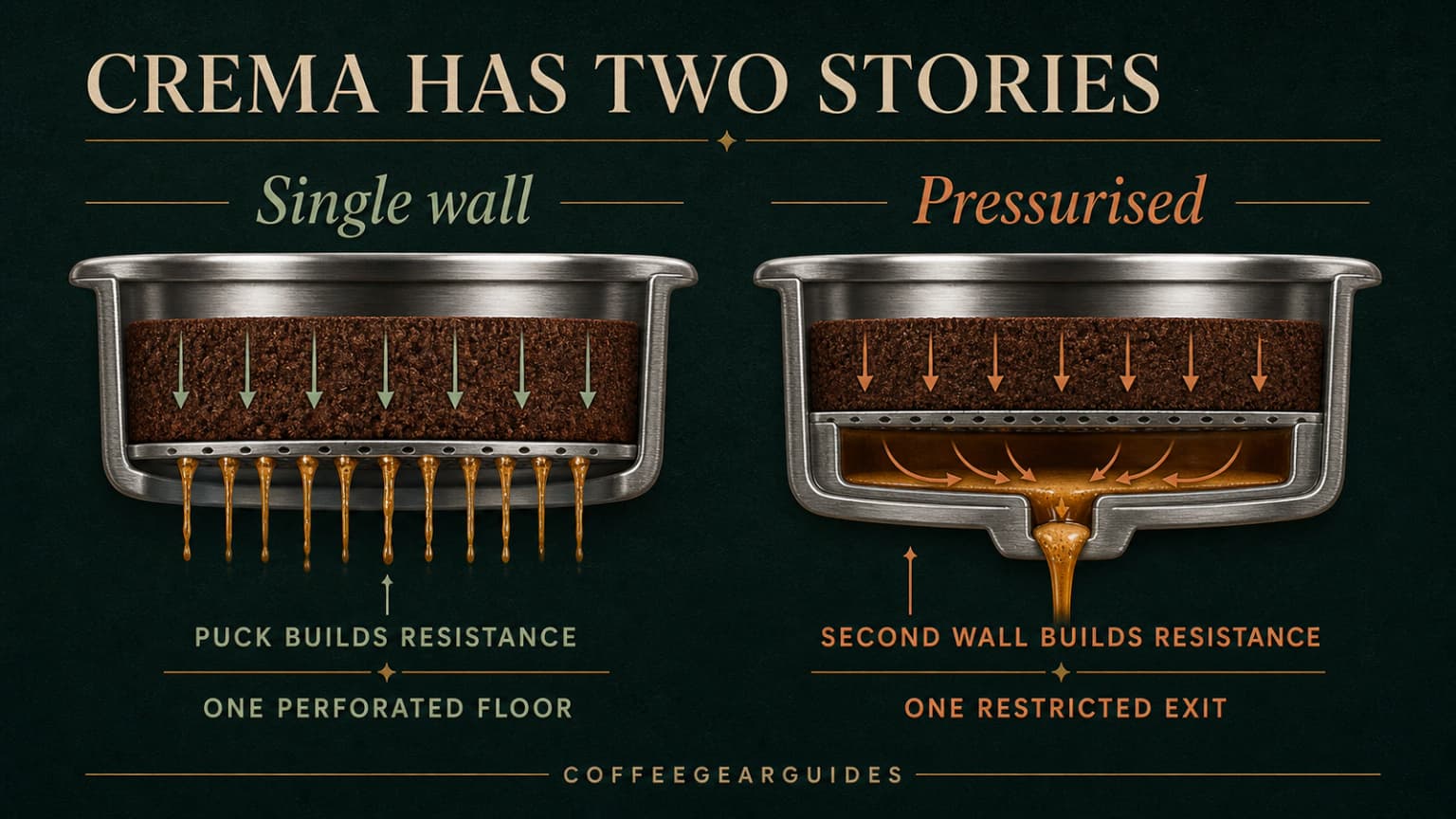
A single-wall basket has one perforated floor. The puck itself has to create the resistance, so grind size, dose, distribution, and freshness all show up in the flow.
A pressurised basket adds a second restriction at the exit. It can turn an imprecise grind into a slower, foamier stream, which genuinely helps when the grinder is basic or the coffee comes pre-ground.
That convenience changes the bean decision. A dark, high-body blend can turn severe when the roast and the basket both add intensity, while a balanced Arabica often becomes easier to enjoy.
Drink style then cuts across the basket line. Straight espresso rewards clarity and a clean finish; milk rewards enough roast development and body to stay recognisable after dilution.
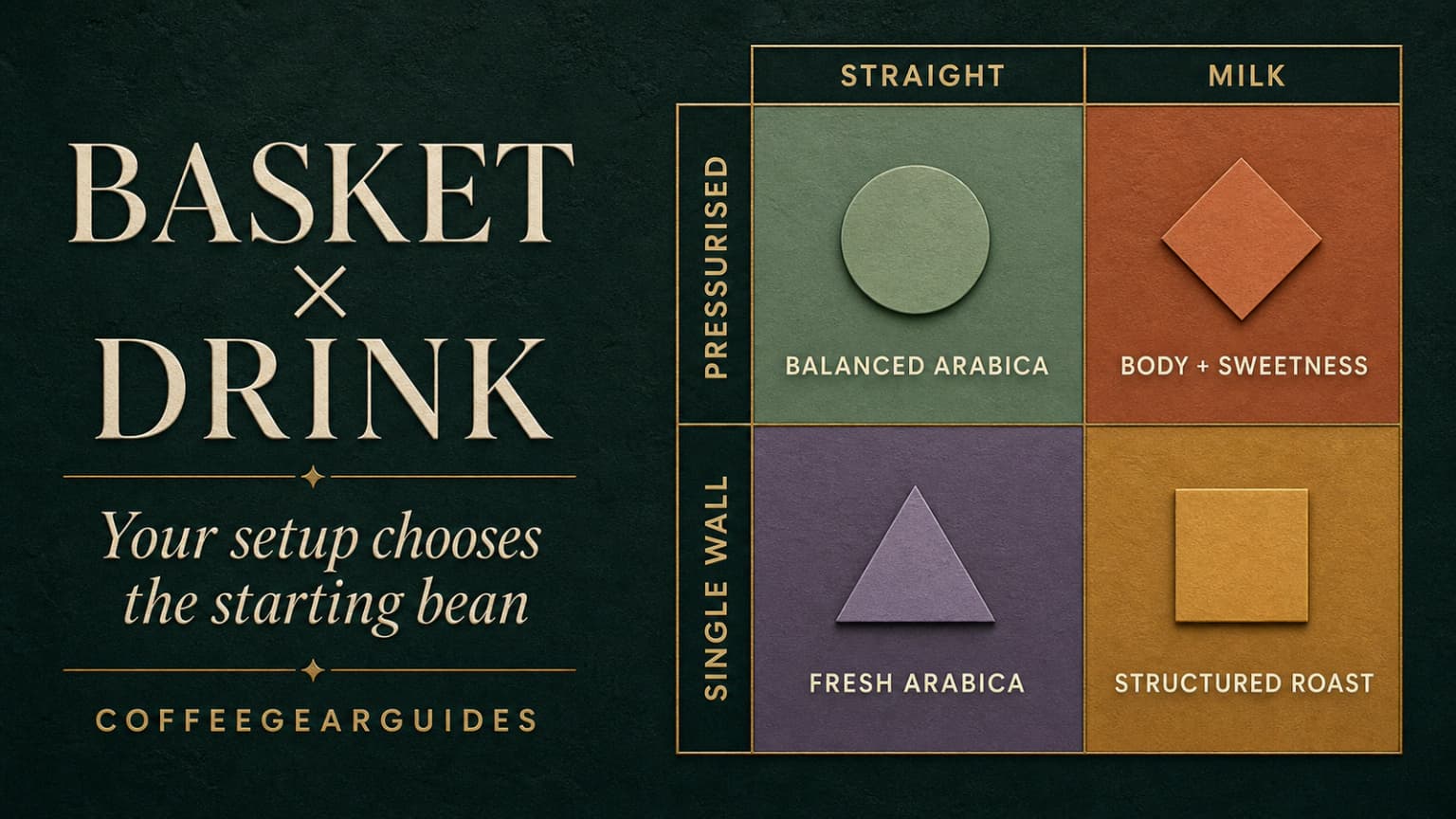
Start where your basket and usual drink meet. Roast labels matter less than this two-part fit.
The upper-left corner of the matrix is the easiest start: a pressurised basket, a milk drink, and a medium-dark bean with solid body.
The most demanding corner is a single-wall basket and straight espresso. It asks the grinder to expose sweetness without hiding dryness, roast defects, or channelling.
Buy the bean your setup can reveal
Buy the bean your setup can reveal
Your basket and drink
Start with this bean profile
Pressurised basket, milk drink
Medium-dark, chocolate-led, ample body; 100% Arabica or a measured blend
Pressurised basket, straight shot
Medium to medium-dark Arabica; avoid the harshest high-intensity roast
Single-wall basket, milk drink
Consistent medium-dark roast with enough structure to survive dilution
Single-wall basket, straight shot
Fresh Arabica with clear roast data and a grinder fine enough to dial it in
The matrix is a starting point, not a flavour law. Dose, water, temperature, and grinder quality still shape the cup.
This is why no bag is "best" in isolation. The same coffee can make a rounded flat white in one kitchen and a bitter, over-foamed double in the next one along.
If you genuinely do not know which basket you own, start in the medium-dark 100% Arabica lane. It has the widest useful range across the six products here.
The 6 best coffee beans for espresso in India
The ranking opens with the broadest recommendation, then moves through more specific drink, budget, acidity, and roast preferences.
Every price below was live when we verified it, and every rating is the figure showing on that Amazon India listing on the day we wrote this.
Ratings and review counts were read on Amazon India the day we published. Prices were verified live and will move. Amazon.in prices as of 15/09/2026. Details
1. Blue Tokai Attikan Estate
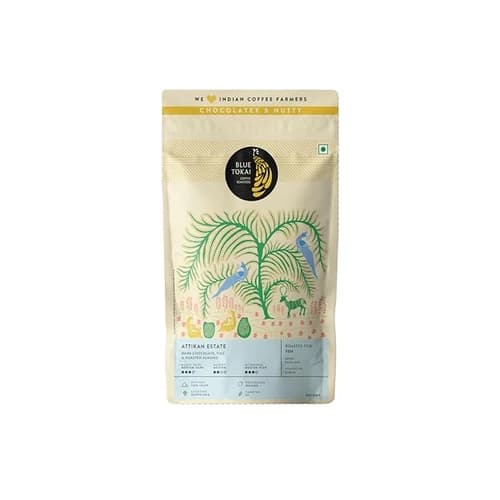
Blue Tokai Attikan Estate ranks first because it occupies the useful middle: developed enough for easy espresso, yet not so dark that roast flavour erases the coffee.
We verified Amazon listing B0CY2SG1X1 as the 250g whole-bean variant. It is a medium-dark, single-origin 100% Arabica coffee, not the similarly named pre-ground option.
Blue Tokai Attikan Estate
Rated 4.3 from 147 ratings
A medium-dark Indian Arabica with a broad espresso range and chocolate-led sweetness. It is our safest first bag for a new home setup.
Key details
100% Arabica from Attikan Estate
Medium-dark roast profile
Dark chocolate, fig, and almond notes
250g whole-bean pack
Listed for espresso and milk drinks
Roaster suggests about ten days of rest
What we like
Balanced enough for straight shots or milk
Easy roast level for many home machines
Small bag limits waste while dialling in
Indian roaster with clear coffee information
Watch out for
Recent reports flag occasional roast inconsistency
The roaster gives its tasting notes as dark chocolate, fig, and roasted almond. Treat those as useful expectations rather than a promise that your machine will reproduce three separate notes.
What matters for espresso is the shape behind them. Chocolate suggests developed sweetness, almond suggests a lower-acid finish, and the fruit note keeps the cup from becoming purely roasty.
On the day we checked, the Amazon India listing held 4.3 stars from 147 ratings. That is a usable base, though far thinner than the evidence sitting behind Lavazza.
Positive owner discussion tends to treat this as an approachable first specialty coffee. Drinkers moving across from instant or commodity dark roast usually notice stronger aroma and a cleaner finish.
The counterweight is recent quality-control feedback, and it deserves saying out loud. One long-time buyer posted a visibly uneven bag and described it as noticeably under-roasted.
A single report cannot define every batch. It does justify checking colour, aroma, roast information, and flow before you assume an odd shot is purely a grinder error.
If the beans look much paler or patchier than you expected, do not spend half the pack forcing a familiar recipe. Photograph the bag and its label, then contact the seller or the roaster promptly.
Fresh Attikan can also be too lively straight after roasting. Blue Tokai suggests about ten days of degassing, which should calm the foamy, unstable flow and make grind changes easier to read.
In a single-wall basket, start at a conventional 1:2 brew ratio and let taste finish the setting, which our brew ratio chart for Indian brewers works through method by method. In a pressurised basket, resist stretching the shot just to fill a bigger cup.
Its real advantage is range. It is sweet enough to drink straight, firm enough for a flat white, and familiar enough for anyone who does not want a bright, citrus-led first espresso.
Buy it if the household alternates between black coffee and milk drinks, or if a new machine needs one sensible reference bean. It gives you the widest chance of learning what your setup can do.
Skip it if you need a cheap 1kg daily bag or if your ideal espresso is intentionally smoky.
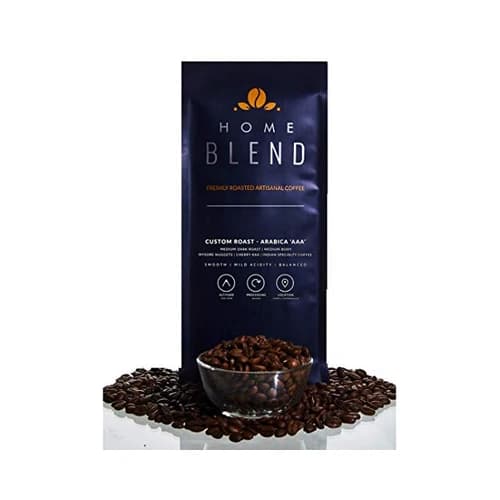
Home Blend Custom Dark Roast is the high-throughput choice. Its 1kg bag makes sense for a household serving several cappuccinos a day, not for one weekend espresso drinker.
Amazon listing B07NMJ6BGZ identifies whole Arabica AAA beans from Coorg and Chikmagalur, grown at a stated 1,100 to 1,500 metres and washed before roasting.
Home Blend Custom Dark Roast
Rated 4.3 from 413 ratings
A 1kg washed Arabica dark roast built around body, crema, and cappuccino strength. It offers the lowest 100% Arabica dose cost here.
The listing describes smooth body, mild acidity, balanced flavour, and sizeable crema. We would weight the first three above the last one, because crema volume is not a quality grade.
The AAA label needs context too. It usually signals a screen-size or sorting tier rather than a tasting score, and it cannot promise the roast suits your palate or your machine.
When we checked, 413 Amazon ratings averaged 4.3 stars. That is the joint-highest rating in this shortlist, carried by nearly three times the evidence behind our number-one pick.
The positive feedback we could read centres on weight and value: a full cup, visible crema, and enough intensity to hold its own in milk. That is why this bag outranks a generic bulk option.
Critical feedback about the roaster is less uniform. The recurring worry is freshness or aroma variation, and that matters more in a 1kg bag, where one disappointing batch is fifty-five doubles.
So the weak point here is not the roast specification. It is the mismatch between bag size and household pace.
At an 18g dose, one kilogram holds roughly 55 complete doubles. One drink a day keeps that bag open for almost eight weeks, before you allow anything for dialling in or shared doses.
Three doubles a day pulls it down to about eighteen days. That is the routine where a kilogram becomes genuinely economical rather than merely cheap-looking.
If you buy it, split most of the bag into small airtight jars on day one. Keep one working portion at room temperature and leave the rest sealed until you need them.
In an Indian monsoon, an open bag is the real enemy, not the calendar. Humid air dulls aroma quickly, so resist decanting a month of beans into a grinder hopper that sits in the light.
Do not keep opening a cold container and returning it to the fridge either. Moisture condenses on cold beans, so let a sealed portion come back to room temperature before you break the seal.
The dark roast should extract readily on machines with fixed temperature and broad grinder steps. If the shot tastes dry or smoky, shorten the yield before making the grind drastically coarser.
This bag is particularly well matched to a pressurised basket and milk. The basket supplies forgiveness, the roast supplies presence, and the milk rounds the sharper edge.
Straight-shot drinkers should start elsewhere unless they already know they prefer traditional dark espresso. The roast may trade away the fruit and finish that make an Arabica premium worthwhile.
Buy it for a family, small office, or repeated cappuccino routine. Skip it for low use, frequent bean switching, or a grinder hopper that traps a full bag in heat and light.
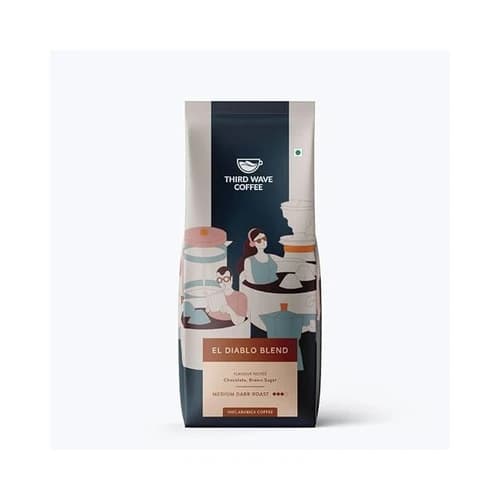
3. Third Wave El Diablo
Third Wave El Diablo is the most dessert-like profile on the list without moving into a very dark roast. Its official notes pair chocolate and brown sugar with zesty orange.
We verified B08B46F4NL as the 250g whole-bean listing. It is a medium-dark 100% Arabica blend in a resealable pouch, with no added flavours or preservatives stated.
Third Wave El Diablo
Rated 4.1 from 164 ratings
A medium-dark Arabica blend with chocolate, brown sugar, and orange in its target profile. It suits drinkers who want sweetness before smoke.
The flavour promise makes sense for espresso. Brown-sugar sweetness and chocolate can support a short shot, while a small orange accent can stop the finish from feeling heavy.
It is still a bag description, not a guarantee. Water, resting time, burr quality, and shot ratio decide how much of that profile reaches the cup.
Its Amazon India average sat at 4.1 stars across 164 ratings when we checked. That clears our threshold, but the narrow margin earns more caution than a 4.3 product does.
Public owner discussion splits in a revealing way. Some describe an appealing balance between dark-roast bitterness and lighter-roast sharpness, particularly from compact espresso brewers.
Others report flat, stale, or over-roasted cups from Third Wave retail coffee. That is not proof every El Diablo bag is faulty, but it does make the roast label and the pack condition worth a look.
The practical answer is to buy the 250g bag rather than commit to bulk. Record the roast or pack information, let the coffee settle, and judge three controlled shots before you change several things at once.
In a straight double, start near 1:2 and stop a touch earlier if the finish dries out. Stretching the yield turns that intended chocolate edge into generic bitterness.
In milk, keep the drink compact. A cortado, piccolo, or flat white gives the brown-sugar profile room to speak; a very large latte reduces it to background roast.
This bean extracts more easily than a light specialty roast, which makes it a sensible partner for the thermoblock bean-to-cup and semi-automatic machines sold here that offer little or no temperature control.
It is not the best choice for someone buying coffee solely to maximise crema. The all-Arabica composition can produce attractive crema when fresh, but not the same persistent cap as a Robusta blend.
Buy it if Attikan sounds too nutty and restrained, yet Davidoff sounds too dark. It gives the shortlist a middle lane built around dessert sweetness rather than pure intensity.
Skip it if batch consistency matters more than profile or if one large milk drink is the only daily order. The Gusto Crema has more body and much denser owner evidence.
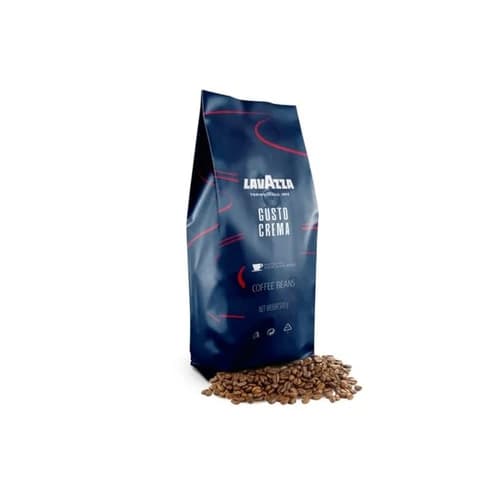
4. Lavazza Gusto Crema
Lavazza Gusto Crema is the traditional café-style value pick. Its Arabica-Robusta blend is designed for body and a visible crema cap rather than delicate single-origin clarity.
Listing B08R8K7XGR is the 500g medium-dark whole-bean bag. Amazon names beans from Coorg and Chikmagalur and states that the pack suits espresso machines and bean-to-cup machines.
Lavazza Gusto Crema
Rated 4.0 from 2,313 ratings
An India-market Arabica-Robusta blend with strong body, persistent foam, and a low dose cost. It is best when milk is part of the plan.
Its evidence base changes the whole discussion. When we checked, 2,313 Amazon ratings averaged exactly 4.0 stars, so this bag clears our bar with nothing to spare.
We keep it because the count is dense and the job is distinct. No other coffee here combines a ₹825 price, a 500g format, an Arabica-Robusta structure, and thousands of owner signals.
The positive pattern is straightforward. Owners report easy crema, a firm cup, and a profile that smooths out once the grind is properly set.
The negative pattern matters just as much. Reports describe packs several months past their packing date, uneven roast colour, limited flavour depth, and a harsh or monotonous straight shot.
Both of those can be true at once. A Robusta blend can throw abundant crema and cut through milk while still lacking the aromatic range a specialty Arabica drinker expects.
Crema is not proof that a bag was roasted recently. Robusta content and a pressurised basket both inflate the visible foam, so let aroma and taste do your freshness checking instead.
This is the best fit for a cappuccino, iced latte, or sweet milk coffee where body has to survive other ingredients. It is less persuasive as a neat espresso for someone seeking fruit or a long finish.
The 500g format is a sensible bridge between a 250g trial bag and a 1kg commitment. At one double a day, it supplies about four weeks before dial-in loss.
Inspect the delivered pack before opening. Check seller, seal, packing or roast information, and remaining shelf life; return a damaged or conspicuously old pack rather than accepting the discount.
On a fixed-temperature machine, start with a shorter yield than you would use for a medium Arabica. Darker, soluble coffee often needs less water to avoid pulling a dry finish.
If a first shot tastes sharp and runs quickly, grind finer. If it runs slowly and tastes charred or drying, shorten the ratio first, then move slightly coarser if needed.
Buy it when value, milk performance, and repeatability matter more than origin detail. The huge review count makes its strengths and limits unusually visible.
Skip it for black espresso if a 4.0 rating already makes you uneasy. We are not rounding that number up, and it stays fourth here because those compromises are real.
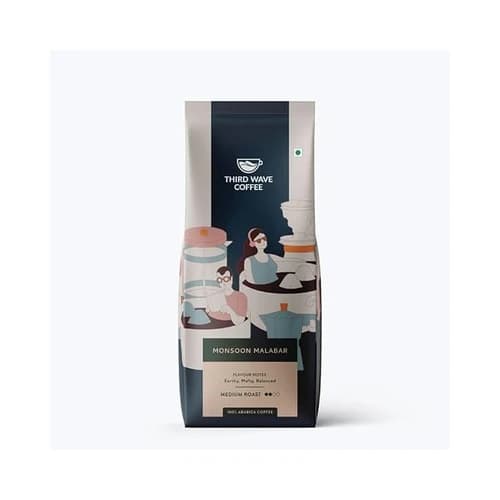
5. Third Wave Monsoon Malabar AA
Third Wave Monsoon Malabar AA is the low-acid specialist and the most divisive bag on this page. Its earthy, malty character comes from a processing step no other coffee here goes through.
We verified B09L67VFT3 as a 250g whole-bean pouch. The listing states 100% Arabica, medium roast, low acidity, smooth body, and earthy, malty flavour.
Third Wave Monsoon Malabar AA
Rated 4.0 from 201 ratings
A medium-roast monsooned Arabica with very low perceived brightness and an earthy, malty identity. It is the most polarising bean here.
Monsooned coffee earns an explanation, because the beans themselves can alarm a first-time buyer. Green coffee sits in open warehouses on the Malabar coast, where monsoon air swells it pale and strips most of the acidity out before roasting.
The resulting cup gets called earthy, malty, spicy, or woody. Those words attract one group of drinkers and repel another, which is exactly why this is a specialist pick and not a safer top-three choice.
The Amazon India page showed 4.0 stars from 201 ratings when we read it. We publish the exact average because owner sentiment here is as divided as the flavour style itself.
Positive owners call the profile mellow, heavy, and comforting. Several espresso drinkers report that its low brightness and dense body work particularly well in milk or in a compact black drink.
Critical owners describe bitterness, astringency, weak aroma, or a flatly stale impression. One recent buyer found the aroma attractive for a week or two, then fading fast in a ground bag.
Buying whole beans reduces that particular risk, though it cannot alter the coffee's earthy identity. If "clean and bright" is your definition of quality, no grind setting will turn this into that cup.
The unusual bean structure changes the grinding too. Do not assume the setting from a dense washed medium roast will carry over, because the first shot can run surprisingly fast or sit well outside your normal range.
If your burr grinder works in coarse steps, make one decisive adjustment when the flow is obviously wrong, then go back to small moves. Repeating tiny changes while the shot gushes can waste half a 250g bag.
Use a modest brew temperature if the machine allows it, and avoid a very long yield. Both choices can restrain the drying, woody side without pretending it is a fruity coffee.
In milk, the malt and earth can resemble cocoa or spice to a receptive palate. In straight espresso, the same notes are exposed and much less forgiving.
Buy this after identifying low acidity as a real preference. It is not our recommendation for someone who simply assumes acidity is always a fault.
Skip it as a blind first bag for a new machine. Start with Attikan Estate, learn the baseline, then try Monsoon Malabar as a deliberate change.
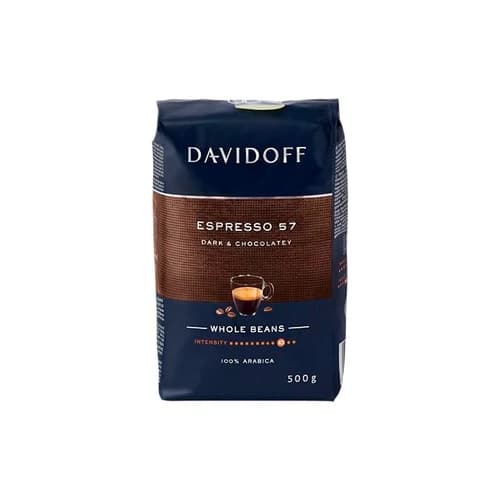
6. Davidoff Espresso 57
Davidoff Espresso 57 is the premium imported dark roast for a traditional palate. It is 100% Arabica, yet Davidoff scores its own roast at the maximum 12 out of 12.
Listing B0019XNZ4K is the 500g whole-bean format, rated 10 of 12 for intensity and 4 of 12 for acidity. Davidoff describes a smooth aroma, a dark profile, and light chocolate notes.
Davidoff Espresso 57
Rated 4.0 from 382 ratings
A very dark 100% Arabica blend for drinkers who want a forceful traditional espresso without adding Robusta. The price and freshness risk are high.
The composition matters. This bag gets its force from roast development rather than Robusta, so it offers a different route to a heavy espresso than Gusto Crema.
That does not make it automatically smoother. At maximum roast, origin detail recedes and the risk of smoke, dryness, or bitterness rises as the shot runs longer.
The listing showed 382 Amazon India ratings averaging exactly 4.0 stars. It stays on this list for a clear use case, not because a premium name excuses a borderline average.
Positive feedback praises intensity, aroma, and a familiar European espresso profile. It appeals to drinkers who actively want dark chocolate and roast in the foreground.
The criticism is predictable and still worth weighing. Some owners find it overwhelmingly bitter, while others receive a bag that feels muted or simply older than a local-roaster purchase.
Imported distribution is where the real risk sits. A long printed shelf life makes a bag safe to sell without making it expressive enough for demanding espresso.
Check the delivered pack before you open it, and never read a best-before date as a roast date. With no roast date on the bag, the cup has to earn your trust through aroma, grinder response, and taste.
The price is hard to defend on value alone. At ₹2,124 for 500g, an 18g dose works out at roughly ₹76 before any dial-in loss, more than twice what Gusto Crema costs you.
Use it in a compact recipe. A ristretto-leaning or standard double can hold onto body, while pushing a large volume through the puck is likely to expose the driest part of the roast.
A machine with temperature control should begin at its lower espresso setting. On a fixed-temperature machine, keep a stable warm-up and use a shorter ratio as the practical lever.
The bag suits flat whites, cappuccinos, and short intense shots. It does not suit a drinker searching for floral acidity or transparent estate character.
Buy it only when "very dark, 100% Arabica, imported" is the exact brief. For general use, Attikan is more balanced and Home Blend is far less expensive per cup.
Crema is evidence, not a score
Crema is the tan foam that sits above a fresh espresso. It forms as gas leaves the brewed coffee and becomes trapped in a film of oils and other coffee compounds.
It is useful evidence, but weak evidence on its own. Freshness, Robusta content, roast development, basket design, and pressure can all change its amount and persistence.
A single-wall basket asks the puck to create resistance. Its crema is therefore linked more closely to how fresh coffee, fine grinding, and preparation behave together.
A pressurised basket adds a restricted exit below the coffee bed. The liquid accelerates through that opening and can whip in gas, producing a foamier surface even when the grind is not precisely set.
The same tan surface can come from puck resistance or a second basket restriction. Taste must settle the question.
This distinction explains a common disappointment. A dramatic crema cap can cover a thin, old, or harsh cup; a modest cap can sit over a sweet, balanced Arabica.
Colour is not a universal score either. Roast level, lighting, bean composition, and extraction change it, so a darker tiger-striped surface is not automatic proof of a better shot.
Read crema as a clue, not a grade
Read crema as a clue, not a grade
What you see
What it may indicate
What to check next
Large foamy cap, thin taste
Pressurised basket or very active gas
Basket floor, roast date, liquid body
Persistent crema, firm bitterness
Robusta blend or developed roast
Composition and finish after stirring
Pale crema, very fast flow
Coarse grind or low puck resistance
Shot time, yield, basket type
Little crema, sweet balanced shot
Older Arabica that still tastes sound
Aroma and flavour, not foam volume
Broken patches and spurting
Uneven flow through the puck
Distribution, tamp, and basket cleanliness
Each visual signal has several causes. Change a setting only after checking the basket and tasting the stirred shot.
Stir before judging. Crema can be intensely bitter on its own, while the liquid below contains the sweetness and acidity that complete the cup.
The practical buying rule is simple. Choose Gusto Crema for milk-friendly body, not because a taller foam cap makes it objectively superior.
Arabica, Robusta, and the milk line
Species is best read as a drink-fit signal rather than a quality grade. Arabica tends to offer more aromatic clarity and softer bitterness, while Robusta usually brings more caffeine, more body, and a more persistent crema.
Those are tendencies, not moral rankings. Poor Arabica is still poor coffee, and a carefully processed Robusta can do exactly the structural work a milk drink needs.
Our six picks make that easy to compare. Five are 100% Arabica, and Gusto Crema is the only stated Arabica-Robusta blend on the page.
A blend makes sense when espresso is an ingredient inside milk. A cappuccino swallows delicate aroma anyway, so a little extra bitterness and body often produces a more complete final drink.
Straight espresso flips that priority. With no milk to soften it, the finish carries the cup, and a balanced Arabica is usually the safer place to start.
Choose composition by the finished drink
Choose composition by the finished drink
Cup decision
100% Arabica tendency
Arabica-Robusta tendency
Straight double
More clarity and softer finish
More force, possible rough edge
Cappuccino
Sweet but may become quiet
Body remains distinct in milk
Crema
Often finer and less persistent
Often thicker and longer lasting
Caffeine feel
Usually lower
Usually higher when Robusta is present
Easy first recipe
Medium-dark is broadly forgiving
Keep the yield short to control bitterness
These are broad tendencies. Roast, freshness, dose, and the share and quality of Robusta can outweigh the species label.
Davidoff proves why composition alone is incomplete. It is all Arabica, yet its maximum roast score makes it more intense and roasty than the medium-dark blend in many recipes.
Monsoon Malabar adds another exception. It is Arabica with low perceived acidity and heavy earthiness because processing changes the profile before roasting.
Read species beside roast and process, never in isolation. Then draw the final line at the amount of milk actually poured, not the drink name printed on a café board.
Match roast to machine control
Home machines are not equally controllable. Some let you set brew temperature and pre-infusion; others hand you one thermostat, one pump button, and a pressurised basket.
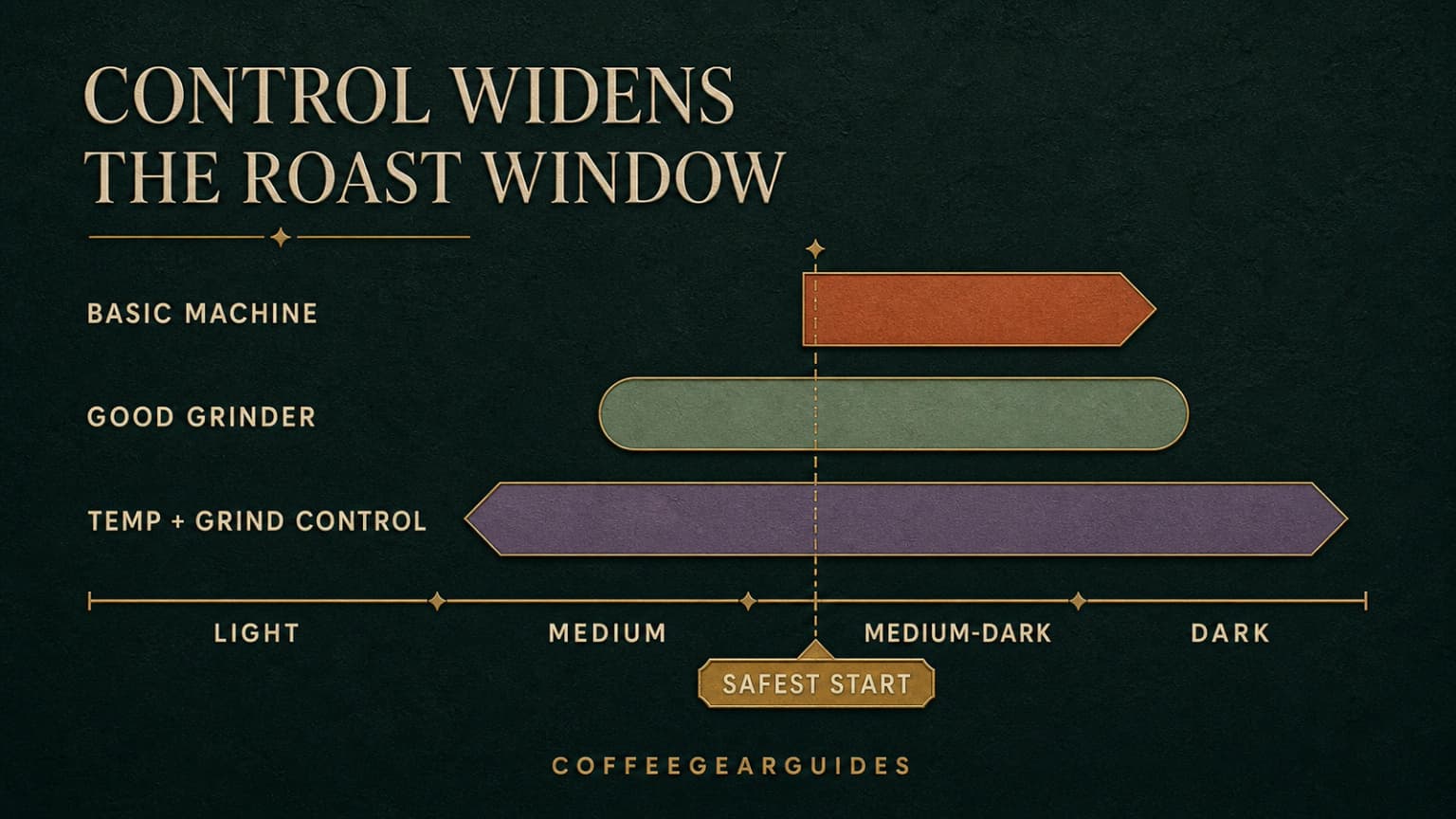
The rule is simple: bean difficulty should shrink as machine control shrinks. A developed roast extracts more readily, so a basic thermoblock has a far better chance of finding sweetness before the shot turns thin.
Very light coffee wants hotter, more even water and a grinder with tiny adjustments. None of our six picks sits at that demanding extreme, which is deliberate.
The other edge matters just as much. A maximum dark roast turns dry on a machine that runs hot and pushes a fixed volume, because you are left with almost no way to restrain the extraction.
Less machine control favours the middle. More control widens the roast range but does not make every roast pleasant.
Attikan and El Diablo sit in the broad centre. Their medium-dark development works with many fixed-temperature machines.
Home Blend and Gusto Crema move toward the forgiving, milk-focused side. They need less persuasion to extract, but a long yield can expose roast bitterness.
Monsoon Malabar is medium roast yet not a normal medium bean. Its monsooned structure and low-acid profile can demand a grinder setting far from your previous bag.
Davidoff occupies the dark limit. Temperature control helps, but a short ratio is often the more important protection against a drying finish.
Grinder control is part of this fit. A single-wall basket and stepped grinder can land between settings, where one click gushes and the next chokes.
In that situation, keep the finer setting and adjust dose slightly within the basket's safe range. Do not overfill until the puck presses against the shower screen.
A pressurised basket reduces that sensitivity. It also lowers the quality ceiling, so upgrading the basket before the grinder can make the setup harder rather than better.
Buy for the controls on your counter now, not for the machine you may own later.
Espresso beans or filter coffee powder?
Most Indian kitchens already own coffee, and it is usually filter coffee powder: a fine grind, commonly cut with 10 to 30 percent chicory and sold for a South Indian filter.
That powder is excellent at its own job and wrong for this one. Chicory dissolves readily and gives a slow drip decoction its body, but it muddies a thirty-second pressure extraction and can gum up a fine basket.
The grind is the second mismatch. Filter powder is milled for a drip filter rather than the narrow, adjustable window an espresso puck needs, and a fixed pre-ground bag leaves you nothing to change when the shot runs fast.
Price makes the swap look bad before it looks good. A 500g pack of chicory-blend filter powder runs roughly ₹340 to ₹505, while 250g of specialty Arabica on this page starts near ₹665.
Per cup that gap narrows sharply, because filter coffee is brewed to be drowned in hot milk and espresso is not. Our moka pot guide for India works through the same supply-route arithmetic in detail.
If you want to keep drinking filter coffee too, buy whole beans and grind twice. One burr grinder covers both jobs, provided it reaches a genuinely fine espresso setting and not just a coarse drip one.
Do not force filter coffee powder through a single-wall basket. A pressurised basket will make something drinkable from it, which is precisely why so many first machines ship with one.
The case against an espresso roast
"Espresso roast" is not a regulated roast level. One roaster may use it for a medium blend, another for glossy dark beans, and a third for any coffee tested on an espresso machine.
Enthusiasts are right to object when a guide treats the label as a technical specification. Pressure does not demand burnt coffee, and a capable setup can make expressive espresso from a lighter roast.
They are also right that a fresh local-roaster bag may beat every marketplace pick here. A roast date, direct shipping, and responsive roaster can matter more than Amazon convenience.
Our list solves a narrower problem: finding well-supported, in-stock Amazon India beans with clear roles. It cannot guarantee the freshest roast batch in every PIN code.
The phrase can still be useful as intent. It often signals lower acidity, more development, and a profile designed to remain legible at a short ratio or under milk.
Treat it as a clue, then verify the actual roast, species, notes, date, and bag size. With those details missing, the word espresso on the front of a bag adds very little.
If none of that appeals, the honest alternative is to stop buying beans altogether. A capsule machine removes the grinder, the roast date, and the dialling in, then charges you several times more per cup for the privilege.
There is no case for buying the darkest bag by reflex. The right roast is the one your machine can extract and your finished drink can balance.
Count the beans lost before the cup
Bag price hides the first-week cost. A new bean usually swallows two or three doses while the grinder travels from the old setting to a stable recipe.
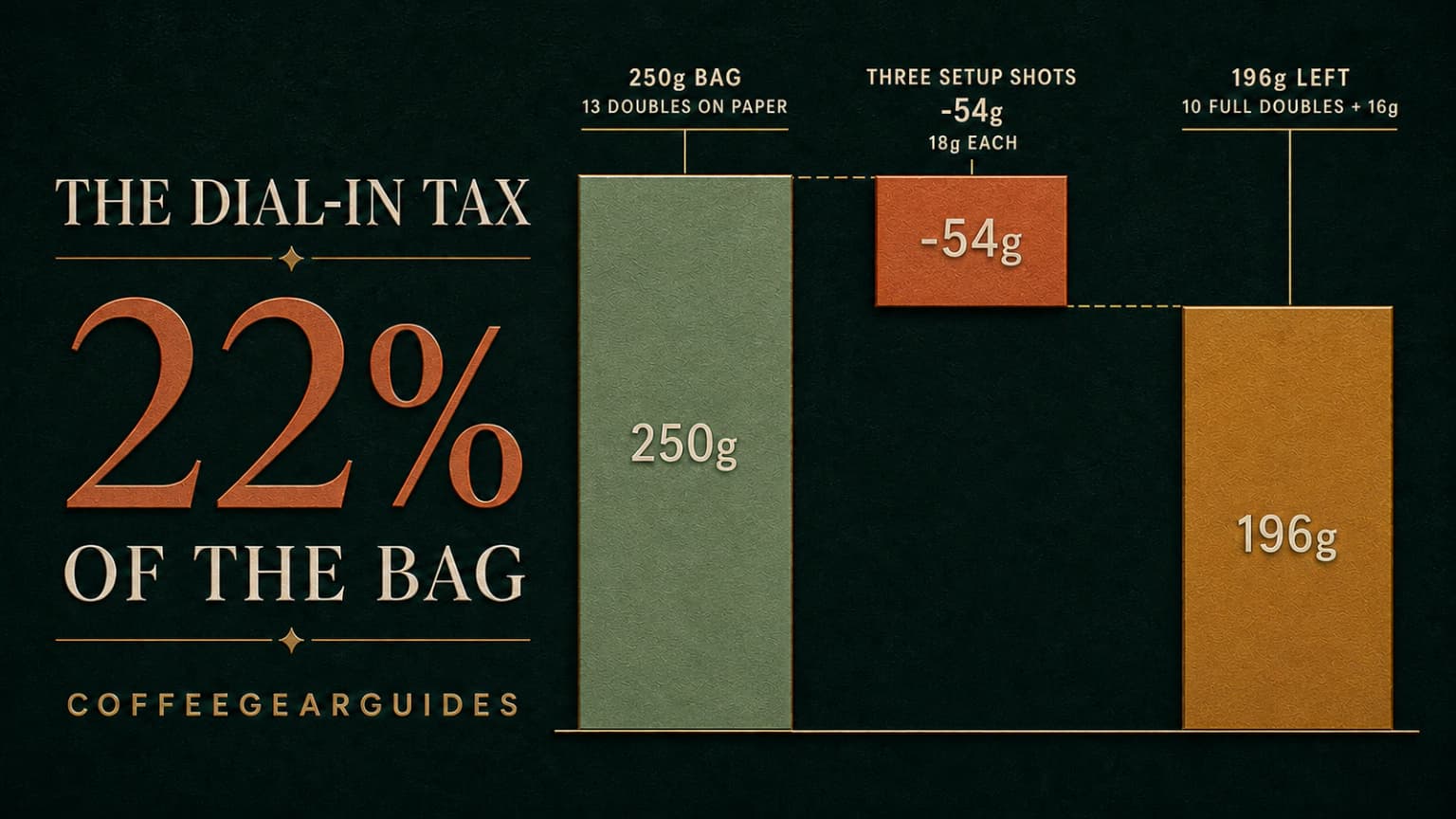
Call it the dial-in tax. That coffee is not wasted if it teaches you the setting, but it hurts a 250g bag far more than a 1kg one.
At an 18g double, 250g holds thirteen complete doses with 16g left over. Losing three of them to calibration removes almost 22 percent of the bag by weight.
The same 54g loss is only 5.4 percent of a kilogram. That is what makes bulk coffee efficient for a stable daily recipe, though slow consumption and stale beans can erase the saving entirely.
There is a cheaper way to avoid the tax altogether, which is to taste a lot before you commit to it. Roastery counters sell the cup and the bag of the same coffee side by side, and the ones we checked in our guide to the best coffee shops in Pune will tell you the roast date before you decide.
A 250g bag gives thirteen full 18g doses on paper, but three setup shots leave only ten complete drinks.
The dial-in tax by bag and price
The dial-in tax by bag and price
Bean
Bag
About per 18g
Three setup doses
Full doubles left
Attikan Estate
250g, ₹665
₹48
₹144
10
Home Blend Dark
1kg, ₹1,799
₹32
₹97
52
El Diablo
250g, ₹699
₹50
₹151
10
Gusto Crema
500g, ₹825
₹30
₹89
24
Monsoon Malabar
250g, ₹699
₹50
₹151
10
Espresso 57
500g, ₹2,124
₹76
₹229
24
Rounded estimates use an 18g dose and 54g of setup coffee. Water, milk, electricity, and leftover partial doses are excluded.
The table changes how value looks. Gusto Crema has the lowest ingredient cost per double, while Davidoff asks the highest price and the largest rupee payment for a bad first setting.
Switching every 250g bag charges the calibration loss repeatedly. Returning to a recorded recipe should need less than the three-dose allowance, which is where repeat buying earns a real advantage.
Small bags are therefore sensible tuition. Use 250g while learning a machine or comparing profiles, then move to 500g or 1kg only after one bean earns repeat status.
When to buy
Amazon India prices often move around Prime Day and the Great Indian Festival. A genuine discount helps most on a proven repeat bag, where the grinder setting is already known.
Do not order three unfamiliar bags merely because each carries a discount badge. Every switch creates another setup cost and makes it harder to learn which change improved the cup.
For a first bag, seller reliability and pack condition matter more than another ₹100 reduction. A returnable delivery gives more protection than a sale on an uncertain variant.
Buy the first bag when there is time to set the grinder carefully. Buy the next one on price only after the first has produced a recipe worth repeating.
Read the first shot from a new bag
The first shot should answer a question, not prove that the purchase was correct. Hold the dose and the target yield steady, so the new bean can show you how it differs from the last one.
Do not start on roast day if the roaster recommends rest. Coffee that is still degassing gives erratic flow, an oversized crema cap, and a sharp cup that settles on its own without any grinder change.
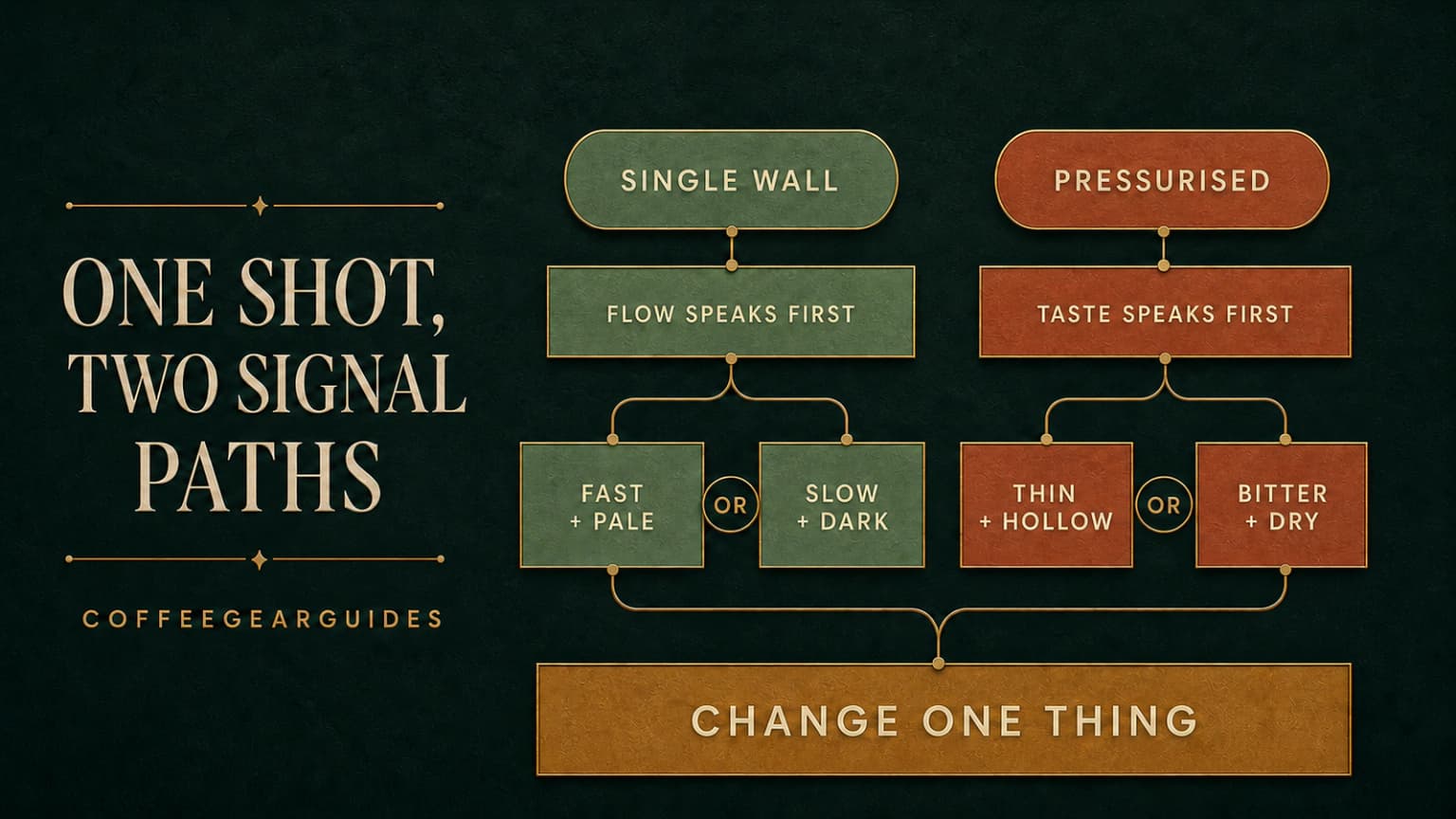
The same first shot provides different evidence. Trust flow more in a single wall and taste more in a pressurised basket.
The split flow begins after any stated rest period. Attikan has explicit guidance; an imported bag without a roast date begins with pack inspection and a cautious baseline.
Use a scale even with a pressurised basket. Volume hides crema, while grams show how much liquid actually left the puck.
A first-shot reading that saves the bag
1
Record the bag and basket
Write down roast or pack information, basket type, dose, grinder setting, and machine temperature. A note turns the next shot into evidence.
Tip Photograph the label before discarding the outer delivery packaging.
2
Begin with a fixed 18g to 36g baseline
Use the dose your basket safely accepts if 18g does not fit. Stop near twice the dry weight instead of filling the cup by eye.
3
Watch the whole stream
Note the delay, flow speed, spurting, and final time. A fast pale stream asks a different question from a slow dark drip.
4
Stir, cool briefly, then taste
Taste sweetness, acidity, roast bitterness, body, and dryness after mixing the crema through. Hot foam alone is a poor judge.
5
Make one decisive correction
Move finer for an obviously fast, thin shot and coarser for a choked one. If flow is close but the finish is dry, shorten the yield first.
Watch out Do not change grind, dose, temperature, and yield together. The next cup will teach nothing.
6
Confirm, then write the recipe
Pull one confirmation shot before declaring success. Record input, output, time, and the milk amount that made the bean work.
Tip Expect small grind changes as the open bag loses gas; that drift is normal.
A pressurised basket may hide changes in flow, so give taste more authority. A single-wall basket exposes flow clearly, but good timing still cannot overrule a harsh or hollow cup.
If three controlled corrections fail, question the bag-machine match. Monsoon Malabar may need a different temperature, while Davidoff may simply be darker than the palate enjoys.
That conclusion is useful. A bean does not become good value because more coffee is sacrificed to defending it.
Reset the grinder between bags
Old grounds can make a new bean taste like the last one. Dark roast fragments and retained fines are especially good at lending bitterness to the first clean dose.
The goal is not laboratory purity. It is a repeatable reset that removes stale exchange without wasting another handful of the new bag.
The between-bag grinder reset
1
Empty the hopper before the old bag ends
Let the final measured dose run through rather than topping old beans with new ones. Mixed beans make the first adjustment unreadable.
2
Brush the dry bean path
Unplug the grinder and follow its manual. Brush the hopper throat, removable upper burr, and chute without sending water near the burrs.
Watch out Do not dismantle a calibrated burr carrier unless the manual says it is user-removable.
3
Return to a safe opening setting
Start slightly coarser when moving from dark to denser medium coffee. This reduces the chance of choking the first shot.
4
Purge only what the grinder retains
Use a small measured purge, then inspect the grounds for old colour and aroma. Large blind purges spend money without proving cleanliness.
Tip A bellows grinder may need less coffee, but follow its maker because forcing air can spread fines.
5
Log the new zero point
Record the first useful setting beside the bean and roast. The note will shorten the reset when that bag returns.
Clean the portafilter and basket at the same changeover. Coffee oil under the basket rim can carry a stale finish even after the grinder is clear.
Do not use rice unless the grinder maker explicitly permits it. Rice can strain burrs, create powder, and leave material in a machine designed for brittle roasted coffee.
For a hopper-based bean-to-cup machine, the reset is less complete. Run the hopper low, remove only user-accessible beans, and never reach into a powered grinder.
The reward is not just cleaner flavour. A written reset separates a bean problem from old grounds, making every later rating and recipe more honest.
Which espresso beans should you buy in 2026?
For most Indian kitchens the answer is the Blue Tokai Attikan Estate, because it fits the widest range of baskets, drinks, and grinders on this page.
The real decision still comes back to basket, drink, and turnover. A bag that fits all three beats a prestigious bean chosen from tasting notes alone.
We scored the six on owner evidence, espresso fit, information quality, value per dose, freshness risk, and how clearly each one serves a distinct buyer.
The three beans we recommend first
Our pick
Attikan Estate
₹665.00
Best for
Black and milk versatility
Profile
Chocolate, fig, almond
Setup
Either basket type
Weak spot
Recent consistency concern
Home Blend Dark
₹1,799.00
Best for
Frequent cappuccinos
Profile
Dark, smooth, low acid
Setup
High-throughput household
Weak spot
Risky 1kg size
El Diablo
₹699.00
Best for
Chocolate-led shots
Profile
Chocolate, brown sugar, orange
Setup
Either basket, modest milk
Weak spot
4.1 rating, batch variation
The three beans we recommend first
Specification
Our pick
Attikan Estate
₹665.00
Home Blend Dark
₹1,799.00
El Diablo
₹699.00
Best for
Black and milk versatility
Frequent cappuccinos
Chocolate-led shots
Profile
Chocolate, fig, almond
Dark, smooth, low acid
Chocolate, brown sugar, orange
Setup
Either basket type
High-throughput household
Either basket, modest milk
Weak spot
Recent consistency concern
Risky 1kg size
4.1 rating, batch variation
Whichever way you go, shop the coffee and beans shelf your equipment can actually reveal, and buy a bag size your household will genuinely finish.
The best result here is not the biggest crema or the most expensive pack. It is a repeatable cup from a bag you get through while it still tastes alive.
Frequently asked questions
Which coffee beans are best for espresso in India?
For most home machines we would start with Blue Tokai Attikan Estate, a medium-dark 100% Arabica that works as a straight shot and holds up in milk. Home Blend Custom Dark Roast is the better value if your household pulls several cappuccinos a day.
There is no single winner here, because the right bag depends on your portafilter basket, your grinder, and how much milk lands in the cup. Our six picks run from about ₹665 to ₹2,124 on Amazon India.
Which roast level is best for espresso in India?
A medium-dark roast is the safest starting point. It extracts readily on fixed-temperature home machines, keeps enough sweetness for a straight shot, and still carries through milk.
Medium roasts suit grinders with fine adjustment and drinkers who want more origin character. Very dark roasts can taste smoky or harsh, especially in a long shot.
Are Indian coffee beans good for espresso?
Yes. Indian Arabica can produce sweet, full espresso, while Indian Robusta can add body, caffeine, and persistent crema to a blend.
The bag still has to suit your basket, grinder, and drink. Origin alone cannot rescue old coffee, a coarse grinder, or a recipe that pushes too much water through the puck.
Is 100% Arabica or an Arabica Robusta blend better for espresso?
Choose 100% Arabica for clearer sweetness and a softer finish in straight espresso. Choose an Arabica-Robusta blend when you want more body and bitterness to remain audible through milk.
Neither is automatically higher quality in the cup. A carefully roasted blend can suit a cappuccino better than an expensive Arabica that disappears under 150ml of milk.
Are whole beans better than ground coffee for espresso?
Buy whole beans if your grinder can make fine, repeatable espresso grounds. Grinding immediately before brewing preserves aroma and lets you adjust flow as a bag ages.
Pre-ground coffee can be practical with a pressurised basket, but choose a small pack. A single-wall basket normally needs grind changes that a fixed pre-ground bag cannot provide.
How fresh should coffee beans be for espresso?
Very fresh is not always ready. Espresso can be foamy and erratic while roasted coffee is still degassing, so many medium and medium-dark beans become easier to dial in after roughly a week.
Use the roaster's advice when it gives one. Blue Tokai recommends about ten days of rest for Attikan Estate, while an imported bag without a roast date should be judged by aroma and shot behaviour.