How Much Coffee Per Cup? India's Coffee to Water Ratio in 2026
Filter coffee decoction runs near 1:6, pour over near 1:16. Our 2026 chart gives exact grams for 8 Indian brewers, plus chicory and milk coffee.
By the CoffeeGearGuides team · India · Updated Aug 24, 2026 · 26 min read
On this page20
The coffee to water ratio is the one number that decides whether a cup reads strong or thin. In India it is also the number nobody agrees on.
A pour over guide says 1:16, a filter kaapi recipe says three spoons, and a capsule machine never asks you at all. Those are not contradictions, because they are measuring different things.
This guide puts the coffee to water ratio for every brewing method Indian homes use onto one scale, in grams. Filter coffee, moka, pour over, press, espresso, bean-to-cup, capsule and cold brew all get a number.
We worked from published brewing standards, food chemistry on coffee and chicory, manufacturer dosing figures, and the recipes Indian kitchens have used for generations. Where those sources disagree, we give the range rather than one tidy number.
Ratio decides strength, grind decides taste
Two different things get called strength, and separating them is the whole skill. One is how much dissolved coffee ends up in each millilitre of your cup, and the ratio alone sets that.
The other is how much of each ground particle dissolved on the way. Grind size, contact time and water temperature set that, and the industry calls it extraction yield.
Roasted coffee is only about 30 percent soluble by weight, so most of what you put in the filter was never going to reach the cup. Of that soluble third, brewing standards generally target 18 to 22 percent of the dry dose actually dissolving.
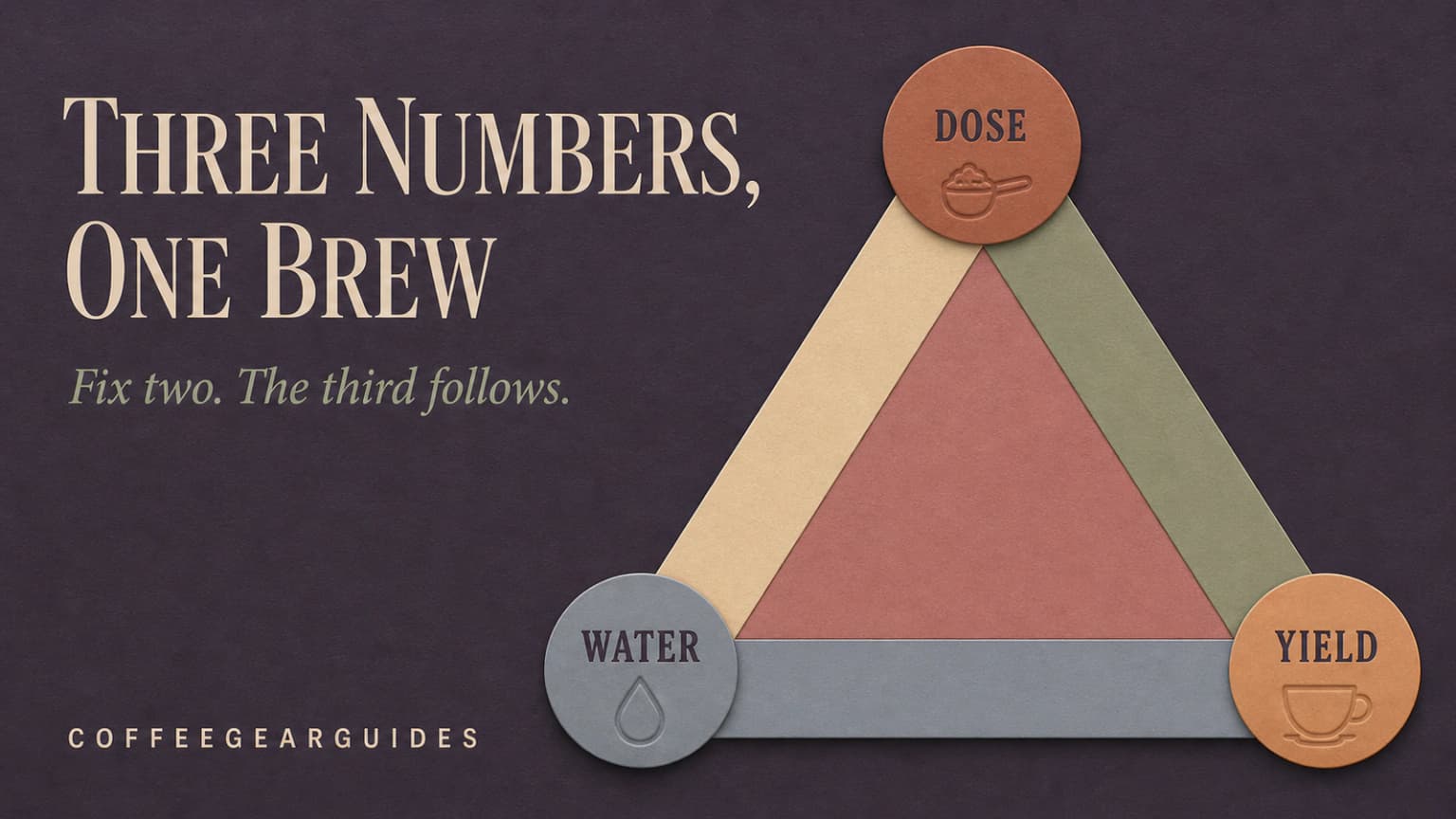
Fix any two of these and the third is decided for you. That is why a recipe carrying only one number can never be repeated by anyone else.
The practical consequence is worth memorising, because it saves years of pointless fiddling. Adding water to a harsh cup makes it weaker and still harsh, and adding coffee to a sour cup makes it stronger and still sour.
Brew ratio is the weight of dry coffee against the weight of water, written either as 1:16 or as grams per litre. Both notations describe the same thing, and Indian packs and recipes tend to use neither.
The published reference point is narrower than the internet suggests. The Specialty Coffee Association's Golden Cup figure is 55 g of coffee per litre of water, with about ten percent of tolerance on either side of it.
That works out closer to 1:18 than to the 1:16 repeated everywhere as the golden ratio. A 1:16 brew is roughly 62 g per litre, which sits just outside the published band rather than at the centre of it.
None of this makes 1:16 wrong. It means the accepted range is wider than any single number, and where you sit inside it is a preference rather than an error.
Brew ratio is not your milk ratio
In most Indian homes coffee is not a drink you brew, it is a drink you assemble. Something concentrated gets made first, and milk turns it into what you actually drink.
That creates a second ratio, and the two get confused constantly. When somebody says one spoon per cup, they usually mean one spoon per finished milk glass, which tells you nothing about how the coffee itself was brewed.
Keeping the two apart is what makes a recipe transferable. A friend's decoction ratio is useful to you, but their milk habit is not.
Three numbers people call the ratio
Three numbers people call the ratio
The number
What it sets
Typical figure here
What moves if you change it
Brew ratio
Dissolved coffee per ml of brew
1:15 to 1:18 for filter brewers
Strength of the coffee before milk
Decoction ratio
How concentrated the extract is
Around 1:6 in a South Indian filter
How far one brew stretches
Decoction to milk
How the finished glass tastes
40 to 50 ml in 150 to 200 ml
The drink, not the brew
Extraction yield
How much of each particle dissolved
18 to 22 percent of the dry dose
Sour, balanced or harsh
Cup size
What every gram figure scales to
150 to 200 ml in most Indian homes
Every dose on this page
The middle three are the ones people mix up. A recipe is only portable if it says which of them it is quoting.
Cup size deserves a moment on its own, because almost every ratio chart online is built around a 240 ml American mug. The Indian coffee cup is smaller, and a stainless tumbler smaller still.
Scale the chart to the vessel you drink from rather than the one the recipe assumed. A 12 g dose that is correct for 200 ml is noticeably weak once it is stretched to 240 ml.
How we built this ratio guide for 2026
CoffeeGearGuides researches rather than tests, and our about page sets out exactly how we work. Nobody here brewed a thousand calibration cups, and we are not going to pretend otherwise.
Published brewing standards supplied the anchor figures, which is where the grams per litre, the extraction band and the temperature ranges come from. Those documents describe what a balanced brew measures like rather than what any one kitchen will enjoy.
Food chemistry supplied the chicory section. Coffee and chicory are not interchangeable powders, and the difference in how readily each dissolves is measurable rather than a matter of opinion.
Manufacturer dosing figures filled in everything that is fixed by hardware. Basket volumes, capsule fill weights and machine dose ranges come from the people who built the equipment, and they are far more specific than general advice.
Last came the Indian recipes themselves. Decoction ratios have been passed down for generations without ever being written in grams, so we converted the traditional measures rather than replacing them.
Where sources disagreed we said so instead of picking the tidier number. Filter coffee ratios in particular vary by household, and any guide claiming one exact figure is inventing precision it does not have.
Coffee to water ratio by brewing method
Every method below opens with its ratio, then the grams for one Indian cup, then what that ratio is doing inside the brewer. These eight cover essentially everything sold into Indian kitchens.
Four of them let you choose the ratio freely, two fix it in hardware, and two leave you only half the decision. Knowing which group you are in saves a great deal of wasted effort.
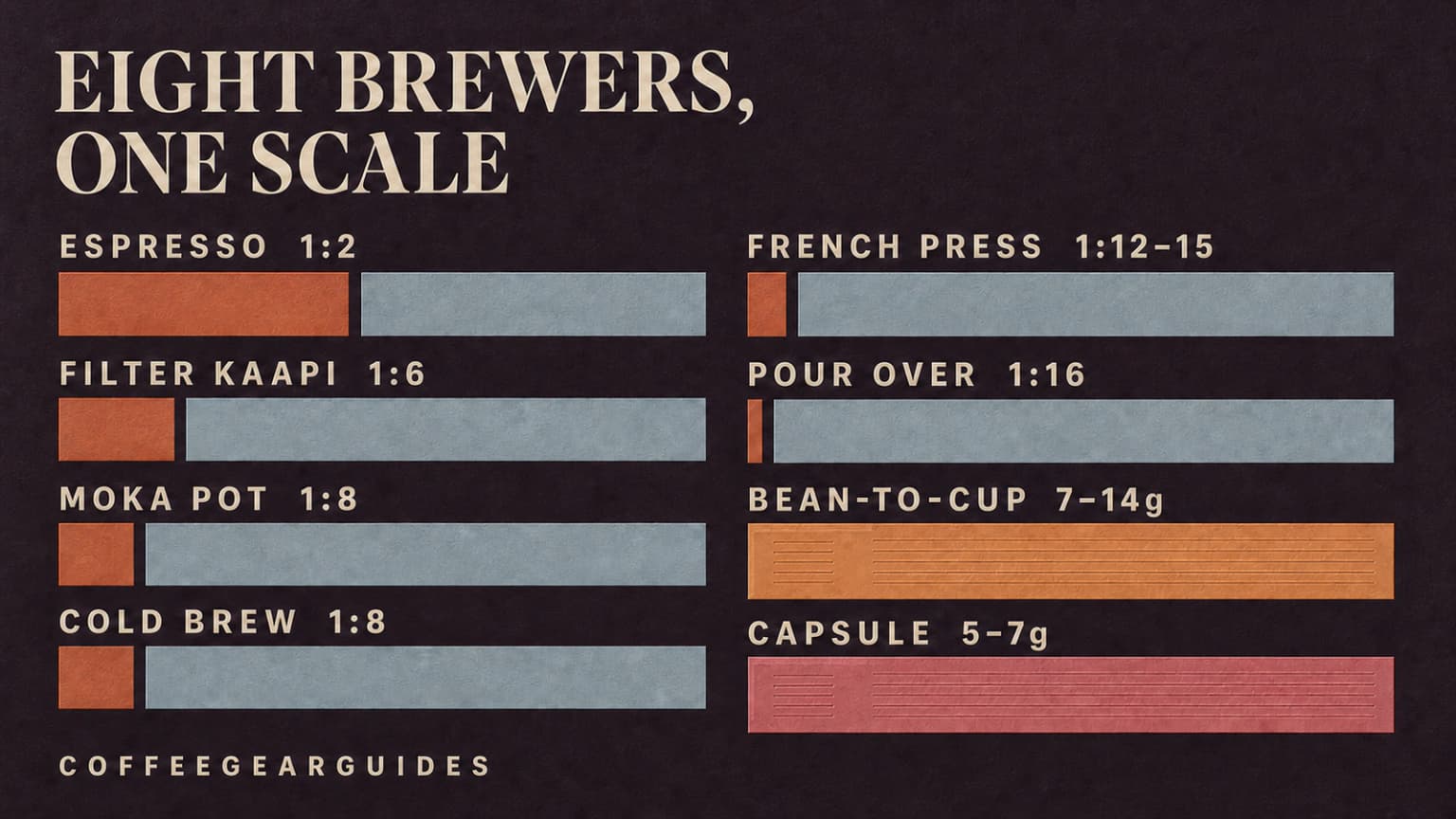
Seen as proportions rather than as numbers, the spread is startling. Espresso and filter coffee decoction are closer to each other than either is to a pour over.
1. South Indian filter coffee
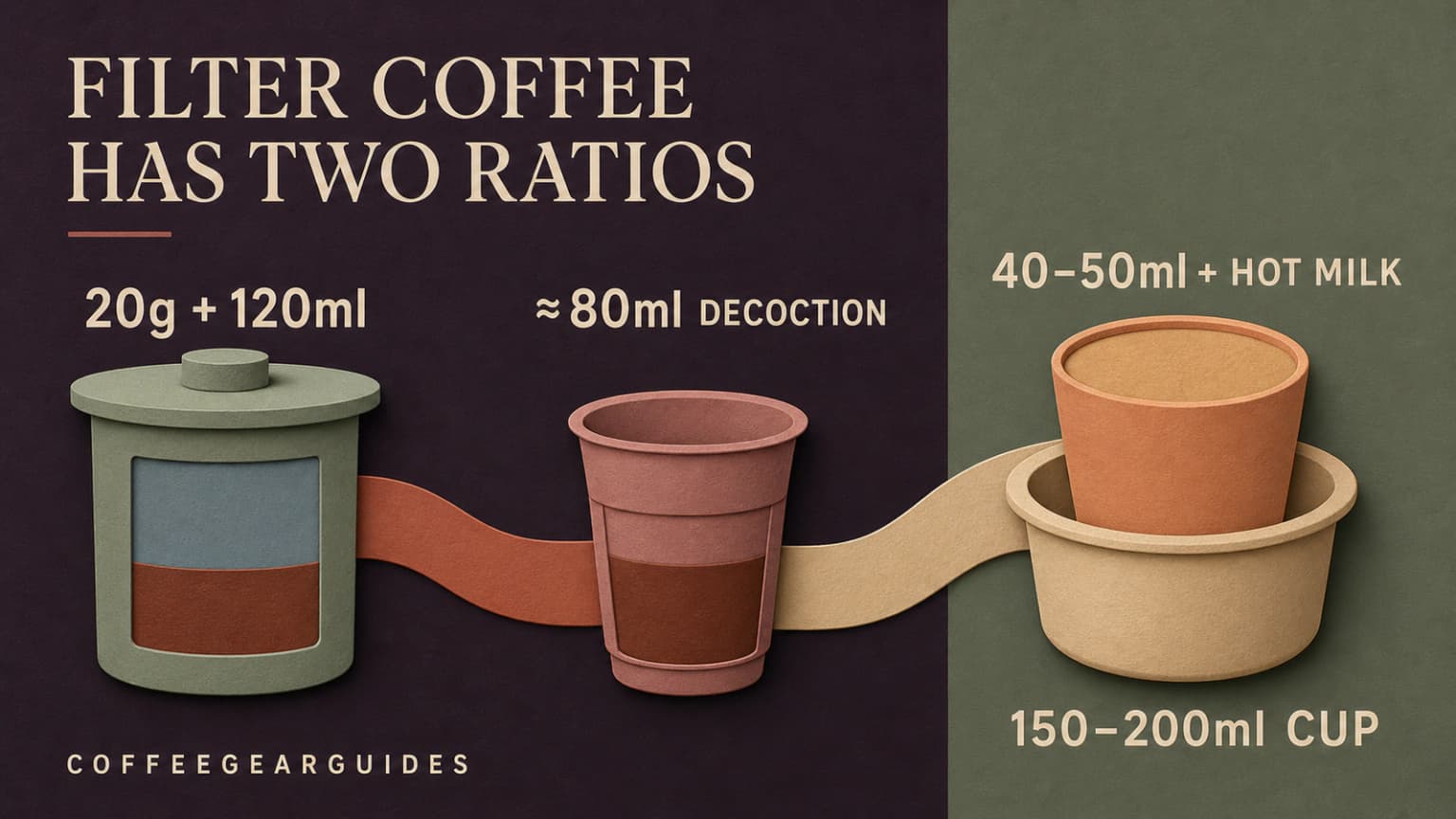
The coffee to water ratio for South Indian filter coffee is about 1:6, which is roughly 20 g of coffee powder to 120 ml of water just off the boil. Expect somewhere near 80 ml of decoction, because wet grounds retain a substantial share of what you poured.
A decoction is a concentrate rather than a drink, so it is brewed at a strength no other method would tolerate. Filter kaapi is diluted with hot milk afterwards, and that dilution is what the extreme ratio exists for.
Contact time is long by design, usually 15 to 20 minutes as water works down through a tightly packed bed. The grind is the finest used in any Indian home brewer, closer to table salt than to sand.
That fineness is exactly why the ratio looks so extreme. A fine grind exposes far more surface area, so the same water pulls a great deal more out of every gram.
Grind matters more here than in any other method on this page, and it is the variable most households never control. Our guide to coffee grinders in India covers what a filter grind asks of a burr set, and why a chicory blend behaves differently under one.
The second half of the recipe is the milk. Around 40 to 50 ml of decoction in a 150 to 200 ml glass is where most households land, and adjusting that is a faster route to a better cup than changing the powder.
2. Moka pot
A moka pot fixes its coffee to water ratio near 1:8 and gives you no say in it. A three cup pot takes roughly 17 g of coffee and yields somewhere near 130 to 150 ml of concentrate.
The funnel basket holds a fixed volume of coffee and the boiler holds a fixed volume of water, so the pot decides. That surprises people arriving from pour over, where every number is a choice.
Under-filling the basket does not make a weaker brew in any useful sense. It leaves headroom, the puck loses its resistance, and the pot pushes water through a gap instead of through coffee.
Fill the basket level and full every time, without tamping. The only ratio adjustment a moka pot really offers is how much of the finished concentrate you pour into your glass.
For an Indian milk coffee that means 40 to 50 ml of concentrate topped with hot milk. That is how a six cup pot serves six or seven people despite yielding under 300 ml.
The cup markings on the box are Italian espresso cups, which is why the numbers never match an Indian glass. The moka pots we recommend for India set out what each size really pours.
If a moka brew tastes harsh, the ratio is not the culprit. Lower the flame, because the pot is finishing too fast and too hot.
3. Pour over
The pour over coffee to water ratio starts at 1:16, which is about 15 g of coffee to 240 g of water for a single cup. Pour it in stages rather than all at once, and work outward from there once you have tasted it.
Nothing about the brewer constrains you here, which is both the appeal and the difficulty. Every number is a choice, so the recipe has to come from you rather than from the hardware.
The first pour is the bloom, roughly twice the coffee weight in water, left for thirty to forty seconds while trapped carbon dioxide escapes. It counts towards the total water, which is a detail plenty of recipes leave out.
Pour rate changes the result even when the ratio has not moved, because a fast pour agitates the bed and a slow one lets it settle. That control is what a narrow spout buys you, and our gooseneck kettle guide for India is honest about who actually needs one.
Water temperature belongs in the same conversation. Brewing standards centre on about 93C, which across most of India means taking the kettle off the boil for around thirty seconds.
Weigh the water rather than measuring it, because a millilitre of water weighs a gram and a scale removes every conversion. This is the one method where a scale genuinely changes the cup.
4. French press
The French press coffee to water ratio sits between 1:12 and 1:15, stronger than a pour over. For a 350 ml press that is roughly 25 g of coffee to 350 g of water, steeped four minutes before the plunge.
Immersion runs stronger because every particle sits in the water for the whole brew instead of meeting it once. Grind coarse, because the mesh filter passes anything finer straight into the cup.
Those fines are why a press cup can taste harsh at a ratio that would be gentle in a filter. They keep extracting after the plunge, so a press left standing gets worse by the minute.
An AeroPress is immersion as well, but its shorter steep and paper filter land it closer to the pour over band. Treat it as a 1:14 to 1:16 brewer rather than a press, and expect a much cleaner cup.
Decant the whole brew into a jug or into cups as soon as you plunge. It is the cheapest improvement available to a press owner, and it costs nothing at all.
The Indian variation worth knowing is that a press handles a chicory blend poorly. Chicory dissolves fast and breaks down into very fine sediment, so the mesh delivers a muddy cup rather than a clean one.
5. Espresso
The espresso brew ratio starts at 1:2, meaning an 18 g dose producing about 36 g of liquid in the cup. Note the change of vocabulary, because here the ratio is dose against yield, not dose against the water the machine pushed through.
Time is the usual reporting number and 25 to 30 seconds is a common target, but it is a symptom rather than a setting. Chase the yield in grams and the seconds will follow.
The basket fixes your dose within a gram or two. An 18 g basket cannot brew 14 g properly, so the ratio conversation begins with whichever basket your machine came with.
Pulling a shorter ratio, nearer 1:1.5, gives a denser and sweeter cup that suits a dark roast. Stretching towards 1:3 lightens the shot and is how a lungo is made, at the cost of a thinner body.
Roast level pushes the ideal ratio around more here than anywhere else, and Indian shelves lean dark. Our guide to espresso beans in India covers which bags forgive a short ratio and which need a longer one.
Milk moves the target again. A shot bound for a 180 ml milk coffee wants to be shorter and denser than one you intend to drink on its own.
6. Bean-to-cup machine
A bean-to-cup machine doses somewhere between 7 and 14 g per cup, well under a manual 18 g double. It hides that number behind a dial marked mild to strong, so the ratio is chosen for you and never actually shown.
The dial moves the grinder's run time, which changes the dose, while the volume button changes the water. If a superautomatic espresso tastes thin next to a cafe one, that gap is usually why rather than the beans.
Set the strength dial towards its upper end and the volume button low, then work down from there. Starting mild and long is the most common setup mistake in the category.
The two controls interact, which manuals rarely explain clearly. Raising strength while also raising volume can leave the ratio exactly where it started.
Some machines expose a gram figure and some only show a row of bean symbols. The bean-to-cup machines we cover for India differ a lot in how much of this they let you see, and that visibility is worth more than an extra drink preset.
Fixed-dose machines still respond to grind. If the strongest setting is not strong enough, a finer grind raises extraction without touching either control.
7. Capsule machine
A capsule fixes the dose at 5 to 7 grams, sealed at the factory, so the ratio decision is taken away completely. That is the point of buying one, and it is also why a capsule cannot be pushed to espresso-machine strength.
Your only lever is the volume button. A 25 ml ristretto and a 110 ml lungo from the same capsule are ratios of roughly 1:4 and 1:18, from a dose that never moved at all.
The correct habit in an Indian kitchen runs against instinct. Pull the short button and add hot milk to reach the volume you want, rather than asking the capsule to fill a large cup with water.
Pressing lungo to fill a 200 ml cup gives you a thin, over-extracted drink and a reputation the machine does not deserve. Our capsule machine guide for India works through that cup-size mismatch in detail.
Two capsules into one cup is a legitimate answer for anyone who wants a genuinely strong milk coffee. It doubles the cost per cup, which is the honest trade rather than a clever workaround.
8. Cold brew
The cold brew coffee to water ratio is 1:8 for a concentrate, which is 100 g of coarse coffee to 800 g of cold water. Steep it twelve to eighteen hours, then dilute roughly one to one with water or milk when you serve.
Cold water dissolves far less than hot water, so cold brew compensates with time and with a heavier dose. That is why its ratio looks nothing like the hot brewers above it.
For ready-to-drink cold brew, go straight to 1:15 or 1:17 and skip the dilution. It is simpler, and it wastes less coffee if you are not brewing for a household.
Indian kitchens have one advantage and one hazard here. Ambient temperatures shorten the steep considerably, and the same warmth makes an unrefrigerated steep risky beyond a day.
Steep in the fridge where you can, and treat the finished brew as perishable. A week is a sensible outer limit for concentrate kept cold.
Coffee to water ratio for an Indian cup
How much coffee per cup? For a 200 ml cup of black coffee the answer is about 12 g, and the coffee to water ratio chart below scales that to every brewer and every cup size.
It is built around the cups Indian homes actually use rather than a 240 ml American mug. Read the row for your brewer and ignore the rest.
Where a ratio is fixed by hardware we have said so. There is no point offering a choice the machine will not accept.
Starting ratios for an Indian cup
Starting ratios for an Indian cup
Method
Brew ratio
Coffee and water
What lands in the cup
South Indian filter
About 1:6
20 g to 120 ml
About 80 ml of decoction
Moka pot, 3 cup
Fixed near 1:8
17 g, basket level and full
130 to 150 ml of concentrate
Pour over
1:15 to 1:17
15 g to 240 g
About 210 ml of black coffee
French press
1:12 to 1:15
25 g to 350 g
About 300 ml after the plunge
Espresso
1:2 by yield
18 g in the basket
About 36 g of espresso
Bean-to-cup
Set by the dial
7 to 14 g per cup
25 to 110 ml, per the button
Capsule
Fixed by the capsule
5 to 7 g, sealed
25 to 110 ml, per the button
Cold brew concentrate
1:8
100 g to 800 g
About 600 ml of concentrate
Instant coffee
Not a brew ratio
About 2 g per level teaspoon
Whatever you dissolve it into
Starting points rather than verdicts. Yields are approximate because wet grounds retain water, and how much they retain depends on grind and dose.
Scaling up is simple arithmetic as long as you scale both numbers. Doubling the coffee without doubling the water is the single most common way a good recipe goes wrong on a busy morning.
Scaling down is less forgiving. Below roughly 10 g of coffee most brewers behave badly, because the bed is too shallow to slow the water, and a small pour over is genuinely harder than a large one.
The decoction maths nobody writes down
Every filter coffee recipe in India is written in spoons, and every one of them skips the step that trips people up. The water you pour in is not the decoction you get out.
Wet coffee grounds hold roughly twice their own weight in water, a figure filter brewers commonly work from. A 20 g dose therefore locks up somewhere near 40 ml before a drop reaches the lower chamber.
Pour 120 ml onto 20 g of powder and about 80 ml comes through. That is why a filter that looks like it should make a cup of decoction makes rather less than one, and why topping it up mid-brew weakens everything.
Filter coffee is two ratios in sequence, and household recipes only ever quote the first. The second one is where the drink is actually decided.
Measure the decoction, not the powder. A household that knows it wants 80 ml of decoction can hit that figure with any dose, any grind and any filter, which is what makes the recipe survive a change of coffee.
The second stage is where personal taste lives. A degree coffee poured strong runs nearer 50 ml of decoction in a 150 ml glass, while a milder morning cup might be 30 ml in 200 ml.
Both are correct, and neither is a brewing decision. They are dilution decisions, taken after the coffee is already made.
One more variable belongs to the vessel rather than to the coffee, and no recipe mentions it. A tightly packed bed in a narrow filter drips slower than a loosely filled wide one, so the same dose in a different dabarah gives a different decoction.
Tamp lightly and consistently rather than hard. The pressed disc is there to slow the water evenly, not to squeeze anything out of it.
Tasting a well made decoction is the fastest way to learn what you are aiming for. The restaurants that still pour one properly are named in our guide to coffee shops in Pune, alongside the specialty rooms that brew the same beans a completely different way.
Why chicory changes the number
A chicory blend needs a slightly smaller dose than 100 percent coffee to reach the same strength. Chicory dissolves more readily, so each gram hands over more to the cup, and the percentage printed on the pack tells you how far to move.
The blends run wide. Bru Green Label declares 53 percent coffee while Cothas Darshini declares 80, so two packs on the same shelf can be very different products.
They do not dissolve alike either. Roasted coffee is about 30 percent soluble, while chicory root is roughly two thirds inulin by dry weight, a carbohydrate that dissolves readily in hot water.
Chicory gives up far more of itself per gram than coffee does. That is why the same spoonful of a heavily blended powder reads stronger and sweeter.
The practical effect is that a chicory-heavy powder delivers more dissolved solids per gram than a 100 percent coffee at the same dose. It reads stronger, thicker and sweeter, and it colours the decoction more deeply.
Published figures for how much more vary with the roast and the method, so we will not quote a precise multiplier. The direction is consistent enough to brew by, and your own taste settles the size of it faster than arithmetic will.
Where a chicory blend starts
Where a chicory blend starts
Printed on the pack
What you have
How it behaves
Where to start
100 percent coffee
Single origin or a coffee-only blend
Slower to give up solids, more aromatic
The full dose in the chart above
85:15
A light touch of chicory
Very close to pure coffee in the cup
The full dose, then taste
80:20
The common South Indian house blend
Fuller body, deeper colour, slight sweetness
Slightly under the full dose
70:30
A firmly chicoried blend
Thick and dark, coffee aroma dialled back
Around a tenth less powder
53:47
Close to half chicory by weight
Very heavy body, distinctly sweet edge
Noticeably less powder, and taste early
Starting points for the same finished strength, not a ranking. A blend is a preference, and South Indian households have brewed the heavier ones for a century.
There is a second reason chicory affects your recipe, and it has nothing to do with strength. Chicory grinds and breaks differently from coffee, which is why blends behave oddly in equipment designed around beans.
If you brew a blend in anything with a filter mesh, expect more sediment than the same dose of coffee would give. That is not a fault in the equipment, and no ratio change will remove it.
The case against weighing your coffee
Everything above assumes precision is worth having, and for a large share of Indian coffee drinking it simply is not. A scale earns its place on a pour over bench and rarely anywhere else.
Consider what actually happens to a measurement error in a filter coffee. A dose that is one gram heavy changes a decoction that is then diluted four or five times over in milk and sugar, and the error is diluted with it.
The household that has poured the same three spoons for thirty years is not brewing badly. They are running a calibrated system in which the spoon, the filter, the powder and the glass have all been matched by repetition.
Instant coffee makes the point plainly, because it has no brew ratio at all. The granules dissolve completely rather than being extracted, so a spoon is the correct instrument here rather than a compromise.
There is also a real cost to precision becoming the hobby. Chasing a tenth of a gram while drinking coffee that was ground last month is solving the smallest problem on the counter.
The honest position is that the ratio matters most where nothing else is fixed. In a pour over, everything is yours to set and a scale is the only way to repeat yesterday.
Find your ratio in three brews
Three brews on three mornings will land you closer than three months of adjusting things at random. The method is to move one number while nailing everything else down.
Use the same coffee, the same grind, the same water and the same brewer for all three. The point is to isolate the ratio, and any second change makes the result unreadable.
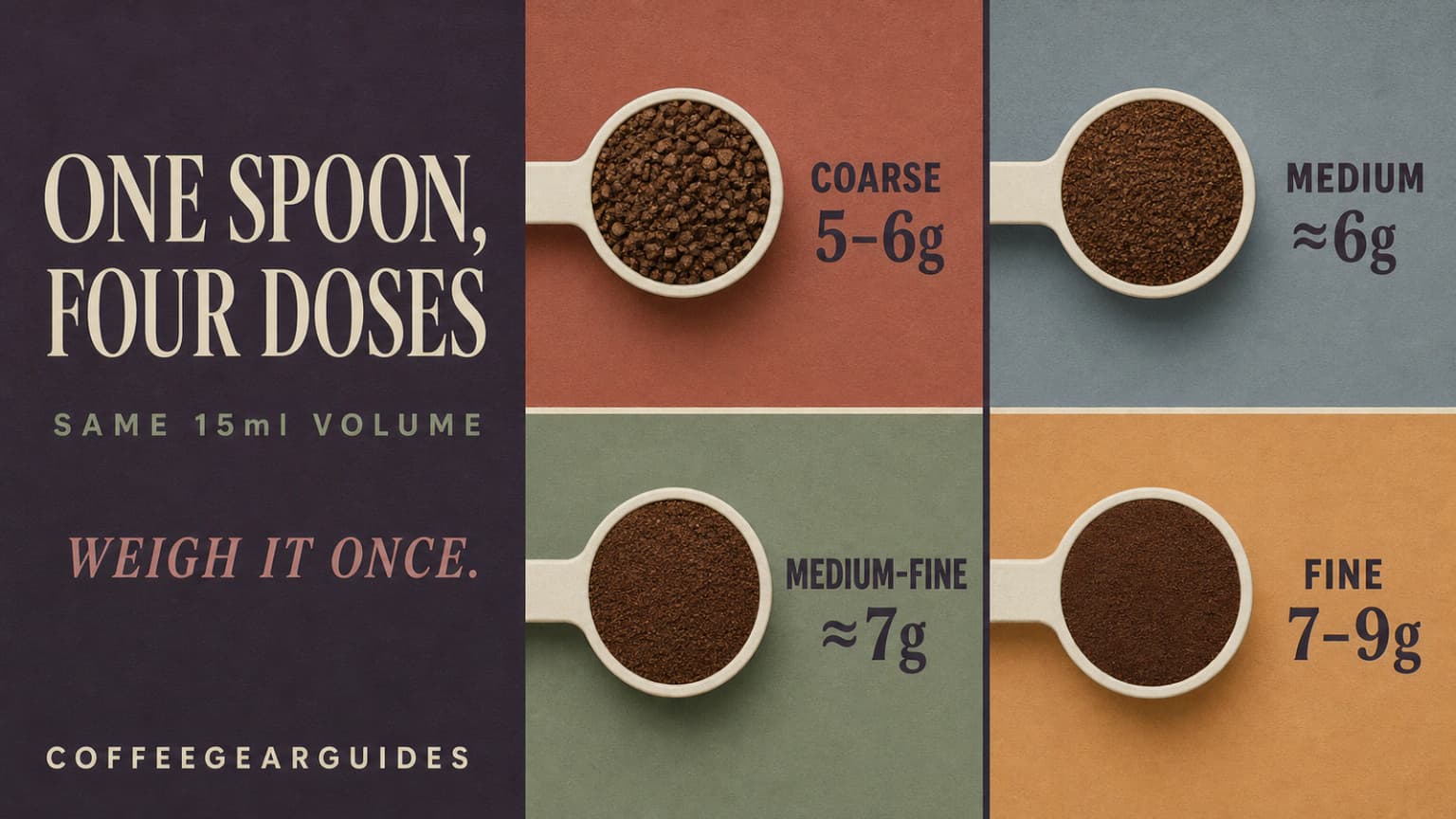
The same spoon, four grinds, four different doses. Nobody is measuring badly, the spoon is simply measuring volume in a job that needs weight.
Three brews to your own ratio
1
Brew one: the middle
Brew at the figure in the chart for your method, weighed rather than spooned. Drink it black, without sugar, and write one word down for how it tasted.
Tip Black and unsweetened only for these three brews. Sugar and milk both mask exactly the difference you are trying to detect.
2
Brew two: one step stronger
Keep the water the same and raise the coffee by about half a gram per 100 ml, which moves a 1:16 towards 1:15. Everything else stays untouched.
3
Brew three: one step weaker
Go back to the original dose and add water instead, taking a 1:16 out towards 1:17. You now have three points on one axis rather than three unrelated cups.
4
Pick a side, then halve the gap
Choose whichever of the three you would happily drink again and move halfway towards it from the middle brew. That fourth cup is usually the one you keep.
Tip If the strongest and the weakest both tasted wrong in the same way, the problem is not the ratio. Look at the grind.
5
Write the winning recipe down
Record the coffee, the grind setting, the dose, the water and the brew time on one line. A recipe you cannot reproduce is not a result.
Three brews will not make you a barista, but they will make your mornings repeatable. That is the whole benefit, and it arrives on day four rather than after a year.
If your household drinks milk coffee, run the same three brews at the decoction stage. Taste the decoction on a teaspoon rather than in the glass, because milk hides the differences you are trying to detect.
Keep the ratio repeatable, cup after cup
Finding a ratio is the easy half. Holding it through a new bag, a new grinder setting and a hurried Tuesday is what separates a good cup from a lucky one.
Most Indian kitchens have no coffee scale and are not about to acquire one, which is fine. A calibrated spoon does the same job for a fraction of the effort, and it only has to be calibrated once per coffee.
Calibrate the spoon you already own
1
Borrow a scale for five minutes
Any kitchen scale that reads to a gram will do. It does not have to live in your kitchen, and it does not have to be a coffee scale.
2
Weigh three level spoons
Fill your usual spoon level three times, weigh each one, and average the three. Level means struck flat with a knife, not shaken down and not heaped.
Watch out A heaped spoon of fine filter powder can hold half again as much as a level one. Pick level or heaped, then stay with that choice.
3
Write the number where the coffee lives
Put it on the tin, on the packet or on a slip of paper inside the container. A figure remembered is a figure that drifts within a fortnight.
Tip Write the water figure beside it. Two numbers on one line is a complete recipe, and one number is a riddle.
4
Recalibrate on every change
A new brand, a new grind setting or a different roast all change what a spoon holds. Reweigh whenever any of those move, which is a few minutes a year.
5
Fix the water measure too
Choose one vessel and fill it to one mark every time. A ratio has two sides, and calibrating only the coffee half leaves you exactly where you began.
Storage quietly undoes all of this in an Indian monsoon. Ground coffee that has taken up moisture weighs more per spoon while delivering less to the cup, so the calibration silently drifts in the worst possible direction.
Keep the powder in an airtight container away from the stove, and buy in sizes you will finish within a few weeks. The rule is weigh once, then trust your spoon, and it holds only for as long as the coffee itself does.
Which ratio should you start with in 2026?
Start at 1:16 for anything you drink undiluted, and at 1:6 for a decoction you intend to cut with milk. Those two numbers cover nearly every cup made in an Indian kitchen.
If your brewer fixes the dose, stop hunting for a coffee to water ratio and start looking at your yield. On a moka pot that means the flame, on a capsule machine the volume button, and on a bean-to-cup the strength dial before anything else.
Change the ratio when a cup is too strong or too weak, and change the grind when it is sour or harsh. Almost every frustrating morning comes from applying one of those to the other problem.
You will find the rest of our brewing work, and every gear guide it points to, in the brewing guides section of our homepage. Measuring one cup properly is a small habit, and it quietly improves every cup after it.
Frequently asked questions
How much coffee should I use for one cup?
For a filter brewer making a 200 ml cup of black coffee, start at 12 g of coffee to 200 g of water. That is close to 1:17, and it is a safe opening figure for almost any drip or pour over.
For an Indian milk coffee the arithmetic runs the other way. You are brewing a small volume of concentrate, so 20 g of powder gives you enough decoction for two glasses, or three if you pour it mild.
Whichever you brew, keep the number fixed for a week before judging it. A ratio only means something once you can repeat it.
What is the coffee to water ratio for South Indian filter coffee?
Filter coffee is brewed far stronger than a Western drip, because it is diluted with milk afterwards. A common starting point is about 1:6, which is roughly 20 g of coffee powder to 120 ml of water.
That gives you somewhere near 80 ml of decoction, because the wet grounds hold on to a good deal of the water you poured.
The second ratio matters just as much. Around 40 to 50 ml of decoction in a 150 to 200 ml glass of hot milk is what most households pour.
How many grams of coffee are in one tablespoon?
There is no single answer, and that is the trouble with spoons. A level 15 ml tablespoon holds roughly 5 to 6 g of coarse press grind, but closer to 7 to 9 g of fine filter coffee powder.
Grind size, roast level and whether the spoon is level or heaped all move the figure. Two people following the same recipe can easily sit a third or more apart on the dose.
The fix takes five minutes. Weigh one level spoon of the coffee you actually buy, write the number down, and you can go back to using the spoon.
Is 1:16 or 1:18 the correct coffee to water ratio?
Both sit inside the accepted range, and 1:16 is not the official standard most people assume it is. The Specialty Coffee Association's Golden Cup figure is 55 g of coffee per litre of water, which works out closer to 1:18.
A 1:16 brew is about 62 g per litre, so it is a little stronger than the published target rather than the published target itself.
Neither is wrong. Treat 1:15 to 1:18 as your working band and let taste decide where inside it you sit.
Does chicory coffee powder need a different ratio?
It generally does. Chicory root is far more readily soluble than roasted coffee, so a blend hands over more dissolved solids per gram and reads stronger at the same dose.
The percentage is printed on Indian packs, and the range is wide. Blends run from around 85:15 down to roughly 53:47 coffee to chicory.
As a practical rule, a heavily chicoried blend needs a slightly smaller dose than a 100 percent coffee powder to land in the same place. Move in small steps and taste between them.
How do I measure coffee without a weighing scale?
Calibrate the spoon you already own. Borrow a kitchen scale once, weigh three level spoons of your usual coffee, and take the average.
Write that number on the coffee tin or on a slip of paper inside it. From then on the spoon is a measuring instrument rather than a guess.
Redo it whenever you change brand, grind or roast. A spoon is accurate for one coffee at a time, never for coffee in general.