We Ranked 6 Coffee Machines with Grinders for India in 2026
We read 3,400+ owner reviews to rank the best coffee machines with grinders in India. Six 2026 picks from ₹21,999 to ₹84,999, and who each one suits.
By the CoffeeGearGuides team · India · Updated Aug 7, 2026 · 35 min read
On this page18
The best coffee machine with a grinder in India does one thing no separate setup manages as reliably. Whole beans go in the top, coffee comes out of the bottom, and nothing goes stale in between.
Ground coffee loses most of its aroma within days of the pack opening, and it loses it faster in a humid kitchen. That single fact decides more about your cup than pressure, wattage or price.
Fresh grounds are also what produce crema, the caramel layer that sits on a good espresso. Stale coffee will not make it, whatever the box claims.
The catch is that this category holds two very different machines. Some grind into a portafilter and hand it to you to tamp. Others, the bean-to-cup machines, grind, tamp, brew and eject the puck while you look at your phone.
We compared specification sheets, Indian service policies, teardown footage, expert reviews and more than 3,400 Amazon India owner reviews across every grind-and-brew machine we could verify in stock.
This 2026 guide covers the six we would spend our own money on, what owners say after the honeymoon ends, and the question that matters more here than in any other market: who fixes it when it stops.
How we chose these coffee machines for 2026
We are a research-led site and we think that is a strength when it is done in the open. You can read exactly how we work on our about page.
The short version is that we do not trust a single launch review, ours or anybody else's. We read the boring evidence instead.
For this guide that meant manufacturer specifications, Indian warranty and service terms, long-term owner reports, and the full spread of Amazon India reviews rather than the flattering top few.
We paid the closest attention to three star reviews, because that is where owners describe real flaws without either rage or evangelism.
Three rules shaped the final list. Every machine had to be live and in stock on Amazon India with a verifiable price on the day we published.
Every machine had to grind whole beans inside its own body. That is what makes something a coffee machine with a grinder rather than a machine you feed ground coffee, or one of the capsule coffee machines we rank separately.
And every machine had to clear a 4.0 star average. Two candidates failed that outright, one of them an Indian brand sitting at 3.6, and both were cut rather than padded into the list.
Two more were cut for thin evidence. A machine with 28 reviews cannot be recommended over a near-identical one with 225, however flattering the smaller average looks.
Where a pick sits exactly at 4.0 rather than comfortably above it, we say so in its section and explain what the critical reviews actually complain about.
Who fixes your coffee machine in India?
Every guide to this category argues about burrs and bar pressure. In India the decision that actually costs you money is a different one, and almost nobody writes about it.
It is not which coffee machine with a grinder you buy. It is who you buy it from.
When it stops working in month fourteen, is there an Indian service network that owns the problem, or a marketplace seller who has quietly stopped replying?
Amazon India sells premium coffee machines through two completely different routes, and the product page does not make the difference obvious.
Some listings come from an official brand distributor. The warranty is the manufacturer's, engineers exist in Indian cities, and spare parts arrive through a supported channel.
Others come from a marketplace importer. The machine may be identical, the price is often better, and the after-sales promise is only as durable as the seller.
The same machine can arrive down either path. The difference only becomes visible in month fourteen.
Two ways the same machine reaches you
Two ways the same machine reaches you
What you are comparing
Brand distributor
Marketplace importer
Who honours the warranty
The manufacturer
The seller, in practice
Service engineers
Network across Indian metros
Usually courier-back repair
Spare parts
Supported supply channel
Imported per request
Typical price
Higher
Often noticeably lower
Installation and demo
Frequently included
Rarely offered
Risk if the seller exits
None, warranty is the brand's
You own the problem
Generalisations, but they hold across the listings we verified. Check the Sold by line on any listing before you buy.
None of this makes the marketplace route wrong. It makes it a priced decision rather than an invisible one.
Our reading is simple. Below about ₹40,000 the saving is large relative to the risk, and a failed machine is a disappointment rather than a disaster.
Above about ₹60,000 we would pay the premium for the distributor listing every time. At that price the machine is furniture you expect to keep, and a repair path is most of what you are buying.
The 6 best coffee machines with grinders
The lineup below runs from the best evidence base to the cheapest honest entry point. Every link was verified live and in stock through Amazon's own product API on the day we published.
At a glance
Best coffee machines with grinders in India, compared
Ratings and review counts recorded on Amazon India at the time of writing. Prices move; use the buttons for the live number. Amazon.in prices as of 15/09/2026. Details
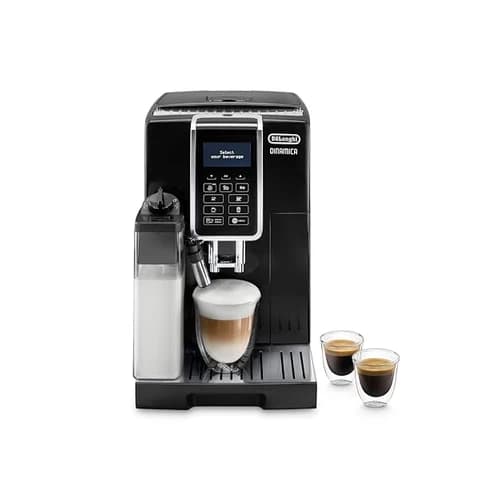
1. De'Longhi Dinamica ECAM350.55.B
Some products earn their ranking on features. This one earns it on evidence.
The Dinamica carries 2,700 Amazon India reviews at a 4.4 star average. That is more owner testimony than the other five machines on this page combined and multiplied several times over.
In a market where most premium listings carry double-digit review counts, that depth of evidence is the rarest thing on this page.
The machine behind that number is a mature, fully automatic design. Beans go into the hopper, an adjustable conical burr grinder feeds a sealed brew unit, and the spent puck drops into a bin you empty twice a week.
De'Longhi lists more than twenty drink functions on the ECAM350.55.B, covering espresso, lungo, americano and the milk drinks, with adjustable strength and volume on each.
De'Longhi Dinamica ECAM350.55.B
Rated 4.4 from 2,700 ratings
The most proven bean-to-cup machine in the Indian market, with a deep owner base, an adjustable burr grinder and an official distributor warranty behind it.
Key details
Fully automatic grinding, tamping, brewing and puck ejection
Adjustable conical burr grinder with a sealed bean hopper
More than twenty drink functions on the control panel
Adjustable strength and volume saved per drink
Removable brew unit that rinses under a tap
Automatic rinse cycles at start-up and shutdown
What we like
By far the deepest Indian owner evidence of any machine here
Sold through an official brand distributor with a real service path
Removable brew unit makes the weekly clean genuinely quick
Strength and volume settings survive across users and drinks
Watch out for
The most expensive machine in this guide at ₹84,999
Milk work is manual on this variant, not a one-touch carafe
Deep cabinet clearance needed for the top-loading hopper
Read enough of those 2,700 reviews and a consistent picture appears. The espresso is described as reliably good rather than thrilling, with steady crema and no drama, which is the honest ceiling of every bean-to-cup machine.
What owners return to again and again is that it keeps working. Multi-year reports are common in a category where most Indian listings are too young to have any.
The honest weak point is the milk. This variant asks you to froth at a wand rather than pressing a cappuccino button, so a household that wants one-touch lattes should look at the Magnifica Evo instead.
The second caveat is cost. At ₹84,999 it is the most you can spend in this guide, and the machines below it are not four times worse.
Buy the Dinamica if you intend to keep a coffee machine for the better part of a decade and want the version of that bet with the most evidence behind it. That is exactly the bet it is priced for.
2. COSTAR Professional
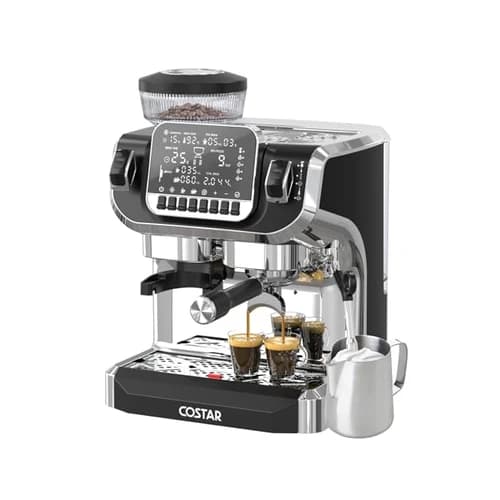
Every guide needs one entry that makes the expensive machines explain themselves. The COSTAR Professional is that entry, and it is better than it has any right to be at ₹34,998.
It is a semi-automatic with a built-in grinder, a 20 bar pump, an LED screen for dosing and a 1.8 litre removable tank. You grind into a portafilter, tamp, lock it in and steam your own milk.
The number that made us take it seriously is 4.5 stars across 225 reviews. That is the second-highest rating in this guide sitting on the second-deepest review base, at 41 percent of the price of the machine above it.
COSTAR Professional Espresso Machine
Rated 4.5 from 225 ratings
A semi-automatic with an integrated grinder, an LED dosing screen and a 20 bar pump, rated 4.5 stars by 225 Indian owners at well under half the price of the European machines.
Key details
Integrated grinder feeding the portafilter directly
20 bar pump with an LED control screen
1.8 litre removable water tank
Steam wand for hands-on milk texturing
Stainless steel body panels
Compact footprint for its capability
What we like
The best rating-to-price ratio of any machine in this guide
A real steam wand teaches skills the automatics never will
A 1.8 litre tank means fewer refills in a multi-cup household
225 reviews is a genuine evidence base at this price
Watch out for
Sold by a marketplace importer, not an official brand distributor
Spare parts have no documented Indian supply channel
Manual workflow is a real learning curve for a first machine
Owner reviews are enthusiastic and specific, which is usually a good sign. The recurring praise is that it feels like a machine that costs more, and the recurring complaint is the learning curve rather than the hardware.
We want to be straight about what you are accepting here. This machine reaches India through a marketplace importer, which is precisely the route we cautioned about earlier in this guide.
At ₹34,998 we think that is a defensible trade, and we would not say the same at ₹70,000. If it fails in year three you have lost a third of what the Dinamica costs, not all of it.
The other honest point is that a semi-automatic asks something of you every single morning. If nobody in the house wants to tamp a portafilter before work, this machine will quietly become a very good-looking object.
Buy the COSTAR if the craft appeals and the budget is real. It is the machine we would recommend to somebody finding out whether home espresso is actually their hobby.
3. De'Longhi La Specialista Touch
The La Specialista Touch carries the highest owner rating in this guide, 4.8 stars across 182 reviews, and it is the machine an enthusiast would pick off this page.
It sits in an unusual place. It is a semi-automatic, so you handle the portafilter and the milk, but almost every step is guided by a touch panel and assisted by the machine.
The built-in grinder feeds a tamping arrangement that takes the most common beginner error out of the process. De'Longhi ships it with a barista kit and lists cold brew among its nine-plus recipes, which is a genuinely useful thing in an Indian summer.
De'Longhi La Specialista Touch EC9455.M
Rated 4.8 from 182 ratings
The highest-rated machine here: a guided semi-automatic with an integrated grinder, assisted tamping, a touch control panel and a cold brew function.
Key details
Integrated grinder with assisted tamping
Touch control panel guiding each stage of the shot
Nine or more recipes including a cold brew function
Professional barista kit included in the box
Steam wand for hand-textured milk
Stainless steel construction throughout
What we like
The highest owner rating in this guide at 4.8 stars
Assisted tamping removes the most common beginner mistake
Cold brew is a real feature in Indian summers, not a gimmick
Sold through an official brand distributor
Watch out for
Still a manual workflow, so mornings cost you minutes
A tamping mechanism adds moving parts to a long-term purchase
A 4.8 average is unusual enough to be worth interrogating rather than celebrating. Reading the reviews, the pattern is that this machine attracts people who wanted exactly what it does, and self-selected buyers rate generously.
That is not a criticism of the machine. It is a reason to be honest that 182 reviews at 4.8 is weaker evidence than 2,700 at 4.4, even though the headline number is prettier.
The real weak point is the same one every semi-automatic has. Assisted or not, you are still grinding, tamping, locking in, brewing and steaming, and that is several minutes you do not spend pressing a button.
Buy the La Specialista Touch if you want the ritual but not the frustration. It is the most enjoyable machine here to actually use, and the guidance means the first week does not humble you the way an unassisted machine would.
4. De'Longhi Magnifica Evo
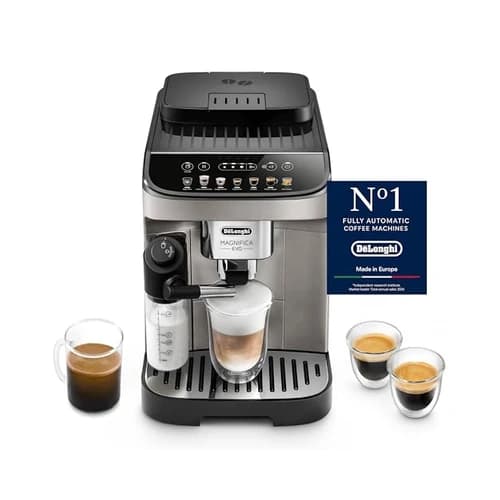
If the Dinamica is the evidence pick, the Magnifica Evo is the milk pick. It is the machine to buy when the drink your household actually makes is a cappuccino, not an espresso.
Its LatteCrema system froths and dispenses milk automatically, so a milk drink is one press rather than a wand and a jug. De'Longhi lists more than twelve hot and cold options on the ECAM290.81, with a colour display to move between them.
Underneath, it is the same architecture as the Dinamica: an adjustable conical burr grinder, a sealed brew unit, automatic puck ejection and self-rinsing at both ends of the day. Owners rate it 4.2 stars across 213 reviews.
De'Longhi Magnifica Evo ECAM290.81
Rated 4.2 from 213 ratings
The one-touch milk machine: LatteCrema automatic frothing, twelve or more hot and cold drinks, and the same proven bean-to-cup core as the Dinamica.
Key details
LatteCrema system froths and dispenses milk automatically
Twelve or more hot and cold drink options
Adjustable conical burr grinder
Colour display for drink selection and settings
Automatic rinse at start-up and shutdown
Milk carafe stores in the fridge between sessions
What we like
Genuine one-touch cappuccino with no wand technique needed
LatteCrema foam folds into the drink rather than sitting on top
Compact for a fully automatic, which suits Indian kitchens
Official brand distributor listing with an Indian service path
Watch out for
The milk carafe has parts that need washing every few days
Espresso is good rather than exceptional, as with all bean-to-cup
Only ₹17,000 cheaper than the far better-evidenced Dinamica
The Evo's 4.2 average is the lowest of the three De'Longhi machines here, and the critical reviews cluster around one thing rather than several: the milk carafe.
It makes better foam than a simpler system, and it asks for more washing in return. Owners who skip that for a few days write the machine's unhappiest reviews, and they are describing a maintenance habit rather than a defect.
That trade is worth understanding before you buy. Silkier foam always costs more cleaning, in every machine ever built, and there is no version of this where you get one without the other.
The awkward part of the Evo's position is arithmetic. It costs ₹67,900 against the Dinamica's ₹84,999, and the Dinamica has roughly thirteen times the owner evidence.
Buy the Magnifica Evo if one-touch milk is the reason you are buying a machine at all. If you would happily froth at a wand, the ₹17,000 gap buys you a great deal more certainty.
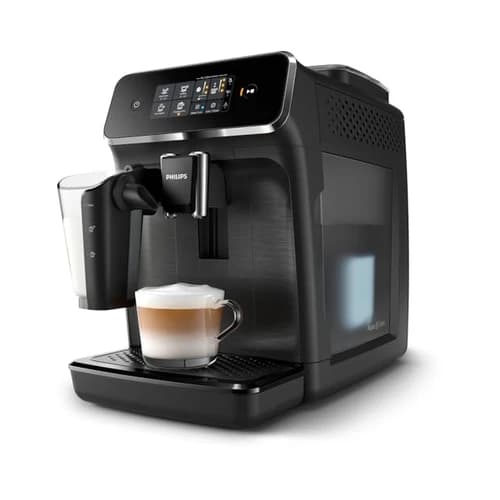
5. Philips LatteGo EP2230/10
The Philips LatteGo earns its place on this list for a reason that has nothing to do with espresso, and we will be direct about its rating before anything else.
At 4.0 stars across 117 reviews it is tied for the lowest average in this guide. That is exactly our cut-off, and it stays because what it does well matters more in India than almost anywhere else.
Two things set it apart. The grinder uses 100 percent ceramic burrs rather than steel, and the AquaClean filter system is designed to postpone descaling for thousands of cups rather than months.
Philips LatteGo EP2230/10
Rated 4.0 from 117 ratings
The low-maintenance option: ceramic burrs, the AquaClean filter system that postpones descaling, and a two-part LatteGo carafe with no tubes to clog.
Key details
100 percent ceramic burr grinder with twelve settings
AquaClean filter system designed to defer descaling
LatteGo two-piece milk carafe with no tubes
Three one-touch drinks including cappuccino
Touch display for strength and volume
Automatic rinse at start-up and shutdown
What we like
The most relevant machine here for hard-water Indian cities
LatteGo carafe rinses clean in seconds with only two parts
Ceramic burrs run cooler and are rated for long service life
Consistent results with effectively no learning curve
Watch out for
A 4.0 rating, tied for the lowest in this guide
Owners consistently report it is loud, especially the milk system
Sold by a marketplace importer at a distributor-level price
The critical reviews are consistent across markets, not just India. Owners report that it is loud, that grounds escape inside the machine, and that the brew group needs cleaning more often than they expected.
A smaller group reports pump or brew-unit faults after the first year. The larger group describes a machine that simply works every morning with less attention than anything else they have owned.
The AquaClean claim deserves a plain reading. Philips rates the filter for thousands of cups before a descale is needed, and that is a real benefit in a hard-water city, but it depends on you changing the cartridge when the machine asks.
The thing that gives us most pause is not the rating. It is that a ₹72,999 machine reaches India through a marketplace importer, which is the price band where we argued a distributor listing is worth paying for.
Buy the LatteGo if you live somewhere with genuinely hard water and the person cleaning the machine is the person who hates cleaning machines. Otherwise the Magnifica Evo costs less and has a better-supported route into the country.
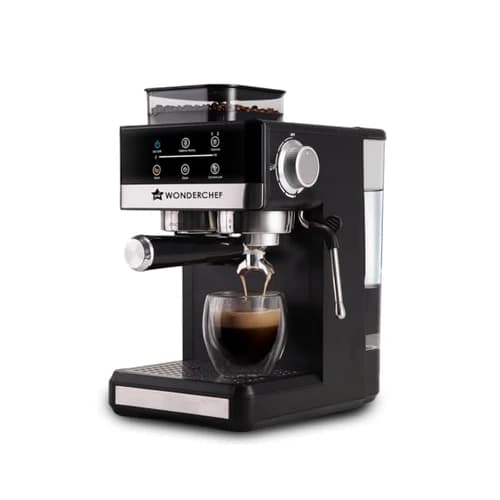
6. Wonderchef Regalia Bean-to-Cup
The Wonderchef Regalia is here to answer a question the other five cannot. What is the cheapest honest way into grind-and-brew coffee in India?
At ₹21,999 it undercuts the next machine on this page by ₹13,000. It grinds whole beans, brews at up to 20 bar, steams milk, holds 1.5 litres of water and carries a two-year Indian warranty.
We have to be transparent about the evidence. It holds 4.0 stars, our minimum, across only 52 reviews, which makes it the thinnest base in this guide by a wide margin.
Wonderchef Regalia Bean-to-Cup
Rated 4.0 from 52 ratings
The cheapest machine here that genuinely grinds its own beans, from an Indian brand with a domestic service network and a two-year warranty.
Key details
Built-in grinder feeding a 20 bar brew system
Espresso, cappuccino, latte, mocha and cold coffee settings
Steam frother for milk drinks
1.5 litre removable water tank
1200W heating with a metal portafilter
Two-year warranty through an Indian brand network
What we like
By far the lowest price of entry into grind-and-brew coffee
Indian brand with a domestic service and spares network
Two-year warranty is longer than several pricier rivals offer
Compact enough for a genuinely small kitchen
Watch out for
Only 52 reviews, the thinnest evidence base in this guide
Sits exactly at our 4.0 star minimum, not comfortably above it
Build and grind consistency do not match the European machines
Fifty-two reviews is enough to notice a pattern and not enough to trust one. We would treat this rating as provisional and re-read it in a year, and we would rather tell you that than present it as settled.
What is not provisional is the service position. Wonderchef is an Indian brand with an Indian network, which means a fault is a support ticket rather than an import problem.
For a first machine that changes the maths. The gap between this and the COSTAR Professional is ₹13,000, and the COSTAR has four times the reviews but no documented Indian parts channel.
The honest limitation is what ₹21,999 buys. Grind consistency and build quality are not at the level of the machines above it, and a keen drinker will feel that inside a year.
Buy the Regalia if the alternative is not buying a machine at all, or if you want to find out whether fresh-ground coffee changes your mornings before committing ₹70,000 to the idea.
What a coffee machine with a grinder does
The phrase "coffee machine with grinder" hides an enormous range. Two machines on this page grind and then stop helping. Three of them grind, tamp, brew and clean up after themselves.
Choosing the wrong side of that line is the most common reason these machines end up in a cupboard, and it has nothing to do with price.
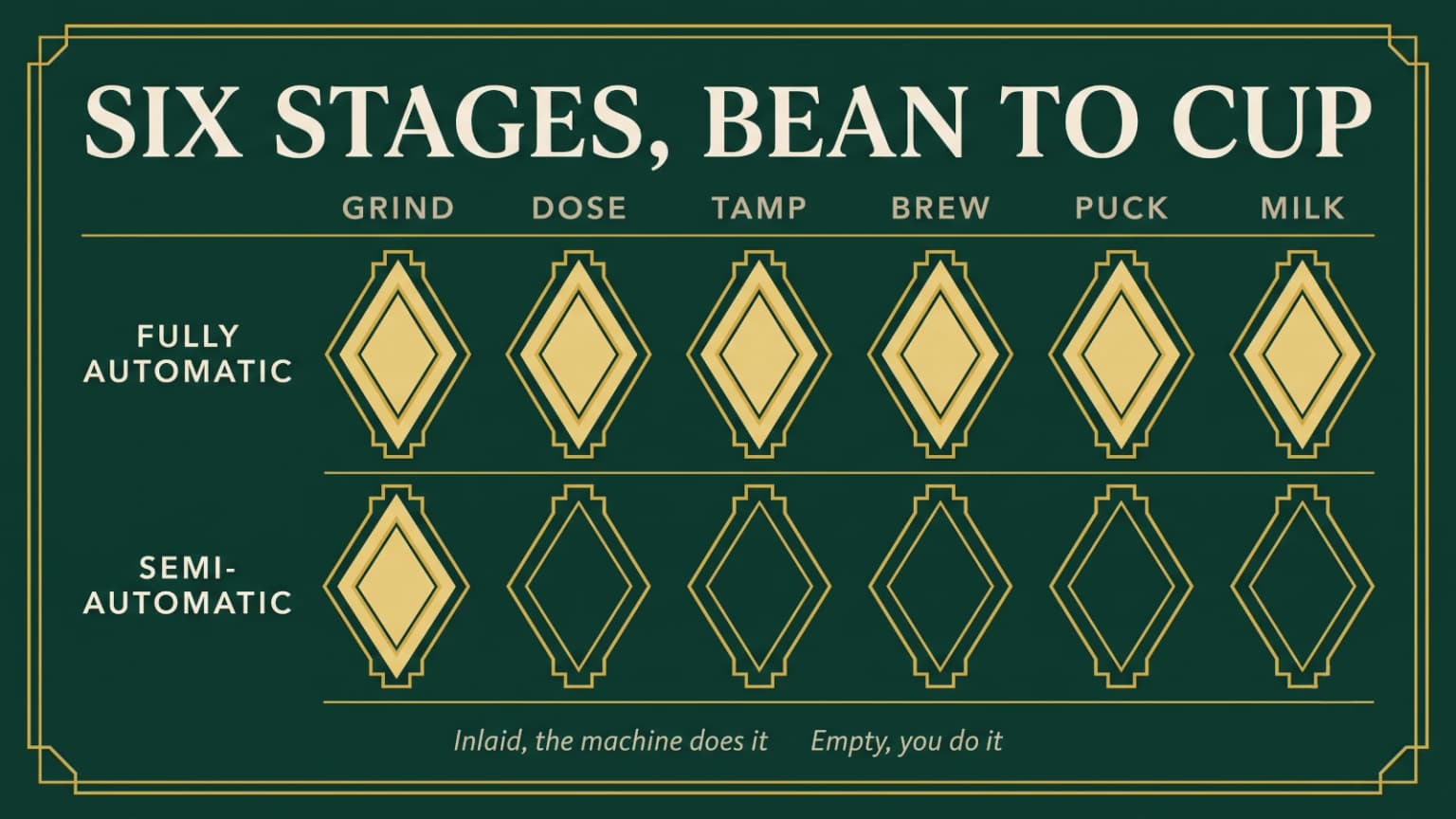
Six stages between the bean and the cup. The only real question is how many of them you want to own.
There are six stages between a whole bean and a finished drink: grinding, dosing, tamping, brewing, clearing the used puck and handling the milk.
A fully automatic machine does all six. The Dinamica, the Magnifica Evo and the Philips are in this group, and the difference between them is mostly the milk stage.
A semi-automatic with a grinder does the first stage and hands you the rest. The COSTAR and the La Specialista Touch work this way, though the La Specialista assists with tamping.
The Wonderchef sits between the two, grinding and brewing while leaving the milk to you at a steam wand.
Now the part almost every competing guide skips. Grinders in this category are not judged by their grind settings alone, they are judged by what happens when they jam.
What happens when the grinder jams
What happens when the grinder jams
Machine
Burr material
Owner access to the burrs
Parts route in India
Dinamica
Steel conical
Hopper and chute, brew unit removable
Brand distributor channel
COSTAR Professional
Steel burr
Hopper and chute
Seller-dependent
La Specialista Touch
Steel conical
Hopper and chute
Brand distributor channel
Magnifica Evo
Steel conical
Hopper and chute, brew unit removable
Brand distributor channel
Philips LatteGo
Ceramic
Hopper and chute, brew group removable
Seller-dependent
Wonderchef Regalia
Built-in burr
Hopper and chute
Indian brand network
Compiled from manufacturer documentation and Indian listing terms at the time of writing. No machine here invites you to dismantle its burr carrier.
Two things fall out of that table. A removable brew unit is the single most useful serviceability feature in this category, because it lets you clear the most common blockage yourself in under a minute.
And ceramic burrs are not automatically better. They run cooler and wear slowly, which is genuinely good, but they are more brittle than steel if a stone finds its way into the hopper.
Stones in coffee are rarer than they used to be and not rare enough to ignore, particularly with beans bought loose rather than from a sealed pack.
Oily dark roasts are the other enemy of an integrated grinder. Picking the right espresso beans for India is a decision in its own right, and it sets how often you will be clearing a blocked chute.
Indian milk and what froths it
Here is a gap in every guide we read while researching this page. They all judge the milk frother as though milk itself were a constant, and in India it very much is not.
The milk in an Indian fridge is usually toned or full-cream cow milk, and in many households it is buffalo milk or a mix. These behave differently under steam and the difference is not subtle.
Protein builds the foam and fat makes it taste rich. Where your usual carton sits on this plot decides which froth system suits you.
The short physics is that protein builds and stabilises foam while fat carries flavour and softens texture. High protein gives you a stiff, long-lasting foam. High fat gives you a rich, glossy one that collapses sooner.
Buffalo milk is higher in both fat and protein than cow milk, which is why it foams generously and then goes coarse if you push it. Toned milk is leaner, foams thinner, and holds its structure better than people expect.
What a steam wand can produce that no automatic carafe quite matches is microfoam, the dense, glossy milk that pours latte art. That is the one thing you give up by pressing a button.
Indian milks under the two froth systems
Indian milks under the two froth systems
What is in your fridge
Fat and protein
At a steam wand
In an automatic carafe
Toned cow milk
Lower fat, moderate protein
Thin but stable, easy to control
Reliable, slightly dry foam
Full-cream cow milk
Higher fat, moderate protein
The best texture available here
Rich and consistent
Buffalo milk
High fat, high protein
Foams fast, turns coarse if overworked
Can overfill the carafe chamber
A2 cow milk
Similar to full-cream cow
Behaves like full-cream
Behaves like full-cream
Oat and soy
Low protein unless fortified
Needs a barista-edition carton
Inconsistent without barista edition
Compiled from dairy composition data and owner reports. Individual brands vary, so treat this as a starting point rather than a specification.
The practical conclusion is straightforward. If your household runs on full-cream cow milk, every machine here will froth it well and the automatic carafes will do it without you learning anything.
If your household runs on buffalo milk, a steam wand gives you the control to stop before the foam goes coarse, which favours the La Specialista Touch or the COSTAR.
Counter fit, voltage, and noise
Owner reviews are full of a complaint no specification comparison predicts. The machine arrived and the kitchen did not have room for it.
Measure three things before you order, because returning a 12 kilogram appliance is a genuinely miserable afternoon.
Height comes first. Every machine here loads beans from the top, so you need clearance above the machine to refill without dragging it forward, and most water tanks lift out vertically too.
Indian modular kitchens frequently run wall units about 450mm above the counter. None of these machines will clear that with the hopper lid open, so plan a spot where nothing overhangs the machine.
Depth is the second surprise. Fully automatic machines are deep, and a machine that overhangs the counter edge will irritate you every day for years.
Then there is voltage, which is the one genuinely dangerous item on this list. Every machine we have listed is a 230V unit sold for the Indian market.
Grey imports from the United States are 110V machines. Running one through a step-up transformer means putting a 1,200W heating element behind an adaptor, and it voids any warranty that existed.
Noise is the last thing to consider and the most underrated. Every one of these grinders is loud for the five to ten seconds it runs, roughly comparable to a mixer grinder.
Owner reports single out the Philips LatteGo as the loudest of the group, with its milk system drawing more complaints than the burrs. If your kitchen shares a wall with a sleeping child, that matters more than any specification.
The honest case for buying separates
We would be writing marketing rather than a guide if we skipped this section, so here is the argument against everything on this page.
Spend an hour on any coffee forum and you will meet the standard advice. Buy a machine without a grinder and put the difference into a proper standalone grinder, because the grinder matters more.
That advice is correct on the merits. A ₹20,000 standalone burr grinder out-grinds every integrated grinder here, adjusts more finely, and can be replaced without the machine leaving your kitchen.
In India the argument is stronger still, for a reason specific to this market. A De'Longhi Dedica sells for around ₹17,000, and pairing it with a good grinder gets you a more capable setup than the Wonderchef Regalia for similar money.
There is a second version of the argument worth taking seriously. If what you actually drink is filter coffee, none of this applies to you at all.
A traditional stainless steel filter costs a few hundred rupees, needs no descaling, cannot break, and makes a drink these machines are physically incapable of producing. That is not a consolation prize; it is a better answer to a different question.
The same logic runs one step further. A moka pot and a hand grinder together cost under ₹10,000, sit on the gas ring you already own, and have nothing inside them to service.
So here is our honest framing. If you want fresh-ground coffee with the least friction in the smallest footprint, an integrated grinder wins on the mornings that actually happen, the rushed ones.
One plug, one warranty, one thing to clean. A separates setup beats it on quality at the cost of counter space, complexity and a second purchase you have to research separately.
What a year of ownership costs
The price on the listing is the beginning of the story. A coffee machine is one of the few appliances you feed, filter and clean on a schedule, and in India one input dominates every other running cost.
That input is water. Not beans, not electricity, not cleaning tablets. Water.
Where you live sets your maintenance schedule more than which machine you buy. Bands are indicative, so test your own supply.
Scale is dissolved mineral that comes out of solution when water is heated, and it coats the boiler and the brew path. It is the leading cause of premature failure in these machines, and much of India has water that produces it fast.
Delhi NCR, Chennai, Hyderabad, Jaipur and much of the Deccan sit in the harder bands. Coastal Kerala, the Northeast and parts of the Himalayan belt sit considerably softer.
The cost of the water you put in
The cost of the water you put in
What you fill the tank with
Typical TDS
Descaling interval
What happens if you ignore it
Hard municipal tap water
Above 300 ppm
Every 4 to 8 weeks
Boiler scaling, weak flow, early failure
Moderate municipal tap water
150 to 300 ppm
Every 2 to 3 months
Gradual flow loss and flat-tasting coffee
RO water, untreated
Below 50 ppm
Rarely needed
Flat, hollow coffee and possible corrosion
RO water, remineralised
Around 150 ppm
Every 4 to 6 months
The target, very little goes wrong
Filtered through AquaClean
Machine dependent
Cartridge changes instead
Scale returns if cartridges lapse
Intervals are indicative and assume a few drinks a day. Test your own supply with a TDS meter rather than guessing from your city.
The RO row surprises people, so it is worth a moment. Water that is too pure makes genuinely worse coffee, because extraction relies on dissolved minerals to carry flavour compounds out of the grounds.
It can also be mildly aggressive towards metal components over time. The target most brewing bodies point at is around 150 ppm, which is why remineralised RO water is the best thing to fill the tank with in most Indian homes.
Beyond water, the yearly costs are modest and predictable. Descaling solution, a cleaning tablet or two, and a filter cartridge if your machine takes one will together sit in the low thousands of rupees.
The machines that cost the most to run are the ones with consumable filter systems, and they are also the ones that cost the least in effort. That trade repeats across the whole category.
When to buy
Coffee machines are seasonal merchandise in India, and the swings are large enough to be worth planning around.
The Great Indian Festival sale in October and Prime Day are when this category moves most, with Republic Day sales in January a distant third. Several machines here were already carrying substantial discounts when we checked.
Our practical advice is unromantic. If the machine you want is already discounted meaningfully, buy it, because these listings move in and out of stock unpredictably.
Three of the strongest candidates we researched for this guide were out of stock on the day we published, including two De'Longhi models and the Bosch VeroCafe. Availability is a real constraint in this market, not a theoretical one.
The live prices on this page update daily, so the buttons always show the current number before you commit.
Your first ninety days
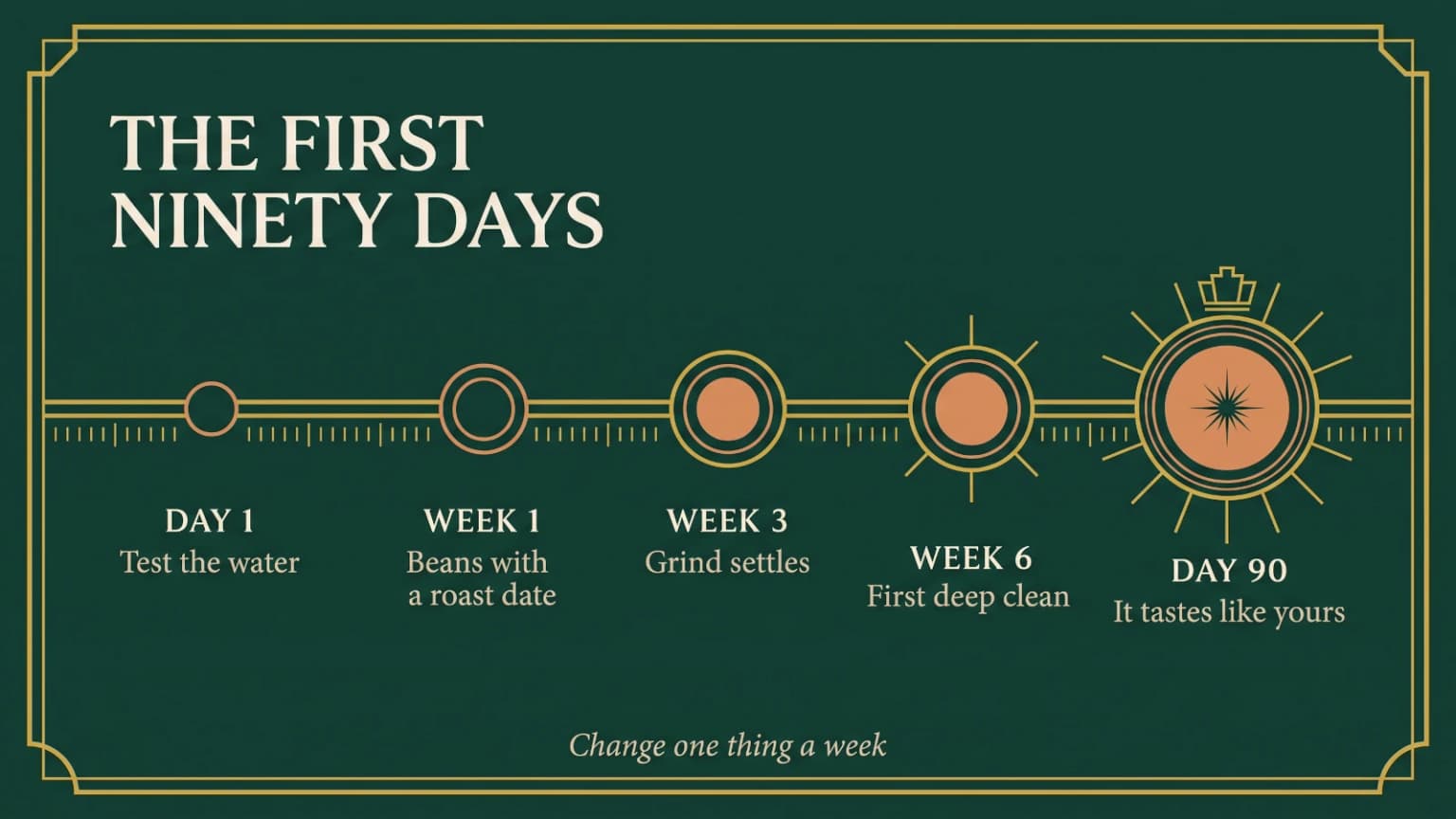
Nobody tells you that the machine you buy and the machine you own three months later make noticeably different coffee. The gap is entirely in what you do in the first weeks.
Most of it is dialling in, the slow business of matching your grind to your beans, your water and your machine. The strength dial is doing the job a weighed dose does elsewhere, and our guide to how much coffee per cup explains what it is really moving.
The first ninety days decide how good the next five years taste. Almost none of it is about the machine.
Setting up a new machine in an Indian kitchen
1
Test your water before the first cup
Use a TDS meter on whatever you plan to fill the tank with. This one reading sets your descaling schedule and tells you whether you need remineralised RO water.
Tip A TDS meter costs about ₹200 and is the highest-return purchase in this entire hobby.
2
Register the warranty and note the seller
Save the invoice, register with the brand if the listing came from a distributor, and record who sold it to you. That record is what you will need in month fourteen.
3
Buy beans with a roast date, not a best-before
Order a small pack from a roaster that prints when it was roasted. Medium roast with a dry surface, and nothing blended with chicory.
Watch out Oily dark roasts are the leading cause of clogged grinders. If beans look wet in the bag, they will clog the chute.
4
Set the grind one step at a time
On a fully automatic, move one setting finer if the coffee tastes thin and one coarser if it tastes harsh. On a semi-automatic, aim for roughly double your dose weight in the cup in 25 to 30 seconds.
Tip Only ever adjust the grind while the grinder is running. Turning the collar on a static bed of beans can wedge grounds against the burrs.
5
Change one variable per week, not per cup
Once the coffee is decent, resist the urge to keep adjusting. Give any change three or four drinks before you judge it, because your first cup of the day is never a fair test.
6
Run the first deep clean at week six
Do the full cycle the manual specifies even though nothing seems wrong. Establishing the habit while the machine is still exciting is how it survives to year five.
Grind adjustment deserves one specific warning that applies to every machine here. Coffee is hygroscopic, and in a Mumbai or Kolkata monsoon it absorbs moisture from the air inside the hopper.
That changes how it flows and how it extracts. If your coffee suddenly tastes different in July and you changed nothing, the weather changed it, and a small grind adjustment is the answer.
Keep the hopper closed, buy smaller packs more often, and do not decant a month of beans into a machine in a humid climate. Storage does more damage than most people credit.
The hard-water maintenance rhythm
Nobody buys a coffee machine for the cleaning. But in India the difference between a machine that lasts three years and one that lasts eight is almost entirely maintenance, and mostly one kind of it.
The routine below is shorter than its reputation. It is roughly ten minutes a week plus a scheduled descale.
Keeping a machine alive in hard water
1
Daily: empty and rinse
Empty the drip tray and puck bin when the machine asks. If you used milk, rinse the wand or carafe immediately rather than after breakfast.
Tip Milk residue gets dramatically harder to remove overnight. This is the single most skipped step in every owner review we read.
2
Weekly: pull the brew unit
On machines with a removable brew unit, take it out and rinse it under a tap with no detergent. It slides out in seconds and prevents most bitter-coffee complaints.
3
Monthly: the grinder and the chute
Empty the hopper, vacuum out the residue and brush the grind chute. Coffee oils build up here and they are what eventually clogs a grinder.
Watch out Never run water or cleaning fluid through a grinder unless the manual explicitly allows it. Burrs are cleaned dry, always.
4
On your water schedule: descale
Descale on the interval your TDS reading demands rather than the generic figure in the manual. In hard-water cities that may mean every six to eight weeks.
Tip Use the descaler the manufacturer specifies. Vinegar is aggressive towards the seals and gaskets in these machines.
5
On prompt: change the filter cartridge
If your machine takes a water filter, change it when prompted rather than when convenient. A lapsed cartridge quietly returns you to the descaling schedule you were avoiding.
The pattern across critical reviews in this category is depressingly consistent. Machines described as broken were very often machines that never saw a brew-unit rinse or a descale on schedule.
Budget the ten weekly minutes as part of the purchase price. With them, every machine in this guide becomes a long-term appliance. Without them, the expensive ones fail expensively.
Which coffee machine should you buy in 2026?
Six machines is a shortlist, not an answer, so here is the answer.
We weighed owner evidence, grinder capability, milk performance, service route into India and running cost. Then we asked the question that separates them: how much of the work do you want to own, and how much certainty do you want behind the purchase?
The three we recommend first
Our pick
Dinamica
₹84,999
You are
Buying for the decade
Best at
Proven, repeatable coffee
Evidence
4.4 stars, 2,700 owners
Weak spot
Milk is manual here
COSTAR Professional
₹34,998
You are
Testing the hobby
Best at
Capability per rupee
Evidence
4.5 stars, 225 owners
Weak spot
No Indian parts channel
La Specialista Touch
₹68,999
You are
In it for the ritual
Best at
Guided hands-on brewing
Evidence
4.8 stars, 182 owners
Weak spot
Costs you minutes daily
The three we recommend first
Specification
Our pick
Dinamica
₹84,999
COSTAR Professional
₹34,998
La Specialista Touch
₹68,999
You are
Buying for the decade
Testing the hobby
In it for the ritual
Best at
Proven, repeatable coffee
Capability per rupee
Guided hands-on brewing
Evidence
4.4 stars, 2,700 owners
4.5 stars, 225 owners
4.8 stars, 182 owners
Weak spot
Milk is manual here
No Indian parts channel
Costs you minutes daily
Whichever way you go, spend the first week on your water and your beans rather than your settings. Those two inputs matter more than every specification in the espresso machines category put together.
A machine that suits your actual mornings gets used every day for years. Daily use is where any of these machines finally justifies its price.
Frequently asked questions
Is a coffee machine with a built-in grinder worth it in India?
For most Indian kitchens, yes, and for a reason that matters more here than in colder markets. Ground coffee goes flat fast, and it goes flat faster in humidity.
A machine that grinds seconds before it brews removes the one variable you cannot fix later. No amount of pressure rescues coffee that lost its aroma three weeks ago.
The trade is that the grinder is welded to the machine's fate. If it fails outside warranty, you are servicing the whole appliance, not replacing a ₹8,000 grinder.
Can these machines make South Indian filter coffee?
No, and we would rather say that plainly than sell you something on a false promise. Filter coffee is a slow gravity drip through a chicory blend in a stainless steel dabara, and it is a different drink built on a different extraction.
What these machines make is espresso and espresso with milk. A good cappuccino is not a substitute for a good degree coffee, and neither one replaces the other.
If filter coffee is your daily drink, a traditional filter costs a few hundred rupees and does its job better than any machine here.
Will Indian hard water damage a coffee machine?
It is the single biggest thing that shortens the life of a coffee machine in India. Scale builds inside the boiler and the brew path, and it builds fastest in Delhi NCR, Chennai, Hyderabad, Jaipur and most of the Deccan.
The fix is not heroic. Use filtered or remineralised water rather than straight tap water, and descale on the schedule your water actually demands rather than the one in the manual.
Machines with a built-in water filter system, like the Philips AquaClean setup, convert descaling from a chore into a cartridge change.
What is the difference between fully automatic and semi-automatic?
A fully automatic machine grinds, doses, tamps, brews and drops the used puck into a bin by itself. You press one button and collect a drink about ninety seconds later.
A semi-automatic grinds into a portafilter and then hands it to you. You tamp it, lock it into the group head, start the shot and steam the milk yourself.
Semi-automatics have the higher ceiling and the steeper learning curve. Fully automatics have the higher floor and make the same decent cup on a bad morning.
Which coffee beans work best in these machines in India?
Medium and medium-dark roasts with a dry, matte surface. Very oily dark roasts coat the burrs and the chute, and clogged grinders are the most common serious complaint owners file about bean-to-cup machines.
Buy from a roaster that prints a roast date rather than only a best-before date. Blue Tokai, Third Wave, Sleepy Owl, KC Roasters and Corridor Seven all ship nationwide.
Avoid anything blended with chicory. Chicory is hygroscopic, it clumps in a hopper, and it is not designed to survive nine bars of pressure.
How long do these coffee machines last in India?
Owner reports and manufacturer service schedules point to five to eight years for the European machines with maintained water treatment, and less for the budget end.
Water quality is the biggest variable by a wide margin, ahead of build quality and well ahead of price. A ₹85,000 machine fed hard tap water will fail before a ₹22,000 machine fed filtered water.
The second variable is parts availability. Brands with an Indian service network outlast brands whose spares have to be imported by whoever sold you the box.